From the architect. Actually, the latest building designed by Péter Kovács, architect from Debrecen (city in east side of Hungary, 240 km. fare from Budapest) does not quite fit into the genre detailed in the introduction as the house is not a family house but a studio. However, a parallel can still be drawn since the building is a deep, personal, self-reflexive work of art, which reflects the role of the architect, layered as it is.
Such an artistic expression makes us think through many things – first of all, the atmosphere of the place. The plot can be localized both on a 1771 Debrecen map and on a map from a hundred years later. This is almost the oldest urban tissue of the so-called “civis city” (civis is a Latin word for “citizen”, it is also a root word for city; in Hungarian history civis cities were old country-towns on the Hungarian Great Plains) which remained intact and consists of barely a few streets. The impressive widening road in front of the house and the name “ötmalom” (five mills) indicate the former circle-shaped dry mills that were attached to work-horses with rods. The wide gates and inner gardens of the old houses found here still show the civil character of the country-town. Péter Kovács knows all the neighbours and their houses very well. He understands these streets. He understands the scales, the whys, the hows. He sums it all up in the following way: a strong, 2.35 m high brick fence turning into the street on the corner closes the plot’s side overlooking Ötmalom Street. The presence of the fence ensures its historical identity and the unique nature of the plot. The slightly appearing bricks – there is a brick paving, too – under the weathered plaster not only show the old building material but also make one feel like travelling back in time. They refer to the old houses’ few opening schemes, which differed from the architectural design of modern apartment houses: back then, mainly walls and roofs dominated. Moreover, the fence is not a part only of this plot; it is a characteristic feature of the street-line. There is another dominant feature of the scenery: the steeple of the so-called “Verestemplom” (red (brick) church) in the background, built it in 1887 (arch. Samuel Petz). The third major feature is the presence of trees. The inspiring key elements at the site are definitely the brick fence, the church steeple, and the trees.”
Obviously, there is a special client-designer relationship when it comes to designing one’s own building. This situation tells us about self-knowledge, the freedom of expression, self-discipline, inner struggles, desires and limits.
Floor Plan
We can almost inhale the evaporating past of the weathered flesh and mossy tiles of the surrounding old houses from the inner terraces and the garden of the corner house – the building is somehow transforming into a house-shaped sculpture. Strolling through the clean white interiors, we get an insight into the inner layers of the realm of architecture.
I found this fishing net, probably lost (or maybe installed by a poacher) on the beach of Goulien, the other night it was an opportunity to make a somewhat unusual picture.
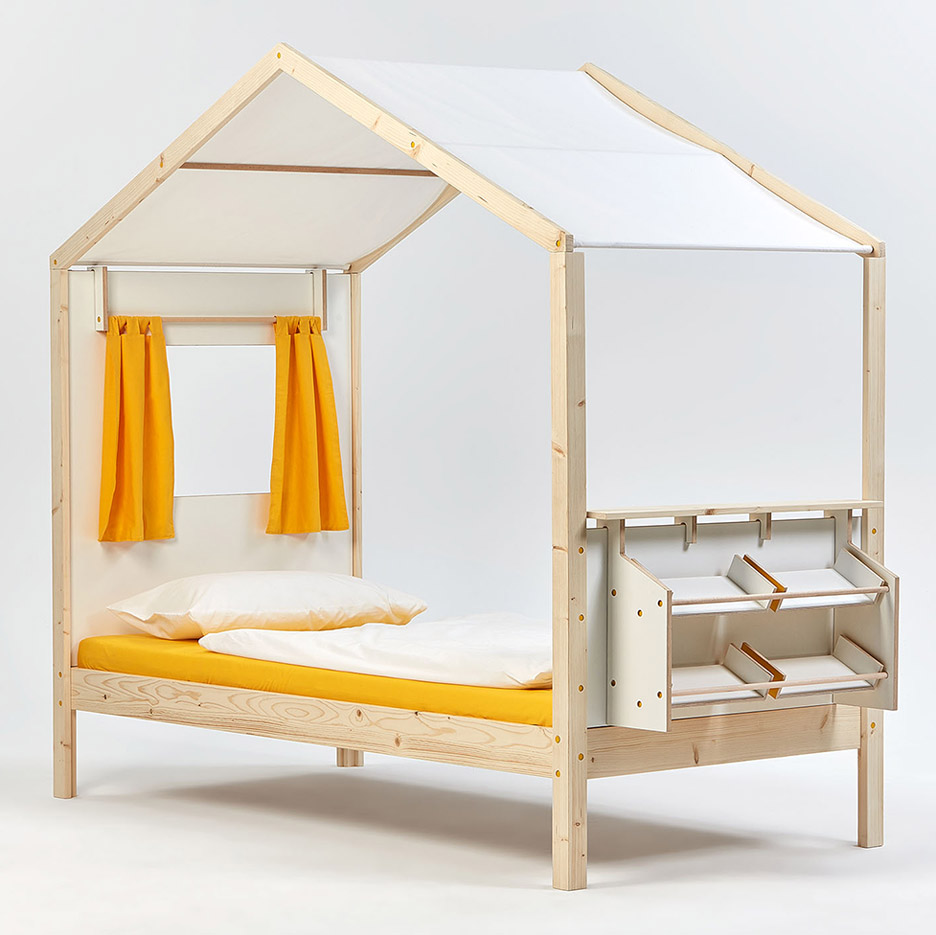
Milan 2016: students from Germany’s Burg Giebichenstein University of Art and Design have designed a range of children’s furniture and lighting that includes house-shaped beds and stackable lanterns (+ slideshow). (more…)
In the small fortress of Zekreet in the desert, time seemed to be frozen in the past.
The materials used for the fortress, mud-stone-wood-reeds, made perfect sense and where harmonious blended with the desert scenery…




 Sig Nordal