Success byDoug Dance http://ift.tt/1VNdWvI

via Sig Nordal, Jr. http://ift.tt/1T496UU

Dream Inn Guest House / Coleman-Davis Pagán Arquitectos

© José Fernando Vazquez

Architects: Coleman-Davis Pagán Arquitectos

Location: 2009 Calle McLeary, San Juan, San Juan 00911, Puerto Rico

Area: 300.0 sqm

Project Year: 2014

Photographs: José Fernando Vazquez, Carlos Esteva, Shellar Garcia

Design Team: José R. Coleman-Davis Pagán, Yadira Adorno Pomales, Shellar M. García Córdova, Edgardo D. Ocasio Roig, Yanitza Maldonado González, Víctor Nieto Villalón, Wilfredo Pérez Espino, Valorie Alicea Chinea, John Santos Ríos, Tamaris Alvarez Custodio, Edward Ramírez Saez

Client: Dream Inn Puerto Rico, Inc.

Mechanical Consultant: Francisco Maté

Electrical Consultant: Raymond Amaral

Structure: Daza Struct. Eng. Services / Luís Daza (structural)

Contractor: Julio Vega Figueroa

© Carlos Esteva

From the architect. A family of long-time Ocean Park residents took on the task of constructing a thirteen(13)room guesthouse, oriented to the family and group traveling market.

© José Fernando Vazquez

Located on McLeary Street, the principal artery bordering this coastal / capital sector, the Inn is conveniently located between the tourist zones of El Condado and Isla Verde (with it’s international airport) – where eateries abound and public transportation is close by.  It is also privileged with proximity to a superb beach, only a three (3) minute walk thru the San Juan’s premier residential community.

Diagram

The tropical modern-minimalist architectural design, emphasizes surface textures and artisan craftsmanship.  The frontal and East facing facades – with its red -tinted concrete referencing traditional architectural filigrees – act as permeable membranes that filter air and sunlight and at the same time buffers outside sound.  This delicate geometry – reduced to simple pre-cast concrete members following a calculated pattern – creates an interesting light and shadow interchange.

© José Fernando Vazquez

The rooms are efficiently accommodated on two (2) main levels oriented to the north and south sides.  They are equally separated by a central corridor that allow natural lighting and ventilation to enter the structure.  All levels are reachable by way of a carefully articulated stair and accessible by elevator.

Section

The key perimeter patios are defined by exposed-textured concrete walls and become sensible extensions of the interior areas, a linear pool enhances the rear terrace. The roof terrace serves as a sundeck and a semi-covered observatory for attractive views of the mountains (to the southeast), the beach (to the north) and the rest of the low-density neighborhood.

© José Fernando Vazquez

Environmentally responsible building technologies have been implemented, such as rainwater collection/distribution system, vacuum-tube solar water heater and LED lighting.

Diagram

http://ift.tt/1YLG5l0

This Week’s Most Popular Posts: April 15th to 22nd

And so concludes Green Week, in which we discussed everything you need to know about medical marijuana. But the week wasn’t all up in smoke; we also learned about laser eye surgery, essential camping gear, credit card rewards, and more. Here’s a look back.

Read more…

http://ift.tt/1MNS6Wg

The Top Five Installations of Salone del Mobile 2016

“Invisible Borders” / MAD Architects. Image © Laurian Ghinitoiu

With the 2016 Salone del Mobile now behind us, Romanian photographer Laurian Ghinitoiu has shared his photos from Milan Design Week, along with his ranking of the top five architectural installations. Read on to see his exceptional collection of images accompanied by short descriptions of each project.

5. BIG, “Alphabet of Light” with Artemide

Alphabet lamp for Artemide / BIG. Image © Laurian Ghinitoiu

BIG’s collaboration with Artemide is an installation of wall-mounted, light-up letters based a typeface designed by the firm. Each letter is constructed with a group of simple elements that are joined together by electromagnetic joints that become invisible when illuminated. The system allows for any shape to be created, either a letter or not.

4. Francis Kéré, “Courtyard Village” at Palazzo Litta

Courtyard Village / Kéré Architecture. Image © Laurian Ghinitoiu

Francis Kéré’s installation “Courtyard Village” at the Palazzo Litta is meant to evoke a traditional African village with an elevated central pavilion and high grasses on the perimeter. A bamboo and wild grass canopy shelters three semicircular, slatted stone enclosures, which are used as an exhibition space.

3. MAD, “Invisible Borders” for Interni

“Invisible Borders” / MAD Architects. Image © Laurian Ghinitoiu

MAD’s “Invisible Borders” installation for Italian magazine Interni is a canopy of ETFE ribbons in gradient colors situated in the Cortile d’Onore courtyard of Università degli Studi di Milano. According to the architects, “The installation reflects the hues of the sky during the day, leaving glimpses of the columns and loggias. In the evening it becomes a luminous surface that brings the courtyard to live with new colors.”

2. Nendo, “50 Manga Chairs” for Friedman Benda

Manga Chairs / nendo. Image © Laurian Ghinitoiu

Nendo’s 50 Manga Chairs for New York based design gallery Friedman Benda, located in the courtyard of the Facoltà Teologica dell’Italia Settentrionale, is a grid of stainless steel chairs inspired by the linework of manga. In the Japanese comics, flat or abstract lines are used to animate gestures such as ‘sweat’, ‘tears’, or ‘speech bubbles’, which the chair designs seek to emulate.

1. Sou Fujimoto, “Forest of Light” for COS

“Forest of Light” for COS / Sou Fujimoto. Image © Laurian Ghinitoiu

Sou Fujimoto’s “Forest of Light” for COS is a room of ceiling mounted spotlights creating cones of white light in a darkened space. As visitors pass through the venue, the lights pulse and darken making for an experience of perpetual flux.

http://ift.tt/248UtHs

North Italy: Verona – Chiesa di San Giorgio in Braida by SwissFiveNine by SwissFiveNine

Chiesa di San Giorgio in Braida. The spots on the white parsonage (left side) are bullet holes from Napoleon’s forces and date back to 1805. See also my gallery “North Italy”. – My own pictures from strolling through the cities Verona and Bergamo in Fall 2015.
via 500px http://ift.tt/1qGTPlJ

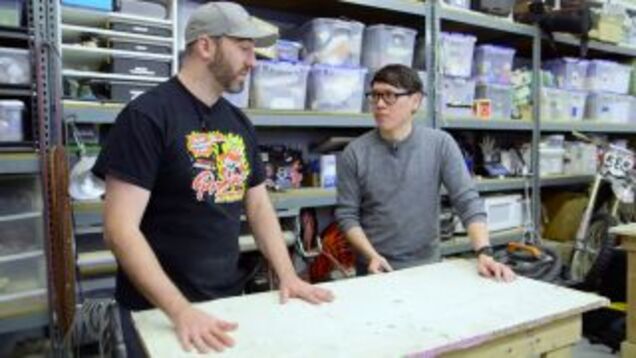
The Best Way To Quickly Cover a Shop Table

Depending on the type of project you’re working on, the easiest way to prepare for a quick cleanup in a workshop is by covering your work table with a giant sheet of paper. Over on Tested they walk you through a variety of tips for doing so.

Read more…

http://ift.tt/1NG1FkS

Bridge of Sighs Oxford England photo via nuvia

Bridge of Sighs, Oxford, England

photo via nuvia

http://ift.tt/1lsocZL