
A cherry tree blossoms in the rain in front of the Gyeonghoeru Pavilion at Gyeongbok Palace in downtown Seoul, South Korea.
via 500px http://ift.tt/20XcTZU
via 500px http://ift.tt/20XcTZU

© Matej Kastelic via Shutterstock
Young designers, fresh out of school, often have incredible potential to contribute to their new firm: with fresh skills and capabilities that may have passed by the company’s older members, they are in an excellent position to make their mark. But maximizing this potential may require expensive training courses, and asking your firm for that opportunity can be daunting. In this article originally published on ArchSmarter, Michael Kilkelly recounts a tale from his own early years as an architect to demonstrate that getting your firm to pay for training may be simpler than most young architects imagine.
When I was a young architect, only a few years out of school, I became interested in 3D rendering. This was back in the mid-nineties so the technology was primitive compared to today. 3D Studio Max had just come out and my firm had a copy.
After work, I would play around with the software. I did a few renderings of the project I was working on as a way to learn the software. The project designer saw them and got excited.
“Can you change this material?” he asked. “What if you rotate the view a little that way? Can we see it at night?”
“Yeah, sure” I replied then headed back to my desk to try and figure it out.
I enjoyed learning the software but it took a lot of trial and error. I hadn’t had any training so I was learning as I went along. As a result, it was slow going.
Word got around that I could create renderings. Remember, this was the mid-nineties. Digital renderings were a novelty for most firms. I started to get rendering requests from other projects. I wanted to improve my skills so I spent more of my free time working on these renderings. It got to a point where I couldn’t keep up with the work load. I couldn’t render fast enough. So I had two options. I could say no when asked if I could help out or I could learn the software better so I could get faster.
As a young architect in his first job, I didn’t want to say no. Instead, I looked into getting some formal training. I found a local course but it was expensive, at least for me. I couldn’t afford it out of pocket so I went to one of the firm principals and asked if the firm would pay.
I was nervous. It was a lot of money and I had only been at the firm less than a year.
I went up to the principal and explained I wanted to take a course on 3D Studio Max.
“So what will this course do for you?” he asked me.
“Well, I’m getting a lot of rendering requests but I’m having trouble getting them all done on time. This course will help me work faster so I won’t miss any more deadlines.”
“Those renderings are pretty good. They’re helping with our business development. How much is the class?”
“Well…”
I paused to get ready for his reaction, then I told him.
“What!!!”
This was what I was afraid of. “Yeah, um. . . I know.” I hung my head.
“Are you kidding? That’s nothing. Go ahead and sign up and we’ll cover the cost.”
I was shocked. “Ahhh…” I stammered. “Okay.”
“In fact,” he said “let’s have you make a presentation when you’re done with the class. We need to get more people up to speed.”
I stood there with my mouth open. This wasn’t what I expected.
“Listen,” he explained. “If you can create these renderings faster, we can include them in more of our client presentations. If we win just one job, that class will have paid for itself 20 times over. Plus, you’ll share what you learned so the whole firm will get something out of it.”
I was focused on the cost of the class but my principal was thinking about the benefits. The cost was nothing compared to the benefit of better and faster renderings.
Learning new skills doesn’t just benefit you. It benefits your employer. A design or engineering firm is only as good as its people. Leveling up your skills helps the firm stay competitive. It’s a win-win situation.
When asking for your firm to pay for training, focus on the benefits of the training. What will you be able to do that you can’t currently? What will the training help you do faster, or cheaper, or better?
Do the math and calculate the return on investment. If a class costs $200 but you’ll save an hour a week, that class will have paid for itself in less than a month.
Many companies have a training budget for their employees. Some even give an allowance to each employment for training and personal development. Even if your company doesn’t have an official policy, they likely have some money put aside for training and conferences.
The key to convincing your firm to pay for training is to focus on the benefits and the return on investment. Also, come up with a strategy for sharing your new knowledge. Lunchtime presentations are great for this. Put these three things together into a mini-proposal and you have a convincing argument. Need help writing the proposal? Check out this article for some good tips.
In the end, training is always a good investment for your firm.
Feature image via Shutterstock.com


© Nico Saieh
Architects: ABESTUDIO
Location: Lago Panguipulli, Los Lagos, Región de los Ríos, Chile
Architect In Charge: Sebastián Browne
Builder: Ruben Paredes, Jose Vega
Area: 187.0 sqm
Project Year: 2016
Photographs: Nico Saieh
© Nico Saieh
Located in the Rivers Region, the project is located within the lakeshore on a natural plain, limited by the native forest and the slope towards Lake Panguipulli, this north facing spot is where the best views are obtained. In the distance you can even see the magnificent Villarica Volcano, and the noeth shore of the lake known under the same name.
© Nico Saieh
The commission consisted on a sheltered barbecue place to be used sporadically and informally as the center of family gatherings. The second challenge in the genesis of the project, to reuse materials coming from the demolition of the client’s old home in Santiago. This old structure was mainly composed by columns, beams, paneling window frames, and doors, all on larch or oak wood.
© Nico Saieh
The project is proposed as a unitary and resounding volume, which covered by an inverted conical shape, it converses with the volcanic environment of the area. Under this roof the program is divided into two: the housing and barbecue area, that occupies a third of the floor area. The southern facade, facing the forest, remains opaque while the rest of the facades are open to the landscape through perimeter windows.
Section
© Nico Saieh
Section
In the interior, an open ceiling that takes advantage on the structure height presenting all spatiality by the geometry of the roof, which culminates in an overhead 27 feet opening. The height from the ground level to the barbecue area and the roof opening act as an exhausting pipe that allows for the smoke to exit and illuminates the interior at the same time.
© Nico Saieh
Plan
© Nico Saieh
The public area, living and dinning room, are strategically located in the center of the first floor, while the spatiality and height of the shell allows to allocates a mezzanine where the a king size bed and bath room are located. To the south end of the building, we can find the service areas, and 4 beds in a row aligned to the back façade, that can be used as sitting area as well. This layout clears the front side as allows for the massive views to be fully appreciated from the interior.
© Nico Saieh
Plan
© Nico Saieh
All the furniture has been designed especially for this project, built on site and labored by local carpenters. The materiality is metalwork and wooden the structure, the shell is covered by larch tiles and the interior is mainly vested in pine and other wood variety.
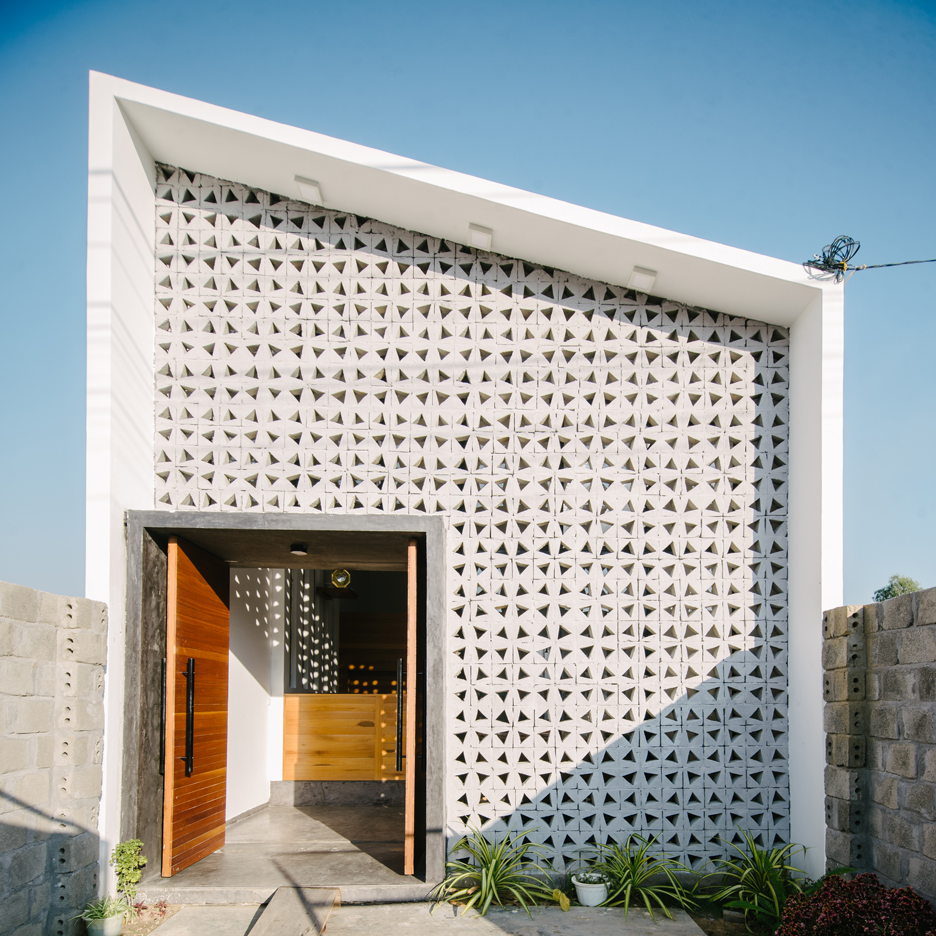
Concrete blocks with triangular apertures allow light to filter into the rooms and courtyards of this house in Vietnam’s Central Highlands, designed by local architects office Khuôn Studio (+ slideshow). (more…)


 Sig Nordal