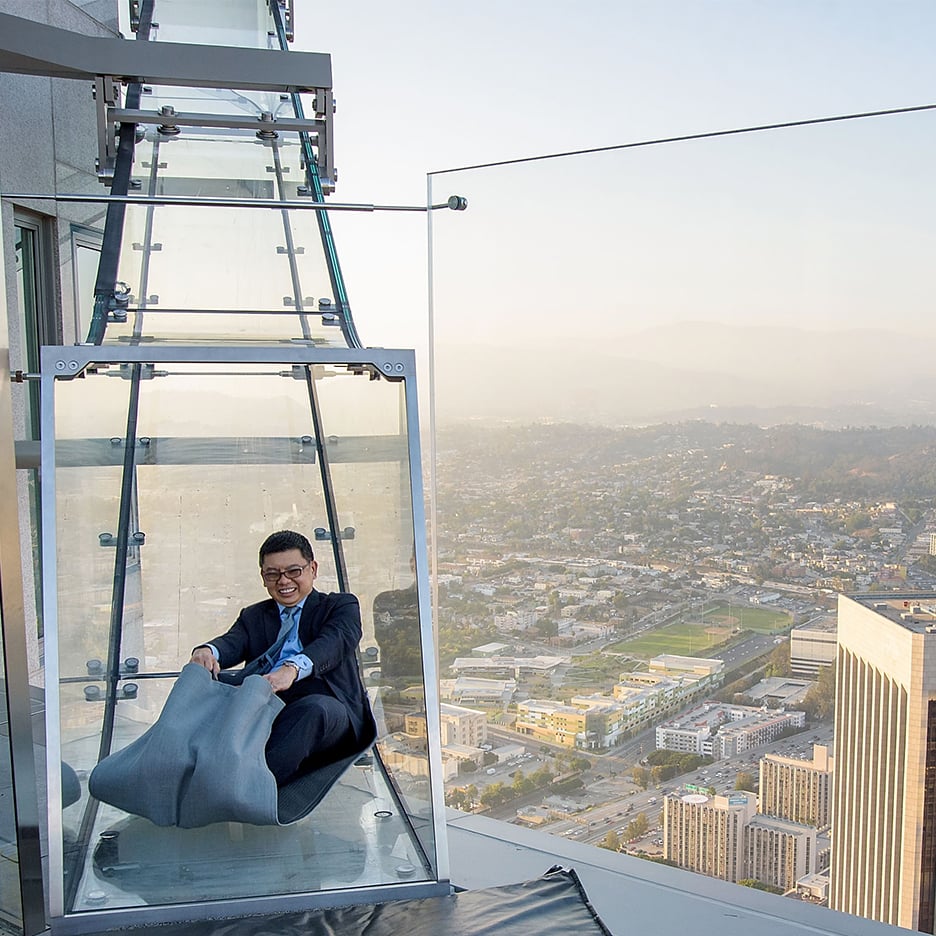
Daredevils can enjoy sweeping views of Los Angeles while descending a transparent slide almost 1,000 feet above the city (+ movie). (more…)
Daredevils can enjoy sweeping views of Los Angeles while descending a transparent slide almost 1,000 feet above the city (+ movie). (more…)


The Walmart Supercenter is generally considered one of the great antagonists of architecture around the world – the hulking behemoth who sold its integrity for the consumer convenience of having everything in one place. Though the first Walmart Supercenter didn’t open until 1988, big box stores have existed in some form since the 1960s, luring in shoppers with low prices and curbside loading lanes. For all the user psychology design that goes into them, the original designs of these buildings rarely pay much mind to their architectural or urban consequences, excluding a few notable exceptions.
Regardless, for the past 20 years big box stores have continued to prosper, prompting tenants to leave their homes and move on to even larger structures, leaving behind giant, open frameworks – for sale on the cheap. In a recent essay for 99% Invisible entitled Ghost Boxes: Reusing Abandoned Big-Box Superstores Across America, author Kurt Kohlstedt explores the architectural potential of these megastructures, drawing inspiration from the architects and communities that have successfully converted them into valuable assets.
Featuring long spans capable of accommodating a variety of program types, these structures have been renovated into libraries, churches, museums and apartment complexes in cities throughout the country. One example Kohlstedt points to is the McAllen Main Library, transformed from a Texas Walmart by MSR Design in 2011, which strategically partitions the open floor plan into human-scaled rooms and zones identified by bright colors and furniture patterns.
The article concludes that as the way we live and shop continues to change, our built environment will need to adapt, and all of the various typologies currently found in suburbia will take on new roles. And while in their current form, big box stores are widely unloved, Kohlstedt argues it is that precise distaste that may save them in the end:
“In many ways, these various suburban typologies are particularly well-suited to adaptation: no one cares about what happens to unloved structures, making them perfect candidates for complete transformations.”
For more big box transformations and to read Kohlstedt’s analysis in its entirety, visit 99% invisible, here.

New York City – New York – USA (by Phil Dolby)


From the architect. The newest addition to Israel’s growing Diamond Exchange District is the uniquely geometrical Amot Atrium Tower, designed by prominent architect Moshe Zur. At 158 meters and with 38 floors of retail, the glass skyscraper holds a LEED platinum certification – the first of its kind in Israel. The building’s name is drawn from its impressive atrium entrance hall, designed by architect Oded Halaf, who incepted a radical idea: constructing a sculptural stair element into the orthogonal, glass-encased, four-story high lobby; a complex and seemingly impossible assignment, which had to be commissioned to a professional who holds knowledge, experience and immense creativity.
Enter Tomer Gelfand: a masterful craftsman who specializes in giving architectural solutions to engineering problems. Since inheriting his father’s 1976-founded studio, Gelfand practices design implementations in wood, stainless steel, and glass. Over the 18-months period, since Halaf presented his rough sketch of the stairs to Gelfand, the latter managed to design, execute, supervise and finalize all stages of construction, turning Halaf’s dream into a reality.
The stair structure is composed of two interlocking parts: a skeletal metal staircase and a sculptural wooden envelope. Together, they rise as an expressive tornado from the reception desk – conceived as the inception plateau and up to the first-floor mezzanine, fourteen meters above. To make this happen, Gelfand devised a system of continuous wooden profiles, that may seem flexible and bendable – but is in fact extremely stiff and stable. Gelfand began by implementing an MRI-type scan to the skeleton, cutting vertically through the structure and generating sections in the width of the given wooden profile. The tremendous amount of resulted sections, each exported with a different radius requirement, produced a seemingly-endless amount of arches. In order to deal with this abundance, Gelfand narrowed it down to ‘master-arches’ – devised by calculating the wooden profile’s average bend tolerance, which dictated the ‘master-arches’ radius and angle.
Next was creating the radial profiles from the material itself: a total of 9,000 meters in length of raw Poplar wood was cut in a CNC machine to create the inventory of master-arches modules, each coded genetically and marked to fit precisely in the grand scheme. As each piece was non-interchangeable, every measure had to be taken in advance to ensure the coherency of the final implementation: For example, each of the connecting points between the modules was completed with a reverse radius; together, it forms a sinus-like wave, thus creating a seamless transition. In addition, the digital saw through the raw wood presented with various natural colors. To solve this, a palate of 12 average shades was drawn from the Poplar pieces and then applied to the modules.
Lastly, the coded profiles were delivered to the site for the final puzzle work: a precise, four-month long delicate work of assembly, managed and supervised by Gelfand himself. The final result encapsulated the paradox of contemporary creation: what appears as an artistic, hand-drawn gesture, is, in fact, a result of an algorithmic data processing and the product of countless interchangeable pieces. Seemingly arbitrary yet utterly computerized; nature’s matter harnessed by today’s true artists of technology.



 Sig Nordal