
Casa Desnuda is a residential project completed by Taller Estilo Arquitectura. The home is located in Merida, Mexico, and was completed in 2015. Casa Desnuda by Taller Estilo Arquitectura: “Luxury is in space” R. Legorreta. If we talk about architecture, in recent years it seems that the trend is to use synthetic and innovative materials, which are at the same time more expensive. Our concern for the “Raw House” project..
💙 Exhaling lights on 500px by Ettore Mongelli, Roma,……

Losing Myself: Inside the Irish Pavilion at the 2016 Venice Biennale

© Niall McLaughlin Architects and Yeoryia Manolopouplou
As part of ArchDaily’s coverage of the 2016 Venice Biennale, we are presenting a series of articles written by the curators of the exhibitions and installations on show.
Our report is a reflection on the lessons learnt through designing and revisiting buildings for people with dementia. Visitors enter our space at the end of the Arsenale through a gap in the partition walls. The room is darkened, in contrast with the projected brightness on the floor. The floor accommodates a 4.8m x 6.4m animated drawing of the Alzheimer’s Respite Center. The drawing is dynamic, with multiple projected hands moving across the plane of the floor as they create fragments of a plan. They merge and overlap. These hands represent sixteen individuals inhabiting a series of rooms at the Alzheimer’s Centre. The projection consistently labours towards the clarity of a completed plan but falls short of achieving it.
© Niall McLaughlin Architects and Yeoryia Manolopouplou
Suspended speakers create a soundscape, consisting of the physical sounds of the act of drawing itself, layered with murmured conversations; sounds of rain and the sea; quotidian noises—a kettle boiling, children playing, people eating—and the bells of the Angelus.
This installation is an attempt to communicate and interpret some of the changes to spatial perception caused by dementia. In order to understand these changes, we have read, researched and questioned. We have spoken to a broad range of people—neuroscientists, psychologists, health workers, philosophers, anthropologists, people with dementia and their families—about dementia, the brain, and the role of design in dementia care. These conversations are recorded on our website.
We are interested in the social function of architecture: how it can improve the lives of people with dementia. Beyond this, we hope that our research into the impact of the condition on spatial cognition will equip us with a deeper understanding of how all of our minds interpret space.
© Niall McLaughlin Architects and Yeoryia Manolopouplou
© Niall McLaughlin Architects and Yeoryia Manolopouplou
Our project has also highlighted the shortcomings of the traditional architectural plan: an inhabitant may never experience the building from the architect’s complete and fixed vantage point. This disconnect is particularly apparent if the inhabitant has Alzheimer’s Disease, and has lost the ability to use memory and projection to see beyond their immediate situation and create a stable model of their environment. Our projected animation attempts to address this, by working to develop a technique for drawing the building from the perspective of inhabitation.
The process has been collaborative, enlisting the skills of an animator, a composer, AV experts, graphic designers and many drafters. We have consulted people with dementia for feedback on the website design. We have been planning, testing and adapting our drawing technique with our drafting collaborators. At times, we have needed to design tools of production, such as glass tables for recording the drawing process. We have had to accept a certain level of unpredictability and uncertainty regarding the finished product, perhaps as a consequence of attempting to represent a cognitive state which is only partially understood, using a medium that we are developing through iteration and experiment.
Abandoned in Cork by slinky2000 Abandoned in Cork Large on…

LP2 completes Tehran office block with louvred wooden facades
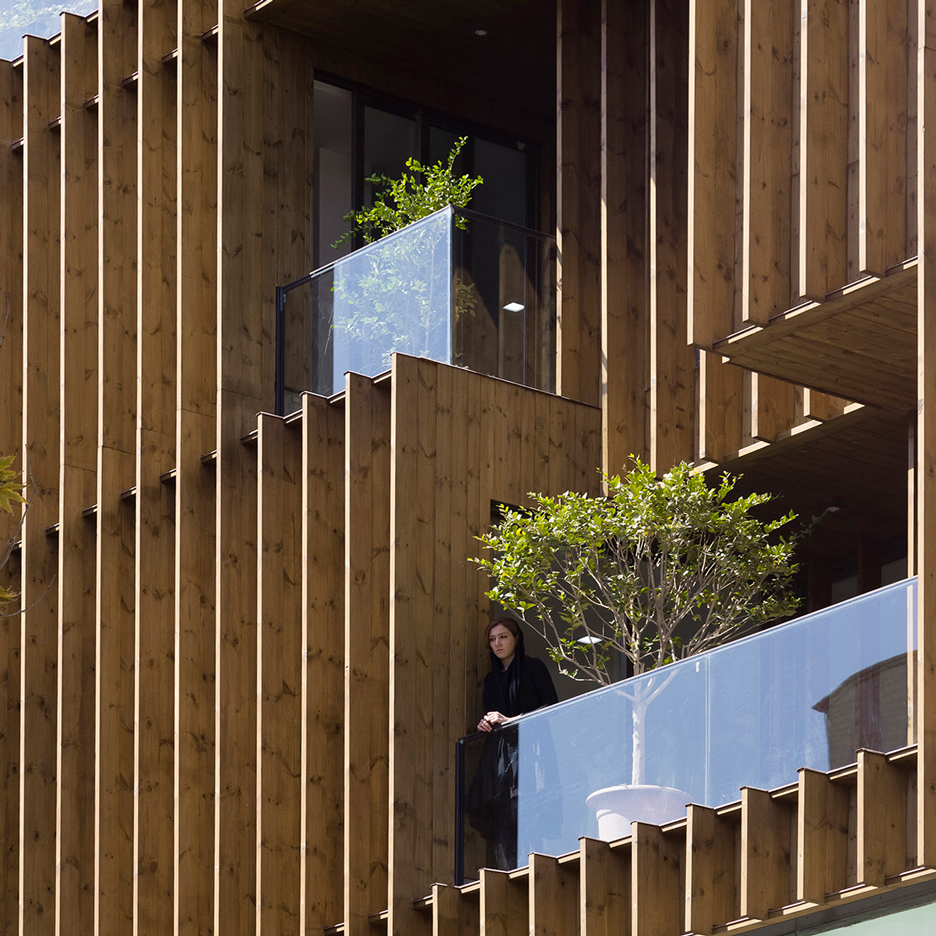
LP2 Architecture Studio has used rotating panels and recessed openings to create flexible spaces for this office block in Tehran, where contemporary architecture is experiencing a boom (+ slideshow). (more…)
Casino La Seyne / DATA

© Javier Callejas
- Architects: DATA
- Location: 83500 La Seyne-sur-Mer, France
- Area: 5100.0 sqm
- Project Year: 2016
- Photographs: Javier Callejas
- Client: Casino de La Seyne-sur-Mer, JOA
- Directeur Technique: Philippe Osmont
- Team: Léonard Lassagne, Colin Reynier, Sylvia Bourgoin, Raphaël Boursier, Clementine Debaere, Edouard Guyard, Eva Salga.
- Consultants : Artelia, Mazet&Associés, Batiserf, VP&Green, Génie Acoustique
- Interior Design: Virginie Curtillet, Studio Divo
- Graphic Documents: Hic et Nunc studio
- Budget: 14.5 M€ HT
© Javier Callejas
Site
From the architect. The brand new leisure complex and cultural centre captures the spirit of the once mighty but now defunct shipyards, docks and the grid warehouses at La Seyne-sur-Mer, and is set alongside the new municipal park between the bay and boulevard Toussaint-Merle.
© Javier Callejas
Plan
The newly completed complex is bordered to the east by a great leisure craft marina and to the west by a recently landscaped public park, at the end of which, just by the old drawbridge, stands a new three star hotel. The casino is thus at the heart of a series of large existing and future installations in the centre of a cultural and commercial hub which will breathe life into the old brick buildings, docks and the marina extension, along a privileged and autonomous beachfront.
© Javier Callejas
The efforts of designers were focused on building a unified architectural arrangement which corresponds with its immediate environment. This quadrilateral schema is geometrically simple and fits naturally into the orthogonal portion of the land alongside the docklands.
Viewed from the park the new complex has the air of an old ship at moored dock, an image that evokes the mixed programme on offer, featuring both a casino yet also a theatre.
© Javier Callejas
Model
A large stone square welcomes the visitor to the shared entrance to the casino and theatre, located right in front of the glass watchtower.
As it faces out to sea and because of its geometry the building sets the scene for these emblematic projects such as the gaming rooms and the panoramic restaurant in the old watchtower, which juts out like a platform with a cantilevered extension at the bow of the harbour.
© Javier Callejas
Siena – Italy (by Eric Huybrechts)

A Contemporary Home by Fabrizia Frezza in Olgiata

Villa Olgiata is a private home located in Olgiata, Rome, Italy. Completed in 2015, it was designed by Fabrizia Frezza. Photos courtesy of Fabrizia Frezza
Småbruk: Pocket Farm in Nes / Scacity and Creativity Studio

Courtesy of Scacity and Creativity Studio
- Architects: Scacity and Creativity Studio
- Location: Akershus, Norway
- Area: 225.0 sqm
- Project Year: 2016
- Photographs: Courtesy of Scacity and Creativity Studio
- Students: Alberto Ballesteros Barea, Jon Erik Dybedal Brekken, Sara Cais Soler, Hiu Yeung Amos Chan, Raphael Fournier, Ingri Heggebø, Jørgen Joacim Høy, Silje Loe, Bao Trung Mai, Alexandra Niedermayr, Sigurd Strøm Nørsterud, Johann Sigurd Ruud, Marc Sanchez Olivares, Johan By Sørheim, Marine Vincentz, Vjera Sleutel.
- Staff: Christian Hermansen and Marcin Wojcik
- Structural Eng : Felice Allievi, DOF engineers
Courtesy of Scacity and Creativity Studio
Description
It is said that Oslo is one of the fastest growing cities in Europe, and that building land within its natural boundaries is full. To accommodate future growth Oslo will have to look beyond, to municipalities within commuting distance. One such municipality is Nes i Akershus, one of the principal agricultural producers of grain in the country. Nes does not want to become a suburb of Oslo, so it is looking for alternative modes of accommodating additional population without losing its rural character.
Courtesy of Scacity and Creativity Studio
Diagram
One possible growth model is the development of Pocket Farms (Småbruk). SCS was asked to design one such development in Dystlandhaugen Farm, founded in the XVIII century, and currently owned by Terje and Elisabeth Maarud. The project consists of four eco-houses, an agricultural barn, and land where resident families may grow food and keep animals. The residents would be those who want to live in a rural setting and do a limited amount of agricultural activities, and yet be close enough to Oslo to be able to commute.
In addition to the design of the four pocket farms SCS has built the agricultural barn, which will be divided amongst the four residents of the pocket farms and serve to store agricultural produce, machinery, and animals.
Courtesy of Scacity and Creativity Studio
The Design
The client was concerned that the new barn, located in the centre of the farmhouse’s main view, may detrimentally affect the outlook from the farmhouse. For this reason the form of the barn is an extension of the undulating topography, which the building picks up and extends, generating the volume required to house the functions of the barn. In order not to disturb the continuity of the topography, the entrance doors are placed at the back, in the space between the building and the woods. The greatest integration of the barn and the topography will occur in the autumn when the colour of the barley matches that of the cladding of the barn and in the winter when fields and barn roof are covered in snow.
Courtesy of Scacity and Creativity Studio
Structure
In pursuance of the integration of the barn to its landscape, the expression of the building envelope is highly muted, consisting of 23 x 36 mm treated softwood battens with 23 mm spaces in-between, through which one sees the black metal roofing sheets.
Courtesy of Scacity and Creativity Studio
It is in the interior that the envelope of the barn displays its structural articulation. The choice of OSB sheets as the main structural material was due to economic constraints and ease of building. The dimensions of the structural members reflect the fact that OSB is not a commonly used structural material. However, once committed to OSB, SCS pursued the idea that it should perform all the structural functions.
The materials used in the building are OSB and untreated softwood for the structure, corrugated metal sheets in roof and walls, covered outside by treated, spaced, softwood battens.
Courtesy of Scacity and Creativity Studio
Detail
Piet Hein Eek unveils first collection with Ikea
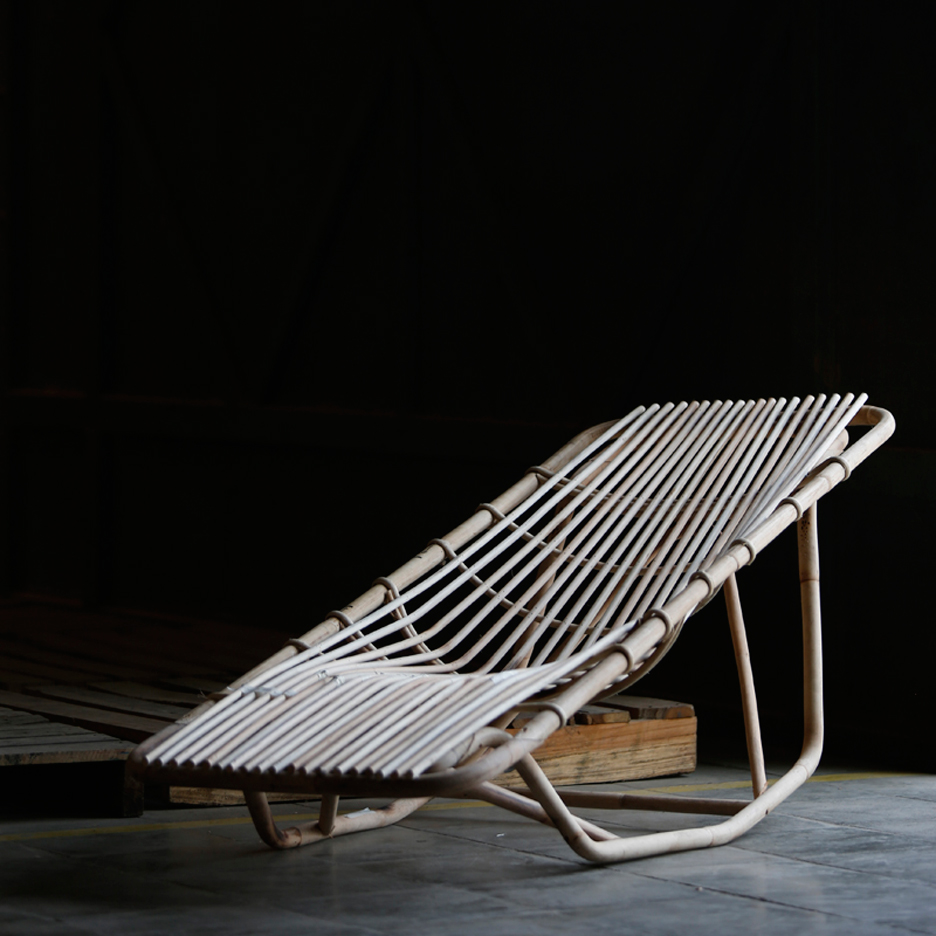
Dutch designer Piet Hein Eek has revealed the first products from his ongoing collaboration with Ikea – a collection of furniture and homewares based on traditional Indonesian and Vietnamese crafts. (more…)

