#Элиста, республика #Калмыкия
На территории Золотой обители Будды Шакьямуни – крупнейшего буддийского храма Республики Калмыкия, одного из крупнейших буддийских храмов в Европе. Здание хурула имеет 63 метров в высоту и вмещает в себе самую большую в России и Европе девятиметровую статую Будды.
In the territory The Golden Abode of the Buddha Shakyamuni. Elista, the capital of the Republic of Kalmykia, a federal subject of the Russian Federation.
“They are projects that cannot be bought, cannot be owned, cannot be possess, to be kept; they are projects in total freedom. Nobody can own this, because if you own something, it’s not free.” -Christo
In this latest video from NOWNESS, Bulgarian artist Christo explains the fleeting nature of his most recent work, The Floating Piers, a floating dock system wrapped in yellow fabric that connects the towns of Sulzano and Peschiera Maraglio to the island of San Paolo in Italy’s Lake Iseo. First conceived by Christo alongside his late wife and creative partner Jeanne-Claude in 1970, The Floating Piers is in the midst of its 16 day run, lasting until July 3rd. After the conclusion of the exhibition, all components will be removed and industrially recycled, leaving its site precisely the way it was found.
“This is why they are made, for everybody, exist in this very precious time and never again, like our life.”
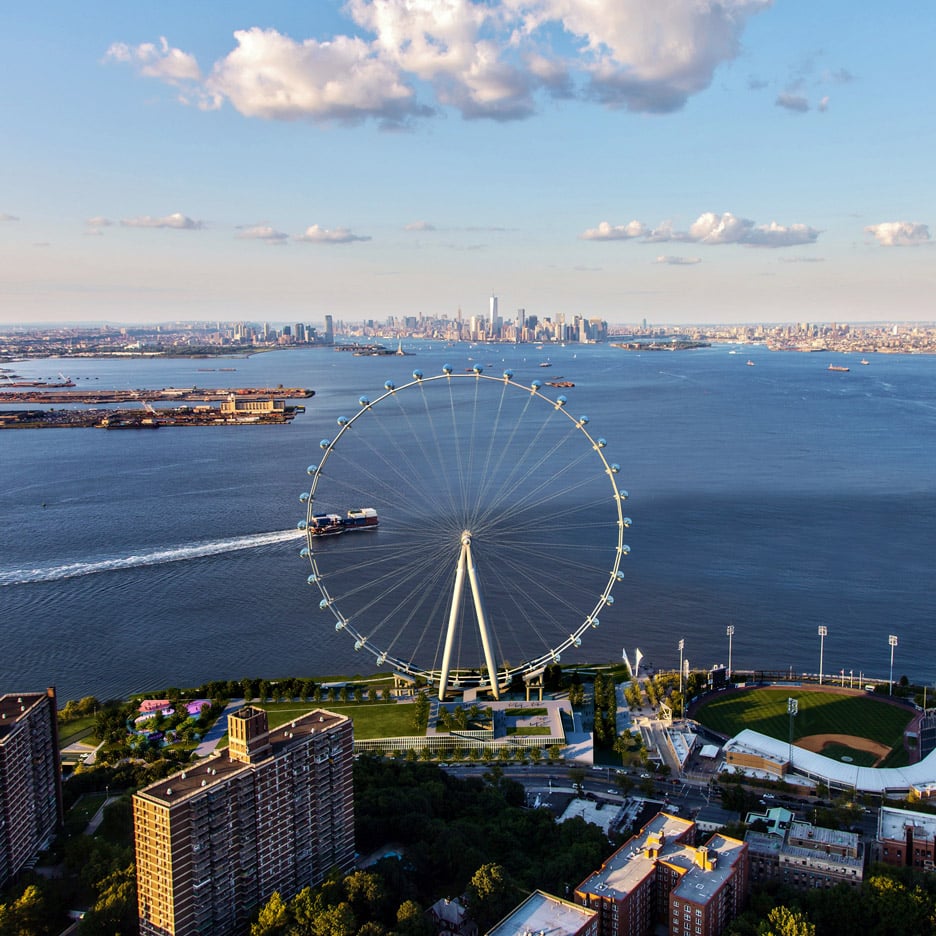
The world’s largest ferris wheel is set to rise on the northern end of New York‘s Staten Island, as constructors finished pouring its foundations last weekend (+ slideshow). (more…)
From the architect. This recently completed addition grew out of the desire to make a building of creative opposites. The addition is designed to in many ways be the antithesis of the existing Kline Center.
This idea of designing the addition in contrast to the existing building led the (then) president Bill Durden to remark on at an early meeting, “I get it, you are renovating, reimagining, revitalizing and rethinking the Kline Center. It should be called the Re_Kline.” The name stuck and we had a metaphoric talisman to guide our process. Its design strategy can be quickly summarized as a form of complementary contrasts.
This building is located on the edge of Dickinson College’s historic campus. Charted in 1783, Dickinson College was the first college in the newly formed United States. The first building on campus, Old West, was designed by Benjamin Latrobe in 1805, the architect of the United States Capital building. It’s restrained detailing in limestone reflected the austere and simple esthetic of the founders, Benjamin Rush and John Dickinson’s vision for the campus.
This building is an addition to a 1980’s athletic complex designed by engineer Daniel Tully, which was constructed using a novel structural system of hyperbolic parabololoid roof shells. The new addition takes that structural system and turns it on its head as a design theme. If the original building was constructed using wooden glue-lam beams the new building is made of exposed steel. If the old building lacks connection to light the new building is filled with natural daylight. If the old building’s structure forms an undulating profile on the skyline the new building creates a quieter presence while referencing the existing building’s roof geometry in the structural steel which supports the facades aluminum sunshade. The pallet of materials for the new building picks up the grey coloration of the campus stone with its enclosure and integrated sunshade system detailed in anodized aluminum.
Site Plan
The addition is made up of a number of distinct constituent parts; a large outdoor covered piazza, a triangulated lobby and connecting sky lit concourse, wood clad office and café volume, a glass enclosed fitness center, a five court squash center and a south facing covered porch. The building was designed as the first part of a master plan. Consequently the residual spaces between the new addition and the original complex are sized to accommodate future growth. In their current state these spaces are designed as a series of garden courts for various athletic activities, such as tai chi, yoga, basketball and impromptu teaching.
Urbanistically the building fulfils a number of important roles within the campus proper. The outdoor covered piazza marks the western terminus of Dickinson Walk which forms the main pedestrian pathway though campus. The pathway continues inside through the lobby and along a two story concourse, which will in future phase eventually link all the athletic programs. At the southern end of the building, a covered porch stretches toward West High Street, one of the main thoroughfares of Carlisle, announcing athletics to the town and campus. At night the building becomes a luminous beacon at this end of the campus, opening up previously tucked away spaces to students and faculty.
Sketches
Dickinson College has a very strong commitment to sustainability in its curriculum, facilities, operations, culture and civic engagements. The new Kline Center Addition takes this sustainable approach holistically with a number of integrated design features. Some of these elements are visible and meant to contribute to the pedagogical strategy of sustainability. As a teaching tool, building’s environment can be manually tuned in the temperate seasons by admitting fresh air through low hopper windows and exhausting it by fan through skylight apertures. A second set of fans recirculate warm air in the winter. The sunshade system is designed to admit low level winter sun while deflecting the harsher summer light. A series of rain water gardens clean and filter street run off before diverting it to a hidden and below-grade water detention system. This system also retains the runoff from the existing building’s tent-like roofscape and remediates a broad area of the campus that was previously prone to flooding.
Comments update: readers’ reactions to the shock result of last Thursday’s EU referendum, in which the UK voted in favour of exiting the European Union, are highlighted in this Brexit-focused roundup of the week’s comments. (more…)
Brexit crisis: UK design firms will likely pay more to protect their designs and miss out on new EU-wide patents if the country leaves the European Union, according to a leading intellectual property law firm. (more…)
The Lucas Museum has been looking for a home in all the wrong places. Following months of fiery debate over the future of the museum’s proposed lakefront location, George Lucas announced that he is abandoning plans to build the project in Chicago and will instead return to looking for a site in California. This is the second failed location for the museum, after being rejected by San Francisco’s Presidio Trust in early 2014.
As it stands now, the site in question is occupied by a 1,500-space parking lot just south of Soldier Field that serves as a tailgating area during the Chicago Bears’ 8 annual home games. Proponents of the museum had argued that the project would bring “an iconic architectural structure and additional green space to an otherwise blank, paved, and bleak city landscape” and provide thousands of jobs, without costing taxpayers any money.
But Friends of the Parks feared the implications of placing a private museum on the public lakefront, claiming that the project was in violation of the public trust doctrine, which states that governments must protect certain natural resources for public use. They had hoped instead to preserve the land to someday become a vast park. While the group had hinted at comprise in recent discussions, the lawsuit was never withdrawn, prompting Lucas to take action.
“No one benefits from continuing their seemingly unending litigation to protect a parking lot,” said Lucas. “The actions initiated by Friends of Parks and their recent attempts to extract concessions from the city have effectively overridden approvals received from numerous democratically elected bodies of government.”
The museum will now return to pursuing a location in California, Lucas’ birthplace and home to many of the filming locations for Star Wars, the famous movie franchise created by Lucas. Potential sites include an island in the middle of San Francisco Bay and the city of Los Angeles, which has publicly expressed interest in the project.








 Sig Nordal