Masterplan by SLA and Saunders Aims to Alleviate Flooding in Copenhagen


© SLA / Beauty and the Bit

© SLA / Beauty and the Bit

Planning and Landscape firm SLA Architects with Saunders Architecture have won an international competition to redesign Hans Tavsens Park and its surrounding area in the central Copenhagen borough of Nørrebro. The competition tasked architects with envisioning a park and streetscape that would benefit the hydrological, biological and social ecosystems of the neighborhood.  The winning proposal, titled The Soul of Nørrebro, tackles the challenge by creating a system of drainage areas and an adaptable park designed to redirect runoff and contain and purify water during flood conditions.


Hans Tavsens Park Flood Conditions. Image © SLA / Beauty and the Bit

Hans Tavsens Park Flood Conditions. Image © SLA / Beauty and the Bit

Located on relatively flat land and along the water, Nørrebro is particularly susceptible to the effects of heavy rain. During particularly torrential rains, referred to as cloudbursts, flooding of major roads and basements is common. Excess water runs directly into Peblinge Lake, one of Copenhagen’s three distinct rectangular shaped lakes, pulling with it dirt or debris from the street.

To mitigate these issues, the 140 million DKK (20 million US Dollars) proposed design will use Hans Tavsens Park to act as a rainwater catchment basin capable to holding up to 18,000 cubic meters of water at a time. The rainwater will then be naturally filtered as it is slowly led into Peblinge Lake through planted drainage paths located along Korsgade, an existing street. The irrigation paths will provide a new identity and microclimate to the street, becoming a visible part of the cityscape.


Hans Tavsens Park Plan. Image © SLA / Beauty and the Bit

Hans Tavsens Park Plan. Image © SLA / Beauty and the Bit

The new park will feature courts and fields for a variety of sports that will serve as retention areas during flooding, a fountain, playground and pathways to the adjacent cemetery. As it travels toward the lake, the drainage basin will also pass by Blågaards School, where it will provide irrigation for gardens and playspaces tended to by school classes. Along Korsgade, the drainage ways will serve as a barrier between the road and sidewalk, emptying into a final biotope along the lake edge.


Blågaards School. Image © SLA / Beauty and the Bit

Blågaards School. Image © SLA / Beauty and the Bit

“Our solution is based on creating a robust city nature that both solves the specific problem of handling torrential rain to avoid flooding, while at the same time creating a new and coherent series of urban spaces that offer stronger social community, greener and more natural experiences and new, creative opportunities for all Copenhageners,” says Stig L. Andersson, partner and design director of SLA.

Construction is set to begin in 2019, with an expected completion date in 2022.


Korsgade Sunny Conditions. Image © SLA / Beauty and the Bit

Korsgade Sunny Conditions. Image © SLA / Beauty and the Bit
  • Architects: SLA, Saunders Architecture
  • Location: Hans Tavsens Park, Hans Tavsens Gade, 2200 København N, Denmark
  • Lead Consultants: SLA
  • Project Team: Ramboll, Arki_Lab, Gadeidræt, Aydin Soei, Social Action, Saunders Architecture
  • Area: 85000.0 sqm
  • Project Year: 2016
  • Photographs: SLA / Beauty and the Bit
http://ift.tt/28Wv8J6

Cervantes Building / Saiz+Rendueles Arquitectos


© Eugeni Pons

© Eugeni Pons


© Eugeni Pons


© Eugeni Pons


© Eugeni Pons


© Eugeni Pons

  • Architects: Saiz+Rendueles Arquitectos
  • Location: Zaragoza, Zaragoza, Spain
  • Author Architectes: Ángel Saiz Artal, Liliana Rendueles Acebo
  • Promoter: Cervantes 19 S.L.
  • Project Year: 2015
  • Photographs: Eugeni Pons
  • Builder: Inviasa
  • Plumbing: Alfredo Sanjuán S.A
  • Electricity: Cerma y Arriaxa S.L.
  • Air Conditioning: SAVISA

© Eugeni Pons

© Eugeni Pons

This residential building makes the most of a tiny space that enjoys a privileged location on a chamfered sidewalk street corner.


© Eugeni Pons

© Eugeni Pons

The public space takes the lead. The strong volumen of the building steps back on the corner to emphasize the main access.


Section

Section

Elevation

Elevation

The building consists in two prisms whose facades face both streets. Each prism hides several homes. These prisms join on the stairs of the building that can be seen from the outside through a hole that “walks” the facade vertically from top to bottom. This hole both gives light and air to the interior of the building.


© Eugeni Pons

© Eugeni Pons

The terraces of the facade unify the holes also maximize the entrance of natural light. They are lined inside with phenolic panels wood-coloured that deliver a sense of depth and warmth to the interiors. The lattice guarantees privacy also invigorates the elevation.


© Eugeni Pons

© Eugeni Pons

http://ift.tt/291tivl

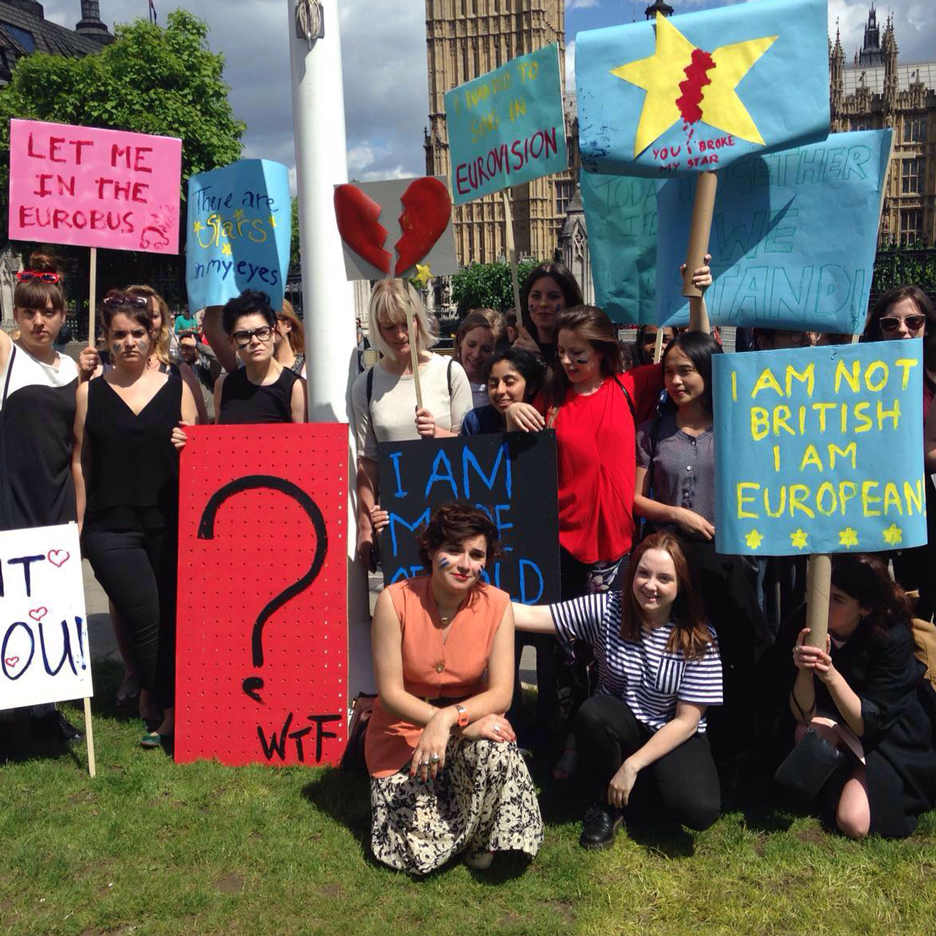
Designers and students to protest in Trafalgar Square as threats to Erasmus programme emerge


EU referendum: the EU referendum was “nothing like democracy” according to designer Nelly Ben Hayoun, who is urging fellow creatives to join a protest in central London tomorrow. (more…)

http://ift.tt/28YVGuM

Banff National Park, Alberta, Canada

ReframingBack/ImperativeConfrontations: Inside Egypt’s Pavilion at the 2016 Venice Biennale


© Michela di Savino, Morgane Quere

© Michela di Savino, Morgane Quere

As part of ArchDaily’s coverage of the 2016 Venice Biennale, we are presenting a series of articles written by the curators of the exhibitions and installations on show.

The Venice Biennale of Architecture is an integral part of architectural culture. However, this year’s cycle “Reporting from the Front” is more unique, highlighting the capacity and potential of architecture’s role inside communities; “architecture makes the difference”, as  2016 Venice Biennale director Alejandro Aravena puts it.

The Egyptian pavilion commissioned and curated by Architect Ahmad Hilal with a team composed of Eslam Salem, Gabriele Secchi, Luca Borlenghi and Mostafa Salem, seeks to reveal various successful stories of architecture narrating the difficulties and challenges inside the Egyptian built environment. The works inside the pavilion reveal how architecture is actively creating change in communities. Nowhere are these confrontations more evident than in the urban context, and nowhere more so than in Egyptian cities. 


© Michela di Savino, Morgane Quere


© Michela di Savino, Morgane Quere


The MAS urban design of ETH Zurich contribution to the Egyptian pavilion. Image © Michela di Savino, Morgane Quere


PennDesign of University of Pennsylvania contribution to the Egyptian pavilion. Image © Michela di Savino, Morgane Quere


© Michela di Savino, Morgane Quere

© Michela di Savino, Morgane Quere

The exhibition’s goal is to re-frame and position in a global forum what we think are examples of a successful architectural and urban conflict resolution where architects, through their work, were the mediators of change, this mediation took the form of built projects, or even research proposals & mappings that attempted to highlight existing problems.

The exhibition titled Reframing Back//Imperative Confrontations, responds directly to this year’s biennale theme “Reporting from the Front” by displaying architectural projects largely by grassroots initiatives, students and young architects. The works presented can be broken down into two large categories – mapping investigations and (built-up projects and experimental proposals). The mapping projects attempt to survey existing conditions with applied analytical lenses, evident in their representational outputs. As with recent mapping efforts in other contexts, here, representation is viewed as a tool to think and present new information. It also entails the same potential shortcomings of mapping exercises when data is poorly researched and could advance a skewed perspective, or completely misinform. The exhibition contains a various investigation about the Egyptian urban condition including sprawl, informal urbanism, desert vernacular architecture, coastal cities, and 19th– and 20th-century heritage buildings which have been all part of the parallel dynamics of growth in Egyptian context for the past half a century. 


The MAS urban design of ETH Zurich contribution to the Egyptian pavilion. Image © Michela di Savino, Morgane Quere

The MAS urban design of ETH Zurich contribution to the Egyptian pavilion. Image © Michela di Savino, Morgane Quere

This pavilion is in no way a comprehensive survey of all initiatives and works that have been produced during the last period in Egypt. it is, however, an attempt to introduce to a large audience the work of those individuals and collectives, students and professionals, who over the course of the past decade, have been searching for new operating models in Egypt and engaging in architecture as a field of critical intellectual inquiry. The works presented here demonstrates the interest of a wide range of actors – government, universities, research centers, independent practitioners – in the Egyptian urban condition marking the occasion to bring forth all these perspectives and approaches in one space and to reflect on the nature of the knowledge produced in the past decade. It is at the same time an opportunity to evaluate its potential for action and transformation.


PennDesign of University of Pennsylvania contribution to the Egyptian pavilion. Image © Michela di Savino, Morgane Quere

PennDesign of University of Pennsylvania contribution to the Egyptian pavilion. Image © Michela di Savino, Morgane Quere

Through an open call, many works have been selected to be exhibited from, among others, the MAS Urban Design of ETH Zürich, School of Design of University of Pennsylvania, Mittelmeerland of AA School of Architecture, Lund University, and MSA architecture department. In addition to Baladilab, Cairobserver, CLUSTER, Community Design Collaborative, GUC Architecture Department, (IN)formal Pattern Language, MADA Architecture Studio, Studio Meem, Takween, Traslochi Emotivi, and Œcumene Studio.


© Michela di Savino, Morgane Quere

© Michela di Savino, Morgane Quere

http://ift.tt/295xbih

Terre de soufre et marmites de boue by adeline.bougard Les…

Terre de soufre et marmites de boue by adeline.bougard Les solfatares de Námafjall (montagne de la mine)
Site hydrothermal de Hverarönd
Région de Myvatn
Islande – 21 juillet 2014
© Adeline Bougard http://flic.kr/p/rLfBB5

http://ift.tt/295xuJN

Hokkaido, Japan photo via herb

Hokkaido, Japan

photo via herb

Joanne Chen designs factory for London artisans based on the teachings of William Morris


Graduate shows 2016: Bartlett graduate Joanne Chen has designed a factory that includes leisure and education facilities, based on the Socialist ideals set out by designer and activist William Morris in the late 19th century. (more…)

http://ift.tt/29h4o8g

A Functional Family Apartment / Studio Raanan Stern


© Gidon Levin

© Gidon Levin


© Gidon Levin


© Gidon Levin


© Gidon Levin


© Gidon Levin

  • Architects: Studio Raanan Stern
  • Location: Tel Aviv-Yafo, Israel
  • Design Team: Architect Raanan Stern and Architect Shany Tal.
  • Area: 0.0 sqm
  • Project Year: 2016
  • Photographs: Gidon Levin

© Gidon Levin

© Gidon Levin

The creation of two dividable public areas was the foundation of planning this family apartment in central Tel Aviv. The apartment was extended and lengthened, with a large space connecting between the existing and new spaces creating a new large public area in the apartment. The apartment size is 165sqm. 


© Gidon Levin

© Gidon Levin

On the street side of the apartment there is a large lounge that is connected to other public functions; the kitchen, terrace, dining and a reading area. An additional family room acts as a children’s area including a library and work space. This area forms a junction leading to all children’s bedrooms. 


Plan

Plan

A long corridor which connects the two lounges is left exposed on the one side with exposed bricks and on the other with the original concrete of the building.  The corridor functions as an axis between all bedrooms and washrooms. 


© Gidon Levin

© Gidon Levin

Down the hall, a large wooden door with hidden hinges and acoustic system, allows separation between the two parts of the house, so that the two lounges can be used in parallel without interfering with one another. 


© Gidon Levin

© Gidon Levin

All carpentry was custom designed and made to fit the requirements of the family and hidden within many storage areas customized specifically according to their use. The black wood cladding in the living room conceals the media system which continues around the corner as a large storage unit for the entrance. The yellow wooden bench facing the street serves as a library for the family’s record collection. The kitchens service unit dividing between the kitchen and the dining space, on one side holds a pantry and many appliances, while on the other side acts as a shelving unit.


© Gidon Levin

© Gidon Levin

Various flooring types, ceiling shelves, painted walls and different materials, allow the division of the public areas according to need without blocking views with a wall or divider. Delicate profiles such as black iron and aluminum separate between materials allowing them to exist side by side harmoniously.


© Gidon Levin

© Gidon Levin

Light fixtures line the length of the corridor emphasizing the movement through the apartment and changes in color and finishing materials of the fixtures produce a rich and varying pace.


© Gidon Levin

© Gidon Levin

To maximize light in private spaces transparent facades were used such as steel doors combined with glass, partitions with upper windows and painting with a glossy finish.

http://ift.tt/28Y6FrW

In the Darkroom

Susan Faludi In the Darkroom side by side

There is a striking moment early in In the Darkroom, the remarkable new memoir by the Pulitzer Prize−winning journalist Susan Faludi. First, some context: the author, whose parents divorced when she was a teenager, has barely spoken to her father in twenty-five years when, in 2004, she receives an e-mail informing her that Steven, at age seventy-six, has had sex reassignment surgery and is now Stefánie. “I have had enough of impersonating a macho aggressive man that I have never been inside,” Stefánie explains.

Faludi is best known for the 1991 bestselling feminist classic Backlash: The Undeclared War Against American Women,  and In the Darkroom makes clear that her feminism emerged in large part as a reaction to growing up with the domineering Steven, whose malevolent bullying, by the end of her parents’ marriage, had escalated into violence. Not long after receiving her father’s shocking news (Faludi had no hint that such a profound change was coming), she visits Stefánie in Budapest, her father’s birthplace, to which he had returned fifteen years earlier. There she finds the “overbearing and autocratic” patriarch of her memory replaced by a self-identified “lady” clad in high heels and pearl earrings and crowing about how men now help her with everything. “I don’t lift a finger,” she tells her celebrated feminist daughter. “It’s one of the great advantages of being a woman. You write about the disadvantages of being a woman, but I’ve only found advantages!”

That loaded remark hints at how fraught it will be for Faludi and Stefánie to reinvent their relationship, a project that is both personal and professional as Stefánie promptly asks Faludi (or dares her, in the author’s view) to write her life story. To be sure, there are charged gender dynamics: Stefánie, at times an almost menacing figure, seems to take pleasure in making her daughter uncomfortable by undressing in front of her, saying, “Oh, come now. We’re all women here.” Yet gender becomes merely one axis of analysis that Faludi explores; as she attempts and often fails to understand her inscrutable father, the book becomes a rumination on larger questions of identity. “Is who you are what you make of yourself, the self you fashion into being,” Faludi wonders, “or is it determined by your inheritance and all its fateful forces, genetic, familial, ethnic, religious, cultural, historical? In other words: is identity what you choose, or what you can’t escape?”

Stefánie’s “fateful forces” are particularly complex. He was born István Friedman in 1927 to wealthy but almost criminally inattentive Jewish parents, with a childhood that was sad and lonely until it became far worse, a terrifying struggle to survive the Nazi occupation. He lived through World War II, after which he left Hungary, Judaism, and István Friedman behind, renaming himself Steven Faludi. Once he made his way to the United States, according to his daughter, he “was eager to present himself as a model of postwar American manhood, with wife and children as supporting cast.” (A convertible and a house in the New York City suburbs, complete with a basement full of tools, rounded out the picture.) Faludi, who delves into Hungary’s long and dark history of anti-Semitism, links this initial transformation to the Hungarian tradition, amply evident in anti-Semitic literature, of feminizing Jewish men. Because Steven, seemingly incapable of self-reflection, later experienced his divorce as abandonment by his family, from his perspective he was denied his proper place both in Hungary and in his suburban home. “As both European Jew and American Dad, my father’s manhood had been doubted, distorted, and besmirched,” Faludi writes.

Faludi seems to be searching for motives beyond gender identity for her father’s transition; the degree to which this goes against conventional wisdom about the transgender experience is demonstrated by the fact that even an elderly high school classmate of her father’s warns her, in the author’s words, “not to conflate religion and gender.” When she asks whether her father always felt himself to be a woman, however, the elusive Stefánie offers no satisfying response. “As far as I could tell, becoming a woman had only added a barricade, another false front to hide behind,” Faludi laments. “Every road to the interior was blocked by a cardboard-cutout of florid femininity, a happy housewife who couldn’t wait to get ‘back to the kitchen.’ ”

Before it was the kitchen, it was the darkroom: the book’s title derives from Steven’s profession as a photographer who, in a time before Photoshop, specialized in retouching images for fashion magazines like Vogue and Glamour. He excelled at techniques known as “dodging,” lightening dark areas, and “masking,” hiding unwanted parts of a photo. By the end of In the Darkroom, it is genuinely moving that Faludi has achieved a hard-won closeness with her difficult parent. Still, so many of her questions, large and small, remain unanswered. Stefánie, who died last year, was dodging and masking to the end.

The Barnes & Noble Review http://ift.tt/29gVCqK