Penda has released plans for a series of stacked villas that will bring gardens high into the skies of Hyderabad, India. The complex is the second stage of the Magic Breeze project for Pooja Crafted Homes – the first stage featuring a landscape design inspired by Indian stepwells and water mazes. The 450,000 square foot (42,000 square meter) development will include 127 duplex sky villas, ranging in size from 2,600 to 4,000 square feet (240 to 370 square meters), each separated by a double-height private garden terrace. The structure will be integrated into the landscape design, turning the park on its side to continue vertically up the side of the building.
Courtesy of Penda
In designing the sky villa complex, Penda looked to the architectural typology of “private house with a garden,” surrounding each 2-story unit with a 500 square foot (46 square meter) balcony containing a ribbon of lawn and a modular planter system. By giving each villa a spacious green-space, even when the units are stacked, the complex retains a sense of lightness and openness. Each planter can be filled by the owner with plants of different sizes and species to create a natural backdrop, or to serve as a garden for vegetables and herbs.
Courtesy of Penda
The gardens also work as an effective passive cooling system for the building, providing natural ventilation throughout the complex and shielding residents from the hot Hyderabad climate. This in turn will save up to 60% of the energy consumed by a typical condominium building, reducing the project’s overall carbon footprint.
Courtesy of Penda
The entire complex was designed in accordance with the traditional Hindu architectural system of Vaastu, which prescribes principles of design, layout, orientation and spatial geometry, as well as an importance of creating architecture in harmony with nature. Vaastu remains an esteemed practice in modern Indian real estate development, being employed by famed Indian architect Charles Correa in many projects throughout his career. Penda responded to this need by giving as much space as possible back to nature in the form of garden terraces.
The complex is set to begin construction in the fall of this year.
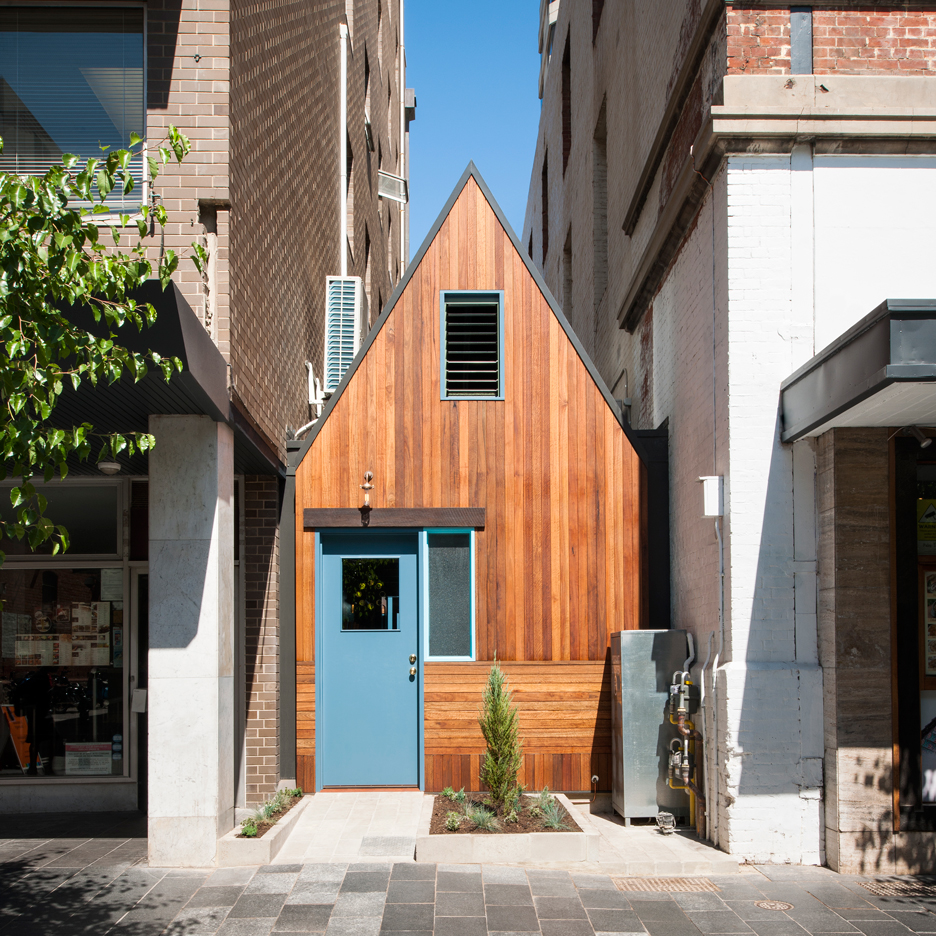
Traditional wilderness huts inspired this bar and kitchen in Adelaide, designed by local office Sans Arc Studio to slot into a narrow alleyway. (more…)
From the architect. The “Maracaná” is a football stadium built during the years 2013-2014 in the popular El Chorrillo neighborhood in Panama City, Panama. The structure replaced an old sports field, baptized by the locals with the name of the legendary Rio de Janeiro stadium. The new building has capacity for five thousand spectators, and is the end point of a recent phase of the linear park that winds along the city’s coastline. El Chorrillo has a longstanding football tradition, and currently has two professional teams in the first division league. The construction of the stadium was part of an effort to provide this dense, low-income neighborhood with more public space and with attractions of metropolitan appeal, in order to better integrate it to the rest of the city. The building is used by a variety of professional and amateur leagues.
The structure is composed by four straight segments of stands, covered with vaulted roofs, and four “cubes”, one on each corner. Access for the public is located under the stands in the eastern and western wings, while the lower levels of the north and south wings house the locker rooms and office spaces, respectively. The access wings include the general lobbies, commercial stalls, and VIP boxes. The public restrooms are located inside the cubes. The structure combines steel and reinforced concrete columns, and includes a roof structure of steel trusses and semi-structural metal sheet.
The eastern and western wings are built over artificial earth mounds, one level above the northern and southern wings. This solution creates different heights for the roofs of the paired sides of the structure, thus generating a welcome dynamism to an otherwise symmetrical building. Architectural movement is also provided by the curved fronts of the eastern and western facades, which contrast with the straight fronts of the north and south wings, and by the curved outer edges of the four roof segments.
The four concrete cubes are the only “solid” components of the exterior facades, and are painted blue or red, in alternating fashion. For their part, the central sections of each facade are clad with rectangular, perforated steel sheets. The color of each cube is “pixelated” towards the center of each façade, transitioning into white before picking up the color of the cube in the opposing corner.
The perforated sheets and the raised roofs lend the building an open, light, and translucent appearance. Between the stands and the roofs, great views are opened and framed towards the bay, the city, the bridge over the canal, and the famous Ancón Hill. At those times of the day when the sun is close to the horizon, a spectacular light effect created by the perforated sheets animates the access lobbies. At night, the interior stadium lights turn the east and west facades into huge lamps of textured light.
In this movie, Karen Hennessy of the Design & Crafts Council of Ireland reflects on the achievements of the Irish Design 2015 initiative, which promoted the work of Irish architects and designers around the world. (more…)
View from Hickson Road pedestrian bridge. Image Courtesy of Tzannes
Adding to the growing trend of timber-framed architecture, Tzannes has released plans for International House Sydney, the “first modern commercial engineered timber building of its size and type in Australia.” Located in the new urban district of Barangaroo, the building was conceived as a gateway to the area, linking pedestrian infrastructure systems and providing six floors of new commercial space.
View from Hickson Road colonnade. Image Courtesy of Tzannes
Taking advantage of the structural capabilities of timber, Tzannes’ design features a colonnade of y-shaped members, giving the building a dynamic presence from the street and providing shade and cover for the pedestrian “Merchant’s Walk.” Behind the colonnade, the seven-story building is made up of two components: a two-story base housing retail that responds to surrounding pathways, and a simple glass envelope above that allows the building’s unique structural frame to be displayed from both the inside and outside.
View from Hickson Road. Image Courtesy of Tzannes
The building has been sited to complete the streetwall on Hickson Road, complementing surrounding buildings and acting as a transitional structure between the street and the towers to the west. The design interacts with the two pedestrian bridges flanking the project, drawing people into the ground-level public space and connecting Barangaroo with downtown Sydney.
In addition to the extensive use of structurally engineered timber, the design for International House Sydney employs recycled hardwood throughout. Noting the renewable and ecological character of timber-framed structures, Tzannes hopes that the project will be seen as a leader in environmentally sustainable design and will set an example for future development in the area.
View from Hickson Road pedestrian bridge. Image Courtesy of Tzannes






 Sig Nordal