Home is where the heart is – or so they say. Everyone deserves a nice place to come home to at the end of the day’s work, and while many of us are fortunate to have a nice marriage or house to come home to, there are also many readers out there who pay for small apartments, live with roommates or still stay with their parents. We need to feel comfortable where we sleep, and feel good about going there ever y night and waking up there every morning. If discomfort comes in the way of a poor relationship or real estate choice, we can’t do everything about it right away, but there are many little things we can do to improve our situation without having to change much of anything!
1. Cook comfort food.
Fill up your house with the smells of muffins and the warmth of rice pudding. Call your mom and ask for grandma’s favourite recipes from when you were younger and enjoy a nostalgic taste-bud-trip down memory lane at your dinner table. There’s something to say for comfort foods that make us feel good after or before a long day of eating takeout salads or bland sandwiches at work. Find an hour or two after work to whip up some classic recipes and relax on the couch for dinner. Feel like a kid again !
2. Invest in decor.
Life is getting more and more expensive, but it shouldn’t come at the cost of comfort. If your home is empty of feeling or emotion, or full o f old styles and ideas, try saving a few dollars and buying some new trinkets for your walls and shelves. A few dollars goes a long way at some of the popular home decor stores, and you can build up a style over time at interesting boutique shops. Remember it doesn’t have to happen all at once, but giving your home a makeover might be just what the doctor ordered. Even a few tacky pictures of flowers or generic decorations will give your home a few new colours to work with. Find things that interest you and suit you.
3. Invite people over more often.
Long gone are the days of hearing the doorbell ring because your friends were in the neighbourhood and decided to pop over. With mass communication so available, it is considered just plain strange to have people suddenly arrive at your door! Unfortunately, it’s made our homes turn into these unapproachable areas of isolation and disclosure. Find a day together with your friends where they can come over and enjoy some conversation at your place. You can have a movie night, play cards, or just drink a bottle of wine and catch up on gossip. Use the opportunity to make some of those comfort foods we talked about, or even do it together. If your home is good enough to have people over, you shouldn’t feel uncomfortable in it ever again.
4. Get a nice couch.
This one seems arbitrary but it is all psychological. Well, perhaps you already have a nice couch, but let’s say you don’t. Think of it like this – your bed is where you sleep, your couch is where you eat. Where can you go to just kick back and relax? You need to have a separate area of comfort for those times you are not ready to sleep or eat. There are many places in the world where the only furniture in an apartment is a bed. Enjoy your living room with a nice place to nap, read, or have a coffee. It w ill ensure a well rounded home, providing comfort in every corner.
5. Maximize sunlight.
Use windows to your advantage by keeping them open, enjoying a fresh breeze, and splaying the sun on places where it should be splayed. Put beautiful things where the sun is going to shine to, and emphasize those areas of the room. If you can’t keep the window open for lack of screen, get a screen and enjoy the freedom. If you have a cat, make the area where the sun shines comfortable for your feline – you know they love to sit in the warm sunlight to bask. A happy cat is a happy home.
6. Keep your favourite food and drinks at hand.
Maybe you’re on a diet, so you only keep healthy food at home. Or perhaps your salary does not allow you to provide luxuries to your food stock at home. Try to find a way to keep a couple of snacks around, so that you can really munch out when you want. I consider myself a healthy person, but sometimes all I want to do is sit around and eat cookies – it’s comforting! But what happens when I don’t have any cookies, and all the stores are closed? Well it’s a bit disappointing. Put a bit aside to keep some fun foods around for yourself and guests; ice cream, biscuits, or some nice ice wine or moscato. You’ll thank yourself later that you kept yourself well stocked for some enjoyment.
7. Clean!
This goes without saying, but I bet if I came over to your house now I could find a couple of things to tidy up! Make it a habit to clean your room day by day, fold your clothes, make your bed. Clean as you cook, so you don’t have dishes later. Don’t let dishes stack up, and make sure there are no little puddles of water anywhere in your home. Use a day off to play some loud music and clean the dust out. You can’t believe how good it feels to live somewhere clean. Feel fresh, feel proud, clean your house, make some comfort food and invite friends over. You will love it!
We decamp to Veneto in northern Italy for a report on the best from the 15th International Venice Architecture Biennale. Chilean curator (and recent Pritzker Prize-winner) Alejandro Aravena has invited the designers of 61 national pavilions to explore how architecture can tackle some of the pressing social and political concerns of our times. Monocle’s Chiara Rimella reports.
In the latest edition of Section D, Monocle 24’s weekly review of design, architecture and craft, Chiara Rimella reports from the Veneto in northern Italy for a report on the best at the 15th International Architecture Biennale – La Biennale di Venezia. Covering Aravena’s central exhibitions, Reporting From the Front, and the designers and curators of the 61 national pavilions, the show seeks to understand how architecture can tackle some of the pressing social and political concerns of our time.
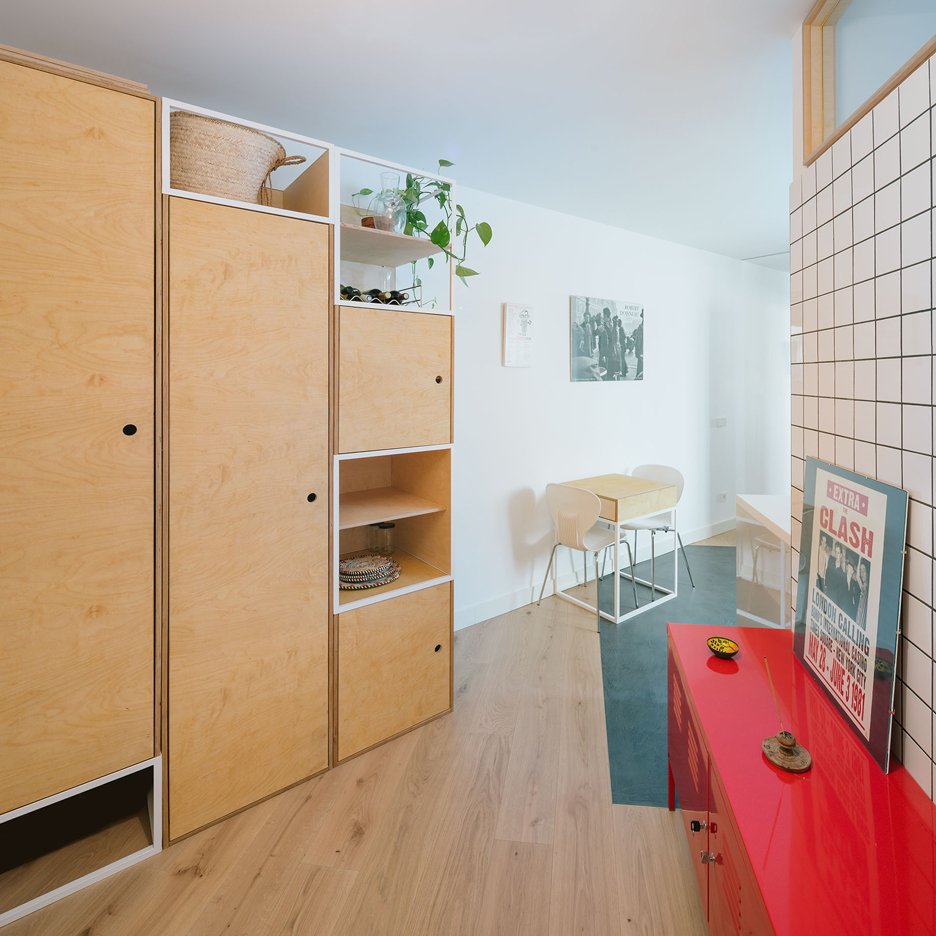
Spanish studio PYO Arquitectos has removed some of the internal walls in a Madrid flat to make it less segregated and bring in more light (+ slideshow). (more…)
This development is in the 19th arrondissement on the northern edge of Paris, within an urban environment characterised by the brick buildings of low-cost housing units developed between the wars.
The triangular site, which measures around 10,000m2, is orientated north–south on its long axis. It is bordered: – On the east by the Parisian périphérique ringroad, – On the south by Rue des Marchais, – On the west by Boulevard d’Indochine, along which runs line T3 of the Paris tramway, – On the north by the city gate Porte Chaumont.
The site slopes steeply from its southern point at the Porte Brunet down to its northern point at the Porte Chaumont.
Plan
Alongside the périphérique, a 6m-high acoustic barrier wall runs for some 280m, protecting the site from traffic noise. Further pressure is put on the site by maintenance access for this barrier.
Our apartment hotel project is on the northern tip of the plot, built as one continued line with Jacques Moussafir’s student residence. The hotel forms a sort of “prow” to the overall development, pointing straight towards Jean Nouvel’s Philharmonie de Paris.
The building is in dialogue with two different environments: – To the west, Boulevard d’Indochine, mostly comprised of the brick facades of the blocks of between-the-wars housing and the landscaping of the T3 tramway, – To the east, the périphérique, a much less human environment, with streams of traffic and all their associated pollutants.
The building, which fills every inch of the site right up to its edges, moulds itself around urban constraints, requirements in the programme, and land restrictions, notably the buttresses of the acoustic barrier on the périphérique side and the related access routes.
A TAPERED FORM DETERMINED BY THE CHALLENGING SITE
The various spatial and technical restrictions literally sculpted the forms of this project: the site is really very narrow, “squeezed” on its southern side by the student residence, and eaten into on the east by the access requirements for the maintenance of the acoustic barrier. The building had to find sufficient space for itself within these constraints to provide the required number of rooms for this apartment hotel.
The resulting volume is tapered: different inclining planes allow for fire access along the eastern facade, while lost space is clawed back on the Boulevard d’Indochine side. Further along, where the hotel meets the student residence, the same crisp angles carry through to this second building; the two projects, hotel and student residences, are powerfully related to one another.
These different angled faces, of a volume that was virtually rectangular to begin with, provide very different perceptions of the building: according to the viewpoint, surfaces appear brighter or darker, more or less cambered, conferring a powerful dynamism to the entire building.
Plan
The facade on the Porte de Chaumont side appears very high because of its narrow width, creating a pedestrian landmark for the Boulevard d’Indochine, and a beacon on the périphérique.
The main pedestrian entrance into the building is at the north-west corner. The proximity of the Porte Chaumont, a tram stop and a vélib city bike stand on the pavement outside, all facilitate access to the hotel.
Section
The hotel has a car park, located beneath the adjoining office building. Access is via the southern corner of the site.
In terms of logistics, a service access between the périphérique and hotel allows for deliveries and waste collection. Coaches can also use this route, which has a secondary, parallel entrance for dropping off guests.
DS House is a private home located in São Paulo, Brazil. Completed in 2015, it was designed by Studio Arthur Casas. DS House by Studio Arthur Casas: “This project is a large renovation of a house designed in the eighties by Italian-Brazilian architect Ugo di Pace. The client, whose grown-up children left the family home, aimed for functionality and further integration between spaces now inhabited only by a couple. The..
The skyline – the meeting of earth and heaven – is the Archimedean point in every swath of architecture that orients the building in its surrounding. Whether it be built in a dense urban fabric, on a high mountain or a narrow, deep canyon – each building is measured by its sky. Classical architecture that developed within the bosom of the church, aspired toward the sublime, the dimensions were propelled upwards by way of vertical windows and tall columns. In contrast, however, modern architecture, particularly residential constructions, see the skyline as a backdrop of human creativity, a horizontal emphasis on the buildings’ dimensions or even as a mere tool serving human needs.
In both the ancient and modern cases, the skyline is the simplest element required to place the building in a concrete context, even an imagined one. Second to that is the presence of another building and then trees and so on down the list of elements in the environment. Perhaps because of this, the architecture of private homes is the last bastion of the architecture of objects – not required to kowtow to its surroundings – it engages both architecture and sculpture.
Such is the S house located in — . At first glance it is a hovering horizontal prism, emphasized by a double skyline – above and below. A second glance seeks out the meeting of the prism with the ground, attempting to decipher the system of physical balance that allows the composition to float while being anchored, as it were, to a horizontal concrete wall resting on a steel beam hovering above an English garden. The result is a choreographed construction held eternally in a gravity-defying pose.
The levitation of the prism, formed by clean lines, dictates the entirety of the grounds and entrance by way of transparent partitions of different types – dropping down toward and marking the ground. As such, the public spaces of the home – the dining room, kitchen, living room, garden and decorative pool – have their inner and outer boundaries entirely blurred. Similarly, the entrance from the street prepares the visitor for the “space vessel” with the aid of shutter-like walls of wood – forming an outdoor lobby – barely visible from the street and open to the interior of the house. A lobby which is built in proportion to the salon, inchoate as it were, formed by an additional mass of concrete that further amplifies the hovering prism.
The design of the lower floor is separate from the prism above, yet nonetheless balances it through cross sections with a certain constructive functionality. It is indeed a counterweight, a balance sheet or even technical anchor in every sense. It gives shelter to intimacy and privacy, housing the bedrooms and managing the inverted relationship to the environment, thereby establishing that this house is not only a virtuous object but a space around which life is calculated.




 Sig Nordal