We all need a bit of self prescribed motivation every now and then. Our house may be plastered in welcoming phrases and inspiring pictures, but unless we are telling it to ourselves convincingly, we may never get the picture. Inspirational slogans and imagery can only do so much for us, because unless we are driving it through ourselves without outside influence it will just become white noise and will have no impact on us. The sources you get inspiration from must be absorbed, tracked and followed upon; we need to do our homework and keep practicing, like a yoga or math student. Here are a couple of things you should be saying to yourself everyday – simple, practical, and effectual. It only takes a few seconds.
1. Today is going to be great!
Whenever your day starts, whether it’s when you get out of bed, get your first coffee, or get to work, you should remind yourself that today is going to be a great day; and trust me, there will be a lot thrown at you to refute it. It could be a cloudy day, there could be bad traffic, you’ve spilled some food, you forgot something at home… any factor could be occurring to pull you down. But as soon as your day is in motion, you should be ready to conquer it. Remember the bright side of everything. If your day started on a bad foot, it can only get better! It’s all about perspective. If you tell yourself you are going to have a good day, you are charging your mind with powerful positive energy and as long as you believe it, you can do it.
2. I am the strongest today that I have ever been.
To some, each passing day means getting a day older, and no one likes getting older. But, I like getting older. Why? Because everyday we reach our new oldest point in life, we have new experiences to learn from. Everyday teach es us something. As humans, we are constantly making mistakes and learning from them, improving ourselves and the quality of life we have. On every new day that we live and is coming to us, we are at a point where we have learned the most and can adapt our feelings, decisions and moral judgements to shape us into the best we can be. Be able to turn your bad decisions into a learning experience and create the best you. Invite age and change, and the more positively you accept it the stronger you will keep becoming.
3. I look great!
You don’t have to be the most beautiful, the strongest looking , the sexiest, the tallest – whatever you think the idea of beauty is. What really matters is how you carry what you have. The way you do your makeup, the way you fit into your clothes, your posture and attitude. If you can have power over the way you appear, anyone can be as beautiful and powerful as you want.
4. I am going to learn something new today.
Maybe you’ve been at the same 9 to 5 job for a long time and things have gotten stale. That doesn’t mean there’s not room for growth and discovery. Challenge yourself to learn something new everyday, in places where you’d least expect. Learn something new about the restaurants in the food court, or about someone you know – or don’t know! See it as a riddle, and if you spend all day trying to learn something new and conquer this riddle, the day will fly by and you will have a bit of fun with it.
5. I am going to overcome something today.
Now that you’ve learned something new, challenge yourself again to put yourself into a moral or mental situation for you to overcome. Rethink how you work at your job and find new ways to overcome simple tasks. Discover new solutions and gameplans for otherwise regular jobs. You could unlock new habits within yourself that improve your productivity.
6. I am going to thank someone today.
This goes without saying, because we thank everyone on a daily basis – people who serve us food, give us change, etc. But I want you to really thank someone, to go out of your way to make someone else feel appreciated and special. Thank people for things they are otherwise unthanked for, or point out habits they do that make everyone else at work feel less burdened. They will appreciate your keen eye for ethic, and everyone will feel better and have a better day for it.
Give thanks for a little, and you will find a lot.
Once dubbed a “flying saucer,” the Parish (Church) of the Holy Sacrifice is a Modernist expression which embodies the complex colonial history of the Philippines. Located on a university campus in Quezon City (formerly the capital of the nation, now a part of the Metro Manila National Capital Region), the domed concrete church was the product of Filipino architect Leandro Locsin, and of three other national artists who contributed to the building’s interior.[1] Locsin’s design, which combines elements of traditional Filipino architecture with postwar International aesthetics, is a potent symbol of a newly-independent nation following centuries of imperial control.
The Republic of the Philippines was one of the many governments to rise from the ashes of the Second World War. The new country’s independence on July 4, 1946, saw the Filipino people liberated from imperial control for the first time since Spain took control of the archipelago in the late 16th Century. The colony passed from Spain to the United States in 1898 as a result of the Paris Treaty that ended the Spanish-American war. Plans to transition the colony to independence were delayed by the outbreak of the war and subsequent Japanese invasion in 1941. At the war’s end, the Philippines was finally given its long-awaited freedom, but at enormous cost: its capital, Manila, had been almost totally destroyed during Japan’s retreat from the islands.[2]
Courtesy of Wikimedia user Ramon FVelasquez
One of the most prominent architectural losses caused by the conflict were the country’s many Catholic churches. Catholicism had reigned supreme on the islands since the arrival of conquistador Miguel Lopez de Legazpi in 1565; the missionaries attending him, along with their brethren to follow, erected hundreds of Baroque, Neo-Gothic, and Rococo churches throughout the Spanish imperial era. These structures, which typically dominated the central squares of colonial communities and served as fortifications for the Japanese, became primary targets toward the end of the occupation. When the time came to rebuild, the process was carried out by a new wave of architects trained or influenced by the United States – among them, Leandro Locsin.[3]
Locsin studied at the University of Santo Tomas in Manila between 1947 and 1953. The prevailing trend in Filipino architectural practice at the time was to emulate the Modernist architecture of the West, an attitude which stemmed from the impression that such buildings represented order, progress and sophistication. More traditional architecture, especially indigenous design, was popularly seen as unsophisticated. Although Locsin worked in the Modernist style, he was noted as being one of the only contemporary designers to capture a “distinct Philippine look” in his designs.[4]
Courtesy of Wikimedia user Ramon FVelasquez
Shortly after Locsin’s graduation from the UST, he was commissioned by Frederic Ossorio to design a school chapel for the Victorias Milling Corporation. Once the design was underway, however, Ossorio was called away to the United States, and the project ultimately fell through. In 1954, Locsin met Father John Delaney, who was seeking an architect to design a chapel for the University of the Philippines campus at Diliman. With permission from Ossorio, Locsin adapted his previous design for the university.[5]
Delaney’s primary directive for the project was that the chapel should reflect the spirit of the youths who would worship there. Noting that the students tended to sing the Mass in unison, Locsin drafted a circular plan that dissolved the traditional boundary between the congregation and choir.[6] This egalitarian sensibility was further enforced by the placement of the altar at the center of the chapel; a symbolic gesture that, while in line with Delaney’s wishes, was found ill-suited to traditionally linear Catholic rites. There was no single, defined entry point, with several entrances distributed evenly around the perimeter of the chapel. The space was sheltered by a concrete dome, supported by reinforced columns and a ring beam; the apparent lightness of this structure earned the Parish its nickname, “the flying saucer.”[7]
Courtesy of Wikimedia user Ramon FVelasquez
The decentralized, open nature of the Parish of the Holy Sacrifice forced Locsin to use vertical dimensions and light to define independent spaces. The low ceiling forming the rim of the chapel promotes movement from the exterior to the interior of the space, humbling visitors as they enter into a place of worship. The transition from the glaring tropical daylight of the Philippines to a shaded concrete passage further emphasizes the sense of movement toward a different, sacred, environment. Once one passes through the peripheral ring, the ceiling rises toward the apex of the dome, which is brightly lit by clerestory windows at the dome’s base – a gesture that simultaneously unifies the worship space and differentiates it from the surrounding passage, all without the use of boundary walls.[8]
Locsin’s chapel initially appears to eschew Filipino tradition entirely, favoring the contemporary design sensibilities of the Western nations that had, until just nine years earlier, been a controlling architectural vocabulary in the Philippines for centuries. The concrete shell dome was, at the time, a new development in Asia – a form without precedent in regional architectural tradition. However, while colonial churches in the Philippines were noted for massive, bottom-heavy walls to withstand frequent earthquakes, the Parish of the Holy Sacrifice’s shell is characterized by visible lightness; at its summit, the dome is only ten centimeters thick. This suspended lightness hints not at Spanish or American influences, but at a traditional Filipino forebear: the bahay kubo (“cube house”).[9]
Example of a typical "bahay kubo". ImageCourtesy of Flickr user Neil Bryan Sietereales
The bahay kubo, the traditional indigenous home built in the Philippines, comprises a single-room house built of bamboo with a steep thatched roof, set atop stilts. The elevation and permeable walls keep the bahay kubo ventilated, cool, and dry – highly desirable qualities in the tropics.[10] The elevation of the house gives it the appearance of suspension in midair, a quality Locsin mimicked for the Parish of the Holy Sacrifice’s dome.[11]
Courtesy of Wikimedia user Ramon FVelasquez
The Parish of the Holy Sacrifice was formally inaugurated on December 20, 1955, with a midnight candlelight procession. Almost immediately, the chapel became a popular center for the faithful in Metro Manila, a status it retains to this day.[12] It is also an enduring symbol of what Locsin himself referred to as a “hybrid culture;” while many Filipino architects continue to emulate the aesthetics of contemporary American architecture, Locsin’s “flying saucer” remains one of the few prominent examples of distinctly Filipino Modernist design.[13,14]
References
[1] “The University” (PDF). University of the PhilippinesDiliman. Retrieved 3 May 2014. [access] p8. [2]Encyclopædia Britannica Online, s. v. “Philippines”, accessed June 22, 2016, [access] [3] Rodell, Paul A. Culture and Customs of the Philippines. Westport, CT: Greenwood Press, 2002. p82-85. [4] Paredes-Santillan, Caryn. “A Study on Bipolarity in the Architecture of Leandro V. Locsin.” Journal of Asian Architecture and Building Engineering JJABE 8, no. 1 (2009): 1-8. p3-4. [5] “The University.” p8. [6] De Ayala, Fernando Zóbel. “The Chapel of the Holy Sacrifice at the University of the Philippines.” Philippine Studies 5, no. 1 (1957): 1-8. [access]. p2-7. [7] Paredes-Santillan, Caryn. “Approaching The Sacred: A Study Of The Spatial Manifestations Of Liminality In The Churches Of Leandro V. Locsin.” Accessed June 22, 2016. [access]. p4-7. [8] Paredes-Santillan, “Approaching the Sacred.” p8-9. [9] Ogura, Nobuyuki, David Leonides T. Yap, and Kenichi Tanoue. “Modern Architecture in the Philippines and the Quest for Filipino Style.” Journal of Asian Architecture and Building Engineering JJABE 1, no. 2 (November 2002): 233-38. p237. [10] Hila, Ma Corazon A. Arkitektura: An Essay on Philippine Ethnic Architecture. Manila: Sentrong Pangkultura Ng Pilipinas, 1992. p11. [11] Ogura et al, p237. [12] De Ayala, p8. [13] Paredes-Santillan, “A Study on Bipolarity in the Architecture of Leandro V. Locsin.” p8. [14] Ogura et al, p238.
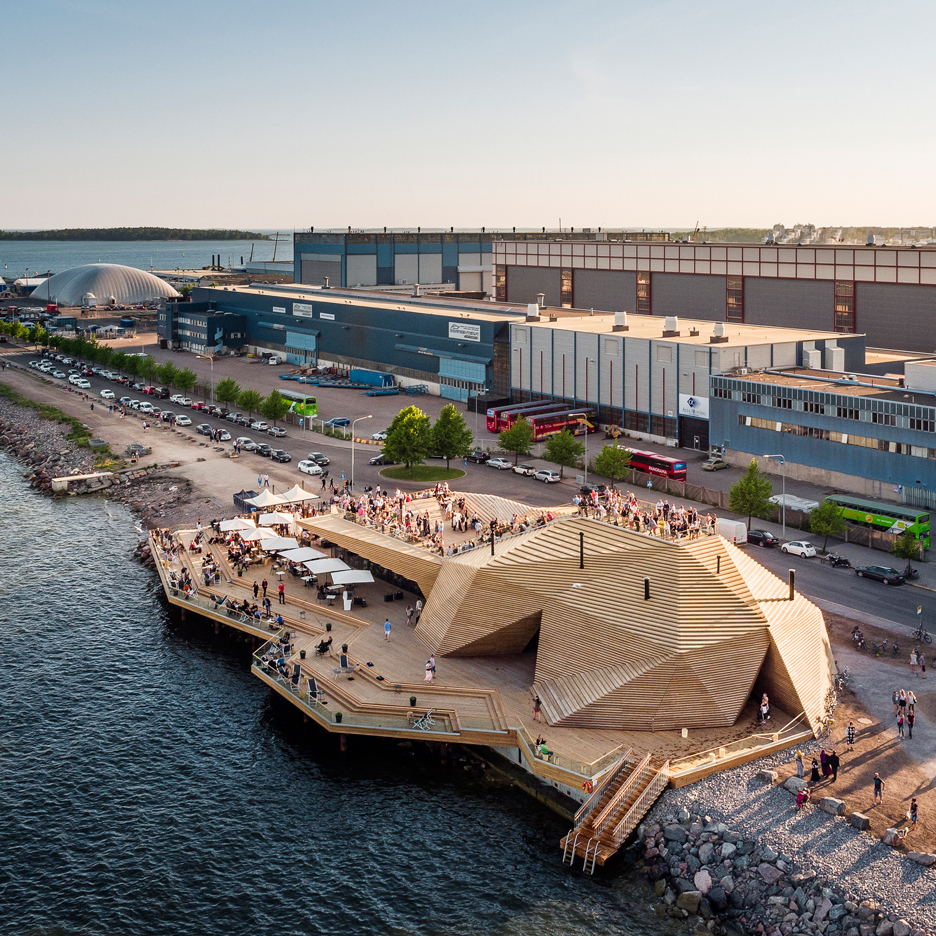
Wooden slats and bleachers provide the multi-faceted volume of this waterfront sauna by Avanto Architects, allowing visitors to climb the roof for a better view of the sea or to lounge in the sun (+ slideshow). (more…)
The house is located on the edge of a rock above a lake. The project preserves grown trees, emphasizes the view to the water, and allows access to the meadow in the middle of a forest.
Sketch
A simple cubic mass 15x15x4 m contains interior spaces formed in a more complex manner.
Organically moulded labyrinth of the interior habitable space allows more day- and sunlight, vistas out and through from the depth of the layout.
Ground Floor Plan
The house hovers over the landscape, it is not founded traditionally. A steel load-distributing modular raft is bedded on existing granite blocks – remnants of former mining. A 2×4 timber frame is erected on the raft. The roof structure is nailed trusswork. The roof is flat finished with extensive green. The façade is ventilated made of lumber. Windows are aluminium.
Twin Peaks is a private residence renovated by Luigi Rosselli Architects. It is located in Sydney, Australia and was completed in 2015. Twin Peaks by Luigi Rosselli Architects: “A Queen Anne style residence reveals its hidden character and history in the late night lights. Two crisp zinc roof gables, observing the shadows on the narrow footpath, guard the new entry door. The early 1900s bricks, shingles and Elizabethan windows have..
Sauna culture Sauna bathing is an essential part of Finnish culture and national identity. There are only 5,4 million Finns but 3,3 million saunas. Public saunas used to be common in bigger cities but now that most new apartments have sauna of their own, public saunas have decreased dramatically in number. There are only a couple remaining. As a sense of community is becoming a more and more important part of new urban culture, many new public saunas are being planned. With Löyly (meaning the steam that comes when you throw water on hot stones in a sauna) Helsinki will offer foreign visitors a public sauna experience all year round – a must when visiting Finland.
Process The project started from the city of Helsinki initiative. Hernesaari is a former industrial area on the Helsinki seashore that is being developed into a residential area. New uses are being developed for the area, while waiting for future changes to come. There is a cruise ship harbor in Hernesaari and the city wanted to activate the area with new functions and to serve visitors with new attractions. We started the project in 2011 designing a temporary sauna village at the furthermost end of the peninsula. The concept didn’t prove financially sustainable so the first client quit the project. We developed a floating sauna with the second client but the concept proved impossible as the site faces the open sea and a floating structure couldn’t withstand high waves and pressure from ice packs. The coastline will change with future development, but the city chose an area where the shoreline will remain as it is currently. We developed a new free form concept with triangular faces. The client changed once again and as actor Jasper Pääkkönen and Member of Parliament Antero Vartia finally got funding, the construction works could begin.
Context The site is unique. Being less than two kilometers away from the city centre, it is very central but at the same time the landscape is like in the outer archipelago. The plot is situated in a future coastal park that will be part of a broader “Helsinki park” connecting the capital city to the sea. The building was designed to be slim and elongated so as not to cut the narrow park strip. The volume is kept as low as possible so that it doesn’t block views from the future residential blocks. Instead of building a conventional building, the sauna is developed into an easy-going, faceted construction that is more part of the park than a conventional building. When the wooden building turns gray, it will become more like a rock on the shoreline.
Architecture The architectural idea is simple: there is a rectangular black box containing the warm spaces that is covered with a free form wooden “cloak”. Instead of being mere decoration, the sculptural structure made of heat treated pine has several functions. It provides people with visual privacy. However, the lamellas don’t limit the sea view from inside it, rather they function like venetian blinds and blocking the views from outside. There are sheltered outside spaces between the warm mass and cloak to cool down in between sauna bathing. The cloak forms intimate terraces between its slopes that serve as a place to sit. The structure protects the building from the harsh coastal climate. It shades the interior spaces with big glass surfaces and helps to reduce the use of energy to cool the building. Moreover, the stepped cloak forms stairs to climb on to the roof and look out terraces on top of the building. The construction forms a big outdoor auditorium for the future marine sports centre’s activities on the sea. There are around 4000 planks that were precisely cut to individual forms by a computer-controlled machine. The big wooden terrace is partly on top of the sea and you can hear the sound of the waves under your feet.
Spatiality The building consists of two parts: public saunas and a restaurant. The saunas and public spaces open up to the sea, with interesting views to city center and even to the open sea. The atmosphere is calm and the spaces dimly lit. Different areas are conceived as spaces within a space. Interesting views open between closed spaces as you move from one area to the next. You enter in the restaurant that is a light and open space. From there a dimly lit sauna path leads to bathing area. Shoes are left in a wardrobe before you go to a reception desk where you get a locker key and a towel. Dressing rooms and showers are separate for men and women. A leather curtain covering the door indicates entry into the unisex area, at which point visitors need to wear a bathing suit. Traditionally men and women bath separately and naked. We wanted to develop sauna culture so that there would be a possibility bath together with your friends not depending on the gender. This makes sauna experience available also for foreign visitors that might not be used to bathing naked.
Interior The interior architecture of the restaurant and the sauna lounge is by Joanna Laajisto Creative Studio. The objective of the design was to create an atmospheric restaurant which compliments the strong architecture of the building. The approach could be called soft minimalism. The challenge was to create intimate seating areas in the large hall like space with two walls of windows. People often feel most comfortable sitting their backs against the wall. The solution was to build a raised platform for the bar area which divides the space into two different areas. A wooden half wall anchors the long custom designed sofas which have a great view of the sea.
The main materials used in the interiors are black concrete, light Scandinavian birch wood, blackened steel and wool. All materials are durable and long lasting. The wood used is pressed, glued and slightly heat treated birch, a new sustainable Finnish innovation made of left over materials of the plywood industry that normally is burned to produce energy. This is how waste is turned into a beautiful recycled material. It´s manufacturing process produces a beautiful cool light color tone and heavy durability.
In addition to the long sofas, Laajisto´s office has used the glued laminated birch on walls, tabletops, the long bar and even in the unisex toilet sink. The upholstered chairs, which add softness to the space, are by Italian manufacturer Torre. All fabrics are soft natural wool by Kvadrat. The bar stools are by Gubi and the wooden chairs in the sauna lounge are by Finnish Nikari. The String lights designed by Micheal Anastassiades for Floss create a subtle rhythm to the space without blocking the views of the Baltic Sea.
Saunas There are three different saunas that are all heated with wood: a continuously heated sauna, a once heated sauna (that is heated in the morning before the sauna is open and stays warm all evening) and a traditional smoke sauna – a true rarity in an urban sauna. This is how you can experience all sorts of Finnish Löyly during a single visit. Between the saunas there is spa area with cold water basin and a fire place room to relax in, between or after sauna bathing. You can swim in the sea and in the winter there is an “avanto”, the whole in the ice for winter swimming – a popular hobby in Finland and our office name as well.
Sustainability The building is heated with district heating and electricity is produced with water and wind power. The building is first FSC-certified building in Finland and second in Scandinavia. Forest Stewardship Council’s certificate proves that wood material comes from responsibly managed forests. The restaurant serves organic food and sustainably caught fish.




 Sig Nordal