
Victory Apartment is a private residence located in Sofia, Bulgaria. Completed in 2016, it was designed by VOOOD. Photos courtesy of Volen Valentinov
The Pilot’s House / AR Design Studio

© Martin Gardner
- Architects: AR Design Studio
- Location: Winchester, United Kingdom
- Contractor: Blue Fish Construction Ltd
- Area: 545.0 sqm
- Photographs: Martin Gardner
- Existing Gia: 375 sqm
- Extension Gia: 170 sqm
© Martin Gardner
Built in the mid-19th century, The Pilot’s House was one of the original ‘Winchester Villas’; a collection of family homes built for the wealthy and located close to England’s oldest school, Winchester College. Built using fine brick-work and flint masonry, the houses were an exquisite example of a grand family home.
© Martin Gardner
Jumping ahead by nearly two hundred years, a married couple facing Winchester’s soaring house prices and in search of a family home for their four children and dog, stumbled upon the house in a sorry state of disrepair. Seeing the potential to restore it back to its former glory they knew they had to purchase it. Occupied with Department of Health and Social Services tenants, the house had a myriad of damp and oddly shaped rooms that had unceremoniously been arranged to maximise occupancy with little care to the quality of the living space or respect to the old home. The roof was also leaky and close to disrepair.
© Martin Gardner
Plan
© Martin Gardner
AR Design Studio was approached by the clients with a brief to return the home to its original splendour and add a 21st Century twist. As well as finely detailed conservation and restoration, the clients were keen to add a modern open-plan living space and an indoor swimming pool. As experts in both restoration and contemporary design, AR Design Studio were the perfect architects to undertake the work and proposed a scheme that would give the clients the family home that they had always dreamed of whilst making their mark on the house with a modern enhancement.
© Martin Gardner
The Victorian-era rooms were inconsiderate of the way in which we live today, so without wanting to disrupt the original layout too much, AR Design Studio proposed a large open-plan living space that would allow the family to make the most of their time together. Adjacent to this space, the indoor swimming pool is a further addition that has become a firm favourite with friends and family for gatherings to suit all ages. The whole extension is covered by a familiar pitched roof that runs away from the rear of the house and elegantly reaches east towards the ancient boundary wall and the rising sun. Informed by the buildings traditional gables and clad in anthracite zinc to tie in with the building’s slate tiles, the new aspect is a contemporary nod towards the old building’s identity. Absorbed in to the garden, the scheme now has a connection to its naturally sloping site. Making the most of this landscape, AR Design Studio included a theme of full-width steps which flow from the garden through the house and into the private courtyard, reducing a visual mass and helping to zone the new spaces whilst responsibly dealing with the changes in level. A further expression of the stepped landscape are the two additional roofs above the living space which help to reduce the contrasting appearance and blur the boundary between the old and the new. The entire southern façade of the extension is glazed and then shaded by an overhanging canopy supported by a colonnade that expresses the form of the new extension and evokes a feeling of grandeur.
© Martin Gardner
The Pilot’s House is now a home with a transcendence quality. The clients have finally found a place to capture a feeling of calm and enjoy the spacious family life that they had always dreamed of.
© Martin Gardner
A Luxury Residence in Son Vida, Mallorca

Villa Origami Luxury Residence was built to the highest standards with super modern finishing. It is located in Son Vida, Mallorca, Spain and was completed in 2014. This stunning house could be yours for $5.4 million. Buy it now!
AD Classics: The Barbican Estate / Chamberlin, Powell and Bon Architects

© Joas Souza
On the 29th December, 1940, at the height of the Second World War, an air raid by the Luftwaffe razed a 35-acre site in the heart of the City of London to the ground. The site was known as the Barbican (a Middle English word meaning fortification), so-called for the Roman wall which once stood in the area. Following the war, the City of London Corporation—the municipal governing body for the area—started to explore possibilities to bring this historic site into the twentieth century.
The Barbican’s location in the financial center of the British capital made it attractive to commercial developers and, as a result, several office schemes were proposed. These were rejected by the Corporation, partly due to the area’s dwindling population. As the area had become increasingly commercialized, the number of residents had plummeted from 100,000 in 1851 to just over 5,000 in 1951.[1] With such a small electorate, the City of London was at risk of losing its Member of Parliament (MP) and, as a result, its political clout. A housing scheme put forward by Chamberlin, Powell and Bon in 1955 offered an opportunity to reverse the population decline by enticing new residents into this void in the City.
Defoe House. Image © Joas Souza
Since 1948, Peter Chamberlin (b. London) and Geoffry Powell (b. Bangalore, India) had been teaching colleagues at London’s Kingston School of Art, where they were joined in 1950 by Christof Bon (b. St. Gall, Switzerland). Their architectural partnership began two years later, after Powell won a competition to design the Golden Lane Estate – a large scale residential project also commissioned by the City of London Corporation. The design of this earlier scheme, located just north of the proposed Barbican site, paved the way for their more ambitious neighboring project.
http://ift.tt/29A6Riz
http://ift.tt/29AN5AJ
While the selection of Chamberlin, Powell and Bon’s housing scheme would allow the Corporation better chances of maintaining its parliamentary representation, it would bring in far less revenue than a commercial development. In order to maximize rental income and make the scheme financially viable, the architects proposed a high-density development aimed at those earning a mid-to-high income.[2] The complex was designed as an urban microcosm, with residential blocks arranged around communal spaces – an approach inspired by the work of Le Corbusier. Le Corbusier’s Unite d’Habitation housing project in Marseilles had been recently completed; his vision for a ‘vertical garden city’ is evident in both the Golden Lane Estate and the Barbican.
© Joas Souza
In addition to “luxury” housing, Chamberlin, Powell and Bon’s masterplan for the Barbican featured cultural facilities (including a concert hall and theater), a shopping mall, underground parking, private gardens, and lakes with fountains and a waterfall. It was hoped that the vast array of amenities within the estate would attract their target market and justify the higher cost of the housing. The Guildhall School of Music and the City of London School for Girls would also be moved to new premises on the site, forging a sense of community within the complex. St. Giles Church, one of the few buildings to survive the bombings of 1940, would stand in the center of the estate.
Collectively, the residential blocks of the estate form one of the most remarkable examples of Brutalist architecture anywhere in the world. The term ‘Brutalism’ is derived from the French béton brut, meaning raw or unfinished concrete. Although the concrete at the Barbican Estate was left exposed, it was not unfinished, having been pick-hammered to give it a rough, rusticated appearance implying a sense of monumentality.
© Joas Souza
The estate comprises three tower blocks, thirteen terrace blocks, two “mews” (terraces of small two-story houses) and a row of townhouses. The tower blocks dominate the skyline, their facades featuring a grid pattern of concrete paneling. The horizontals of this concrete grid are broken by the continuous lines of the verticals, emphasizing the height of the towers. The terrace blocks, meanwhile, are orientated horizontally, creating a dynamic contrast to the soaring towers. In both the tower and terrace blocks, the layout of the apartments was designed to maximize the amount of natural light in the rooms that would most benefit from it. Bedrooms, dining rooms and living rooms are therefore positioned along external walls, while kitchens and bathrooms are placed against inner walls.
Highwalk and podium at Lauderdale Tower. Image © Joas Souza
The residential blocks are linked by two systems of pedestrian circulation: the highwalk and the podium. The highwalk, a network of bridges and narrow walkways, encompasses the estate. The podium is a raised platform which becomes a new ‘ground level’ once inside the boundary of the estate. This design feature allows the Barbican to be entirely pedestrianized, with road and rail traffic passing underneath, out of both sight and sound.
All three tower blocks and the majority of the terrace blocks stand above the podium on piloti, enabling pedestrians to navigate the estate unimpeded by buildings. Perhaps the most striking of these can be found beneath Gilbert House, a terrace block spanning the lake which bisects the podium. The height of the columns allows even the highwalk to pass beneath the main structure; a bridge is nestled amongst the supporting colonnade. The podium creates a sense of airiness, while the highwalk encourages movement and exploration; together, they produce open space which flows throughout the estate.
Gilbert House piloti. Image © Joas Souza
While developing the design for the Barbican, Chamberlin, Powell and Bon travelled abroad extensively to seek architectural inspiration, spending much of their time in Italy. Bon had spent part of his earlier career working in Milan, and the architecture of Italy held a great fascination for the three architects. This influence is evident in the estate; the penthouses of the terrace blocks, for example, have barrel-vaulted roofs – a feature widely employed in Roman architecture. The architects cited the canals, bridges and pavements of Venice as the model for the pedestrians systems of the Barbican, describing it as “the best example of a city where foot and service traffic is completely segregated. This segregation,” they continued, “has worked admirably for many centuries and there is no good reason why the principle should not be applied equally effectively in the City of London.”[3]
http://ift.tt/29A6Riz
http://ift.tt/29AN7s6
The lake and gardens provide the residents with generous communal outdoor space; a rarity in an otherwise heavily built-up area of London. These landscaped areas lie below the level of the podium, with the changing elevations adding visual interest and lending a sense of seclusion. To ensure the underground line below did not disturb those enjoying the gardens, Ove Arup devised an engineering solution to reduce vibration from passing trains. The track was mounted on rubber bearings; the only section of the entire London Underground network to be modified in this way.
© Joas Souza
Chamberlin, Powell and Bon’s original plans featured five tower blocks of twenty stories. These designs were rejected by the planning authority, primarily on the grounds that the scheme had insufficient outdoor space.[4] In response, the architects reduced the number of tower blocks to three in order to minimize the buildings’ footprints. At the same time, they more than doubled their height to maintain housing density.
Cromwell Tower is forty-three stories high, while Lauderdale Tower and Shakespeare Tower stand at forty-four stories; at the time they were the tallest residential towers in Europe.[5] The architects devised ingenious solutions to the perceived problems of living in buildings of this height. “Each lift,” for example, “is designed with a secondary small panel door which provides direct access between the lift and a tenant’s service cupboard. […] In this way the daily milk, the morning newspaper and post can be delivered directly from the lifts to the individual flats without the milkman or the postman having to get out of the lift.”[6] Similar attention to detail was paid to the fixtures and fittings: the architects installed windows which pivoted horizontally to make them easy to clean from the inside, and a Garchey sink unit was employed across almost all residential blocks to facilitate waste disposal.[7]
© Joas Souza
Standing at such a height and with complex programmatic requirements, the project demanded specialised engineering, delivered by Ove Arup & Partners. The towers utilise pre-cast reinforced concrete elements for the frame, which places the majority of the load around the exterior of the building “on the same principle as is familiar in a chimney.”[8] Roughly triangular in plan, each floor of the towers contains three apartments arranged around a central core of lift shafts, stairwells and service risers. The living rooms are located at each corner of the triangle, where the meeting of two walls affords panoramic views.
Plan: Lauderdale Tower
The highly distinctive cantilevered balconies of the towers, with their elegantly curved tips, resemble the hull of a ship. They also have a practical application: their unique form reduces wind resistance and eases the strain on the structural frame. The long protrusions of the balconies, a design feature recommended by the engineers, create deep eaves over the apartments below.[9] The eaves offer both protection from the elements and a sense of security to residents, some of whom, the architects reasoned, “might otherwise dislike the impression of living on the edge of a cliff.”[10]
http://ift.tt/29A6Riz
http://ift.tt/29AMZsF
Surviving fragments of the ancient Roman wall, and a later 13th-century bastion, can be found about the estate. History and modernity collide as the weathered bricks of these ruins are juxtaposed against the grey concrete of the monolithic structures above. Further references to the history of the site were made by naming each of the residential blocks after a prominent local figure. Shakespeare Tower, for instance, is so called because the great playwright once lived in the area.
Construction of the Barbican Estate took thirteen years, concluding in 1976 with the completion of Shakespeare Tower. Critics have accused the layout of the estate as being disorientating and cluttered, though the blame for this cannot be entirely attributed to the design. In 1964 the City of London Corporation presented Chamberlin, Powell and Bon with a revised brief which demanded an expanded theater and concert hall. The outcome of this was the Barbican Center, a building which had to be shoehorned into the master plan after construction had already begun.
Podium at Defoe House. Image © Joas Souza
As Brutalism became the prevailing architectural style for new housing estates in Britain throughout the 1970s, the reputation of the Barbican suffered from association with less successful projects (such as the Hulme Crescents in Manchester). More recently, however, the estate has benefited from a resurgence of public interest in Modernist and Brutalist architecture. It received Grade II listed status from the British government in 2001, and apartments in the estate are now highly sought after.
Residents speak of the excellent quality of life they enjoy there; architecture critic Jonathan Glancey spent four years living in the estate, and proclaims that “there is nothing like [it] in scale, intelligence, ingenuity, quality, urban landscaping and sheer abstract artistry anywhere else in Britain, perhaps even the world.”[11] Alongside buildings such as the Royal National Theatre in London and Park Hill Estate in Sheffield, the Barbican Estate has become a symbol of British post-war architecture.
References
[1] Harwood, Elain. Space, Hope and Brutalism: English Architecture, 1945-1975. London: Yale University Press, 2015. p.73
[2] Harwood, Elain. Chamberlin, Powell and Bon: The Barbican and Beyond. London: RIBA Publishing, 2011. p.103
[3] Chamberlin, Powell and Bon Architects. “Proposals” In Barbican Redevelopment 1959. London: City of London Corporation, 1959. p.5
[4] Ibid. Harwood. Chamberlin, Powell and Bon. p.108
[5] Orazi, Stefi. Modernist Estates: the buildings and the people who live in them today. London: Frances Lincoln, 2015. p.109
[6] Ibid. Chamberlin, Powell and Bon Architects. p.15
[7] Ibid. Harwood. Chamberlin, Powell and Bon. p.118
[8] Ibid. Chamberlin, Powell and Bon Architects. “Technical Section”. p.6
[9] Ibid. Harwood. Space, Hope and Brutalism. p.74
[10] Ibid. Chamberlin, Powell and Bon Architects. “Proposals”. p.15
[11] Glancey, Jonathan. “Barbican: the critics’ verdict”. Time Out, 6 February, 2007. Accessed 10 June, 2016 [access]
- Architects: Chamberlin, Powell and Bon Architects
- Location: Barbican Estate, London EC2Y, United Kingdom
- Architects In Charge: Peter Chamberlin, Geoffry Powell, Christof Bon
- Structural Engineers: Ove Arup & Partners
- Area: 160000.0 sqm
- Project Year: 1976
- Photographs: Joas Souza
💙 Emerald Hills on 500px by Thomas Dawson, Victoria,……

10 Signs You Are In The Right Relationship
The dating scene is a tough one. These days with the online dating scene taking over the more traditional methods, you just never know who or what you’re getting anymore. We tread carefully, always keeping one foot in the other direction, ready to bolt at a moment’s notice. Caution is necessary more now than ever before. It’s hard to know really if you are getting into the right relationship.
As we move forward into the first year of dating, we lesson our grip on the door handle and start relaxing a little more in the company of our new partner. The questions and doubts are almost non existent. The odd red flag still pops up but for the most part, we’re doing ok. As we go into year two we’re pretty confident that this person just might be the one. If you recognize any of the signs below, you might be in the right relationship for you.
 You don’t have to watch your words.
You know that no matter what you say, your partner will either laugh it off, shrug it off, or call you out on it. There doesn’t have to be a filter, mind you that’s independent of being rude or mean which you should never do anyway, and you know your partner will not judge you.
No judging ever.
Your partner accepts you and all of you. Your flaws, imperfections, even your crazy family (and they won’t judge you based on your family either). They love you just the way you are and think you are the best. Ever. Your partner doesn’t judge anyone, period.
No changing.
Unlike some partners in the past who wanted you to change your clothes, your hair, your perfume/cologne or even your job, this new partner isn’t interested in changing any part of you except maybe your marital status to married. They take you just the way you are.
Patience is beautiful.
One of you has lots, the other one doesn’t. What a perfect balance. If you are the one with no patience, your new partner has a wonderful way of calming you down. If they have no patience, they gladly accept and appreciate yours. Such a great combination, really.
Freedom.
Lots of it. They give it, well, freely. You can go out with your friends, have a great time and never have to answer a million trust related questions. They are happy you have your own social circle still and encourage you to go out and have fun with them. Feel like a solo road trip? They’ll encourage that too and maybe even pack you a little snack bag for the road.
We are equals.
You both cook, do dishes, take out the garbage, look after the dog/cat, whatever the chore is. They are more than happy to chip in and do their part. There is no such thing as, that’s your job. There is no squabbling over whose turn it is. Stuff just gets done by both of you, equally, no questions or quips about it.
Let me hold you.
There is compassion and lots of it, especially when you need it. even if you’re just having a plain old shitty day, they get it, and will offer up a shoulder to cry on or an ear to talk to. If you want to scream and shout about work, they’ll listen to that too, and then patiently calm you down.
Let’s get crazy.
The wild side sometimes needs to be released and you can certainly do it with this person. They are in the car waiting for you to get ready! You two have a no holds bar attitude towards adventure. And it’s good, so good.
Like minded people stick together.
It’s always nice to know that what you value, they value and the causes you believe in, they believe in them too. Volunteering your thing? they are right there with you lending a hand.
I’m your biggest fan.
If you have a plan or an idea or some crazy thought about doing something out of this world, they stand by you 100% and cheer you on. They are more than happy to offer a hand, advice if you need it but most importantly, encouragement and support. They want you to succeed just as bad as you want it.
Clearly, there are many more signs that you are in a great relationship but these are pretty solid ones. What can you add to this list?
The post 10 Signs You Are In The Right Relationship appeared first on Change your thoughts.
Abandoned House Window by Freaktography Another example of the…

Unite boss says excluding Corbyn from Labour leadership ballot would be ‘sordid fix’ – Politics live
Rolling coverage of all the day’s political developments as they happen, including David Cameron chairing his last cabinet meeting and Labour’s NEC meeting to decide whether Jeremy Corbyn will be in the Labour leadership contest
8.48am BST
Good morning. I’m Andrew Sparrow, and I’m blogging for the day.
Len McCluskey, the Unite general secretary, has been on the Today programme. He said that if Labour’s national executive committee tries to exclude Jeremy Corbyn from the Labour leadership contest when it meets this afternoon, that would be a “sordid fix”.
Len McCluskey says it would be ‘a sordid fix’ if Jeremy Corbyn is not automatically on the ballot. #r4today
8.47am BST
Good morning and welcome to our daily politics live blog
Merkel urges Britain to quickly clarify relationship with EU https://t.co/w180w0o53E http://pic.twitter.com/UKbP2r7KDf
Who’s the new top cat in Downing Street tonight – Larry in stand off – join us @ITV news at ten http://pic.twitter.com/OPkARFNWAj
Politics blog | The Guardian http://ift.tt/29KucOo
School of Arts Calaisis / ARC.AME

Courtesy of ARC.AME
- Architects: ARC.AME
- Location: Calais, France
- General Enterprise: Rabot Dutilleul Construction
- Area: 4584.0 sqm
- Project Year: 2015
- Photographs: Courtesy of ARC.AME
- Engineers: INGEROP Engigneers
- Landscape: BABYLONE
Courtesy of ARC.AME
From the architect. A building included inside the town
The facade on the boulevard represents a major turning point although it remains integrated in the existing templates. The facility exposes itself as a symbol of renewal, at the same time respecting the balance of the urban context that surrounds it.
Courtesy of ARC.AME
A building opened over the town.
The copper woven mesh opens like a curtain over the city. It unfolds like a filter in front of a fully glazed façade. It shows off the facility while protecting it. The underlying play of transparency and light varies depending on the time of day and school schedules. The life of the building reflects and is integrated in the lively downtown.
Courtesy of ARC.AME
Plan
Courtesy of ARC.AME
A full light building
Artistic activities require natural high-quality light. Light without dazzle requires a detailed and specific approach in each direction. The gardens and patios are outstanding pieces of work, which allow soft light to radiate – in depth – within the entire building. All workshops benefit from a full front natural light.
Section
Section
A work of art building
An art school opens the way for specific thought, allowing to directly express its showcase vocation in the service of artistic disciplines.
Courtesy of ARC.AME
We favoured the use of materials strongly expressing this particularity:
-Copper for its intrinsic qualities of natural material: brightness, lightness, but also for its outstanding longevity which makes it the king of all the material used in the greatest public monuments blankets.
-A convergence between sculpture, painting, engraving and architecture, it is one of the materials that best reflects the artistic ambition of the architectural project.
-The concrete mould completes the mineral look of the project. Its textured appearance contrasts with the image of a bas-relief with the smooth patina copper.
-The plant completes the composition of raw materials. Garden Arts, planted patios, grassed roofs and a green wall, make the vegetation pervasive and visible everywhere in the project.
Courtesy of ARC.AME
Diversity programs centrality Town Houses.
The project brings together in a unique framework an art school and 25 flats. These are not two separate buildings, but a project composed of two programs carried out with the same ambition and inventiveness of renewal for the heart of town. The flats are like houses placed on the roof, they offer a unique architectural response adapted to the needs of a new way of living in the city centre.
Courtesy of ARC.AME
BIG creates “bubble-like cloud pavilion” at Roskilde Festival 2016
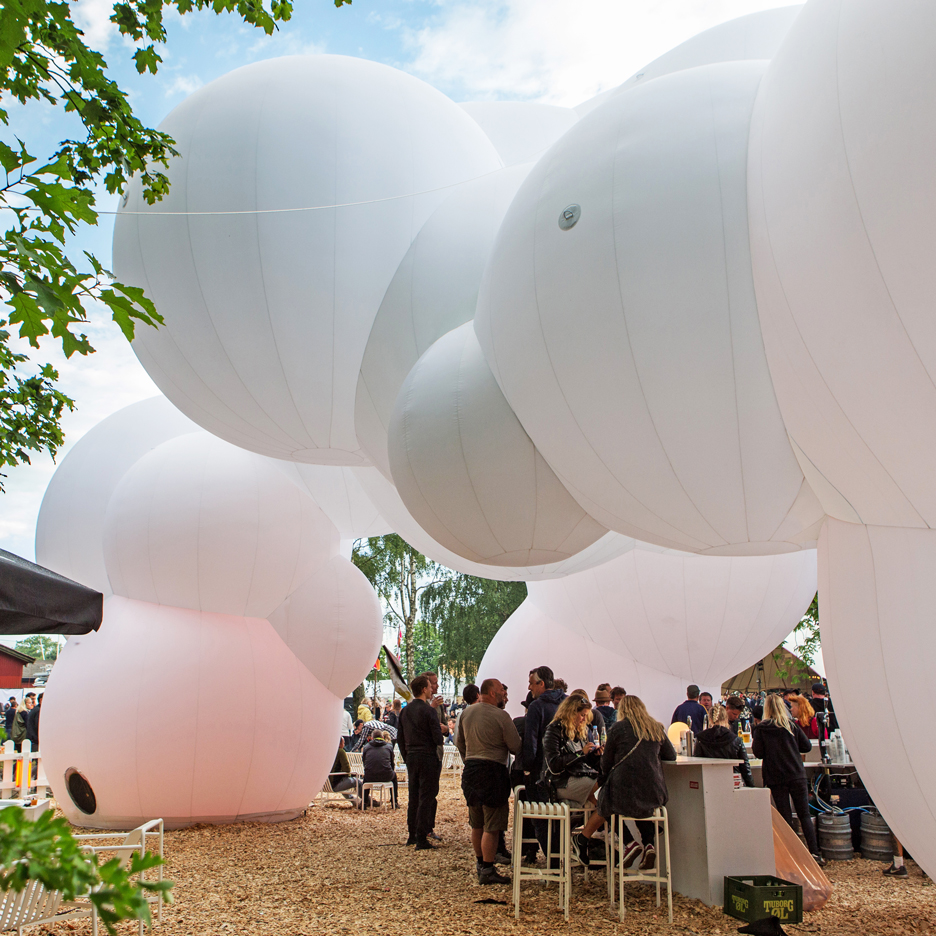
Bjarke Ingels’ firm has revealed images of a huge inflatable pavilion it created for this year’s edition of the annual music festival in Roskilde, Denmark (+ slideshow). (more…)

