The exhibit, entitled Oskar Hansen: Open Form, will detail “the evolution of Hansen’s theory of Open Form from its origin in his own architectural projects to its application in a firm, visual games, and other artistic practices.”
Through his Open Form theory, Hansen sought to counter the Athens Charter and the followers of Le Corbusier by highlighting participation, process, and a change of hierarchy between artist and viewer.
Courtesy of Igor Hansen
As a member of Team 10, Hansen presented his theory at the group’s founding meeting at the International Congresses of Modern Architecture (CIAM) in 1959.
The exhibition is divided into seven sections that develop Hansen’s idea of Open Form—Architect as a Curator, Politics of Scale, Counter-Monument, Architecture as Events, House as Open Form, Art and Didactics, and Tradition of Open Form.
Courtesy of Warsaw Academy of Fine Arts Museum
Oskar Hansen: Open Form will be on display at YSoA through December 17 in the Paul Rudolph Hall. It is free and open to the public Monday to Friday 9:00-5:00, and Saturday 10:00-5:00.
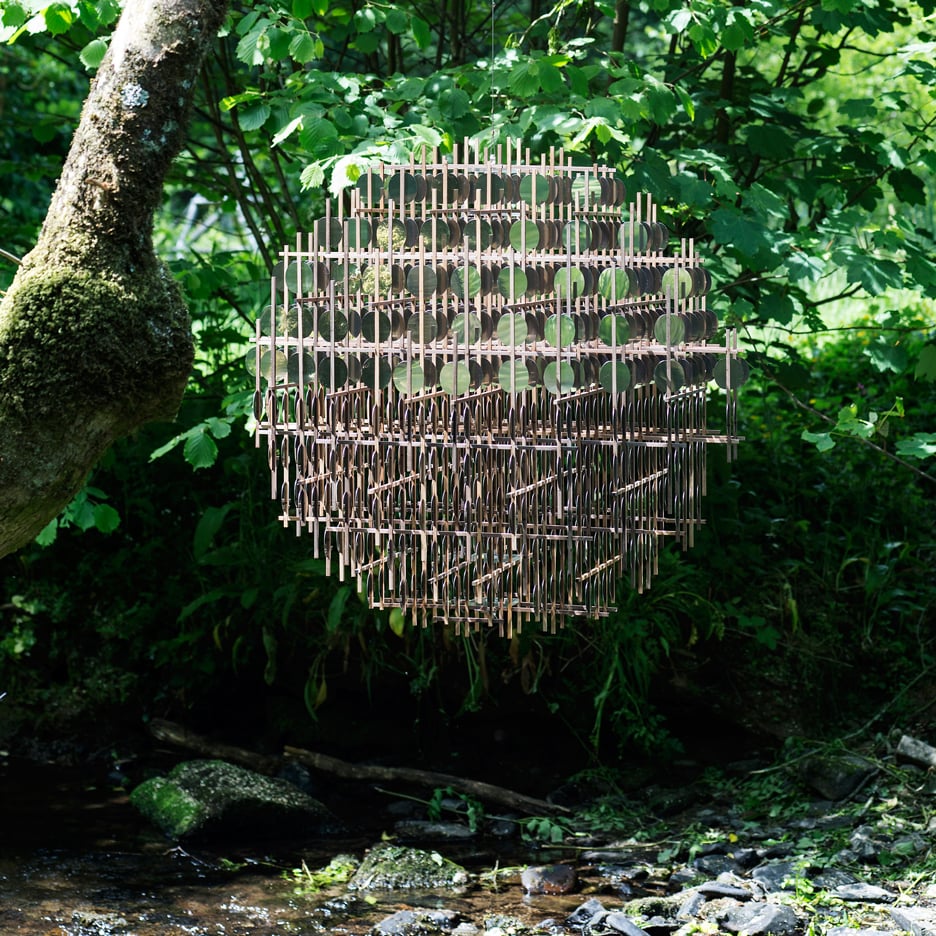
Hundreds of reflective “pennies” form this spherical sculpture, created by Giles Miller‘s London design studio for Devon’s Broomhill Sculpture Park (+ movie). (more…)
From the architect. The first of several buildings intended for a rugged and pristine site in the Santa Lucia Preserve, the Halls Ridge Knoll guesthouse is a thoughtful modernist intervention, carefully detailed in stone, timber and glass. The master plan for this vacation retreat calls for a guesthouse, workshop and main residence. Each will be anchored to the land with a series of massive stone walls and fireplace chimneys, marking the passage along the ridge and culminating in a stone court at the future main residence.
Designed to choreograph movement along the extraordinary ridge-top site, the guesthouse celebrates its magical surroundings. The Santa Lucia Preserve is a remarkably beautiful, vast landscape that was previously a historic cattle ranch. The site has a rolling topography, a forest of ancient live oaks and manzanita, and offers panoramic views of the San Clemente Mountains and Los Padres National Forest beyond.
Exploded Axonometric
The first building constructed on site is the guesthouse. A simple, uncomplicated building, it flanks the winding entry drive and is anchored to the sloping site with a massive stone wall, screening the house and pool. A timber-framed shed roof springs from the wall, supporting naturally weathered zinc roofing over cedar-clad volumes.
The guesthouse is sited to take advantage of the temperate California climate. Expansive windows provide natural lighting throughout the house, while a broad overhang shades the interiors from the summer sun. Sliding doors and operable hopper windows throughout the house use the prevailing winds for natural ventilation, while also providing expansive views of the mountain range. Wood flooring in the living space of the house is reclaimed from an old barn.
First Prize Winner "Ugandan LGBT Youth Asylum" by Enrico Chinellato and Jacopo Donato . Image via Bee Breeders
Bee Breeders, organizers of international architectural competitions, have announced this week the three winners and six honorable mentions of their Uganda LGBT Youth Asylum Center competition. Inspired by recent activism in Uganda, Bee Breeders sought the design of a community center to welcome those in the LGBT community who have been ostracized from their home environments. The judges said that they were looking for designs that focused on social integration, not isolation, celebrating those who created “a community center, not a prison.”
Within their brief, Bee Breeders acknowledged the hostility of the Ugandan social environment and the resultant need for a place of calm, refuge, and empowerment. The building needed to facilitate interaction between inhabitants so that those who have experienced adversity or aggression could meet like-minded individuals. The judges remarked that the chosen projects showed great foresight of a near future with improved social conditions for all.
The inspiration for the competition originally stemmed from the work of Kamoga Hassan and other Ugandan LGBT activists; the sole voices against a harsh, anti-homosexual regime. These individuals face persecution for their activism, yet continue to do so in a bold effort to promote equality. Hassan’s new documentary “Where is Home” follows the stories of Ugandan LGBT asylum seekers, and can be viewed here.
First Prize Winner "Ugandan LGBT Youth Asylum" by Enrico Chinellato and Jacopo Donato . Image via Bee Breeders
The contradicting logic of the spiraling form made this proposal stand out; the walls simultaneously encourage open circulation paths and create an inner sanctum, protected from the outside world. The organic form seamlessly blends into the landscape, and the simplicity of the spiral has the potential to become a symbol of hope for those seeking asylum.
Read the full interview with the first prize winning team here.
SECOND PRIZE WINNER
Marcelo Venzon, Julia Park, Guilherme Pardini and João Paulo Carrascoza | Brazil
Second Prize Winner "Ugandan LGBT Youth Asylum" by Marcelo Venzon, Julia Park, Guilherme Pardini and João Paulo Carrascoza. Image via Bee Breeders
The second place winners proposed a colorful, tensioned structure which is comprised of low-cost, uncomplicated materials. A tent is held up by a series of columns, linked by cables and support a wired mesh which creates a “protective membrane” from the outside world. The cables allow visual permeability so as to not block it off completely. Due to the nature of the organic form and its materiality, this design has the potential to be replicated anywhere.
Read an interview with the second prize winners here.
Third Prize Winner "Ugandan LGBT Youth Asylum" by Tatiana Ioannidou and Chariton Lazarides. Image via Bee Breeders
The third place winners proposal initiates a small village within their building through intensive programmatic zoning. By mimicking the social relationships between the elements of a village, the building is able to connect outwards into it’s greater social environment. Continuing their focus on social sustainability, the building is comprised of locally sourced materials such as brick and incorporates environmentally conscious elements such as solar panels and rainwater collection.
HONORABLE MENTIONS
Julia Szmit, Karolina Zieińska and Anna Kaczmarek
Honorable Mention "Ugandan LGBT Youth Asylum" by Julia Szmit, Karolina Zieińska and Anna Kaczmarek. Image via Bee Breeders
Caterina Pedo, Dino Merisi and Martina Manara
Honorable Mention "Ugandan LGBT Youth Asylum" by Caterina Pedo, Dino Merisi and Martina Manara. Image via Bee Breeders
Marta Dell’ovo, Aurora Destro; Maria Francesca Di Alessandro and Carlo Alberto Di Carlo
Honorable Mention "Ugandan LGBT Youth Asylum" by Marta Dell'ovo, Aurora Destro, Maria Francesca Di Alessandro and Carlo Alberto Di Carlo. Image via Bee Breeders
Axel Demazieres and Julien Guerneiu
Honorable Mention "Ugandan LGBT Youth Asylum" by Axel Demazieres and Julien Guerneiu. Image via Bee Breeders
Edoardo Nieri and Marco D’Ambrogio
Honorable Mention "Ugandan LGBT Youth Asylum" by Edoardo Nieri and Marco D'Ambrogio. Image via Bee Breeders
Keith Greenwald and Lisa Ekle
Honorable Mention "Ugandan LGBT Youth Asylum" by Keith Greenwald and Lisa Ekle. Image via Bee Breeders
For more information on each of the winners and honorable mentions, check out the competition website.
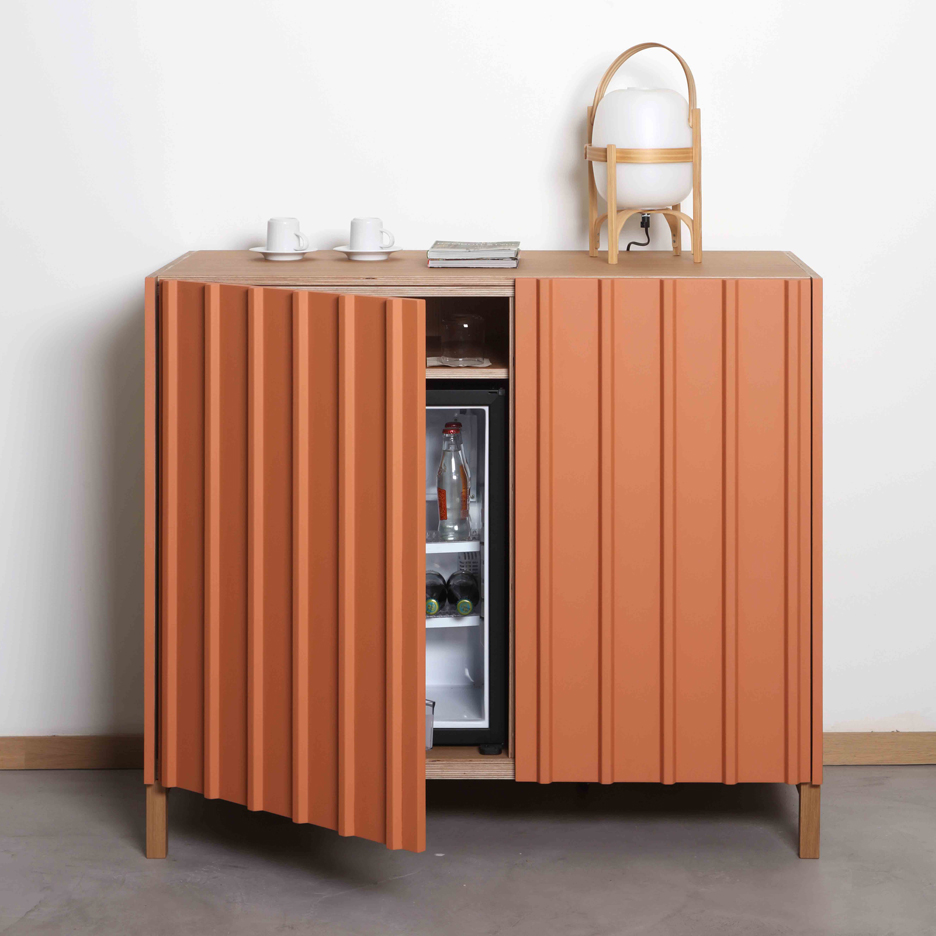
Spanish design studio Papila has designed a range of freestanding cabinets for the hotel industry that replace unattractive mini fridges (+ slideshow). (more…)
Financed By: Realdania, Hjørring Kommune and ENV-fonden
Ferocious pounding storms constantly move and shape the fantastic dune landscape on the northwest coast of Denmark. In 1968 an enormous sand dune devoured Rubjerg Knude Ligthouse leaving the tower as the only remaining structure, poised on the edge of the rapidly eroding cliff.
This spring the lighthouse was reopened and retrofitted with an architectural installation that give the public the last chance to enjoy the unique vistas and wild dynamic spectacle of nature, from the top of the lighthouse.
BESSARDs’ STUDIO and JAJA Architects designed a scenographic stairway giving access to the tower and making the ascent a sequence of architectural experiences. Staging its historic function as a beacon for the seafarers, they inserted a gigantic wind-powered kaleidoscope into the lighthouse that captures natural light and reflection, sending it inwards to create an ever-changing cascade of colors and glimpses of the sea and surrounding landscape. The kaleidoscope also functions as the structural element on which the stair wraps itself around. The triangular shape of the kaleidoscope in combination with the perforated and transparent stair create a playful interaction with the square geometry of the lighthouse, staging a unique experience of the vertical space, which stretches between earth and sky.
The project is a variation on the properties of one unique material: steel. Rusted, mirror polished, bent, perforated, welded and finally carefully assembled into a monolith inside the lighthouse. It provides a visual and tactile experience reacting to the extreme meteorological characteristics of the site that creates an aging process that gradually merges the kaleidoscope together with the historic lighthouse.
According to geological surveys, the lighthouse will be taken by the sea within the next 2 to 15 years. Nobody knows exactly when the tower will fall but when it will, the project will be entirely disassembled and – thanks to its constructive system – be remounted or recycled.
The revitalization of Rubjerg Knude Lighthouse is part of a nation-wide initiative of architectural interventions that seek to invite the public to experience the most unique and remarkable areas of the Danish landscape. Rubjerg Knude transformation was commissioned by Realdania Foundation, The Danish Nature Agency and Hjørring Municipality.
The building permit for MVSA Architects’ ‘Mall of the Netherlands‘ has officially been approved by the municipality of Leidschendam. Commissioned by Unibail Rodamco, the project entails a renovation and extension of the existing Leidsenhage shopping center, as well as an entirely new interior design.
Courtesy of MVSA Architects
In order to adapt to changing needs of consumers and the evolving role of the physical store since the popularization of online shopping, Leidsenhage is being transformed and given a completely new identity. The project centers on “a customized design that binds the strong diversity and ever-changing retail landscape.”
Courtesy of MVSA Architects
Inspired by the concept of a draped silk scarf, the façade of the Mall brings together the extension and existing buildings in the complex.
“Our concept for ‘Mall of the Netherlands’ is based on the idea of one gesture, one design, one identity. We believe it gives the shopping center the allure and comfort it deserves,” noted MVSA Architects exectutive director Roberto Meyer.
Courtesy of MVSA Architects
Courtesy of MVSA Architects
The ‘Mall of the Netherland’ will feature a Central Plaza that will connect all wings of the building, as well as a Dining Plaza that will serve as a “hospitality hotspot” on the first floor of the complex.
The Mall is expected to be completed in the beginning of 2019.






 Sig Nordal