This second home has a rather peculiar story. Spasm was commissioned to demolish an existing structure, which was deemed structurally unfit for occupation, and build a new home on the same site. An in depth study, prompted us to reimagine the idea of occupying the site.
Many radical strategies were adopted Retaining and recycling the debris of the demolished building as a mound. The sleeping spaces as an introverted assembly around existing trees on the ground level, where one descends into the coolness and comfort of the earth.
The main pavilion-esque living space on the upper faces the north, overlooking the mature trees which stood on site. The pool sits at the upper level terrace and seems to rise out of the mound. The house has been imagined in Blue Gray Kotah, an Indian stone which forms the main substance of the expression. The naturalness, monolithic quality, cost, availability in different formats, and wear-worthiness of the stone led to its choice as the best defense against the harsh humidity and fierce rain that affects this region. Kotah stone is used in several forms, from fine chips, to strips, to slabs, to solid cove cut skirtings. The bath spaces are finished in white Indian Bhanswara marble.
Section
Section
The spatial construct makes the occupation of this home about the elements. The changes in light intensity are palpable, as is the mood of the rain whether gentle or violently loud. We hope we have delivered the vessel for the family to live a life under the skies, a place to enjoy the rain, wet breezes, encounter rare bugs , a place to grab the dew laden cool grass between their toes.
From the architect. Located in a suburban satellite city 12 miles west of Jakarta, this 10 person architects’ studio occupies a walled rectangular parcel with several pre-existing tress. The studio occupies a corner of the site and is defined by a 4 x 8 m grid of slender steel columns.
A large reflecting pool abuts the structure on two sides and a wooden terrace cuts across the site, dividing the ground – floor plan of the studio. The ground floor houses a double-height work area at the front of the structure and across the terrace a smaller meeting room.
A painted steel chair leads to an upper floor office. Seperated by an exterior area, an additional two storey volume at the back of the site houses a kitchen and lavatory on the ground floor and a servant’s room on the upper storey. While the exterior walls of the ground floor are glass, the upper storey, wider in plan and thus cantilevering over the space below, is clad in panels of glass-reinforced concrete.
Floor Plan
A pitched wooden roof with concrete tile cladding covers the entire structure, projecting over studio and service volumes. The eaves of the roof are supported by the two exterior rows of columns, five of which fall within the water. Two inner rows of columns, situated within the glass walls of the ground floor, carry the load of the building to concrete foundations. The pool’s water comes to the edge of the glass perimeter, seemingly doubling the spaces of the studio with its relfection.
The use of glass is intended to maximize the view of the surrounding area : exotic leafy trees in an area of 500m2. The studio’s mass follows the pattern of established shady trees, with two buildings built right among the trees. The green landscape is exposed by the architect through the studio. The setting of the buildings are set by the existing of the trees around the site. The building was split it by two separated building one another. It is separated by existing tree which is located almost in the middle of the site.
Section
The ground floor on the studio, which seems to float, is used for public activities, such as receiving guests, meetings, administrative work and negotiations with clients and suppliers. “We want the leafy trees to be visible to the guests, making them feel at home,’ explains the architect.
The ground floor is efficiently designed with a clean line. There aren’t many ornaments on this floor so that it seems practical, modern and functional. Granite material is installed to exude coolness in the room, as well as a pool that delivers cool air.The second floor on the other hand is more spacious and is utilized as the main building. This is the place where the architects work.
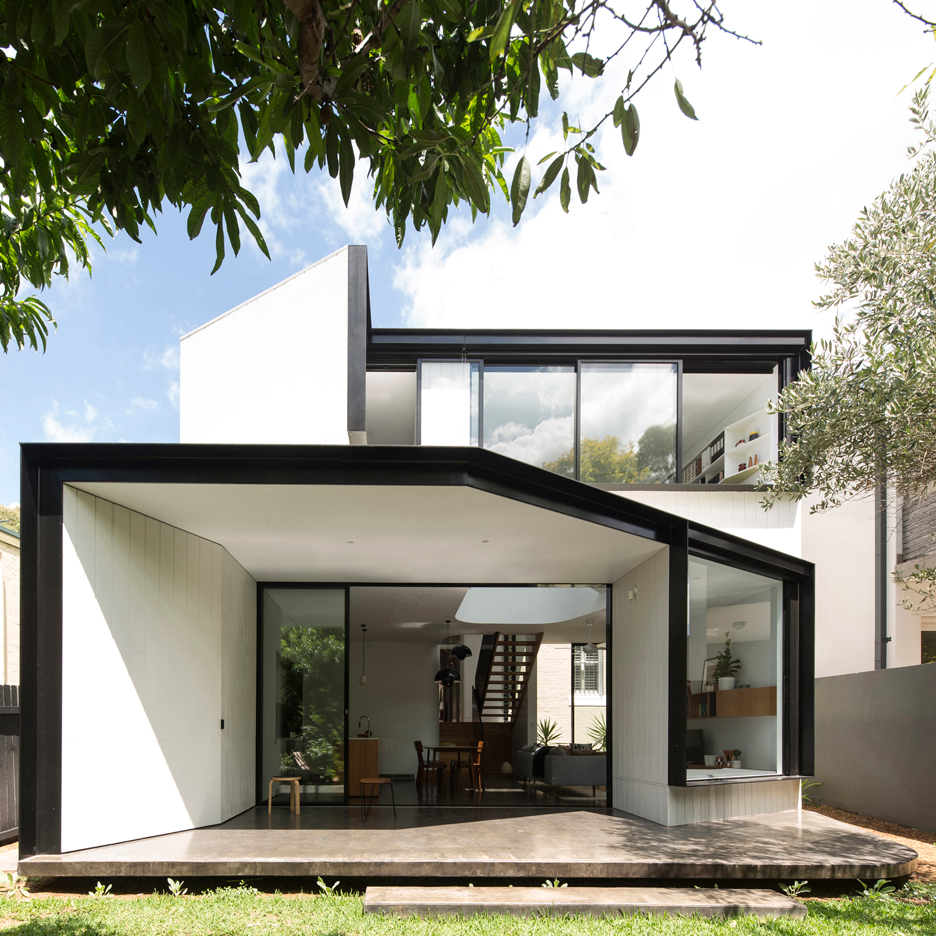
Australian architect Christopher Polly has added an asymmetric extension to an early 20th-century house in Sydney, creating a bright double-height living space filled with Modernist furniture (+ slideshow). (more…)
Sinseol-dong is a place that some ‘urban hanok’ still exist. However, as walking that area, it is hard to catch at once that the building is hanok. Because most of them are too old and repaired for several decades. Even some are too old to use as a dwelling and mostly over maximum FAR.
The site of project was so rigid with district plan and restriction. This place is not allowed to construct new building. In detail, it was only possible to construct 50% area of existed building ;49.5 sqm (Previous- 99.9 sqm). Paradoxically, because of the complicated restriction, this shabby, old hanok could survive so far.
Section
Structural weakness of Hanok(traditional wooden structure)
Due to the Hanok’s wooden structure, It is hard to extend vertically. It became more weaker when remodeling hanok. That is one of the reasons why hanok is limited in progress as a modern architecture.
Before. Image Courtesy of CoRe architect
As a way to extend hanok vertically, we adapted steel frame structure to make the other volume floating above the hanok. So the hanok could be preserved as much as possible. And the new volume could stand as a independent structure.
Exploded Diagram
New possibility (proposal)
All this time, the version of Hanok could be said that ‘the single-traditonal one’, ‘a 2-3 story adapted hanok’ or ‘a hanok on the other volume’.
‘Sinseol-dong hanok’ takes another position. It tries to make other floating volume above hanok by using a new steel frame structure. By repairing and reinforcing, the hanok and new volume could exist respectively and also co-exist. We’ve searched how the hanok could keep its shape and make balance with modern architecture at the same time.
1st Floor Plan
There are many factors to repair and extend existing hanok; structure, restriction, cost etc. Also the factor of restriction and way to resolve will not be same in hanok in buk-chon and hanok in sinseol-dong. It can be said that the restricting factors in sinseol-dong gave clues to make other possibility in this project.
It has 7 steel-columns on the ground -away from the court of ㄷ-shape hanok. It could have been more easy to solve if the column stood in the middle of the roof of hanok, but it would have worse in detail then -like insulation, waterproofing and finishing. To do this, we arranged column avoiding roof of hanok and made cantilever structure using horizontal beams and inclined beams.