From the architect. In Buddhist mythology Jetvana is the name of one the Buddha’s most important spatial edifice which when literally translated means: the grove of Jeta, land donated to the sangha for founding a monastery. It was of semiotic significance that the site offered by Samir Somaiya owner of the neighboring sugar factory in rural Maharashtra for the Buddhist Learning Center was thickly forested, an idyllic grove of sorts.
Diagram
The institute was programmed as a spiritual & skill development center for the native Dalit Baudh Ambedkar Buddhist community. The mandate of Jetavana is to provide a spiritual anchor for their practice of Buddhist thought through meditation and yoga while also imparting training and skill development for members of the community.
With the mandate of not harming a single tree on site the sizable program was split up into 6 buildings each situated in gaps between the heavy planting. Through the design process two courtyards emerged as links suturing these buildings into a common identity.
Floor Plan
Further by inverting the roof profile with a center valley in the middle and rising edges the interior spaces were visually connected with the foliage outside. The interior spaces hence are also a function of the outside setting, with a lightness that belies the heavy programs on site. The separation of the roof from the walls while providing much needed cross ventilation also scales the building towards the courtyard.
Working closely with Hunnarshala, an institution looking to revive and resuscitate local building traditions we collated a material palate that uses rammed loadbearing walls of basalt stone dust. The stone dust, which is waste from a nearby quarry, is mixed with waste fly ash, a by-product from the adjoining factory that in the past was paying people to cart the waste fly ash away. Repurposed wood from old shipping vessels act as roof structure, with the understructure made of mud rolls, which are also great insulation. The roof itself is finished with clay roof tiles, remnants from older demolished buildings.
Section
The flooring is a traditional mud and dung floor done by members of the local community, which is known to have antiseptic properties.
Our approach to the Jetavan project looks to extend the idea of the regional paradigm whilst separating it from the pervasive ‘image’ of what defines the local. The construction process also sets out an approach that looks to further construction techniques based on local materiality not necessarily used natively but appropriate for it’s context.
From the architect. This is the rebuilt small house for elderly couple in a small country town in Gifu. Two daughters are already grown, are working at Tokyo, and don’t intend to come back here for next 30 years at least.
It is clear that the lifespan of house is clearly longer than the lifespan of the owner. So we architects have to think about how the new house can be the part of landscape in such shrinking country town.
Detail Section
On the south side, there is highway, where many shops stands besides originally. We generally put the house back to the north side from the street, to get sun light or avoid from traffic noise, as the surrounding houses did. But we think that it should be avoided at the very beginning. If we build a new house in the above-mentioned situation, it has to contribute to the landscape of this street, we think.
Then we decided to make roof face along the street, and extend the eaves as long as possible toward the street. House wall is set back 2 meters from the street to make a parking space. So we can make the house face along the street, and when it is raining or snowing we can enter the house without getting wet after parking the car.
On the other hand, if we make roof face on the south side, it is hard to get sun light into the house. So we put dormer window on the roof and inflate it to penetrate between south and north. Then it helps natural ventilation and the space under the window can be small loft for the daughters and grandsons when they come back in the vacation.
A Big eaves is the traditional Japanese element and a dormer window is the traditional European element. But if we focus on the function, it can be combined and be new expression of architecture, we think. We tried to make the new house not extraordinary in the area, and also like advanced in wrong way in the architectural history.
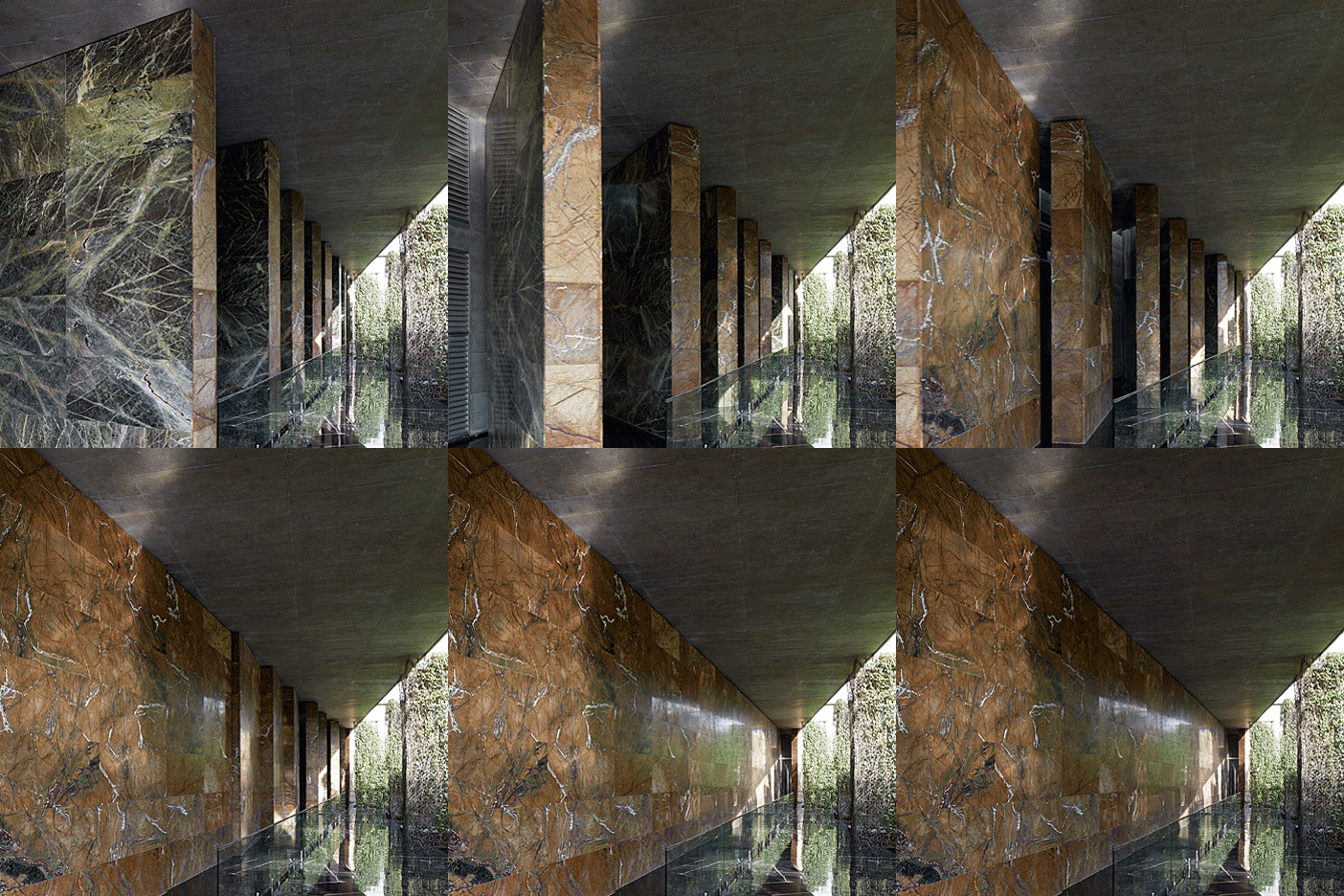
At the touch of a button, the chunky marble walls that surround this house in India divide up into spinning and sliding panels, revealing a more lightweight glass facade behind (photos by Edmund Sumner + slideshow). (more…)