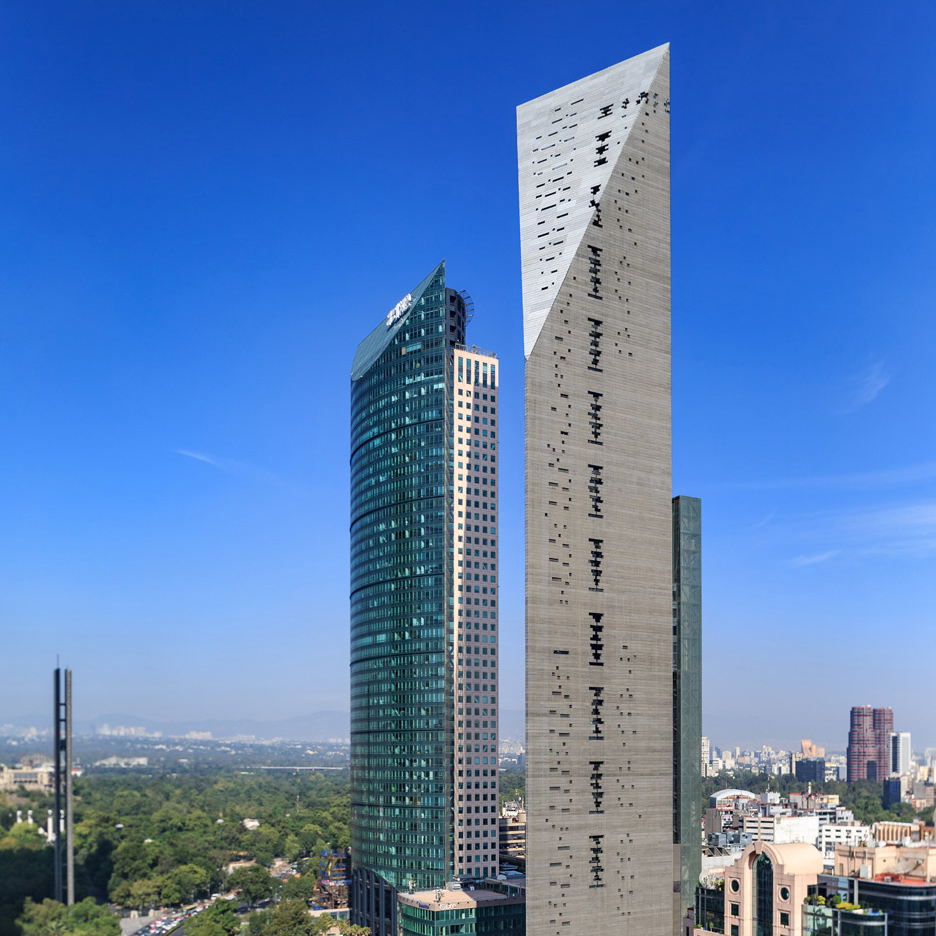
LBR&A Arquitectos has completed a three-sided skyscraper in the heart of Mexico City that rises 246 metres, making it the tallest tower in the sprawling metropolis (+ slideshow). (more…)
LBR&A Arquitectos has completed a three-sided skyscraper in the heart of Mexico City that rises 246 metres, making it the tallest tower in the sprawling metropolis (+ slideshow). (more…)

The Brick Industry Association (BIA) has announced the results of the 2016 Brick in Architecture Awards, given to “the country’s most visionary projects incorporating fired-clay brick.” This year, there were a total of 32 medalists with Best in Class winners in seven categories: Commercial, Educational (Higher Education), Educational (K-12), Healthcare, Municipal/Government, Residential (Multifamily) and Residential (Single Family).
“These winners demonstrate the best of brick’s aesthetic flexibility, and as a material made from abundant natural resources, it’s a perfect strategy in sustainable design,” said Ray Leonhard, BIA’s president and CEO.
Read on for the Best in Class winners:
Prairie View A&M Agriculture and Business, Prairie View, TX / Overland Partners
Intermediate School 230Q Annex, Queens, NY / John Ciardullo Associates, P.C.
Baylor Surgical Hospital at Fort Worth, Fort Worth, TX / Page Southerland Page, Inc.
Millwood Fire Station, Millwood, NY / Ohlhausen DuBois Architects
Old Parkland Campus, Dallas, TX / Beck Architecture, LLC
46-09 Eleventh St., Long Island City, NY / GF55 Partners
New Georgian Revival Home – Greenwich, CT / Charles Hilton Architects
This year’s judges included Steve Berg, BWBR; Fiske Crowell, Sasaki Associates; Kristin Hawkins, Pelli Clarke Pelli Architects; David Meleca, David B. Meleca Architects, LLC; Clint Rigsby, SeamonWhiteside and Fernando Villa, Magnusson Architecture and Planning, PC.
The complete list of winners, a brief video trailer, and a photo gallery of all winning projects are available on BIA’s website.


San Francisco – California – USA (by Sonny Abesamis)

In this series by renowned financial institution Goldman Sachs, Talks at GS, some of architecture’s leading minds, including David Adjaye and Maya Lin, talk about how their careers have developed, their secrets to success, and what they are working on right now. The most recent video features Bjarke Ingels discussing his design approach and the development of this year’s Serpentine Pavilion. In addition to the videos, Goldman Sachs has also sat down with two other design leaders to talk about their careers.
Find the rest of the interviews after the break.
Two excerpts from other interviews with architectural leaders:
Zhang Xin, SOHO China
Co-founder and CEO of real estate development company SOHO China (known for their Galaxy SOHO project by Zaha Hadid Architects) Zhang Xin was asked about entrepreneurship and innovations in architecture.
On her inventive approach to architecture: “People want to see something new and creative, to touch and feel something different. In working with architects, I always say, ‘I don’t want you to produce something you’ve done. I want you to think about something you have never done before.’”
On successful teamwork: “Everyone has different skills, and I prefer to make every [business] decision as a group. Whenever I have an idea, the decision is never mine alone. We sound out every idea with senior management and make a collective decision.”
On entrepreneurship: “Entrepreneurs start with a dream and believe they can do something. There are good days and bad days. They will certainly doubt themselves and want to give up, but it’s [ultimately] about the fearlessness of walking in and figuring it out.”
Julia Peyton-Jones & Hans-Ulrich Obrist, Co-Directors of the Serpentine Galleries
Julia Peyton-Jones and Hans-Ulrich Obrist are directors of the Serpentine Galleries, famous in the architecture world for their summer Serpentine Pavilion program. They visited Goldman Sachs to discuss pushing boundaries in art and architecture.
Peyton-Jones, on challenging museum traditions: “The first time [Obrist] and I collaborated was in 1995, when I invited him to curate a show at the gallery called “Take Me, I’m Yours”, a very radical idea whereby anybody coming to the Serpentine could take and touch and use and experience all the elements of the show. Of course, the whole idea of museum galleries is that you don’t touch anything, so it really turned that whole idea of engaging with contemporary art on its head.”
Obrist, on shifting focus to emerging architects: “We recently realized that a new generation of architects have now started to build amazing things. Beginning with Sou Fujimoto, then last year Smiljan Radić of Chile, and this year with SelgasCano, it’s now the third time in a row that we are working with this younger emerging generation, which is a very exciting experience and is pushing [the commission] into another dimension.”
Peyton-Jones, on her ambitions as a curator: “The opportunity we have been given with a small scale is to really work harder. The gallery never, ever looks the same for two exhibitions. If you have a small space, you have to reinvent it, recreate it and rethink it every time.”
The rest of the Talks at GS, featuring leaders from all fields, can be found here.

From the architect. Family Villa XL is located on the outskirts of a new residential area and it is designed for a large family of seven. Area is dominated by typical Slovenian urban / rural landscape, that is why the design paraphrases the surrounding typical architectural elements . The house is conceptually formed from two mutually parallel volumes and one connecting volume, which is placed perpendicularly to the other two. All the volumes are elongated with symmetrical gable roofs. Shortest volume is extended into a roofed carport.
While the basement level is constructed with reinforced steel the upper floors consist entirely of cross-laminated timber elements.
Floor plans are spacious and organized in three levels. Living area, enclosed with large glass surfaces opens to the atrium maintaining the flowing communication between the house interior and surrounding nature.
Facade is composed with large-format panels – the connection volume in lighter and the other two in darker colours. Larger glass surfaces are moved inwards and combined with wood cladding. Placed over them is a pattern of vertical narrow wooden elements that simultaneously function also as sunscreens

The ring of fire by Völundur Jónsson Another one from Álftafjörður, just fooling around with my postprocessing and trying to explore new areas. http://flic.kr/p/4C692r

 Sig Nordal