Even in England, Jon Savage’s 1966: The Year the Decade Exploded hasn’t been reviewed as broadly or warmly as his definitive 1991 Sex Pistols biography England’s Dreaming or his century-straddling 2007 social-intellectual history Teenage. And in the U.S., it’s been totally, and unjustly, ignored. I figure the problem is twofold. First, while at bottom a work of history, 1966 isn’t merely music-centered — unlike the highly subcultural England’s Dreaming, it’s pop-centered. Second, while Savage is right to see the year when “the ’60s” became what we mean by that metonym as epitomized by its pop music, in the U.S. and the U.K. both history and music were racing toward the future in parallel, not identically. They “exploded” simultaneously, but somewhat differently.
Pop — not “serious” enough. U.S.-U.K. — dueling perspectives? Nevertheless, as someone who began writing about 1966 and its panoply of aftermaths as I turned 24 in the East Village that year, I learned a lot I didn’t know from Savage, who began the year as a London 12-year-old glued to pirate radio. Although he’s less comfortable describing the American phenomena he had to come here and research than the British ones he’s long since incorporated into his discursive apparatus, he’s careful to give the two nations equal time.
In fact, one of 1966‘s chief virtues is how dutifully and agilely this British freelance intellectual finesses these double complexities. Of course he focuses on singles rather than album — beyond Beatles–Stones–Dylan, 45s were still where the conceptual action was. But on both sides of the Atlantic he finds sociohistorical gold in not just major artists but utter obscurities — in what has to be called “art” because it was too weird for “pop.” Nor does he make the fatal error of privileging the “pop groups” soon to be designated “rock bands” over black artists. On the contrary, James Brown and Motown in particular get many pages and unmitigated respect. But typifying his schema’s pitfalls is something I’d never grasped — in Britain, the Motown classics covered by both the early Beatles and the early Stones remained more cult items than hits until Motown enlisted effective U.K. record-biz partners in 1965. I’m grateful to Savage for clearing this up. But, if only because it’s literally impossible for him to squeeze everything in, he doesn’t explore it enough.
The complexities begin with an Anglocentric generalization in a January chapter that builds to the sentence: “The pace of life quickened in the mid-sixties, and the fear of nuclear annihilation was the rocket fuel.” This gave me pause — while “the Bomb” was without question a potent metaphor in post-WW2 America, the ban-the-bomb movement and hence bomb consciousness remained relatively marginal here. But as Savage reminds us, in Britain the Campaign for Nuclear Disarmament — fueled, I’d venture, by Britain’s ingrained left traditions and the still-fresh horrors of the Blitz — was mobilizing a counterculture by 1958. Yet as Savage then explains, the CND had “peaked in about ’64-’65,” leaving the U.S. to set the decade’s political tone via both its Vietnam War, which embroiled a draftee army that numbered 185,000 at the beginning of 1966 and 385,000 just 12 months later, and its civil rights movement, which inspired a white New Left datable to SDS’s 1962 Port Huron Statement and in 1966 amalgamated the lessons of 1965’s Selma march, the Civil Rights Act, and the Watts rebellion into one controversial, irresistible slogan: Black Power.
Backtracking to clarify and condensing for speed, Savage squeezes these upheavals and many more into his 547 pages by keying a month-titled chapter to each. May extols both a women’s movement sparked by Casey Hayden and Mary King’s 1966 critique of SDS’s gender-based “caste system” and the Supremes and Dusty Springfield; stretching a little, August links a barely nascent gay rights movement to doomed U.K. producer Joe Meek. Usually, however, chapter themes are less explicitly political: youth ideology, lysergic mind expansion, Warhol’s Factory, the onset of “soul,” riots on Sunset Strip, and the mad ferment, brave experiments, and silly pretensions of “rock.” There’s a crucial and perhaps underplayed moment midway in, when Prime Minister Harold Wilson imposes wage and price freezes on a British economy that stalled years before America’s did, sealing Swinging London’s decline into last year’s brand. As the year slows to a close, the Beatles are rumored to be recording an album that will change everything. Next year’s brand: the Summer of Love.
Without undertaking the impossible task of folding all this action into a neat narrative, Savage constructs his mosaic efficiently. And always he keeps one eye and both ears on the music. In this his wide range is no less remarkable than his sense of thematic relevance. By picking and choosing — although he’s scrupulous about noting the wild cards the pop charts always put on the table — he illustrates his evolving theses with classics and finds, number ones shrouded in memory and minor hits you missed and flops you never heard of. On the Brit side are brief portraits of not just Beatles-Stones-Who but Yardbirds–Kinks–Small Faces, on the Yank side deep readings of “Eight Miles High” and “Good Vibrations” and “I’ll Be Your Mirror” (as well as Norma Tanega’s “Walkin’ My Cat Named Dog,” a touchstone I’d long believed lost to history). There’s a pained yet comedic minor R&B hit about the draft and a foreshortened James Brown B-side so frantic Savage can’t resist claiming that it “completely deconstructed black music.” There are smitten accounts of Wilson Pickett‘s “Land of 1000 Dances” and the Four Tops’ “Reach Out I’ll Be There.”
Scanning these passages again, I was struck by how nostalgic just the raw titles made me — recalling the music sparked an affection and awe that recalling the history did not. I knew this was just art transmuting truth into beauty and pop putting a happy face on “96 Tears” and “Happenings Ten Years Time Ago.” But to get a better bead on it I played and replayed Jon Savage’s 1966: The Year the Decade Exploded, the double-CD he put together for Ace Records to accompany his tome. Soon I found that it sounded even better than it had when I reviewed it back in January. Turns out Savage was righter than I’d thought about arcana from the Ugly’s prophetic, anti-hegemonic opener “The Quiet Explosion” (all that in 2:40, really!) or the Human Expression’s freaked-out speed trip “Love at Psychedelic Velocity” (“We were basically trying to attract attention,” Savage was told). And with the music on my mind I began to wonder about something that hadn’t occurred to me as I read. No matter how “objectively” accounted for, history is always individual for each person experiencing it. What was tweenage Jon doing all this time? How many of these tunes did he relish as a record nerd a-borning?
Having traversed unreasonable elation and tumultuous rage, giddy hope and thwarted potential, Savage ends his big year fraught and exhausted — on his final musical selection, a fragile Tim Hardin wonders, “How can we hang on to a dream?” In Britain, maybe this was how it was. But in America, I don’t think so, because subtending what Otis Redding had yet to dub “the love generation” was a material base that, as Savage notes, was already shrinking in Wilson’s U.K. — two decades of rising prosperity with three years to go. And for me personally I know this wasn’t how it was, because 1966 was when I fell in love and found my lifework, while Savage — and here I’m compelled to guess — was a fresh-minted teenager trying to figure out who he was, a struggle I’d guess once again came to some sort of resolution in punk 1977. How his own life evolved in tandem with his nation’s during the 11 intervening years is something I’d love to learn more about.
Introducing movement to drawings and diagrams is an excellent way to show the development and progress of ideas fundamental to a project. Animated GIFs can therefore be a useful tool to improve your project presentation, explaining in a lean way a large amount of complex information.
When it comes to architectural drawings, it’s fundamental to understand what information needs to be highlighted and what is the best way to show it, getting rid of all the extra data to focus attention on the main asset. With that in mind, here is a list of 7 different types of animated GIF that really show off the best of every project.
1) Context
To show specific environmental characteristics in one drawing could be a very complex task. Even if you manage to put in one drawing all the information needed to understand a project’s surroundings, the result can often be messy and over-saturated with information. Animated GIFs are a great tool to show accurate context information in a very clean way.
To graphically explain the idea behind a project can be a real challenge. Whether you want to focus on the underlying volumetric logic or the process of reasoning that takes you from an existing building to a final proposal, animated GIFs can provide a coherent sequence to communicate your approach to the project.
Most projects have more than one level. Even in single story constructions, there is always a ground floor and a roof that can relate to each other in multiple ways, with skylights, roof terraces, and so on. When a project has more than one floor, the inter-level interaction becomes more complex and therefore more difficult to explain. Animated GIFs can be used to show different relations between each level and the whole project or between every level.
Architectural details can have very complex junctions and material specification. Sometimes, one element can be turned to another position, or it can be moved or opened or elevated. Think in a light adjustable facade that can change position according to the weather and amount of light. By using animated GIFs you can portray the whole function cycle of one specific piece, making a much more complete detail.
The program of a project defines a wide network of human relations that develop within the designed space. Diagrams and especially movement can deliver complete information in a simple way.
With an animated GIF the architect can show in one image the complete structure or construction process of the project; from its foundation to the last roof beam, GIFs are a great tool to simply show a building’s structural makeup.
A general animated view of your project is an excellent way to show different stages of your intervention; you can share an internal journey through a building or show multiple ways of inhabiting your design, among other possibilities.
The “Blanche” Chalet, whose name evokes the spirit of the vernacular houses of the region, is situated in La Malbaie’s area of the “Terrasses Cap à l’Aigle”. Its simple and pure architecture gently complements the landscape of Charlevoix in a modern fashion.
The raw concrete materiality of the lower level is a nod to the stone foundations of the old wooden barns that once swept the landscape. This base also serves as the foundation for the main entrance and houses the technical functions of the cottage. Perched on the podium, the upper two levels are clad in a white stained wood, which is reminiscent of lime plaster that was applied to the ancestral homes of the area. The wood is smooth or raw textured and, at times, creates an openwork siding, depending on the façade, bringing lightness and joy to the house.
The four bedrooms of the “Blanche” Chalet are centrally located in order to maximize the panoramic views of the living spaces that are at the top level. The kitchen and dining room are characterized by large 360-degree fenestration, while the living space is housed in a floating overhang whose unique form is reminiscent of the structure of vernacular bridges. This raised volume allows for a direct experience of the enchanting sunsets of Cap à l’Aigle and the shimmering reflections of the estuary of the St. Lawrence within the comforts of the home.
This cottage residence is the expression of the atmosphere sought by its owner. The social nature of the house, its openness to family, friendly, and sometimes professional exchanges are favoured by its composition that sensitively juxtaposes the spaces of common life and the private life (bedrooms). The abundant use of fenestration underlines a constant connection between the interior and nature, including the lake and the forest. The use of natural materials, such as stone, wood, and steel in pure and unique forms links the building to the context and invites contemplation.
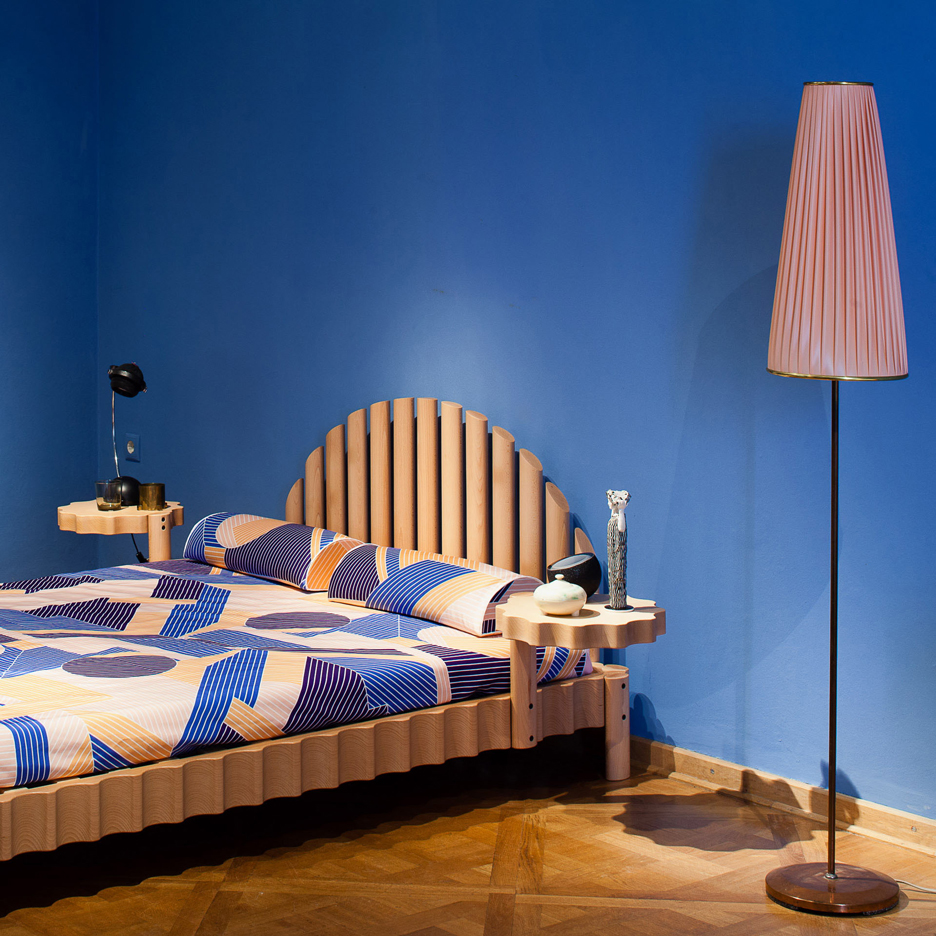
An exhibition dedicated to the friendships and rivalries between designers has seen the likes of Philippe Malouin and Bethan Laura Wood come together to create collaborative pieces (+ slideshow). (more…)
Brexit design summit: how has the EU referendum affected the UK’s architects and designers and what will Brexit mean for the sector? Dezeen convened a summit of leading practitioners, retailers, writers and lawyers to discuss the implications and explore what action can be taken. (more…)
It’s the Chilean architect Alejandro Aravena’s habit to look at architecture as a way to help people, and not to simply dazzle them with form. The ethos and practice of Aravena’s Santiago-based firm, Elemental, is essentially the blueprint for each national pavilion at this year’s Venice Architecture Biennale (through Nov. 27), which he is directing. His brief, “Reporting from the Front,” asks a simple question, one that’s increasingly difficult to address: How can the advancement of architecture, given physical needs and local contexts, actually improve the quality of people’s lives?
The question is central to how Aravena approaches his own work. Before he puts pen to paper, the economic, environmental, political, and social dimensions of the built environment are fully taken into account.
This is not Aravena’s first involvement in the Venice Architecture Biennale. In 2008, Elemental won the event’s Silver Lion award for promising young architects. Shortly after, in 2010, Aravena and his firm were tasked with rebuilding the Chilean city of Constitución following an earthquake and tsunami that leveled huge swathes of its urban landscape. For Aravena, this was a pivotal moment for understanding how to solve political and social conflicts with architecture, a skill set that he and his colleagues had been honing for years while building a portfolio of innovative design solutions for public spaces, infrastructure, and public buildings. This social awareness earned Aravena the Pritzker Prize earlier this year, making him the first Chilean architect to receive the most prestigious award in architecture. He is only the second architect ever to win a Pritzker and be director of the Venice Architecture Biennale in the same year (following Kazuyo Sejima, who achieved the feat in 2010).
None of the plaudits or attention seem to have inflated Aravena’s ego. He is not accepting billion dollar commissions in Dubai to build phallic, showy skyscrapers. He is not working on any hotels or casinos for Donald Trump. Instead, he continues to create projects that address problems, especially in the context of growing needs that are developing in our global political climate. The point for Aravena is to improve people’s lives. Surface recently spoke with him about natural disasters, reconstruction, and the scarcity of meaning in architecture today.
Having just finished your stint as director of architecture at the Venice Biennale and recently won a Pritzker, you must be bored to death with interviews.
More than bored. I don’t have that many things to say.
Let’s check. You’re the first Pritzker recipient from Chile. Is that a source of nationalistic pride for you? And if we’re talking about great contemporary Chilean architects, who would you mention?
Well, we are really surprised by the general positive feeling about this award. It’s a kind of collective feeling of achievement—that it happened to all of us, the country. Even in remote places. And here’s the thing: Architecture by definition is a kind of embassy that talks about many different disciplines and institutions. There is a kind of critical mass required to produce quality architecture, and that may explain this feeling. From that point of view, I would say there are many architects in Chile who create that critical mass. Smilion Raditch, Eduardo Castiglio, Jose Cruz, Teresa Molar—the fact that I could easily name 10 is very unusual. I think it’s a very good sign. It’s a good moment in Chile.
Let’s talk about your practice, Elemental. When you’re commissioned by a company, a private resident, a university or a country to design projects, what is the first question that you ask them?
What informs the form of this project? In the end, architecture is about giving form to the places where people live. It’s not more complicated than that. Everything in the end has to have a form. And someone has to give the form to those elements or institutions. With that form, you qualify the lives of people for better or worse for a long time.
Our buildings have to function. They have to be within budget, they have to fulfill a purpose. We begin by trying to understand all the threats; laws, environment, time frame, materials, expectation. We start by designing the question before going into the answer. This is mainly about trying to understand the forces at play.
Is it fair to say that architecture has to exist and find reconciliation in this tug of war between formal considerations and practical ones?
If architecture is about giving form to the places where we live, and life ranges from basic needs to artistic desires, the task of architecture and the difficulty of producing architecture is that it’s not about choosing one or the other, but integrating the two of them. If there is any power in architecture, it’s the power of synthesis. At least that is how we like to perceive it. Not in one single project that we have done, not even social housing, did we forget that life can not just be about mere satisfaction of physical needs. And the other way around; if you just concentrate on the artistic cultural aspect, but you haven’t satisfied basic needs, you don’t even have the possibility to have a life beyond mere survival. So the task of architecture should be that of integrating, and that again is in the text that I provided as part of the Venice Biennale.
Seems risky.
Every single project that we go into has a very high risk of failing, and the only thing that we have is our professional reputation. And yet, we’re willing to risk that reputation in a project if the potential outcome is relevant. And this is what we’ve been trying to do with the Biennale as well. It may not be perfect, but at least we take the risk of trying to address a relevant problem.
Perhaps that’s why your work seems to be a little more down to earth than some of your Pritzker Prize–winning predecessors. You’ve always been in the spotlight for your involvement on different academic and cultural boards, and you participation in various biennales. But now that you’re won a Pritzker, is there any sense of added “starchitect” pressure, and will we start seeing you building weird cookie-cutter museums in places like Abu Dhabi or Azerbaijan?
Not really. Having chosen to live in Chile is already a filter against that. We’re not in the right places. We’re not going to the cocktail parties where you’re “supposed” to go, or playing golf with the right people. We’re a small enough office to still be able to work on the project we want. What I want to do is make a contribution by having a pen in my hand and drawing things. I don’t want to spend my day as an administrator. The kind of office that we have is small enough that I can still be involved in each project that we take care of. Yet we have to be big enough to address complex projects, like the reconstruction of our entire city, Santiago, after an earthquake. You can’t solve that working on your own in a garage. You need a certain number of offices. We are very conscious that time is by far the most limited resource we have, and in that sense, we try to balance one third of our time with social housing, one other third with buildings, and another third with city design.
Rebuilding Santiago certainly must have tested the knowledge of your firm. And I suppose living in a seismic country such as Chile has informed quite a bit of your design.
Absolutely. And if anything is clear, we don’t have all the resources to do things on our own. There isn’t enough money to provide and deliver a middle-class house. We can only provide one portion of that house. It’s a fact, not a choice. When working in scarce environments, like after an earthquake, you have to be able to channel everybody’s capacities; the state, the private market, the families themselves, NGOs, because nothing on its own will solve the problem. And that was pretty much the case with Santiago’s last big earthquake and reconstruction. That’s why we started a participatory process. We had to channel different sources of funding in order to rebuild, and in that case, there was not only scarcity of money, but of time.
Speaking of scarcity of resources, how would you begin to approach the looming issue that is the U.S.’s infrastructure—roads, rail lines, bridges, and so on, which are all basically on the brink of of decay and collapse?
Now that you mention it, yes, I would agree that you’re beginning to have obsolete infrastructure. Not only in physical terms, but also in terms of mobility and expectations. I mean, the car in the ’50s was the notion of modernity and progress and success. Nowadays, it’s a threat to our quality of life. It’s a cultural shift also in the way that infrastructure was designed and how do we define quality of life. At the time, speed was a sign of advancement; now the best trip is the one that you never make. I would also say that there are not enough resources to resolve everything. In cities like ours in Latin America, there is not enough money or space. You have to establish priorities. This is something that I think is very healthy in the urban structure. You have to be very clear about what produces the most public good and what will only benefit a certain constituency on a private level.
What, would you say, in terms of comparative architecture, are some of the stark differences between Western nations and the global south?
The assumption is that in the north there are more resources. In the south there are fewer. I don’t know if that’s the case with Australia, but in general. Africa, South America, compared to Europe and the U.S., let’s say. More resources versus fewer resources is the biggest difference. A scarcity of means forces you to have an abundance of meaning. You have to give a lot of reasons why you’re doing what you’re doing. You can’t do whatever you want just because you want to. You have to justify it and that somehow tempers projects in the global south. Eventually—and this is what we witnessed not that long ago—an abundance of resources may lead you to a scarcity of meaning. More than a difference in facts, it’s a difference in attitude.
What challenges you in more rural or private projects, like a residential home in the wilderness?
It’s not that different than urban housing in that you allow the bigger forces at play to take control, such as nature. There is matter and we organize it into a form, and will our intelligence or sensitivity or constraints so that those materials have one form instead of another.
I’m curious about the way you use space: What’s your favorite room in a house?
The space around the house. I may be talking from the perspective of living in Santiago, which has incredible weather, so the best part of the house is everything that was left in between the house and the limit of the lot; the garden, the courtyard. The “non-room.”
A happy couple is a delicate balance between “the personal flavors” of the two individuals who are part of it. Just like preparing food you’ll have to pay attention to all the ingredients in the mix. Too much of one and the dish is spoiled.
How likely to match is the combination of your personalities? Are you more like chocolate and hot peppers? Or like steak and potatoes?
Take just now this fun, quick quiz to find out which two foods are you and your partner!





 Sig Nordal