Grow Box / Merge Architects


© John Horner

© John Horner


© John Horner


© John Horner


© John Horner


© John Horner

  • Principal In Charge: Elizabeth Whittaker
  • Project Manager: Amit Oza
  • Project Designer: Allison Austin
  • Project Team: Jamie Pelletier, Anne-Sophie Divenyi, Duncan Scovil
  • Structural Engineer: Evan Hankin
  • Steel Fabricator: Ramos Iron Work
  • General Contractor: Evergreen Group Company, Inc

© John Horner

© John Horner

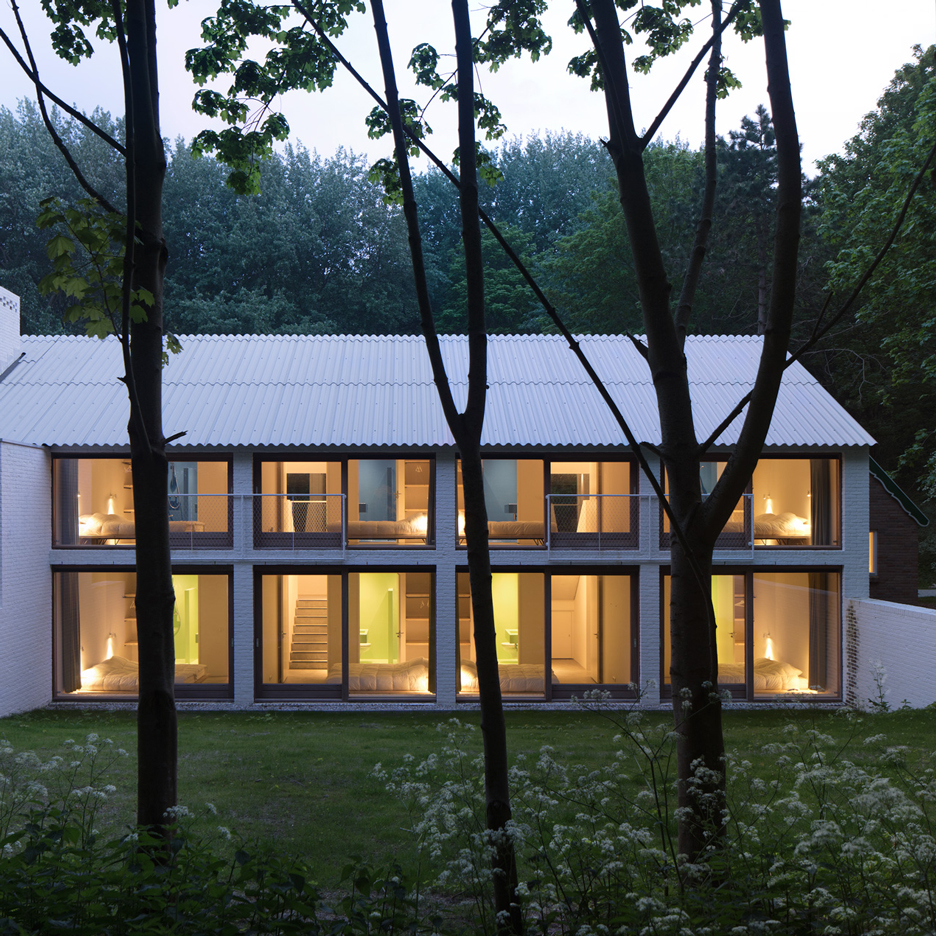
From the architect. Grow Box is a 1975sf (185 m2) home in Lexington, MA, designed for an MIT University Professor, his wife, and their young son. The landscape surrounding the house is elaborately planted, with over 40 different varieties of Japanese maple trees painstakingly cultivated and maintained by the clients.  


© John Horner

© John Horner

The extents of the existing gardens limited the footprint of the new house, and inspired an architecture that utilizes landscape to affect space that expands beyond the physical limits of the house. The resulting design is a compact volume penetrated by slot gardens and entry decks that both define space within the house, and erode the boundary between interior and exterior.


© John Horner

© John Horner

The slot recessed gardens are organized geometrically by a central courtyard garden that contains a single Himalayan birch tree. This garden, which will collect rain in the summer and snow in the winter, underlines one’s experience of the elements as the literal and metaphorical centerpiece of the home.


© John Horner

© John Horner

Floor Plan

Floor Plan

© John Horner

© John Horner

Floor Plan

Floor Plan

On the interior, each room is paired with at least one garden, the deep recessed rectangular proportions of which allow the clients to visually inhabit the garden while maintaining privacy from the neighboring houses and adjacent street.


© John Horner

© John Horner

On the exterior, the intriguing visual contrast between the crisp geometry of the house and the sinuous landscape is both enhanced and obfuscated by the tree-trunk hue of the weathering steel cladding. Large areas of glazing surrounding the slot gardens and floor-to-ceiling windows reflect the surrounding trees and plantings, further blurring the distinction between architecture and nature.


Section

Section

http://ift.tt/2aj5OTF

Cluster of gabled blocks form forest holiday home by Studio Nauta


Dutch office Studio Nauta created an ensemble of new and old gabled blocks for this family holiday home, which is secluded within a dense forest on the southern coastline of the Netherlands (+ slideshow). (more…)

http://ift.tt/2aeW61S

How Dirty Is Your Mind Really?

Do you think you have a dirty mind? No, no offense there, just another way to asses your creativity. It seems that the more creative the mind is, the more dirty can be.

Maybe, you have a very creative mind that can connect almost everything into something dirty. Or maybe, you have a very practical way of thinking that doesn’t leave much to the imagination. Either ways, there are advantages and disadvantages, and it’s helpful to know where you stand.

dirty_mindTake just now this quick, easy and fun quiz to find out how dirty your mind is!

How Dirty Is Your Mind Really?
//cdn.playbuzz.com/widget/feed.js

Leave a comment below to tell us what you’ve got!

The post How Dirty Is Your Mind Really? appeared first on Change your thoughts.

http://ift.tt/29XV2QG

Washington Monument – Washington D.C. – USA (by Anh Dinh)

Washington Monument – Washington D.C. – USA (by Anh Dinh)

NYC Lowline Receives First Official City Approval


Courtesy of NYCEDC

Courtesy of NYCEDC

Deputy Mayor for Housing and Economic Development Alicia Glen and NYCEDC President Maria Torres-Springer have announced New York City’s first official approval of the Lowline project in Manhattan’s Lower East Side. As the first major step in making the project a reality, the approval will help to create the world’s first underground park, a community-oriented public and cultural space that will become both a local resource and an attraction for worldwide visitors.

Although the Metropolitan Transit Authority (MTA) did express interest in the space last fall, the Lowline team was awarded conditional use due its high community potential.


Courtesy of NYCEDC


Courtesy of NYCEDC


Courtesy of NYCEDC


Courtesy of NYCEDC

Conceptualized in 2011, the Lowline seeks to utilize cutting edge solar technology to transform the abandoned Williamsburg Bridge Trolley Terminal located under Delancey Street into a one-acre underground public park. Here, sunlight is delivered underground, activating photosynthesis to create lush garden space year-round.


Courtesy of NYCEDC

Courtesy of NYCEDC

In addition to creating much-needed public space, the Lowline is hoped to set a model for adaptive reuse and cultivation of abandoned underground spaces, as well as “to shape the future of the City through innovation, deep community engagement, education, and youth development.”


Courtesy of NYCEDC

Courtesy of NYCEDC

Courtesy of NYCEDC

Courtesy of NYCEDC

Courtesy of NYCEDC

Courtesy of NYCEDC

New York City is the place where visionary ideas get turned into tangible realities, said NYCEDC President Maria Torres-Springer. Today we move one step closer to making the Lowline a reality, which will serve as a cultural and educational hub for this vibrant community and pioneer cutting-edge technology.


Courtesy of NYCEDC

Courtesy of NYCEDC

Courtesy of NYCEDC

Courtesy of NYCEDC

Courtesy of NYCEDC

Courtesy of NYCEDC

Since October 2015, the Lowline has been showcased in the experimental Lowline Lab, which tests the project’s solar technology and subterranean horticulture, and has attracted nearly 70,000 visitors and hosted youth education visits for nearly 2,000 children across New York City. The Lowline Lab will remain open through March 2017, and is free and open to the public on weekends.


Courtesy of NYCEDC

Courtesy of NYCEDC

Courtesy of NYCEDC

Courtesy of NYCEDC

Courtesy of NYCEDC

Courtesy of NYCEDC

News via NYCEDC.

http://ift.tt/2ax9cXE

banshy: Banff National Park // Jordan Herschel …

banshy:

Banff National Park // Jordan Herschel http://ift.tt/1VXLtQH

http://ift.tt/29XSy4N

Top 5 Fitness Trends for 2016

Towards the end of 2015, a number of predictions about fitness trends for 2016 came out. Some of them were outdated while some ideas really grabbed our attention. Let’s not waste our time discussing the outdated suggestions but focus on what trends are expected to rule the roster for the rest of the year. The suggestions are going to be very sensible and realistic, so you can even use them as a reference to take your fitness to the next level.

Fitness Programs at Faith-Based Institutions

In recent times, we have seen religious places such as churches, temples, and mosques and other faith-based places like ashrams and synagogues showing more interest towards educating people about the right methods for health and fitness improvement through meditation, chakra dhyana and yoga.

These are places where people gather in huge numbers hoping for some peace. They are bonded by a set of common belief and values that is strongly implanted in their minds from their ancestors. Of late, many such faith-based institutions have started offering special classes which not only involves prayers and counseling but also nutrition advice and health care tips to reach a higher level of well-being.

John, a regular visitor of Sivananda Yoga Ashram in California, tells us “any individual who joins a faith-based community becomes a part of a big group of people that are looking to help each other out and create a spiritual and friendly environment. The teachings include a number of practices that are aimed at improving the health, wellness, and mental state of a person. Not just in Sivananda but even in other faith-based communities, you can see people going on a regular basis to get relief from problems such as divorce, debt, and drug addiction.”

When you do something by faith, something that you are ready to accept and follow, you automatically see the difference in your mood and actions. We do not say that faith-based communities will replace health clubs, but they will play a major role in improving the life of people in the coming years.

An Increase In Online Video-On-Demand Programs And Video Streaming Services

Stressful work conditions, frequent travelling, and other activities leave us with little or no time to attend health and fitness courses. That said, people who want to learn will keep learning, no matter how busy they are.

That is probably one reason why we see fitness enthusiasts looking up the Internet for self-help videos to learn various ways on how they can improve their physical and mental well-being.

Videos are interactive and fun to watch and learn from. In future, we continue to see a rapid increase in online video-on-demand programs and video streaming services that are dominated by how-to and tips-based demonstrations by instructors.

See Also: 14 Top Fitness Apps to Get You in Shape 

Wearable Technology

wearable technology

There is no doubt about the fact that technology has become an integral part of people’s life. The concept of wearable technology has grown tremendously over the past couple of years, and there are predictions stating that it grow into a $30 billion market by 2020.

Wearable technology refers to using gadgets to track a range of activities that influence the health and fitness condition of a person. From heart rate monitors to activity trackers and smart wristbands, there are tons of gadgets that help keep track of a person’s fitness activities.

You can use fitness gadgets to track how many calories you burnt while climbing the stairs, how many hours you slept, what your heart rate is when you’re stressed out, and more. Fitness equipment come with round the clock monitoring facilities, and people are finding their use very convenient in maintaining or improving their health condition.

Group Fitness Sessions For Better Results

group fitness sessions

The usual scene is that there is always a group of people that hit the gym and practice weight-training and there is another group going outdoors for activities like jogging, cycling, and swimming. However, that is expected to change in the coming months.

Considering people’s demand for coach-led training sessions for more fun and motivation during training sessions, we believe health clubs and fitness studios will introduce group fitness sessions segregating training programs into different formats ranging from short to medium to lengthy in order to meet the demands of people in basic, intermediate, and advanced categories.

In other words, we could see instructors include cardio and weights in every session so the user gets the best of both worlds.

Health Coaching For Fitness Instructors

Usually when you walk into the gym, there is always an instructor who is highly knowledgeable and skilled about workout routines and use of equipment. You will get all the advice you need on how to go from a skinny fellow to a professional bodybuilder. However, not all of them are great health experts. The gym is not where you get the best health advice.

But, this 2016 or someone down the line, we could see fitness experts work with health experts and gain equal knowledge and awareness about the right diet and nutrition and health factors to help their students get better results from their workouts. It’s the combination of the best health and fitness advice that can guide a student to experience overall development of his/her physical and mental well-being.

See Also: Breaking the Fast: What I Have Learned Using Intermittent Fasting

So, which trend do you bet on? What is your outlook on fitness trends for 2016? Please comment your answers below and we’ll pick up from there.

The post Top 5 Fitness Trends for 2016 appeared first on Dumb Little Man.

http://ift.tt/2aeI3JG

This Spray-On Compound Can Protect Buildings During Disasters And Explosions


A wall coated with Paxcon (left) vs an untreated wall (right) after a TNT detonation. Image Courtesy of Line-X

A wall coated with Paxcon (left) vs an untreated wall (right) after a TNT detonation. Image Courtesy of Line-X

A game-changing protective coating from Line-X has the power to make buildings virtually impenetrable. The spray creates a thin barrier which is watertight, abrasion and impact resistant and can withstand high temperatures; all of which combine to make it almost indestructible. The concoction deemed “Paxcon®,” is stronger than steel, and can protect buildings from explosions or natural disasters such as earthquakes or storms. 

Walls which are painted with Paxcon® can withstand explosions up to 20 times greater than naked walls, a claim which Line-X has substantiated with rigorous testing over the past 20 years. Researchers at New Mexico Institute’s Energetic Materials Research and Testing Center (EMRTC) conducted the test in the video below, wherein two identical concrete walls are constructed; one with Paxcon® coating, and one without. The video shows the Paxcon® wall withstanding the blast, the wall “flexing” with the explosion but remaining intact. 

The extreme differences in the post-explosion condition of the office furniture and safety dummies show the capability of Paxcon® to prevent fatalities if a building collapses or blasts. The dummy in the Paxcon®-protected structure remained unharmed, whilst everything in the non-treated room was torn to shreds. The TNT was detonated just 30 meters from the dual structures, a blast which would be impossible to mitigate with standardized building materials and methods.

The concoction, a compound of elastomeric polymers, has been outperforming comparable coatings of stainless steel and carbon fiber in similar circumstances. Besides buildings, it has been implemented as a protective coating on bulletproof vests, farming equipment, automobiles and even airplanes. Despite its impenetrability and chemical makeup, it has been proven to be so safe that you can drink potable water from a container coated with the substance.

Line-X has already proven it’s effectiveness on wood, plasterboard, brick, steel, block, and it is currently available to consumers to apply on virtually any surface. It’s versatility and ease of application could see the coating become an industry standard in construction and engineering, greatly improving the stability and security of the buildings around us.

For more proof, the video below shows the incredible amounts of force an object coated in Paxcon® can withstand. For more information, check out the Line-X website. 

News via Interesting Engineering.

http://ift.tt/29YhyGv

Pernilla Ohrstedt designs custom Silhouette table for Dezeen offices


Architect Pernilla Ohrstedt has created a collection of sleek black tables for Dezeen’s new offices, located in east London (+ slideshow). (more…)

http://ift.tt/2ad9t5U

Chapelle Corneille / atelier d’architecture King Kong


© Eric Peltier

© Eric Peltier


© Eric Peltier


© Eric Peltier


© Eric Peltier


© Eric Peltier

  • Chief Project Manager : Paul Marion
  • Project Manager : Flora Beth
  • Heritage Architect: Aurélien Dufour
  • Structural Design Engineer: Khephren Ingénierie fluid mechanics engineer: LBE
  • Fluides Scenography: Ducks Scéno
  • Lighting Design: Wonderfulight
  • Acoustic Engineering Consultant: Kahle Acoustics
  • Surroundings: 1200 sqm
  • Client: Région Normandie

© Eric Peltier

© Eric Peltier

From the architect. Respect for the past and innovation go hand in hand in this atypical design whose urban vocation is eminently symbolic.


© Eric Peltier

© Eric Peltier

The Chapelle Corneille, a listed heritage building built in the 17th century in a Baroque style through which the spirit of the Counter Reformation clearly transpires, has been home to high quality musical events for a number of years now, notably during festivals held during the summer and in October, gathering large audiences. Conscious of this success, the Région Normandie wished to reinforce the chapel’s role as a designated concert venue for non-amplified music, offering upgraded facilities to meet modern day requirements in terms both of acoustics and accessibility, and providing professional amenities on a par with the musicians’ talent.


© Eric Peltier

© Eric Peltier

The architects were acutely aware of the need to breathe new life into the chapel while respecting the original building’s integrity, harmoniously integrating 21st century developments within the 17th century architecture.


© Eric Peltier

© Eric Peltier

The difference in height between the building and street level was sufficiently great for facilities catering for the needs of concert-goers and artists alike to be integrated into the basement. This solution also provided easy access for people with reduced mobility, creating a meaningful link between the building as a historical monument and in its modern day vocation.


© Eric Peltier

© Eric Peltier

The new entrance to the venue is sheltered beneath glazing running along the building’s eastern façade, leading the spectator to the reception area and lobby situated beneath the chapel, and from there on to the stairway and lift taking them up to the main auditorium itself. This layout also draws upon the building’s spiritual role, and, just as the believer moves from the ritual of meditation to the awakening of light, so the concert-goer leaves the hustle and bustle of everyday life for the miracle of music.


Chapel Floor Plan

Chapel Floor Plan

The access configuration does not complicate the visitor’s reading of the building, in no way interfering with the mainstays of its identity and, in its practicality, eloquently bridging today and yesteryear. The configuration also enabled the architects to endow the building with a façade on an equal footing with its vocation past and present.


© Eric Peltier

© Eric Peltier

A succession of steps trickle down from the main entrance in gentle curves to the seating area, espousing the incline of the plot. Inspired by the urban staging dear to architects of the Baroque period, in which a building was seen uniquely from the standpoint of its surrounding context, the dark grey tones of the stone stairways set off the chapel’s magnificence, its primarily white facades already revealing in this play on light and dark. The people of Rouen are clearly keen to embrace the revisited edifice, and they naturally wend their way across the series of surfaces, both organic and urbane, showcasing a heritage building which for too many years had been abandoned to the stranglehold of the surrounding urban fabric.


Sections

Sections

A common entrance is situated on Rue Bourg-l’Abbé for use by both the general public and musicians. The latter may go down the imposing exterior stairway to reach the stage-side entrance hall positioned on the ground floor of the chapel and connecting the auditorium with the dressing rooms.


© Eric Peltier

© Eric Peltier

A mural frieze runs above the slope leading up to the ample reception hall, retracing the chapel’s history from its origins to the present day.

The box office and basement foyer are situated in the reception hall, where a bar awaits spectators, while the cloakrooms and toilets are also positioned in the spaces created beneath the chapel.


© Antoine Guilhem-Ducléon

© Antoine Guilhem-Ducléon

A lift and staircase in varnished crude steel lead up from the basement foyer to the auditorium, voicing their presence like two contemporary sculptures.


© Eric Peltier

© Eric Peltier

A second foyer on ground floor level has been positioned in the first bay of the nave, and also offers a light refreshment service, in complement to the basement level bar which is for its part connected to the water and electricity supply.


© Eric Peltier

© Eric Peltier

The particular requirements of the musicians have also been taken into account, as the project specifications stipulated. The adjacent building already used to house the dressing rooms has enjoyed total renovation and now offers two vast communal dressing rooms and individual dressing rooms for men and women. A meeting room has also been provided, along with a production office, technical office and logistic zone, all of which have access to a spacious terraced area. A physical bond has been created between this building and the chapel, thereby strengthening the functional and symbolic unity of the whole.


© Eric Peltier

© Eric Peltier

http://ift.tt/2aiFKYK