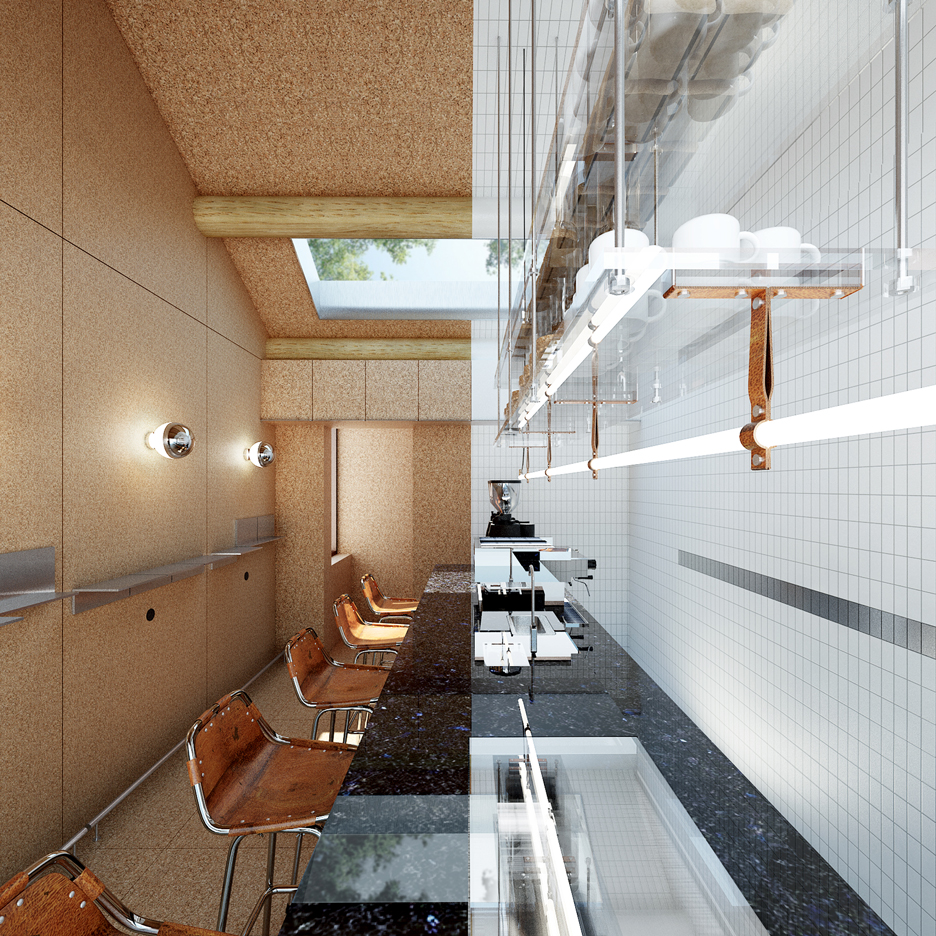
Office AIO has converted a courtyard residence in Beijing‘s Xiang’er Hutong into a tiny cork- and tile-lined coffee bar with a traditionally styled guest room (+ slideshow). (more…)
Office AIO has converted a courtyard residence in Beijing‘s Xiang’er Hutong into a tiny cork- and tile-lined coffee bar with a traditionally styled guest room (+ slideshow). (more…)

After discovering a vibrant new pigment of blue by accident, chemists at Oregon State University have brought the compound to market in the form of a paint that looks promising to architectural sustainability.
While experimenting with materials to study applications for electronics in 2009, OSU chemist Mas Subramanian and his team mixed black manganese oxide with other chemicals and heated them to 2,000 degrees Fahrenheit. Little did they know, one of their samples would turn into a brilliant blue color.
This pigment, called YInMn Blue, or MasBlue, is formed from a crystal structure that allows its manganese ions to absorb red and green light, and to reflect only blue light. While this structure was previously known, it had never been utilized for commercial purposes, including for pigments.
Used in paints, the pigment is highly versatile, especially as it reflects infrared light at the high rate of about 40 percent, therefore helping to keep buildings cool. Similarly, YInMn Blue products can be used in coatings, plastics, and even roofing materials as a part of sustainable roofing efforts.
Furthermore, none of the ingredients in the pigment are toxic, making it especially innovative to use the compound in paints. “Ever since the early Egyptians developed some of the first blue pigments, the pigment industry has been struggling to address problems with safety, toxicity, and durability,” explains Subramanian.
With its stability and durability even with exposure to water and oil, the pigment is additionally resistant to fading.
In May of 2012, the Subramanian team received a patent from the U.S. Patent Office for the pigment, and has been working with Shepherd Color Co. to develop the commercially-available paint.
The team is additionally expanding their research to include a range of other colors with similar properties.
Learn more about the pigment, here.
News via Oregon State University H/T Interesting Engineering.
The Norse mythology is full of rich characters. Everybody has heard about Thor, the supreme deity or Valhalla the land of the dead warriors. But there are many, many more gods in the Norse pantheon. Everyone has specific powers and rules over a certain world. The nine worlds in which all beings inhabit centers around a cosmological tree, Yggdrasil. The gods inhabit the heavenly realm of Asgard whereas humanity inhabits Midgard, a region in the center of the cosmos.
Now, beside assessing the qualities you share with a Norse god, you have the opportunity to find out more about those gods an their realm.
Take just now this quick, easy quiz and find out which Norse God are you.
The post Which Norse God Are You? appeared first on Change your thoughts.

💙 Punchbowl Falls on 500px by Jason Matias, Issaquah, USA☀ … http://ift.tt/1TvknDa

DIYA is a private home located in Ahmedabad, Gujarat, India. It was designed by SPASM Design Architects in 2016. DIYA by SPASM Design Architects: “Ahmedabad, is predominantly dry through the year, though it does rain occasionally during monsoon months, from late June to August. The clients a young couple with a daughter of 9 and their parents, contacted us for a family home. Pre-existing trees, and a large lawn, prompted..

From the architect. Dutch design office zone zuid architecten recently completed a new home in one of the suburbs of Roosendaal. The 225 sq m house is designed as a deconstruction of a traditional Dutch house silhouette, several floors for living with a gable roof.
The main goal was to create a strong relation between the interior and the exterior of the plot. For example the house is placed on a raised terrace. This terrace becomes part of the living space but also the other way around. The volumes are then shifted relative to each other and are abstracting the silhouette.
In addition, the outdoor relationship is enforced by the glass wedge that splits the volume into two, this creates light and space deep into the home. But also the bay windows contribute to a optimal penetration of the surrounding area, they come out of the façade literally.
The house contains next to the living room and kitchen, 4 bedrooms, 2 bathrooms, a game room, two storage rooms a partly covered sun terrace and the swimming pool. All of these spaces are connected to each other by a strong pattern of lines materialized wood, concrete, plaster and glass.
Zone zuid architecten designed the house, but also the matching furniture is the work of the architect. So for example the kitchen is extra narrow which comes out on the bay window in the front volume. The kitchen is made of a combination of wood, steel and concrete and floats above the floor, exactly like the house floating above ground level.

House in Chamusca Da Beira is a project completed by João Mendes Ribeiro in 2015. The home is located in Chamusca, Portugal. House in Chamusca Da Beira by João Mendes Ribeiro: “The project for the House in Chamusca da Beira consists in the requalification of a small built aggregate in a rural estate and on its enlargement with the construction from scratch of a new small building, directly articulated with..

This week on Dezeen: the launch of the Pokémon Go augmented reality video game changed the way players interacted with cities and buildings, and brands began releasing products to help players “catch ’em all”. (more…)

💙 Last sunday evening on 500px by Mademoiselle MV ☀ Canon EOS… http://ift.tt/1oTdeit
 Sig Nordal