Why do you need a call to action and how do you write one that gets more of your customers to click, call or buy? Here’s how to get customers to act now.
Self-publishing is a way for authors to get their work published without using a traditional book publisher. Learn the pros and cons of self-publishing here.
From the architect. This house is located at the beautification zone of the ancient city of Kyoto, and it is built like two lean-to extended out from the 2-story main house.
Courtesy of Hideyuki Nakayama Architecture
The center of activities is, if anything, based on those lean-to. Those spaces are simply produced by spanning rafters between the retaining walls of the adjacent house and the main house, end various elements such as kitchen, a dining table, furniture and a bath tub are set around the main house, encircling the main house. The space is somewhat like a passage garden by alternately aligning the exterior and the lean-to along with the site boundary.
Floor Plan
By spending time going back and forth everyday through this passage garden, the residents can see the small and hard to grasp shape of the main house from outside in various angle. The volume of the house can appear like a tower, or a castle wall depending on the location to look at. The place where the family sleeps is on second floor of the main house and one will access from the staircase reaching out from the passage garden, therefore it is as if like going home rather than simply going to a bedroom. In this way the interior of the main house became a space slightly kept distance from the area spending daily lives.
The inside is a curved Horizont-like space, where the portion of the staircase, the thin steelframe floor, and the equally lined fittings are scattered around without displaying a sense of distance to each other. The relationship among those elements can be visible only after the residents reside and move around, along with the furniture placed at certain locations and drops shadow of each. The gable side of the house shows the doll-house conditions, open and visible from the adjacent street.
Section
There was no intention from the beginning to bring in the exterior into the interior, or release the daily life of the resident to the surroundings. However, there was such a thought of providing a depth to the extent of life produced within the cityscape, site ground and the house – which we have never felt before. I imagine the sort of new, powerful residents of the house transforming the house into a living space or a cityscape, through the daily lives of the family of four fully utilizing the depth of the extent I tried to produce.
Prince Bay Marketing Exhibition Centre is located at Shekou Harbour, Shekou, the birthplace of the Shenzhen Economic Reform. The recent ‘Shekou Starting Again Plan’has further positioned Shekou Harbour as the heart of the important Shekou Free Trade Area. Therefore, in response to the area’s unique geographical and cultural characteristics, it was essential for the design of the exhibition center to reflect the past triumphs while looking forward to the immense future potential of Shekou.
The design concept is based on the shape of a “three-blade propeller”, which extends out into of three sets of 70 meter smooth surfaces and three super-scale windows. The three surfaces represent Chiwan Hill, Weibo Hill and Shenzhen Bay respectively, while the three windows open to Shekou Bay, Chiwan Bay, and Dananshan Park. The orientation of the surfaces and windows provide a visual tour of the famous spots of Shekou while allowing visual consistency and clear sense of space.
Diagram
Floating + Twisted
Located in the reclaimed land, the site is surrounded by wide open space. By raising the main space of the building to 6 metres high, line of vision is suddenly opened up to views of cruise ships and mountain trees in the distance. Airy overhangs provide shaded respite for visitors from the strong subtropical sunlight. Moreover, the twisted shape make flowing curves at the interchange, folding out to building volumes made of glass and steel, creating lightness and more dynamic form.
An Opaque Box Exhibition Box + Transparent Side Court
Three double-layer opaque exhibition halls are built around a three storey high atrium. Throughout the descending visitor route, a variety of high-tech virtual images and model images are presented, displaying Shekou’s past, present, and future. Visitors are free to walk around the side court made of glass louvers. They could overlook the mountain and sea, recalling the city throughout the generations, and enjoy the view of Prince Bay while appreciating the city’s urban growth. The alternating experience of “inside” and “outside”, together with the contradiction of “opaque” and “transparency”, allow the conversion between “virtual” and “reality”, and transformation between “time” and “space”, producing a rich multi-dimensional experience. The Edge of the side court flip up to form the roof, a covering for the “hanging garden” with fantastic views. The material of the exhibition hall include dark red brick and etching copper reflecting the history of Shekou, while the glazed glass of the side atrium suggests futurity. Merging of these two materials at a distance echo a balance of warm and cold.
For a temporary building, glass and steel are the most environmental-friendly materials. The design applies “twist and turn” to the geometry in order to break the boundary between “wall” and “roof”, thus guiding viewer’s sight towards sky. Meanwhile, it forms an elegant wave-like curved profile, symbolising the influence of harbour culture. To realise the ideal 3D effect within budget, the team came up with a solution of breaking the structure into 2D parts. By accurate 3D model optimisation and analysis, 270 main keels with 90 different lengths (total length 3645m), and 6300 pieces of rectangle glass with 1800 sizes (optimised to 420) ultimately realised the elegant yet powerful shape.
As the client required the project to be completed within an extremely short time of 10 months, from design to complete construction, it was necessary for the AECOM team to taking the ‘design-build delivery system’ which allows high design accuracy and effective implementation. The multi-disciplinary team within AECOM collaborated extensively, to produce and manage the architectural, landscape and interior design during the entire design process, while coordinating with the exhibition, lighting and curtain wall design teams to ultimately completed this “unrealisable” task.
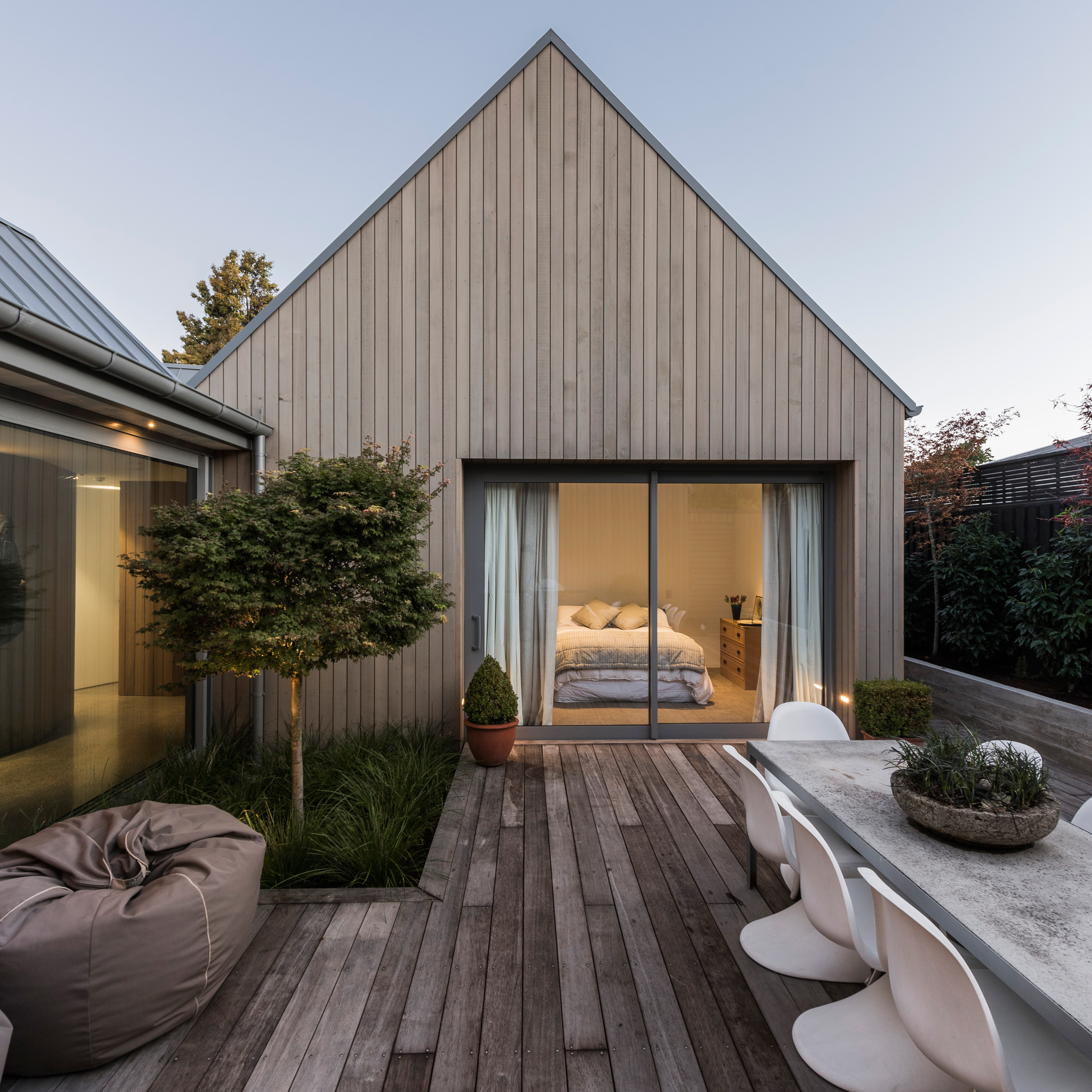
House-shaped blocks and courtyards make up this cedar-clad residence in Christchurch, New Zealand, which architect Case Ornsby designed to replace another destroyed in the 2011 earthquake (+ slideshow). (more…)


 Sig Nordal