
Casa M is a private home designed by 3C+M architettura. It is located in Bari, Italy and was completed in 2015. Photos courtesy of 3C+M architettura
Copenhagen’s Northmodern design fair will showcase Scandinavian furniture and interiors
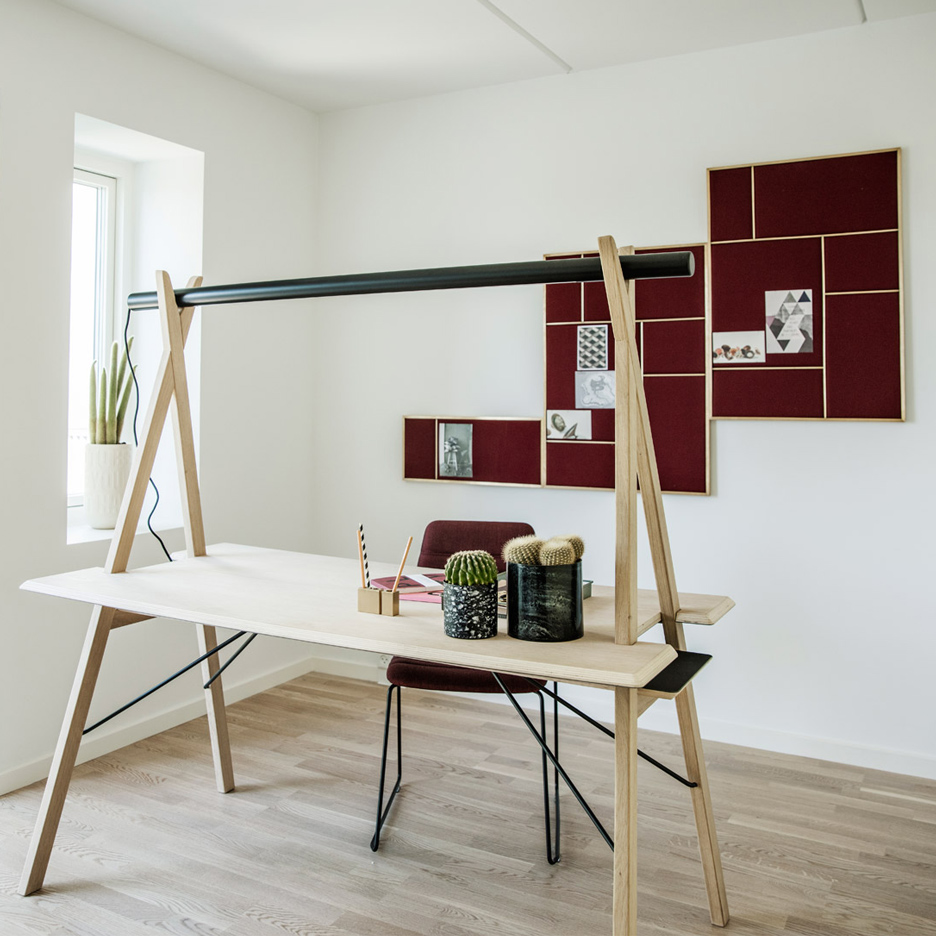
Dezeen promotion: design event Northmodern is set to present Nordic, northern European and international furniture, lighting and accessories in Copenhagen from 18 to 20 August 2016 (+ slideshow). (more…)
RAG Building / Piet Hein Eek + Amvest

© Thomas Mayer
- Architects: Piet Hein Eek , Amvest
- Location: The Netherlands
- Project Year: 2015
- Photographs: Thomas Mayer
© Thomas Mayer
From the architect. The RAG building is the first building to be realised by architectural firm Eek and Dekkers. The project fits seamlessly with the way Piet Hein Eek has been working for decades. Instead of worrying only about the design, Eek focuses on the entire process from idea to commissioning. Eek and Dekkers have found common ground in this approach. It is this command of the whole process, from concept to completion, that secures the result. This working method is characterised by simplicity, whereby existing elements are treated with respect and used as a starting point for new creations.
© Thomas Mayer
In its previous life the RAG building functioned as a pumping station, supplying the surrounding factories with compressed air and vacuum, among other things. The industrial buildings around the RAG have now made way for new build homes, so that the building has gradually become the centre of a residential area. The RAG itself has also been allocated residential status. The roof construction with riveted rafters, concrete coffering (‘bims’ plates) and large industrial steel windows give the building a unique character.
Ground Floor Plan
The concept for the development of the building was itself embedded within the building. A low-rise construction was realised across the full length of the façade on the south side of the RAG building in the sixties. The roof of this low rise formed a perfect roof terrace for the adjoining living rooms and kitchens. It was obvious that the living rooms should be situated under these beautiful roof structures.
© Thomas Mayer
As the building is so large, the plan with a terrace on the roof of the adjoining construction was a virtually perfect solution for the section adjacent to the facade. But what to do with the other section? After a, in retrospect, remarkably long period of deliberation and careful consideration, we found the solution. We decided to take out one section of the grid from the heart of the building, sacrifice two windows on either side and to remove the ‘bims’ plates. We thus created an open internal street in which the roof terraces could once again be realised to the south. The sun rises and sets beautifully over the building, parallel to the new inner street. With this intervention we were able to solve everything at once. The windows, doors and existing elements could again be 100% put to use. In the new inner street, we not only made the roof terraces but also all the necessary doors and windows. Wherever the upper floors meet the original steel windows in the outer façade, we devised a detail that allows the 30 centimetre-thick concrete package to correspond exactly with the original horizontal window frames. We respect and use the existing details and incorporate the rest in newly built elements.
Scheme
The inner street has a private-public character and is the property of the residents. They all live together under one roof, but there is no problem with privacy as the properties are south-facing. The living room wall of the neighbouring home is visible from the roof terraces of the properties in the inner street, with above it glass right up to the apex of the roof. The new window frames and facades of the inner street are all made of wood. Although we initially envisioned typical steel windows and doors, as were originally used in the building, budget cuts ultimately forced us to search for alternatives. The wooden window frames turned out to be a great improvement. Instead of imitating the old and building upon it, the numerous large glass surfaces are clearly distinguished from the existing elements. It emphasises the design and the additions – new is new and old is old.
© Thomas Mayer
The building stands upon an enormous basement that is half underground. This cellar was originally used to house supply and drainage pipes, maintenance and was also the foundation for the machines. As all existing windows and doors were based on this height, we reinstated the original level after completely demolishing the cellar. The living spaces on the ground floor are thus a metre above ground level and have a view of the surroundings, yet are not overlooked. The cellars are low, yet very serviceable as bicycle cellars and storage spaces. A ramp on the east side of the building provides access to the cellars adjacent to the central section under the inner street. The construction of the floor is as thin as possible and includes a large atrium with stairs. The atrium also provides two apartments on the ground floor with their own balconies.
© Thomas Mayer
Global Architects & Associates Design a Private Residence in Hoàng Văn Thái

A’s House Project is a private home located in Hoàng Văn Thái, Thanh Xuân, Hà Nội, Vietnam. It was designed by Global Architects & Associates in 2016. A’s House Project by Global Architects & Associates: “Separated from the noisy city, the house is humbly ensconced in a small alley on Hoang Van Thai Street, Hanoi. With an area of just over 46 square meters (495 square feet), the house is..
rivermusic: Mini Mossy Waterfall by Gary Minish…

6 Simple Steps To Take Your Life Back
Does it seem that you are being pulled in a million different directions every single day? Your spouse, your kids, the boss, your best friend, your mom. Everyone wants a piece of you, right now. The problem with all that? You forgot how to say no and you reluctantly say yes. Your life no longer belongs to you. You are at everyone’s beck and call and quite frankly, you’ve just about had enough.
The problem only exists because we let it. We’ve continually made ourselves available to every single living thing on the planet except for one. You. It seems that push has almost come to shove now and we’re ready to take our life back. How hard will that be? Whether it be easy or hard all depends on you. How bad do you want to take your life back and have time for you? Here are a few tips to help you stay on track to do that.
 1. Make a you schedule.
And stick to it. Block out a section on the calendar a few times a week or as often as you can and dedicate it as your time. No interruptions, just you and the things you love to do. Go for a walk, take a short drive in the country, watch silly movies, whatever. Turn your phone off and spend time loving you.
2. Tell them.
Let people know that you won’t be as available as you have been in the past. Make sure they know to only contact you in the case of an absolute emergency, otherwise, they can deal with the situation themselves or call another friend or family member. Make sure they respect this time that you have dedicated to yourself.
3. Shut it down.
Turn off your phone (unless someone is about ready to have a baby!) and set it aside. Let it go to voicemail. Make sure you have made yourself unavailable to all and totally available to yourself. Whoever is calling, will call back or call someone else. You don’t always have to answer the phone and you don’t always have to run when someone calls.
4. Take a solo vacation.
This is one fantastic way to discover who you truly are and enjoy your own company. You will learn new things about yourself and your surroundings, wherever they may be. You may even find a new purpose or passion while you are out on your travels. Many people who have done this, have discovered that they love to travel and learn about different cultures. This could inspire many to write, blog or do mission work.
5. Treat day.
One day a week, take yourself out to dinner, lunch, a movie or an ice cream. Have a treat day where it’s just you and your favourite thing, food, or snack. Go buy yourself some flowers or, if you’re a guy, maybe your favourite cologne or techy gadget. Whatever the case, honour yourself with a treat day. It’s important to do for yourself as you do for others. You are just as important, if not even more, as everyone else. Embrace your awesomeness.
6. Sign a declaration.
Or write a letter to yourself stating that from now on, you are taking back your life and doing things for yourself. Write about how much you love yourself and how important it is for your mental health and emotional well being to take time each week for you. Look at this letter or declaration as often as you need to, to remind yourself how important you are.
If you don’t take time to honour yourself and take back your life, you will eventually crash and burn. If that doesn’t happen, you will end up feeling resentment towards everyone you are bending over backwards for and will wind up just hating life. Period. As much as we do enjoy doing things for others it’s important to not forget about ourselves while doing so. You’ll enjoy life, your friends and family that much more.
The post 6 Simple Steps To Take Your Life Back appeared first on Change your thoughts.
Ghosts of the abandoned Orphanage by andre govia. Abandoned…

Jean Pierre Crousse to Lead Speakers at Annual Charles Correa Foundation Z-Axis Conference in Goa

Gandhi Ashram. Image © Charles Correa Associates
The second annual Z-Axis Conference, organised by the Charles Correa Foundation, will center on the notion of Buildings As Ideas. Held in the western Indian city of Goa at the Kala Academy, one of Correa’s later projects, the conference is a tribute to his memory and belief that “buildings are ideas that manifest and take form.” Jean Pierre Crousse, of Lima-based practice Barclay & Crousse, will open the conference with the keynote address; other international speakers include Camilo Rebelo, Ilze Wolff, Yung Ho Chang, Dick van Gameren and ArchDaily‘s James Taylor-Foster.
Courtesy of Charles Correa Foundation
Courtesy of Charles Correa Foundation
Courtesy of Charles Correa Foundation
Courtesy of Charles Correa Foundation
Courtesy of Charles Correa Foundation
Courtesy of Charles Correa Foundation
Courtesy of Charles Correa Foundation
Courtesy of Charles Correa Foundation
Courtesy of Charles Correa Foundation
Courtesy of Charles Correa Foundation
Courtesy of Charles Correa Foundation
Courtesy of Charles Correa Foundation
Courtesy of Charles Correa Foundation
Courtesy of Charles Correa Foundation
Courtesy of Charles Correa Foundation
Courtesy of Charles Correa Foundation
Courtesy of Charles Correa Foundation
Conference Timetable. Image Courtesy of Charles Correa Foundation
You find out more about the conference, which will run between the 1st and 3rd September 2016, here. Public registration is online here.
Felice Varini creates optical illusion on roof of Le Corbusier’s Unité d’Habitation
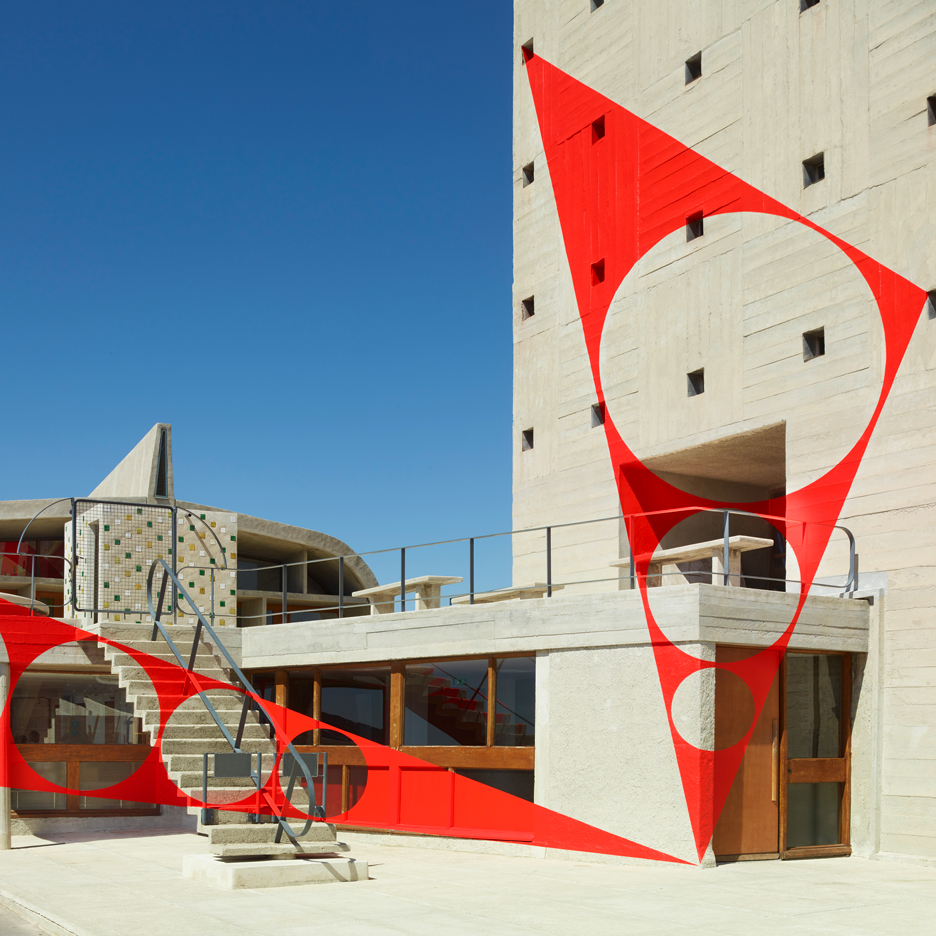
Swiss artist Felice Varini has used brightly coloured paintwork to transform the rooftop of Le Corbusier‘s iconic Unité d’Habitation in Marseille into a huge optical illusion (+ slideshow). (more…)
Asse Landform / ORG Permanent Modernity + C2O Architects

© Filip Dujardin
- Architects: ORG Permanent Modernity + C2O Architects
- Location: Asse, Belgium
- Area: 8100.0 sqm
- Project Year: 2014
- Photographs: Filip Dujardin, Franki Construct
- Consultants: Grontmij NV (Structural, Mechanical), Venac (Acoustics)
© Filip Dujardin
The project is the result of a competition initiated in 2009 by the Town of Asse, Belgium for a regional fire station and a youth center. The site (a brownfield of formerly asphalt production industries) is located on the outer edge of the Town Center. Beyond the ring road the landscape is open, rural. A “land-form” concept was developed as a means to preserve existing landscape features and create a dialogue between the new buildings. The land form is scaled appropriately to the landscape and organizes the new buildings – a youth center and a fire station – into one common shape. As a singular and bounded entity, the form does not suggest sprawling growth in any direction, but rather offers a clear vision for future landscape, infrastructure and building decisions.
Diagram
A subtle bend in the landform and building denotes the principal entrance to the site. A clear solution had to be found for addressing the public functions given the multiple buildings (where is the front door?). As opposed to a strip of buildings with a parking lot to serve as the main orienting device, a public plaza between the youth center and the fire station serves as a formal front. Custom pavements, markings, road obstacles, street furniture, lighting, local trees and plant species, and a smooth topographic contour break down the scale of this large universally accessible plane.
© Filip Dujardin
© Filip Dujardin
The plaza acts as a ‘town square’, gathering and distributing the many building users: pedestrians, cyclists, cars, buses, emergency vehicles, and fire trucks. Both the fire officers and youth center have staged public events and festivals in the square. It is within the public plaza where a fundamental ideological basis for the project is confirmed. Upon entering the plaza: the site, form, and scale akin to a “Big-Box” setting are designed to create a civic environment.
Plan
Plan
The Fire station has a solid, sober, and functional appearance and maintains a banality characteristic of Big Box typologies. Building voids in and around the programmatic spaces reveal the buildings economical and repetitive construction logic. However, through detailing precision, material joints, alignments, and finishes –any sense that this is a conventional building technology is disrupted.
© Filip Dujardin
© Filip Dujardin
Within the building, a circulation corridor cuts through the programmatic spaces, extends vertically via a long continuous stairway, and follows the curve of the building. The upper levels, which house the private living and sleeping quarters of the fire officers, are formally distinguished. Four volumes, each with different functions (kitchen, dining, private rooms, gymnasium), roof slopes, and separated by roof gardens are supported and punctuated by red painted glue laminated beams.
© Filip Dujardin
 Sig Nordal