Binh House / Landmak Architecture


© Le Anh Duc

© Le Anh Duc


© Le Anh Duc


© Le Anh Duc


© Le Anh Duc


© Le Anh Duc

  • Architects: Landmak Architecture
  • Location: Hòa Lạc, Thạch Thất, Hà Nội, Vietnam
  • Architect In Charge: Ta Tien Vinh, Truong Tuan Chung
  • Project Year: 2015
  • Photographs: Le Anh Duc
  • Design Team: Le Minh Hoang, Ngo Hung, Tran Viet Phu, Nguyen Thao, Vu Nam Son, Pham Dinh Hanh, Dang Viet Anh

© Le Anh Duc

© Le Anh Duc

From the architect. This house is built on a bad land shape which is separated from the narrowest part of a large land. It has ugly shape and is most cramped. In suburban, people often build houses on very large land plots, therefore, the small area (in comparison with the land in this area) is paid less attention to build a house.


© Le Anh Duc

© Le Anh Duc

It is almost abandoned until a young man buys it at cheap price. He is my relative and he would like me to design it. We face the situation that the land is located far from center and local construction workers are not professional and illegible with architectural drawings.


Section

Section

Section

Section

It is really hard for us to develop a special concept with much details when implementing. We have considered the designed solutions so much and finally we choose a very practical and minimalist concept. A skin is made of brick with hollow to create the void in the most tapering angle in front of the land, it is used for planting trees to provide privacy to the interior, separates from road but still enables good ventilation and lighting for the living room and the front façade. At the back of land, in the most tapering edge, a void is created and we make a concrete panel which is hung 70cm above ground with the cupboard below and the garden above. This design enables the light, ventilation, and creates depth for kitchen and dining room (originally it is very narrow area).


© Le Anh Duc

© Le Anh Duc

The remaining spaces are bedrooms, stair, roof, toilets which are designed minimally and practically to maximize space utilization and minimize construction cost.
The house is complete with the joy of the host and create new exciting atmosphere to residents walking across the road in front of the house.


© Le Anh Duc

© Le Anh Duc

http://ift.tt/2apmMLk

Hampshire, Englandphoto via courtney

Hampshire, England

photo via courtney

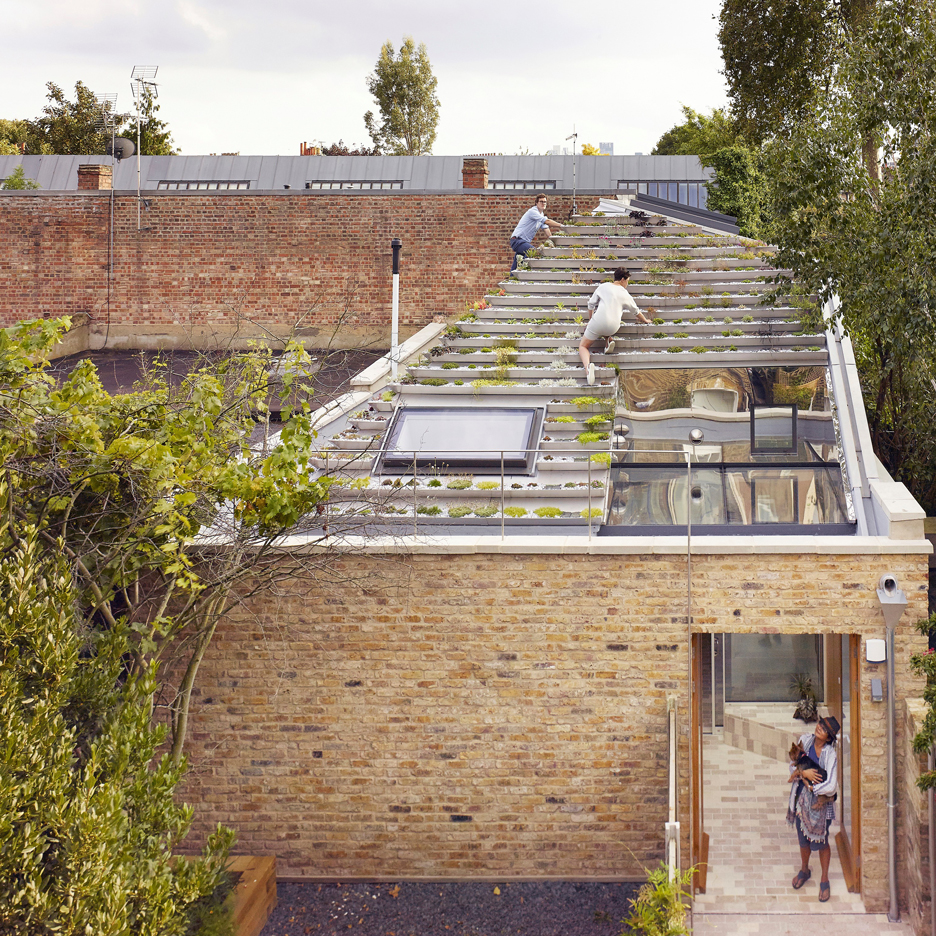
Hayhurst and Co creates “hanging-basket roof” for designers’ home and studio


Architecture studio Hayhurst and Co has built a home and studio for leading leather-design duo Whitaker Malem, featuring a steeply stepped roof covered in over 800 plants (+ slideshow). (more…)

http://ift.tt/2aUFcsw

Nashare Hotel / C+ Architects + Naza design studio


© Xu Xiaodong

© Xu Xiaodong


© Xu Xiaodong


© Xu Xiaodong


© Xu Xiaodong


© Xu Xiaodong

  • Interior Design: Deep design consultant
  • Lobby Furniture And Art Display: Fang Xiaofeng

© Xu Xiaodong

© Xu Xiaodong

Capturing Views of the Sea From the Forest

Nashare Hotel locates in a forest beside Huandao south road in Xiamen of China. It is facing Taiwan Canal by the most popular Huandao Road beach and just ten minutes drive from the attractive cultural town – Zengcuoan. The hotel is built in a tranquil space consisting of acacias, pines and natural stones far away from the city. It’s an ideal hidden world for relaxation.


© Xu Xiaodong

© Xu Xiaodong

Isolated Relaxation Environment

Nashare, related to “Naza Hotel” design series, has only 12 rooms and the vast majority of which are independent units. Every unit has a separated entrance and courtyard to ensure quiet and private home spatial experience. In addition, the magnificent ocean and forest could be seen from all rooms.


plan

plan

Design Intention

The relationship between the nature and design is achieved by elaborate design control in cooperation with environment. Creating an appropriate space to engage with nature is the main idea of Nashare. The house is the space carrier; therefore, “Invisible container” is the design concept.


© Xu Xiaodong

© Xu Xiaodong

There are two room types. One is renovating the existing space, including container refurbishment. Another is placing the container on the hill after renovation. The rocks and trees create a great view for all rooms. Furthermore, the renovation and placement of containers are environment-friendly. In terms of the landscape, keeping an original status is achieved by reducing artificial elements and blurring the boundary between the architecture and surroundings.


© Xu Xiaodong

© Xu Xiaodong

Dotted single unit congregates on site as a cluster, and each of them could completely engage with nature. Due to the level change, every unit has different height. Consequently, it looks like a vertical cluster. Although the house is separated from each other, they are connected by the path and views. Architecture as an “invisible container” is to emphasize the experience of nature. 


© Xu Xiaodong

© Xu Xiaodong

Exposed facade is painted in dark gray to merge into the shadow. In comparison of exterior gray, the interior warm wood color could reflect soft light to create a relaxing atmosphere especially at night. The design from space to furnishings is plain and unvarnished.


© Xu Xiaodong

© Xu Xiaodong

Creative Space for Design and Art

The purity of environment provides an opportunity to present the design and art in Nashare. The hotel collaborates with designers, artists to provide a space for creation, displaying and communication. The space could host painting and photograph exhibitions and salons to combine relaxation and meditation in such a natural environment.

http://ift.tt/2aBuLZc

House MS / Heinrich Lessing Architekt BDA


© Achim Reissner

© Achim Reissner

© Achim Reissner

© Achim Reissner

The task was to design a house within the middle of the existing village Budenheim close to Mainz. We kept the volume of the existing building although we could not maintain the whole substance. 


© Achim Reissner

© Achim Reissner

Plan 1

Plan 1

The old sheds gave us an idea of what the relation between the new volumes should be. The existing walnut tree supported the concept of keeping the courtyard. The heights of the house are orientated toward the neighbor’s heights.


© Achim Reissner

© Achim Reissner

Plan 2

Plan 2

The new house got space for two children, a big living room including a kitchen and the eating area. The parents have their own rooms in the volume with the flat roof. All rooms are orientated toward the courtyard with the walnut tree.


© Achim Reissner

© Achim Reissner

http://ift.tt/2aUwomq

Thalhimers, abandoned Cloverleaf Mall (now demolished) by Ayne…

via Abandonedforgotten http://ift.tt/2aYJiwZ

Sketchfab Strengthens Commitment to Virtual Reality With New Features


Image adapted from screenshot of San Carlo alle Quattro Fontane model by Matthew Brennan

Image adapted from screenshot of San Carlo alle Quattro Fontane model by Matthew Brennan

Online model sharing site Sketchfab last week announced three new features intended to solidify its position as one of the web’s foremost platforms for sharing VR-viewable 3D models online. Originally launched in January of this year, the virtual reality features of Sketchfab’s platform have proven to be popular and has even led to Sketchfab being referred to as “the Youtube of VR.”

However, with its initial launch Sketchfab’s VR capabilities clearly privileged simplicity and a low barrier for entry—the platform was viewable using just a smartphone web browser and basic VR headset such as Google Cardboard, and models required no extra work to make them VR compatible. As a result, Sketchfab’s VR platform lacked the features of more high-end systems of viewing VR. With their latest update, Sketchfab has added useful features while keeping barriers to entry low.

The new features launched are:

Teleportation within the model

Previously, moving around a model while in VR mode was impossible without removing the headset and swiping your way around the model with your finger. Now, Sketchfab has implemented a simple “look and click” teleportation system which allows you to position yourself on any flat surface simply by looking at it and clicking the built-in button on Google Cardboard or any other headset.

VR Scene Editor

While Sketchfab automatically enables any model to be viewed in VR, effectively showing a model in VR is a lot more complex than adding stereoscopic vision and a motion tracker. Sketchfab has now added a built-in VR scene editor to the model settings which allows designers to set things such as the correct eye-height to view a model—an indispensable tool for architects wanting to give a realistic experience of interiors.

In-headset browsing

Finally, Sketchfab has added a system to browse their vast library of models without the tedious task of removing the headset between each model. Using the same “look and click” system as the teleportation feature, users can now navigate from within the headset itself.

Find out more about Sketchfab’s new features via their blog post.

http://ift.tt/2aRjgNG

Deodoro Olympic Park Rio 2016 / Vigliecca & Associados


Courtesy of Divulgação Ministério do Esporte

Courtesy of Divulgação Ministério do Esporte


Courtesy of Divulgação Ministério do Esporte


Courtesy of Divulgação Ministério do Esporte


Courtesy of Divulgação Ministério do Esporte


Courtesy of Divulgação Ministério do Esporte

  • Technical Coordinators: Ronald Werner (Master Plan/Arena da Juventude), Fernanda Trotti (Parque Radical), Kelly Bozzato (Centro Olímpico de Hóquei), Rafael Alcântara, Pedro Ichimaru (Hipismo e Readequações)
  • Landscape: Raul Pereira e Rulian Nociti
  • Design Team: Ana Luiza Galvão, André Ciampi, André Godinho, Angélica Larocca, Barbara Iseli, Carolina Passos, Cintia Marino, Dalmer Ordontis, Daniel Pizzocolo, Fabio Ucella, Guilherme Filocomo, Guilherme Maia, Hernani Paiva, Juan Sebastián Longhini, Julio Bastos, Lina Corrêa, Lucia Viana, Lucila Pintos, Maria Elisa Fernandes, Mariana Puglisi, Marina Piccolo, Rebeca Grinspum, Renato Silveira, Romildo Barros, Thaís Velasco
  • Operational Support: Neli Shimizu, Arielli Siqueira, Caroline Picolo, Deborah Giannini, Hediane Kuasne, Laryssa Cardoso, Luci Maie, Martha Martins, Paulo de Arruda Serra
  • Consultants: Focus Group (Engenharias), Robert Campbell, John Felton, Damien Dungworth (Canoagem Slalon), Tom Ritzenthaler, Johan Lindstrom (BMX), Pierre Michelet (Hipismo), David Douek, Caterina Chippari (Sustentabilidade), Raphael Magalhães, Pedro Moretti (Consultoria Ambiental), Marília Martins (Consultoria de Especificações Técnicas)
  • Capacity: 71.800
  • Client: Prefeitura do Rio de Janeiro/Ministério do Esporte

Courtesy of Divulgação Ministério do Esporte

Courtesy of Divulgação Ministério do Esporte

From the architect. The Deodoro Olympic Park has an area of ​​2 million square meters, being the largest of the Olympic areas with the second largest capacity, as it hosts 11 Olympic and four Paralympic sports modalities in the RIO 2016 Olympics. The Olympic sports are Canoe Slalom, Cycling (BMX and Mountain Bike), Field Hockey, Shooting Sport, Modern Pentathlon, Basketball (women’s only), Rugby and Equestrian (Jumping, Dressage and Eventing). The Paralympic competitions include Wheelchair Fencing, Shooting, 7-a-side Football and Equestrian Dressage.

After the Olympics, Deodoro will offer the greatest legacy of RIO 2016. Instead of just simply aiming at creating a center of excellence competitions, the project developed by Vigliecca & Associates architectural firm had as a main objective the Olympic legacy. Differently than what we have seen so far in terms of post-olympic legacies, Deodoro’s legacy goes beyond the sporting sphere. It is focused mainly on generating recreational areas for the population.


Courtesy of Divulgação Ministério do Esporte

Courtesy of Divulgação Ministério do Esporte

Considered radical sports, Canoe Slalom, BMX and Mountain Bike were grouped in the same area within the complex. An extra layer of significance was given to this radical sports complex by incorporating a public park with additional features such as a skate park, a picnic area, multipurpose rooms and elevated walking and running tracks that together make up the Radical Park, which will be the second largest public park in Rio de Janeiro. This area in particular has the largest amount of young people and one of the lowest Human Development Indexes (HDI) in the city.

The creation of the Radical Park reinforces the hope for social and sportive development for the local young community. It is predicted that Deodoro’s legacy will attend 1.5 million people living in 10 neighborhoods and 3 cities. With 490 thousand square meters, of which 60% is green space, the Radical Park showcases the importance of preserving the local vegetation that will also be enriched by new species of vegetation coming from the Atlantic Forest. It also contributes in the establishment of an emotional connection between the population and the city through an interaction with the environment.


Courtesy of Divulgação Ministério do Esporte

Courtesy of Divulgação Ministério do Esporte

This is a unique situation that offers the opportunity of an important shift for the population as well as a consolidation of one of the most symbolic legacies for Rio de Janeiro. An urban park in one of the most underprivileged areas of the city that fulfills its social and environmental functions in addition to connecting to the public transportation system, already available on site. A large park that is connected to the city. A public facility of metropolitan scale.

In addition to the recreational function, the Radical Park will be used as a place of education and training of athletes for the modalities of Slalom, BMX and Mountain Bike. Another legacy of Deodoro will be the Youth Arena. The building, which during the Olympic Games will host Female Basketball and Modern Pentathlon Fencing competitions, will turn into an athlete improvement training center and will continue the work that already has been developed in Deodoro, evidenced by the 2015 Pan American Games in Toronto. Almost half of the medals won by Brazil – more precisely 48% – were won by military athletes who are part of the High Performance Program of the Ministries of Defense and Sports.


Courtesy of Divulgação Ministério do Esporte

Courtesy of Divulgação Ministério do Esporte

The Deodoro Olympic Park exists since 2007, year in which it was created for the Pan American Games. One of the biggest challenges for the RIO 2016 project was to adapt existing sports facilities to Olympic standards and integrate them into the new facilities, forming a unit while making them useful and economic once used in legacy mode. The complexity of the project was enhanced by the steepness of the terrain, the presence of a railway, two roads and a river crossing the area of intervention. 

Since Deodoro covers a large area, it was divided in two sectors: North and South. The North sector is subdivided in Zones A and B while the South sector concentrates Zone C. Zone A houses the Extreme Park, including the Olympic Slalom Stadium, the Olympic BMX Centre and the Mountain Bike Olympic Park. Zone B comprises the Youth Arena, the National Shooting Centre, the Deodoro Aquatics Centre, the Deodoro Stadium and the Olympic Field Hockey Centre. The C Zone includes the Olympic Equestrian Centre, formed by the Cross Country Circuit, the Central Arena and the Groomers Village, a veterinary clinic, blacksmith, stables, a training track, the Coliseum, a hot Walker and an organic waste shelter.


Masterplan

Masterplan

 This project is the result of an international public competition which Vigliecca & Associados architectural firm, through a consortium, was the winner. The competition, sponsored by the State Government of Rio de Janeiro in 2013, determined basic guidelines for the Deodoro Olympic Park project and the general urban plan as well.


Courtesy of Divulgação Ministério do Esporte

Courtesy of Divulgação Ministério do Esporte

http://ift.tt/2aU6UVs

10 Terrific Dream Facts That Will Make You Awestruck

//pagead2.googlesyndication.com/pagead/js/adsbygoogle.js

(adsbygoogle = window.adsbygoogle || []).push({});

Ready to hear some amazing dream facts?

Raise your hand if you have found your nose stuck between books trying to understand Freud’s theories or various other interpretations to try to decipher some wild dream. Well, no shame there!

Dreams are intriguing realms of our brains. These manifestations are sometime inspired by our imagination and often by our lived experiences. In any case, they have continued to interest scientists, doctors, psychologists and laity for decades now.

Whether you know, what your dreams exactly mean or not, knowing some lesser-known facts about them is sure to satiate some of your curiosity:

//pagead2.googlesyndication.com/pagead/js/adsbygoogle.js

(adsbygoogle = window.adsbygoogle || []).push({});

1. Do I know you?

You can never meet ‘new’ people in your dreams. When you see a person in your dream, regardless of whether you recognise them or not, they are cannot be a figment of your imagination.

//c.amazon-adsystem.com/aax2/getads.js

//<![CDATA[
aax_getad_mpb({
"slot_uuid":"16dcbcd0-2124-4a85-9abe-c263dd9084e5"
});
//]]>

This means that our brain is incapable of conjuring up faces on its own. The faces that you see in your dreams are those that your brain has registered, consciously or sub-consciously, at some point.

2. Lucid Dreaming

lucid dreaming

An interesting manifestation of dreaming is lucid dreaming. As the name suggests, a person is aware that they are dreaming in such a state. They are able to interact with and control their surroundings in contrast to passive dreaming, where they are mere observers.

//pagead2.googlesyndication.com/pagead/js/adsbygoogle.js

(adsbygoogle = window.adsbygoogle || []).push({});

This psychological phenomenon has amused scientists for a long time who have developed certain techniques to train the mind to lucid dream.

3. I Knew It!

People often report that they had a premonition about a future event in a dream and have attached several superstitions to this belief. Scientists call this precognitive dreaming.

//pagead2.googlesyndication.com/pagead/js/adsbygoogle.js

(adsbygoogle = window.adsbygoogle || []).push({});

Credulity aside, this can be explained simply by the fact that a large number of events happen every day and for some dream of yours to corroborate with a recent event is not improbable. The most quoted example of precognitive dreaming is of Abraham Lincoln having dreamt of his own assassination!

4. The Science Of It

Scientist have been enchanted with how varied our dreams can be in terms of imagery and brain function. This has led to the development of the specialized science of Oneirology, which insists on understanding how our brain functions when we are dreaming.

The results of such research can lead to a better understanding of how dreams help in memory building and also give us a deeper insight into certain mental disorders.

5. Somnambulism

Yes, there is a fancy word for sleepwalking. It literally breaks down as- ‘somn’ from Latin Somnus, meaning sleep and ‘amble’, the Latin word for ‘to walk’. It is an extreme form of sleep disorder where people become capable of walking around, while still asleep. Not just that, people are known to have performed activities during sleepwalking, which they have neither skill for nor recollection of when they wake up!

A rather interesting example of such somnambulism is from London, where a 15-year girl climbed a 130-foot construction crane, all while sleepwalking!

See Also: 7 Sleeping Tips to Boost the Quality of Your Sleep

//pagead2.googlesyndication.com/pagead/js/adsbygoogle.js

(adsbygoogle = window.adsbygoogle || []).push({});

6. Dreaming Blind

The imagery in our dreams in based on what we see every day in real life. But due to their lack of the sense of sight, blind people experience reality and hence dreaming, differently from those who can see.

Congenitally blind people have heightened auditory, olfactory and tactile senses when they are dreaming. They also report of more nightmares, which scientists have linked to the difficulties they face in getting by in real life.

7. Game On!

Dr. Jayne Gackenbach of the MacEwan University led an extensive research programme to conclude that video game players tend to exercise more control over their dreams. This also makes gamers excellent candidates for lucid dreaming as they are attuned to responding to virtual reality.

Another conclusion she drew from a 2008 study was that gamers cope better with nightmares in comparison to non-gamers. This is because they are used to problem-solving and fighting back when faced with a scary or sticky situation, as they do when playing a game.

You now have the perfect excuse for the next time your parents ask you to turn off that Xbox!

8. Boost Creativity

dreams and creativity

Researchers at Harvard Medical School suggest that dreaming is an essential process to boost creativity and learning. Through dreams, the brain processes newly acquired information and integrates it.

This is one of the reasons why people with serious REM disorders, which render them incapable of dreaming, face serious creative retardation. So, listen to your mother the next time she asks you to have a good night’s sleep before an exam.

9. So Many Dreams, So Little Time

In the course of their lifetime, an average person can have as many as 100,000 dreams. You can have as many as seven different dreams on a single night.

This number is quite large considering that we can dream for only the duration of the REM cycle of our sleep which tends to last not more than 2 hours.

10. Oh Baby!

Women with children are more prone to nightmares than pregnant women or women who have no children. Understandably, these nightmares pertain to bad things that can happen to their children.


//pagead2.googlesyndication.com/pagead/js/adsbygoogle.js

(adsbygoogle = window.adsbygoogle || []).push({});

(function(d) {
var params =
{
id: “cb4f919c-04fa-460c-b2ff-2c7f9ecf4472”,
d: “ZHVtYmxpdHRsZW1hbi5jb20=”,
wid: “165294”,
cb: (new Date()).getTime()
};

var qs=[];
for(var key in params) qs.push(key+’=’+encodeURIComponent(params[key]));
var s = d.createElement(‘script’);s.type=’text/javascript’;s.async=true;
var p = ‘https:’ == document.location.protocol ? ‘https’ : ‘http’;
s.src = p + “://api.content.ad/Scripts/widget2.aspx?” + qs.join(‘&’);
d.getElementById(“contentad165294”).appendChild(s);
})(document);

The post 10 Terrific Dream Facts That Will Make You Awestruck appeared first on Dumb Little Man.

http://ift.tt/2ayF3bV