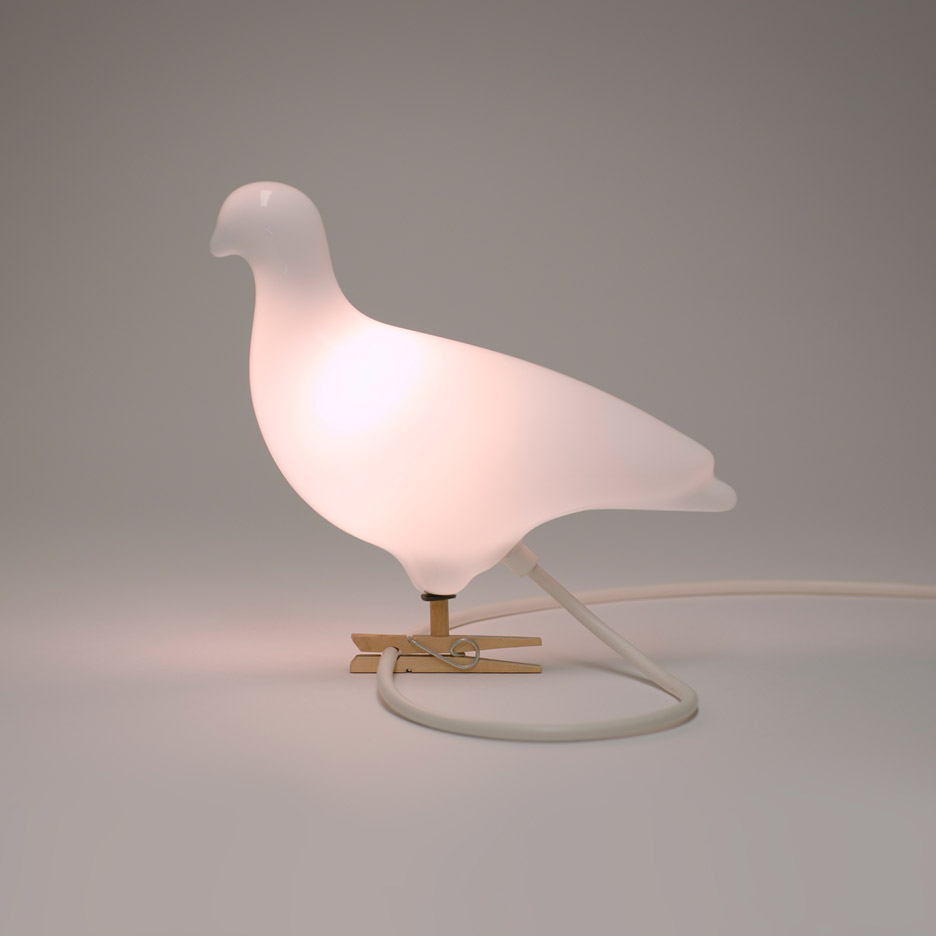
Most Loved: in our next exclusive movie, designer Ed Carpenter reflects on how the pigeon-shaped lamp he presented at his graduation show in 2001 became a bestseller in museums and design shops around the world. (more…)
Most Loved: in our next exclusive movie, designer Ed Carpenter reflects on how the pigeon-shaped lamp he presented at his graduation show in 2001 became a bestseller in museums and design shops around the world. (more…)

Czech-Republic-based firm Zavoral Architekt (ZA) has unveiled its proposal for Palach Museum, a museum and memorial to Jan Palach in Vsetaty, Czech Republic.
As a Czech dissident, Jan Palach protested Soviet invasion and communist government in Czechoslovakia in 1968 via self-immolation.
The Palach Museum will be located at the house where Palach was born in the small town of Vsetaty, and will transform the space into a triangular, two-story labyrinth. The project will additionally feature a garden space for calm contemplation.
The proposal was an entry to an architectural competition, and was awarded second place.
News via Zavoral Architekt (ZA).

The house ER is situated 70km northwest of Brasília. It dates from 2008, at the time we were contacted to make a beautiful property in the country. The challenge that we accepted in a heartbeat. After eight years we received one unexpected news. We were informed that finally the house will be built. Obviously some modification were needed, but without prejudice to the original conception of the house. They actually contribute significantly to the design.
Placed in a strategic site, the house ER is situated in the highest place of the property and pointed for the contemplation of the valley that composes the unique landscape of the region. The design is simple. A pavilion of reduced spaces 250 m2 in total. The program is designed in linear shape that is accommodate between heavy stone walls, two bedrooms, one bathroom, living room/dining room, kitchen and open service area. This part of the program is under the ceramic roof witch configures the horizontal planes of the house in opposition to the vertical ones on the stone walls. The garage, under a concrete roof and the service area under a concrete pergola, they are located in the two extremities of the house and are self-contained by another two stone walls.
The openings established by the doors and windows follow the same principle based on a composition of planes, that give unit to the house. They were carefully placed so the viewers could grant a harmonic rhythm, characterized by the open and closed planes of the same size that define the façade and its austerity to the architectonic expression of the house. It’s worth to mention that the windows placed along the lengthwise of the house, placed in the same position but on opposite sides to ensure the constant ventilation and thermic comfort to the house interior. They have double packing. The first in glass and aluminum frames, the second by the pantograph wood frames that make full-time ventilation possible and privacy when needed. They open to the exuberant landscape and embraced by the wood deck that allow an extension of the house itself into an external balcony protected by the ceramic roof.
The materials were defined by the stone, wood, concrete and ceramic roof tiles. Rustic materials to give the house the perfect consonance to it site. “…A house in a country site, in the landscape of the cerrado.”

The notion of the “Primitive Hut” has been part of the architectural discourse for decades; indeed, history suggests that it provided the Ancient Greeks with direct inspiration for Doric Order. But how do you build a wattle and daub hut, or create tiled roof, or develop primitive underfloor heating—all from scratch—today?
A YouTube channel aims to demonstrate that, even in the 21st Century, these skills haven’t been entirely lost. Its creator—whose identity is unknown and is based in the far north of Queensland, Australia—describes primitive technology as a “hobby” in which he “makes things in the wild completely from scratch, using no modern tools or materials.” This is the strict rule, he continues: “if you want a fire, use fire sticks; an axe, pick up a stone and shape it; a hut, build one from trees, mud, rocks.” The challenge lies in seeing how far he can go without the need for the types of tools the building industry relies on today.
Read about the full process, here.
Read about the full process, here.
Read about the full process, here.
You can support the project on Patreon.

Apartment in Alfinach is a private home designed by rh Studio. Covering an area of 753 square feet, the home is located in Valencia, Spain. Photos by: Rafael Ochando Fons

Sonder is the word to describe the phenomenon that occurs when you realize and acknowledge that everyone around you is living a life as detailed and complex as yours. When you are walking to the subway or parked in traffic waiting for the light to change, sonder is what happens when your thoughts deviate from your own inner monologue to that of others. Sonder is what happens when you are walking through the streets of your city with a bag of groceries and a nervous twitch in your head reminding you of that accidental text you sent, that time you forget to say goodbye and that awful situation that happened at work, when you look up and realize that all the hundreds of other people you see around you are experiencing the exact same phenomenon at the same time as you.
The term sonder itself is a recently coined phrase, created in the blogosphere and not seen before. As much as it is a trend word, now that the concept has been brought to the attention of millions, it should not be played down and its thoughtful ramifications should be properly considered.
When we are down and out we become rather selfish, and for good measure, as when our mind and bodies experience what we see as stress, it is our duty to look inward to defend ourselves as humans and seek strength and prosperity. We become a turtle and use our shell to distance ourselves from other outside stressors, in order for us to overcome the ones we are currently feeling. It’s a defensive mechanism and a soothing technique too. When we are vulnerable we are not in a position to positively help anyone else, and we tend to see things from a one track mind.
The concept of sonder, which roughly means to probe or to search in French and German, respectively, gives us respite from our social withdrawal, which is a great way to overcome any fleeting bad energies we are carrying at the time. We all have bad days, but it is not healthy to dwell on them, and we should do that as little as possible. When you are having a dim reflection of your current day or life events, look around you and consider all the other people enduring the same heavy feelings you are; or better yet, use the positive energy from all the happy people you see to motivate yourself.
Sonder doesn’t have to reflect the burdens we all carry, but also the joy we share. Sonder is the realization of the vivid lives that we all share and enjoy together. When you see someone laughing, laugh with them; togetherness and unity is what keeps us all together. It is the way for us to realize our collective ambitions – that when you are on the tram home thinking of new business ideas and writing down new ideas for your next home design or essay, someone else is too, creating and developing the world together, independently.
In order to overcome our personal demons we have to immediately replace the feelings with something else. An act of selflessness is the perfect solution. Instead of focusing on why you are having a bad day, transit your mind to think of other people around you. Consider what they might be experiencing in their day to day life; do not use it as a comparison to make up fanciful stories that let you rest your head, but as something to think of and help you overcome your own struggles more confidently.
This concept allows us to think better of people. At one fancy restaurant I worked at, I remember our manager hired a new bartender who was tall, obese and otherwise quite sloppy. He had sloppy hair and wore his unfitting cloth es in a sloppy manner, while the rest of us were quite well to do. He had a good high English accent, but no one could overcome his uncouth style and manners.
I saw what was happening as none of the other staff members gave him any positive attention, so I made the effort to become very nice to him and welcome him to our staff family.
It quickly turned out that despite his sloppy looks, he was a world class bartender with an excellent taste for foods, had brilliant wit, a charming girlfriend, and quickly became one of our best friends. He made a point to me one night to mention that I was the only person that was nice to him when he started, while now he lead our friendship groups and was often the life of the party. His personality and hidden charm showed all of us not to judge a book by its cover.
Sonder is all of these things. It’s a way to allow us to get over the little things that bring our day down while we remember all the single moms on the bus working hard on their way home after a long day, the kids who are about to write hugely important exams, the people smiling for no reason, and the ability for us to look up to people we don’t know yet, but just might one day.
The post Why You Should Be Experiencing Sonder appeared first on Change your thoughts.


A tropical addition to the restaurant scene in Amsterdam East, Bar Botanique, designed by Studio Modijefsky, brings a fresh and green interior to the former local Dutch café, De Ponteneur. Located adjacent to the multicultural Javastraat, Bar Botanique Café Tropique is the place to be from early mornings to late in the evening.
Double high large windows cover the entire façade of the corner building and spill in plenty of daylight, creating a direct link between the interior and its surroundings. The windows are a focal point in the design and concept of the interior, mirrors hang from the ceiling reflecting light and the scenery. A train, running by opposite the café, creates a flickering reflection which is captured in the bar back wall with the diverse use of colour, fabric and mirror strokes.
The space has been divided and defined using railings in a playful way. Inspired by the old railings in the café, the new railings reach up to the high ceiling and create a clear path between the bar and lounge area. Warm oak plinths cover the floor while a bright green concrete floor naturally connects the different areas of the interior.
Located on the entresol and souterrain the dining area is separated from the rest of the interior. Warm pink walls, a flower press menu-board and green velvet bench rolls give the souterrain a character of its own. Custom light fixtures which are made using simple glass plates with engraved circles on them create pleasant circular shadows along the wall up to the ceiling.
A glossy ceiling creates reflections and connects the soutterain and entresol. A green tiled menu with papyrus plants stretches along the wall in the entresol. Furnished with pink marble tables, the souterrain has a spectacular view looking into the space.
Historically a gym and later a local café, the new interior takes a great part of its identity from its past. New elements in the interior are introduced such as surprising hanging elements, geometric rings holdings plants from the ceiling, bold geometric shapes, organic motifs, custom glass racks with light tubes and furniture details, which pay respect to the past.
The botanical sensation of the space is visible in the colour scheme and the organic shapes which form the bar front, bar back wall, the hanging mobiles and lights. A rich colour pallet inspired by nature is used for the furniture and compliments the interior. Colorful marble table tops in green and pink stand by velvet banquets which reflect the identity of the former café in their details. A stroke of bright blue, the lounge chairs, appear in the interior in front of the bar with the brown marble top, giving it yet another colour boost. The bar front, tiled in a tropical pattern with a marble counter top is complimented by a completely custom made back bar. It consists of a composition of rounded shapes, metal mesh and light boxes, with a centre piece showcasing the bottles. A bright yellow coffee machine shines in the custom made copper coffee corner, adding another touch of colour to the space.
Plants have a strong presence in the interior. Palm trees, philodendron, ferns and monsteras create an ever changing interior. Highlighted with lamps, the plants create dramatic effects on the ceiling and walls, as the sun goes down the shadows become more present and the bar life begins.
Logo design and identity has also been completed by Studio Modijefsky. A custom font has been designed for the logo to reflect the playful nature of the concept, it appears in the interior on custom signage. The logo wraps around the building on the facade, each letter on a window forming BAR BOTANIQUE all the way around the corner. The house number, 581, can be seen on the main entrance glass door while the number 8 forms unique and custom made door handles.
The menu design follows the design principles of the interior, organic shapes and the custom font have been used to make collages. Organically shaped, the forms on the menu take their colours from the interior design. The collages form an artwork which is used as a canvas to design a random, unique and tropical menu for this botanical café.

Atelier HAKO Architects has squeezed a three-storey house onto a four-metre-wide site in Tokyo, suggesting that skinny houses are still the rage in Japan (+ slideshow). (more…)
 Sig Nordal