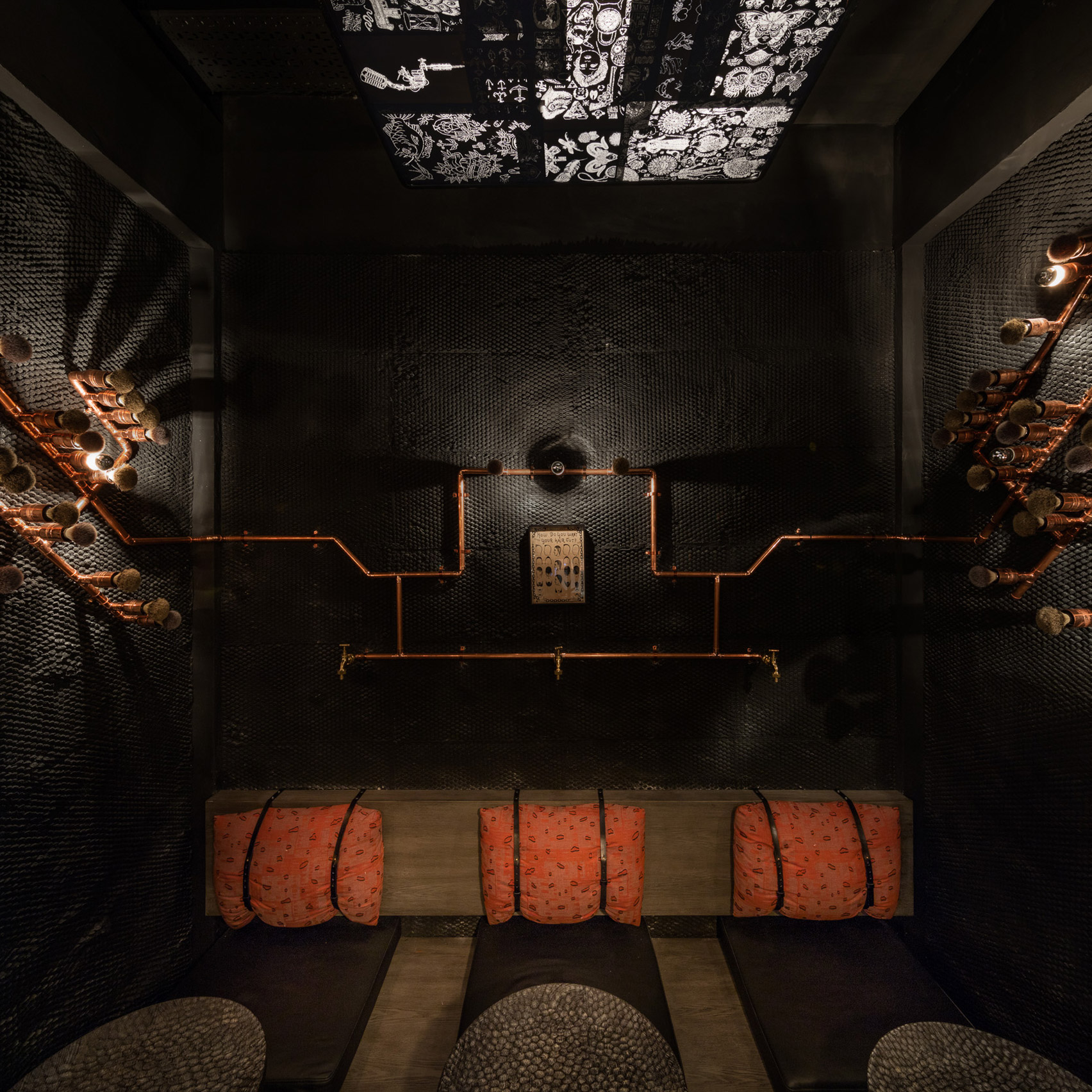
Joyce Wang Studio‘s latest restaurant in Hong Kong features burnt walls, a chandelier made from smoked washing-machine drums and a barbershop-themed den (+ slideshow). (more…)
Joyce Wang Studio‘s latest restaurant in Hong Kong features burnt walls, a chandelier made from smoked washing-machine drums and a barbershop-themed den (+ slideshow). (more…)


Satellite Architects have designed a pixelated facade for Designjunction temporary exhibition space at Cubitt House in Kings Cross, London. The facade combines natural and artificial elements by wrapping a reflective, gridded screen on top of a second screen of trees and bushes, allowing the foliage to peek through.
It is the combination of the natural artificial elements that Satellite Architects believe “reflect the temporary nature of the Design Junction exhibition.” The array of pixelated panels merges the obvious structural system with reflections of the context and glimpses of nature, softening the strength of the grid.
The reflective elements amplify the facades presence, multiplying the natural elements to give the feeling that visitors are “passing through the shrouded foliage” as they pass through to the exhibition. The panels are composed of an integrated wayfinding device, guiding visitors to the entrances.
The facade will be constructed in early September this year, in time for the Designjunction Festival which runs from 22-25th September in Kings Cross, London. The exhibition has been organized as part of the London Design Festival.
For more information on the exhibitions, check out the Designjunction website.
News via Satellite Architects.


Art, the new face of academia to the city.
As part of an ambitious master plan, Pontificia Universidad Javeriana has been conducting a series of architectural competitions with the aim of boosting its urban and architectural development for the next 20 years in a spirit of high creative, spatial and technological quality. Gerardo Arango S. J. Building, home of the School of Arts was the first in this series of buildings by competition and as such was intended to represent in its location and construction these new values that the university wanted to project to the city and the country.
To this end the southern edge of the campus was chosen, in direct relation to Enrique Olaya Herrera National Park. From early on the project took as its greatest asset this privileged location and entered the competition as the new door to the university that is open to the city through the park creating new roles for the university as an open and highly active institution in Bogota.
The project is a new stage for the arts and innovation thus enhancing the natural condition that the park has to collect and concentrate different activities of social and urban life of this capital city. We have designed a building for the creation of new arts that supports diversity and enhances social exchange through art as a tool for reflection of the new realities that the country is ready to face.
The implementation and arrangement of the parts of the building has the additional attribute of integrating into a new public space the buildings that circumscribe it on the north, east and west sides. Tower and platform are the elements that enable the project to achieve this goal. A platform that is very closely linked to the park and topography and is above all the extension of public space between the university and the national park as a new plaza. In the center of this new public area grows the tower that finishes configuring the plaza to relate buildings that surround it, generating a new scale for the whole.
The tower is in turn divided into three volumes representing in their materiality and disposition each of the disciplines that make up the proposed school, generating a set of three autonomous worlds that are related through circulation, gaps and perspective connections vertically throughout the building.
Following this logic, the world of visual arts associated with light is arranged in the last levels to take advantage of natural light through the overhead lighting provided by large skylights along with a translucent facade built from U-Glass that allows natural light to fade evenly. The classrooms are designed as flexible, generous and high spaces, with finishes that have been designed so that students can intervene them freely.
The second world, of silence and music, is constructed as an introverted space in gloom that offers a more private experience, a propitious space for music practice, for this reason the materiality of it has been thought of as more dense and solid. for which we use GRC panels on the facade and interior walls, which together with fewer openings to the outside gives that particular atmosphere to the building.
On the platform, dominating the new horizon that the building proposes and relations with the outside, a transparent and multiple world, a double-height space that allows the relationship between the three disciplines, a large gallery as a backdrop to the park and the city where students can dialogue through art with established artists.
Finally on the platform we locate the world of movement, represented in the performing arts and for this purpose contains large classrooms and auditoriums as well as the administrative offices of the school that are separated from the classroom by a large interior staircase as an open street that draws the topography and is offered as public bleachers in direct relation to the exterior surface. These worlds are offset in large overhangs of 5.5 meters to the south and and north forming access thresholds as well as large urban balconies and generating space for peripheral stairs ascending in a spiral, promoting a space with movement, clear spatial contrasts in the atmospheres of each discipline and in relation to the distant landscape of the city.
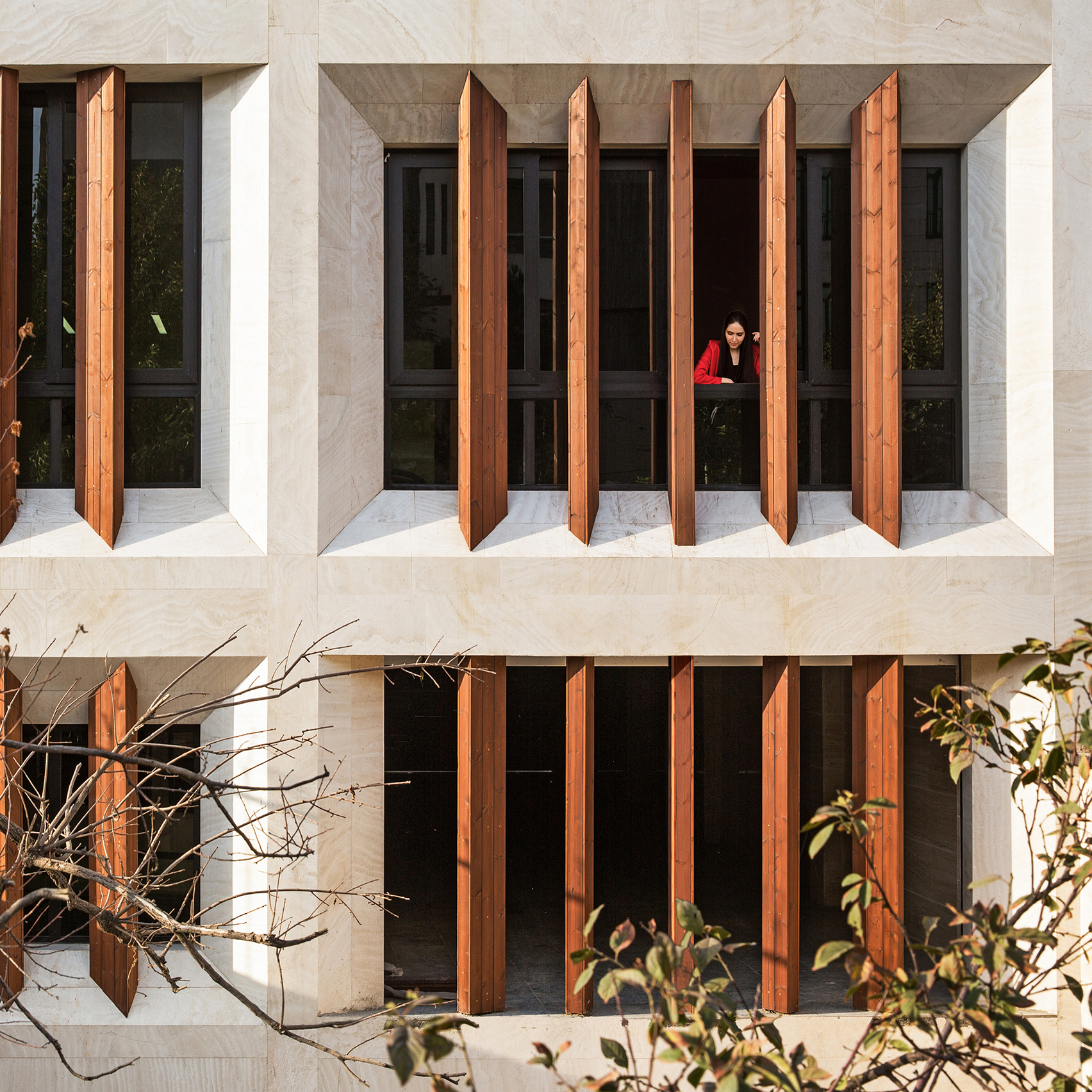
Faceted recesses in the stone-clad facade of this office building in the Iranian capital, Tehran, contain wooden louvres that provide shade to the large windows behind (+ slideshow). (more…)

Form4 Architecture has won first place at the International Design Awards for its project, Sea Song, which additionally was honored by the Green Good Design Awards presented by The European Centre for Architecture, Art, Design, and Urban Studies, in collaboration with The Chicago Athenaeum’s Museum for Architecture and Design.
Located in Big Sur on the coast of California, Sea Song is designed as an unobtrusive form to the natural landscape. “Likened to a trio of gliding Manta Rays, its environmental footprint is virtually null, being raised on a cantilevered podium.”
To further its goals of sustainability, the project is additionally designed to be self-sustaining, net-zero energy, and is aiming for LEED Platinum certification via technologies such as photovoltaics, self-cleaning glass, rainwater retention, and xeriscape.
Learn more about the project here.
News via Form4 Architecture.

San Juan Island – Washington – USA (by annajewelsphotography)
Instagram: annajewels

The 2016 European Architecture Students Assembly (EASA) has concluded in Nida, Lithuania. Centering around its title theme of “Not Yet Decided,” the two-week event included 35 workshops, with over half of the results still available to view around Nida. Among the most noticeable are “Highlight,” a 10-meter tall observation tower close to Nida’s lighthouse, a “nomadic theater” named “Atmosphere,” a relaxation space known as “The Living Room” at the end of a pier, and a sculptural seating installation on the beach known as “Dream Dune.” Read on to see images of all the completed installations.
EASA 2016 was organized in cooperation with the Neringa City Municipality, the Curonian Spit National Park, Lithuania’s Universities, The Architecture Fund, The Culture Support Fund, and various architects, private and public companies, and institutions. In 2017, EASA will head to Denmark, where it will enliven the town of Fredericia.
 Sig Nordal