5 Kindergartens / colectivoMEL


© colectivoMEL

© colectivoMEL


© colectivoMEL


© colectivoMEL


© colectivoMEL


© colectivoMEL

  • Architects: colectivoMEL
  • Location: Guiné-Bissáu
  • Construction: Barrote
  • Authors : Hugo Dourado, Ana Baptista
  • Area: 200.0 m2
  • Year Of Project: 2016
  • Photographies: colectivoMEL
  • Employer: Fé e Cooperação (NGO)
  • Funded By: Instituto Camões, União Europeia

© colectivoMEL

© colectivoMEL

The Environment

We thought of this project watching the environment, the sun, the marks of the rain, the wind and the children. In Guiné-Bissau our concepts are abstract.
There the architecture is made up of two parts, inner space and outer space with transitional space codes.


© colectivoMEL

© colectivoMEL

The interior is intimate shelter!
It’s a place for protection, dark, windowless and small. It’s mass and matter.
The exterior is the stage of all happenings! Outside bodies are washed, hair is cut food is prepared and eaten, one remains expectant watching the action that unfolds in exterior of the houses, people play, talk, grow up, marry.


© colectivoMEL

© colectivoMEL

These two spaces, indoor and outdoor are limited by the coverage that is the maximum expression of vernacular architecture.The cover protects the interior from rain, the exterior of the heat and marks building in Nature.


Floor Plan

Floor Plan

Concept
We took the lesson from “djemberens”, a cover that houses a “djumbai”. That cover houses the action, of a child painting the tree that sees projected on the curved wall of a child who discovers two distinct sounds when walking the steps with different materials. of four children who discover their reflection in the mirror and they laugh. of other children running through the narrow walls that resemble a maze and do not see another one that hides in a small niche of two dozen children aware listen to “The Silence of the Agua” from J. Saramago in the room open to the cashew trees. Mass and matter at service of children, stimulating them. A Garden space where birds fly and sing, and so do children.


© colectivoMEL

© colectivoMEL

The project is developed according to the North / South axis in its larger facades, considered the most favourable orientation in order to control insolation. The spaces largely open and covered help ventilation and prevent overheating. The large sloped roof protects the structure during the rainy season. The kindergarten buildings integrate with school pre-existing buildings, and promote the control of exterior spaces, forming the ground for the school environment. The project respects Nature integrating wherever possible the pre-existing trees and enjoying their shading as part of the project.


© colectivoMEL

© colectivoMEL

The choice of materials was based on the observation of the various local construction systems, resource efficiency, durability and use of the local empirical knowledge. The constructive options solve and prevent problems such as overheating or flooding, termite invasion and degradation caused by the use and the strong climatic characteristics. We used a mixed structure of iron and wood profiles, which limits the space and support a thatched cover.


© colectivoMEL

© colectivoMEL

The kindergarten is prepared at its base to house 100 children divided into two shifts, 50 children per shift and follows the defined dimensions of 1,5m2 per child dimension to which we added 1m2 of covered outdoor space. Each room is designed for a maximum of 25 children, and in those cases where it is necessary to accommodate 150 children, the space grows, forming another room.


© colectivoMEL

© colectivoMEL

The whole project is designed in order to involve the community from the first moment of conception to materialisation of the proposal, with the objective to promote ownership and identification of users with the equipment that we propose.

http://ift.tt/2bfm2c0

Shed Roof House / Hiroki Tominaga-Atelier


© Takumi Ota

© Takumi Ota


© Takumi Ota


© Takumi Ota


© Takumi Ota


© Takumi Ota

  • Architects: Hiroki Tominaga-Atelier
  • Location: Yamanashi Prefecture, Japan
  • Architects In Charge: Hiroki Tominaga, Yae Fujima
  • Area: 112.66 sqm
  • Project Year: 2014
  • Photographs: Takumi Ota

© Takumi Ota

© Takumi Ota

From the architect. This is the second house at the foot of Mt. Fuji. Because of deep forest, we can’t see the shape of mountain, but the south side of the site is a part of Mt. Fuji.

The Client wants to make Loft space, so we decided Shed roof which is opened to Mt.Fuji.


© Takumi Ota

© Takumi Ota

On the other hand, if we chose the shed roof, heavy snow falls to the north side of the house in winter, and north entrance will be buried in snow.


Section Detail

Section Detail

So we started redesigning the roof from regarding the Shed roof as one plate which drops snow and rain. We fixed the slant of the roof, but fold it In a longitudinal direction, to redesign how to drop snow and rain.


© Takumi Ota

© Takumi Ota

Approach terrace penetrates into the house volume and it divides this house to two volumes.


© Takumi Ota

© Takumi Ota

The shed roof is folded in the mountain fold over this entrance approach, so snow and rain fall beside this approach. When we fold it in the valley fold, we can gather the snow beside the parking space. On the rainy day, we can see the rain fall from the valley of the roof from the picture window.


1st Floor Plan

1st Floor Plan

In the lounge space surrounding wood stove, we can find the Valley of ceiling in the big room. It divides one room gently, then we started to consider how to use the space.


© Takumi Ota

© Takumi Ota

As response to the roof design, the slop and step is installed into the house, it is like another landscape for the clients who loves the outdoor life for example trekking or mountain bike.


© Takumi Ota

© Takumi Ota

© Takumi Ota

© Takumi Ota

Loft space connects two volume of the house, and also act as the daylighting space and ventilation wind tunnel which keeps room condition comfortable in the passive way.


© Takumi Ota

© Takumi Ota

http://ift.tt/2c4zN2R

Marimba House / ISON Architects


© Kim jong oh

© Kim jong oh


© Kim jong oh


© Kim jong oh


© Kim jong oh


© Kim jong oh

  • Architects: ISON Architects
  • Location: Yeonhui-dong, Seodaemun-gu, Seoul, South Korea
  • Desing Team: Jean Son, Minji Kim
  • Area: 369.91 sqm
  • Project Year: 2015
  • Photographs: Kim jong oh
  • Construction: STUGA

© Kim jong oh

© Kim jong oh

This house is for a residence and a studio of the percussion musician. Four plots are arrayed facing one another alongside two streets and in two houses on each plot parents and grandmother of the musician are already reside. Two plots are still empty and on two empty plots, houses would be planned. 


© Kim jong oh

© Kim jong oh

We started from the placement of this house as a part of the masterplan based in the idea that one individual house on each and every plot. Eventually four houses for 3 generation were arranged around a courtyard in the center. Each house were consist of a low pitched roof on the first floor gathering toward the courtyard and a mass -placed on the upper floor of the low pitched roof – at the corner side toward the street.  


© Kim jong oh

© Kim jong oh

The pitched roof on the first floor is rising toward the street side and it is automatically connected to the mass on the second floor. On that mass, private rooms are placed and under the pitched roof, there are studios and living room. Studios for practicing and recording were given an open characteristic by placing them next to the inner courtyard and street since there might be frequent visitor access. We placed the living room between the studios and the private rooms to act as a loose connection.


Plan

Plan

The structure and interior of the house is mainly wooden, since the sound was the most important factor while considering the proper structure. Two elements are creating a relationship between the performance place and the courtyard, one is a long and low –height is 2.2m- opening toward the courtyard, and the other one is a sufficient –depth is 1.8m- awning continues along the front facade. In addition we set a wooden folding door –it serves for a visual depth- on the inner side of the long and low opening for controlling the sound reflection of glass. We set a skylight at the meeting point of the pitched roof and the upper mass for the effective penetration of the natural light to deep space. And also, the cube formed mass and pitched roof were separated.     


© Kim jong oh

© Kim jong oh

The cube formed mass on the second floor was consisted of rooms and terrace with a high density which is a clear contrast of spacious 1st floor. And orange-colored dry bit was applied on the exterior of this mass considering the most frequently used material in the neighborhood, the brick.  


Plan

Plan

The fence as a boundary between the street and site is emphasizing vertical line by 10mm thick iron flat bar with 100mm interval which are aliened in diverse height reacting sometimes to the mass of the house and sometimes to the courtyard for solving opening and privacy at the same time. 


© Kim jong oh

© Kim jong oh

Experiencing the unique sequence of space from street, courtyard, studio, living room on the first floor, terrace on the upper floor and finally to the dramatically opened roof top might provide rich architectural images not only to the residents but also to the visitors –mostly musicians-


© Kim jong oh

© Kim jong oh

http://ift.tt/2bEfN5p

Library of Chantilly, France photo via vivian

Library of Chantilly, France

photo via vivian

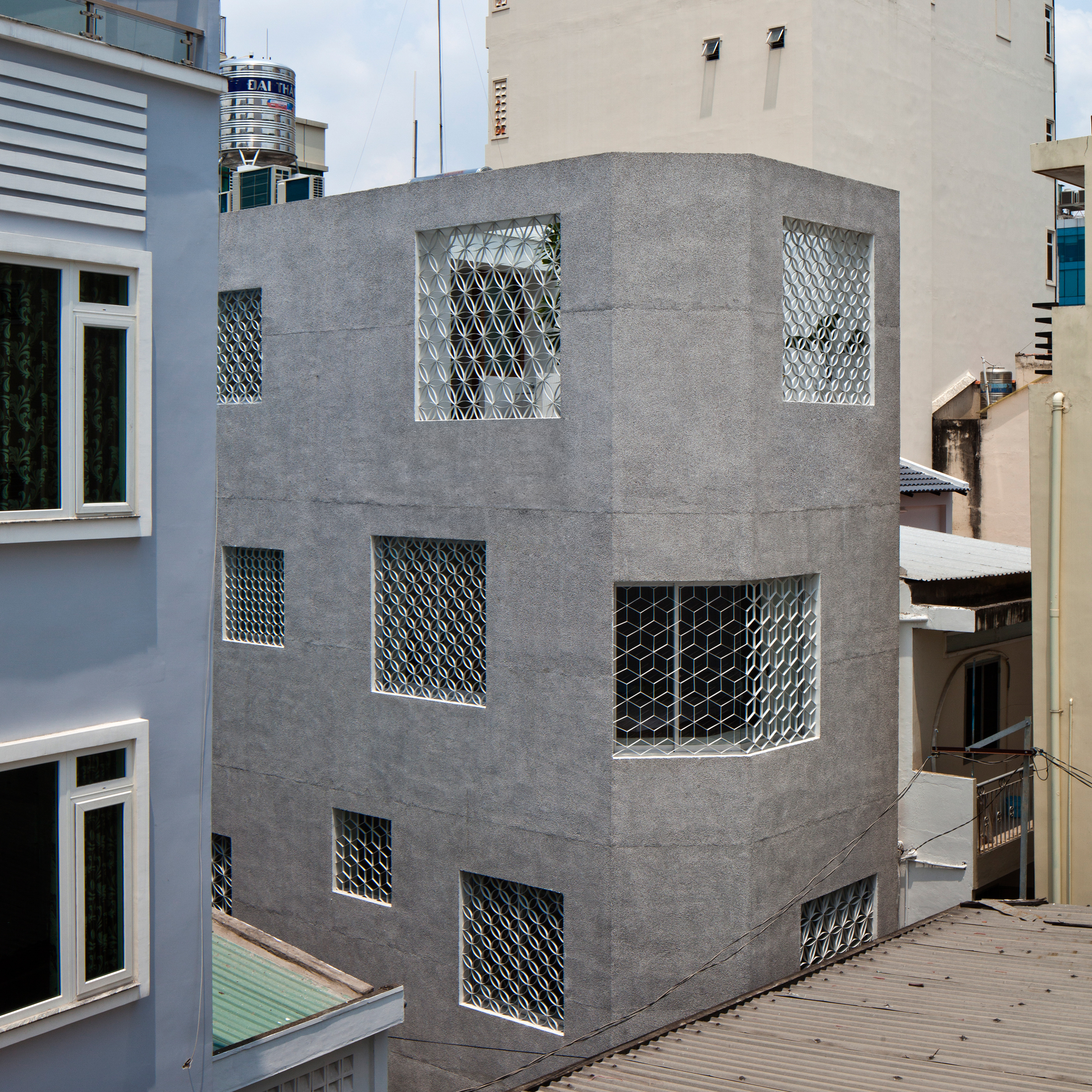
Hem House by Sanuki Daisuke features patterned window grilles and a hidden roof garden


Patterned grills screen the windows of this terrazzo-covered house in Ho Chi Minh City, which has been designed by local studio Sanuki Daisuke Architects to make the most of the site’s little natural light (+ slideshow). (more…)

http://ift.tt/2bdop4W

Abandoned Mystery Spot For Halloween! by ~ Liberty Images Now…

via Abandonedforgotten http://ift.tt/2bA4blh

Friday Afternoon in the Universe

Kerouac Old Angel

I’ve long been drawn to lost books, hidden books, books that reverberate through an author’s career like subterranean bits of code. Kurt Vonnegut’s Canary in a Cathouse, Lynne Tillman’s Weird Fucks, Patti Smith’s Witt or Ha! Ha! Houdini! — each reads to me as a secret message, highlighting (or so it seems) a set of elemental concerns. This is especially the case with Jack Kerouac’s Old Angel Midnight, a prose poem (or a cycle of prose poems) written in five notebooks over three years, from 1956 to 1959. Partly, it’s the provenance: When I was a young reader, just discovering Kerouac, Old Angel Midnight was — along with Some of the Dharma, San Francisco Blues, and other then-unpublished works — the stuff of legend, a manuscript that seemed essential in some sense to the author’s canon but only marginally available if at all. Inspired by his friend Lucien Carr (the original title was Lucien Midnight), the text was published in two installments during Kerouac’s lifetime, parts 1−49 in the Spring 1959 issue of Big Table and the remaining 18 sections in Evergreen Review in 1964. It first came out in book form in 1973. My initial exposure came via snippets cited in biographies by Ann Charters and Gerald Nicosia, the latter of whom called it perhaps “the closet thing to Finnegans Wake in American literature,” although, he concluded, “the ultimate failure of the piece is due to its being too successful an imitation, for it lacks the original conception that distinguished the majority of his works.

Nicosia has a point: Old Angel Midnight is a pastiche (homage, even) to Finnegans Wake. But it is also something more than that, a tone poem, an extended stream of consciousness that aspires — Kerouac was nothing if not ambitious — to channel the breath of creation itself. “Friday afternoon in the universe,” the book begins, “in all directions in & out you got your men women dogs children horses pones tics perts parts pans pools palls pails parturiences and petty Thieveries that turn into heavenly Buddha — I know boy what’s I talking about case I made the world & had Old Angel Midnight for my name and concocted up a world so nothing you had forever thereafter make believe it’s real.” I fell in love with it the first time I read the words. Partly, it’s the felicity of the set-up, Friday afternoon in the universe, “workinmen on scaffolds painting white paint & ants merlying in lil black dens & microbes warring in yr kidney & mesaroolies microbing in the innards of mercery & microbe microbes dreaming of the ultimate microbehood which then ultimates outward to the endless vast empty atom which is this imaginary universe.” (There’s something accessible about this vision yet also cosmic, which is, of course, the whole idea. We tend to think of Kerouac as a road warrior, desperate for kicks and experience, but this is a misreading that deflects his actual concerns. His subject, rather, is consciousness, “the point of ecstasy,” he notes in On the Road, “that I always wanted to reach, which was the complete step across chronological time into timeless shadows, and wonderment in the bleakness of the mortal realm.” In Old Angel Midnight, he achieves this by stripping away even the loosest frame of narrative. “I’ve been finally doodling with an endless automatic writing piece,” he wrote to the novelist John Clellon Holmes in 1956, “which raves on and on with no direction and no story and surely that won’t do tho I’ll finish it anyway while doing other things . . . ”

Those “other things,” it turns out, are instructive, if only in what they suggest about Kerouac’s creative state of mind. Old Angel Midnight comes out of a run of odd work, ancillary (but not really), poetic more than narrative. It was directly preceded by The Scripture of the Golden Eternity, his attempt to write a Buddhist sutra, and before that by the long poem Mexico City Blues. During this period, he also wrote Some of the Dharma and two short novels, Visions of Gerard — about his older brother, who died in 1926 at age nine — and Tristessa, a love song of sorts for a Mexico City prostitute. All of these works are impressionistic, even the fiction, and all of them deal directly with the tragedy and transcendence of being alive. “Dying is ecstasy,” he writes early in Old Angel Midnight. And then: “I’m not a teacher, not a sage, not a Roshi, not a writer or master or even a giggling dharma bum I’m my mother’s son & my mother is the universe — ”

What we’re seeing is a shift away from storytelling toward something more like the direct transcription of experience. This suggests, I think, a key tension in Kerouac: the Buddhist intention, on the one hand, of being in the moment, juxtaposed against the writer’s intention to set it down. Kerouac knows everything is ephemeral, that we and all that surrounds us, “[t]he Mill Valley trees, the pines with green mint look . . . [t]he little tragic windy cottages” will disappear. It’s the source of his sadness, but also of his inspiration; his work represents a sustained attempt at self-preservation despite his understanding that nothing, really, can be preserved. That’s what makes Old Angel Midnight so vivid, because it is an attempt to record something close to pure perception, even as it recognizes the impossibility of the task. “Silence in my window now in the fullmoon of haiku,” Kerouac intones, “which goes OO yellow continent in a birdbath, April full moon which rattle the goldroom little death chair that never will collapse.”

Here, we get close to what I admire best about the book, its embrace of sound, of rhythm and music, of literature as aural in the most specific sense. As such, Old Angel Midnight is a record of listening, of hearing beyond, or beneath, language, of seeking to engage a cosmic beat. It’s not the only work of Kerouac’s to attempt this; his 1962 novel Big Sur ends with a long poem called “Sea: Sounds of the Pacific Ocean at Big Sur.” Yet like the fiction that contains it, “Sea” is an unconsoling effort; “But these waves scare me — ” Kerouac admits. “I am going to die / in full despair — ” Old Angel Midnight, on the other hand, is about acceptance . . . or better yet, about presence, about pause. It’s encoded in that opening gambit, Friday afternoon in the universe, “timeless to the ends of the last lightyear it might as well be getting late Friday afternoon where we start so’s old Sound can come home when worksa done & drink his beer & tweak his children’s eyes — ” That’s vintage Kerouac right there, down to the beer and the sentimentality, “but that’s alright,” he reassures us, “because now everything’ll be alright & we’ll soothe the forever boys & girls & before we’re thru we’ll find a name for this Goddam Golden Eternity & tell a story too.”

The Barnes & Noble Review http://ift.tt/2bgb2zG

Fiery Awakening

Last Day of Pompeii Crop

Mount Vesuvius erupted on August 24, 79 CE, burying the 13,000 inhabitants of Pompeii and vicinity, a 700-year-old settlement that had evolved into a complex urban environment. The Vesuvius eruption is one of history’s iconic lessons on the mutability theme, and the excavation of the Pompeii-Herculaneum region, ongoing since the early eighteenth century, is one of the triumphs of archeology.

The scholars continue to dig and debate, says the Cambridge classicist Mary Beard in The Fires of Vesuvius: Pompeii Lost and Found, and the human story of those buried instantly under fifteen feet of pumice and ash remains hauntingly compelling. The site “offers more vivid glimpses of real people and their real lives than almost anywhere else in the Roman world,” says Beard: “the medical man who died clutching his box of instruments . . . the slave found in the garden of a large house in the center of town, his movements surely hampered by the iron bands around his ankles.” Even the streets and houses, now recovered in minute detail, preserve their human tales:

We meet unlucky lovers (“Successus the weaver’s in love with a barmaid called Iris and she doesn’t give a toss” as one scrawled graffito runs) and shameless bed-wetters (“I’ve pissed in bed, I haven’t lied / But, dear landlord, there was no chamber pot supplied,” boasts the rhyme on a lodging house bedroom wall). We can follow the traces of Pompeii’s children, from the toddler who must have had great fun sticking a couple of coins into the fresh plaster of the main hall . . . to the bored kids who scratched a series of stickmen at child height in the entranceway to a suite of baths . . .

Another legendary volcanic eruption is tied to this week, that of Indonesia’s Krakatoa on August 27, 1883, which killed 40,000 (perhaps many more) in a variety of elemental ways: superheated gas, molten rock, and tsunami. Simon Winchester’s bestseller Krakatoa: the Day the World Exploded, which tracks the catastrophe backward to earlier eruptions on the site and forward to the still-lingering regional aftermath, recreates the inexorable details of the volcano’s “paroxysmal phase”:

An immense wave then leaves Krakatoa at almost exactly 10:00 A.M. — and then, two minutes later, according to all the instruments that record it, came the fourth and greatest explosion of them all, a detonation that was heard thousands of miles away and that is still said to be the most violent explosion ever recorded and experienced by modern man. The cloud of gas and white-hot pumice, fire, and smoke is believed to have risen — been hurled, more probably, blasted as though from a gigantic cannon — as many as twenty-four miles into the air . . .

Krakatoa may have been the most violent modern planetary explosion, but surely the “volcano felt round the world” is the eruption of Indonesia’s Mount Tambora, throughout the spring of 1815. In The Year Without Summer: 1816 and the Volcano That Darkened the World and Changed History, William and Nicholas Klingaman describe the worldwide repercussions, which rippled beyond meteorological upheavals and agricultural disasters to altered migration patterns and religious revivals, and even impacted literary history. “We watch them as they approach from the opposite side of the lake,” wrote Mary Shelley of the extreme storms at Lake Geneva, “observing the lightning play among the clouds in various parts of the heavens . . . ” Driven inside by the unusually bad weather, Shelley and her famous friends entertained themselves with the ghost stories that helped to inspire her Frankenstein.

In Waking the Giant, the volcanologist Bill McGuire discusses the growing body of evidence indicating that, through our recent contributions to climate change, we are collectively creating an environmental monster of our own:

Many geological systems such as extant volcanoes, active faults, and unstable slopes are shown to be often critically poised so that even tiny external perturbations can be capable of triggering reactions in the form, respectively, of volcanic eruptions, earthquakes, and landslides. In this light, it would be surprising indeed if the melting ice sheets, rising sea levels, and changing weather patterns that will undoubtedly characterize the coming century and beyond, did not go some of the way — at the very least — towards reawakening the slumbering giant beneath our feet.

The Barnes & Noble Review http://ift.tt/2bgbSML

Hot Tomorrow: The Urgency and Beauty of Cli-Fi

Cli Fi Crop

Earlier this summer — in a year marked by new record global temperatures — I toured some of the more exotic, outré, and far-fetched works of “Anthropocene fiction” that envisioned how humanity might imprint its often lethal image onto our home planet — even distorting other planets and the whole cosmos at large. After such visions as entire worlds clad in steel, and a solar system whose components were juggled about and reprocessed, the simple notion of Greenhouse Earth — the scenario where an unintentional and relatively tiny incremental change in average world temperature brings vast environmental and geophysical disasters and sociopolitical and cultural disruption and mass mortality — is now hardly science-fictional at all. Climate change is indeed the stuff of daily headlines, to an extent than when we encounter a recent front-page feature in The New York Times reporting on “climate refugees” in the USA and South America, the pairing of those two terms requires little in the way of explanation.

But the hard-edged Paris Agreement realities of climate change do not preclude science fiction focusing its speculative lens on the topic, any more than the reality of the atomic bomb dampened the power of A Canticle for Leibowitz or The Road. To the contrary, science fiction remains, as ever, the best tool for charting our path into such a chaotic future. Thus the birth of a newish subgenre of SF, what has recently been dubbed “climate fiction” or “cli-fi.” Though writers from Frank Herbert and Roger Zelazny to George Turner had by the 1970s used ecological awareness as an imaginative springboard, the awareness that human-created planetary warming was incontrovertibly real has made it a topic of urgency for many twenty-first-century writers.

Two new cli-fi anthologies represent the latest literary broadcasts from these shifting and still unfixed hothouse futures, while an ambitious novel from 2015 displays how cli-fi crosses boundaries into unclassifable literary territory as well. Finally, two recent works of nonfiction borrow SF modes of thinking to look at the grimly real issues human communities face as the result of our impact on the planet.

Current cli-fi might be said to owe a great deal to two voices. Kim Stanley Robinson contributed one of the first landmarks of the genre with his Science in the Capital trilogy (2004−7). And his outspoken, prominent comrade in the battle these days is Paolo Bacigalupi, with such novels as The Windup Girl (2009) and The Water Knife (2015). Depicting the harsh realities of a dog-eat-dog future of dwindling resources, Bacigalupi’s novels reflect the same world-correcting missionary impulses as Orwell’s 1984.

Along with over two dozen other writers, Robinson and Bacigalupi feature in Loosed Upon the World, the mammoth new reprint anthology of cli-fi from master editor John Joseph Adams. The oldest tale herein is 1990’s “Hot Sky” by Robert Silverberg, with all the rest reflecting twenty-first-century publication dates, thus making this volume reflective of the most current thinking on the topic.

Bacigalupi’s introduction sets the stern and Cassandran tone for the volume, as he registers his disbelief in, and moral objection to, any kind of techno-wizard solutions to our current climate chaos. His own story “Shooting the Apocalypse” kicks off the fiction, and inhabits that same water-starved American Southwest that he vividly conjured up in The Water Knife. Violence and the hardscrabble life prevail, with few if any heroes or solutions on the scene.

Written before the current Zika outbreaks, Toiya Kristen Finley’s “Outer Rims” looks prophetic in its depiction of a new disease as encountered firsthand by a hapless mother and her kids. Admittedly, this tight focus on small-scale stories, often domestic, shared by many entries here (Tobias Buckell’s “The Rainy Season”; Nancy Kress’s “A Hundred Hundred Daisies”; Jim Shepard’s “The Netherlands Lives with Water”; Jason Gurley’s “Quiet Town”; et al.) serves to drive home the emotional immediacy of climate change. But it also abjures, to some extent, the traditional mission of SF, which, as characterized in the famous lament by Neal Stephenson, was always to portray the doing of big things.

Sean McMullen’s bracingly mordant “The Precedent” does not shy away from this older mandate, although the Big Thing he concentrates on is a tearing down rather than a building up. In the year 2035, what amounts to the Nuremberg Trials of the Greenhouse Era are underway, with all the big-carbon-footprint sinners up for summary execution. McMullen captures all the self-righteous Year Zero fanaticism of the movement and yet does not proclaim either side the moral victors.

Alan Dean Foster conjures up almost a 1950s monster-movie vibe with his tale of insects on the rampage in “That Creeping Sensation.” Silverberg’s pivotal tale of iceberg harvesting — midway between Frank Herbert’s 1970 epiphany and the present volume — evokes Conradian Weltschmerz in his usual potent manner. Cat Sparks zeroes in on an outsider milieu with her “Hot Rods.” And Buckell and Karl Schroeder poke cleverly at the seams of macro-scale remediation schemes in their “Mitigation.”

The majority of these tales are narrowly limited to First World settings (“Staying Afloat” by Angela Penrose is a notable exception), but these assembled stories nevertheless bring enough variety, ingenuity, and compassion to the theme to convincingly and shockingly limn these early days of the new era, without necessarily illuminating any exit signs.

* * *

Jonathan Strahan assembles brand-new tales of the Anthropocene in Drowned Worlds, and even labels them as such in the book’s subtitle: Tales from the Anthropocene and Beyond. He thus makes his book one of the few to actually employ that pivotal descriptor, and the stories themselves follow suit by being totally on target and au courant, a testament to his editorial acumen and direction. There’s almost zero overlap with the authors in the Adams collection, and because these stories were deliberately commissioned around the topic, they exhibit a moderately tighter focus on the Ballardian Umwelt cited by Strahan in his introduction than do the Adams selections, which arose spontaneously, hither and yon, over the years.

Paul McAuley kicks off the volume nicely with “Elves of Antarctica,” chronicling the remediation efforts at the icecap, as seen through the eyes of a simple yet deeply empathetic worker named Mike Torres. Many small and subtle touches contribute to the tangibility of this future: “[He] tithed to the Marshallese Reclamation Movement . . . ” The story gives a hopeful spin to its inevitabilities.

Skipping around through the subsequent tales, we find other gleams of sunshine amid the wreckage. “Venice Drowned” by Kim Stanley Robinson shows the life of a tour guide amid the ruins of that city and a moment of his epiphany. “Let them [the scavengers] have what was under the water. What lived in Venice was still afloat.” In “Brownsville Station,” Christopher Rowe vividly posits a “linear city” arcing around the Gulf of Mexico, a habitat that shields its citizens from the environment. His viewpoint character is the “Young Conductor,” the crisis a fracture in the vital express train tube. Echoes of Lucas’s THX1138 flavor the mix.

All too often, only changes in the world during the Anthropocene future are considered, neglecting any parallel changes in our species, directed or spontaneous. But Kathleen Ann Goonan, superb mistress of biopunk, makes no such omissions, chronicling the family life centered on the matriarch Zoe Raphael-Aphrodite, “a mature tropical reef in the shape of a voluptuous woman . . . ” With her many hybridizing grafts, Zoe represents the “hopeful monsters” we must all become to survive. This tale, my personal favorite, strikes me as the apex of the book.

Equally bracing in another way, Jeffrey Ford follows the opposite, nihilistic path in “What Is,” surveying a kind of Cormac McCarthy dog-eat-dog landscape. “The New Venusians” by Sean Williams is a rollicking account of some rogue terraforming applied to Venus, as seen through the eyes of an elderly fellow and his feisty granddaughter. James Morrow’s wit and cynicism have never been more acidic than in “Only Ten More Shopping Days Left Till Ragnarök,” which follows some hapless tourists who opt for the Arctic travel package. And finally, Lavie Tidhar’s “Drowned” brings a mythological slant to the aftermath of civilization’s collapse, involving contradictory narrators and a disarming simplicity of language.

This well-wrought anthology marks a bold move toward not merely acceptance of Anthropocene realities, but taking charge of trends and forces and learning how to conduct eternal human behavior on new platforms and with new limitations and new possibilities.

* * *

If climate change brings us a wealth of fiction as exciting and bracing and unpredictable as by Claire Vaye Watkins did in 2015 with Gold Fame Citrus — well, I can’t realistically say that all the global chaos and suffering would be totally redeemed by such literary treasures. But we could at least call it a silver lining.

This masterful, affecting, surreal, and heartbreaking book takes place some twenty-five years into the future, in an era when California (that mythic realm once denominated by the triple allures of the title) is practically an unpopulated wasteland save for scattered raggle-taggle misfits, its bankrupt citizens carted away to evacuation camps, its multimillion-dollar homes abandoned. At first glance, the most obvious point of recent comparison for this scenario would be Paolo Bacigalupi’s The Water Knife. But whereas Bacigalupi went all Realpolitik and thriller and noir in his novel, Watkins takes an essentially Ballardian tack, delving more into “inner space” and bizarre emotional states while still manifesting acute attention to vivid objective correlatives, thick sensual and sensory details. And after all, whereas Ballard’s The Drowned World claims all the attention and influence nowadays, appearing in bright new editions, that author’s neglected The Burning World hosts not inconsiderable pleasures and lessons along an opposite axis.

Certainly the opener to Watkins’s book could not be more in line with the fetishes of the Sage of Shepperton. An abandoned mansion, an empty swimming pool, a beautiful young woman playing dress-up with the lost finery of the old resident, while her lover, a psychically scarred war veteran who shields himself from reality by a carapace of competence, stays busy outside, digging a latrine — this is pure Vermilion Sands, conveyed in a lush yet clinical prose to rival JGB’s own voice.

Watkins’s heroine is Luz Dunn, and she is utterly emblematic of her era. Born famously as “Baby Dunn,” she and her fate in a climate-change world were deliberately linked by the media with that of the Golden State. “The child has been adopted by the Bureau of Conservation, which embarks today on a heroic undertaking that will expand the California Aqueduct a hundredfold . . . ” Revisited by detrimental online fame throughout her upbringing, she has gone off the rails and ended up aimless and lost, living a refugee’s life with the ex-soldier named Ray — who loves Luz immensely — in the shards of the culture.

One night she and Ray descend to the city to hang out with the tribal gutterpunks and lowlifes who remain. There they encounter a mysterious toddler who, missing obvious parents, is being abused by the tribe. Ray and Luz abduct the child, out of a mix of compassion and a selfish desire for a motivating engine to their lives. After a time back in the starlet’s mansion learning the peculiar needs and abilities of the little girl they dub Ig, they embark on a half-assed hegira towards some nebulously dreamed better life.

On the road, Luz and Ray get separated, and Luz and Ig end up in the Amargosa, a newly formed realm of sand, “a dead swath of it blown off the Central Valley and Great Plains, accumulated somewhere between here and Vegas.” There they encounter the floating commune ruled by the slightly Mansonesque, slightly ridiculous figure of Levi Zabriskie. Amid this new “family,” Luz and Ig will experience strange tides of change and many freaky happenings, before Luz meets her ultimate, perfect apotheosis.

By shifting between the interior states of Luz, Ray, and Levi, Watkins inhabits their consciousnesses with depth and insightfulness. The three emerge as fully formed entities with all the perverse willfulness, for good or ill, that denominates our species. Lesser characters, such as Levi’s harem, receive a good helping of individuation as well. And Watkins is not shy about non-traditional methods of narration, such as the section that begins: “There are three ways to learn about a character.” Here, a portrait of Ray is assembled from lists and fragments. Another section purports to be the full text, with illustrations, of a naturalist’s book that Levi has written.

Watkins’s novel harks to a whole tradition of California apocalypses, starting with Nathanael West and going straight through George R. Stewart, Rudy Wurlitzer, Thomas Pynchon, Kurt Vonnegut, Lucius Shepard, and — again — K. S. Robinson. Her depiction of the minds and attitudes of the remnant population, all of whom are seeking some twisted, debased, half-recalled variant of the “gold, fame, citrus” triad, feels indelibly accurate. And her insights into how a resource-deprived world would function, or malfunction, is keenly detailed. One feels every sand-gritted bedsheet and precious warm gulp of bottled water. Additionally, there’s a big riff on the automated nuclear waste depository at Yucca Flats and the “molemen” who live there that summons up images of Bradbury’s famous devastated automated house performing its senseless tasks in the absence of all humans.

But the paramount achievement of this book is the ironic elegance of its prose, its black-humored assessments of the human condition, its absurdist imagery and its incantatory fevered assaults on this sea change afflicting the world and the new rituals that arise therefrom.

Though it was the colony that moved across the desert, the reverse felt true. It wasn’t long before the swimming pool oasis left them — save for the water they drained from it, and the chairs, ropes, sheets of fiberglass, peels of tin and other salvageables they pried from it, and the algae, which Jimmer scraped from the bottom and dried for his concoctions. This was life at the colony: the solid, grounded, unyielding world getting up and walking away. Ravines, canyons, ranges, alluvial fans and gardens of boulders, all folded beneath them. They pilfered from abandoned Indian casinos and deserted truck stops. The sturdy was no longer something to hold on to.

Undespairing and defiant in the face of disaster, Watkins and her creations demand that we do not throw up our hands in defeat, but press on to find ways to go on living in a world whose changes even fiction has to accept.

* * *

Science fiction, of course, is not the only literary medium by which the Anthropocene is parsed. Several nonfiction books of late have begun to delve into the implications of this new era, and here we consider two outstanding recent titles as capstone to this survey.

Roy Scranton’s passionate yet clear-eyed screed, Learning to Die in the Anthropocene: Reflections on the End of a Civilization, is a kind of scientifically rigorous Tibetan Book of the Dead or Zen Mind, Beginner’s Mind for our modern naked ape−dominated era. Curiously enough, despite its insistence on the essential value of humanist texts such as Gilgamesh for our survival, and despite being very much aligned with the core methodologies of SF, it stringently avoids mentioning any actual SF, except for a passing nod to Star Trek. Yet such an omission can be forgiven, for the book is almost science fictional itself.

What I mean is that Scranton plumbs the intersection of history and technology, culture and philosophy in the same manner that the best science fiction does, seeking to illuminate the hidden foundational assumptions of our culture, its virtues and defects, and to chart where these traits are leading us. It reads like a book that H. G. Wells might have written in the prime of his career as polemicist and educator.

Limning the science of our current and future predicament in vivid layman’s terms and exhibiting the same anti-techno-fix stance as Bacigalupi, Scranton holds up a hopeful torch for humanity’s adaptation to the unprecedented conditions of our altered landscape. “We humans are precocious multicellular energy machines building hives on a rock in space, machines made up of and connected to countless other machines, each of us a microcosm.” The vision might have come from T. J. Bass or Olaf Stapledon, and it should form a valuable springboard for future science fictional forays by novelists wise enough to heed Scranton’s insights.

In The Birth of the Anthropocene, Jeremy Davies clears away so much fog from the concept in such a readable and clear-eyed manner that there can be no excuse any longer for employing this neologism in sloppy fashion.

His introduction parses the several definitions of the term and plumps for one in particular: a hard-edge scientific description in line with the rigorous methodology of stratigraphic studies, as determined by longstanding scientific committees. If we are to believe that the Anthropocene is indeed a new era, then we must define it in the same way we have defined previous eras, pinning down its start to an accurate date universally acknowledged by an irrefutable set of markers.

But this insistence on scientific precision hasn’t gotten in the way of the book’s many touching and startling moments, nor its clarion call for practical measures to be undertaken. My favorite section, “An Obituary for the Holocene,” divides the Holocene, that earlier epoch that contains all of human history, into twelve sections of one thousand years each, Davies presents a capsule history of our species that is incredibly stirring and hopeful, further boosting his contention that the Anthropocene is not a disjunction so much as a natural transition, something to be adapted to, not feared. Ultimately, this is a book to inspire and educate, not alarm and frighten the reader. It really should be part of the new curriculum for all good citizens of this strange new world.

* * *

Perhaps we can sum up the necessity for and allure of cli-fi and its allied nonfiction by quoting author Cat Sparks from a recent interview on the topic. With her own cli-fi novel, Lotus Blue, due out soon, and nearing the completion of her Ph.D. in climate change fiction, Sparks has plainly devoted much intellectual energy to the topic and its themes. She remains unsentimental but optimistic about the literature and its ability to help.

Climate fiction definitely has a part to play. In my eyes the argument that art should be beholden to nothing and no one breaks down when it comes to a situation as dire as this one, where the one planet in the universe known for certain to harbor life is under threat of being rendered uninhabitable . . . What we need is people talking about alternative pathways. We need this in science, politics, government and we need this in art. Because people respond to art differently to the way they respond to facts and figures. Art has the power of becoming personal. Different media speaks to different people in different ways. Art encourages people to think and feel.

And, one might add, even to act.

The Barnes & Noble Review http://ift.tt/2c4bbY5

Lubrano Ciavarra clads weekend retreat in Rhode Island using cedar and rough-cut slate


Providing sweeping views of a wilderness reserve was the primary goal for US studio Lubrano Ciavarra when designing this large wood-and-slate holiday home in Rhode Island (+ slideshow). (more…)

http://ift.tt/2bfYsvz