
💙 Mt Rockwell on 500px by Lee Parks, Greenville, USA☀ Canon EOS… http://ift.tt/1nHfYyG
💙 Mt Rockwell on 500px by Lee Parks, Greenville, USA☀ Canon EOS… http://ift.tt/1nHfYyG
We all want to change the world but we wonder how. What special skills do you have that will make a difference? Often we think we are nobody special and there isn’t anything we can do to help or change the world. This is where you’re wrong. Each and every one of us has unique gifts and talents that no one else has. What you think is nothing someone else might think is fantastic.
So you don’t think you can make a difference? You think the world is too big for you to make a dent in its progress to global peace? Think again. Below are just a few things you can to do make a difference that will be greatly appreciated by many, much more than you think.
Donate old clothes and household items. Instead of selling them and trying to make a profit, why not donate them to a shelter? There are many people in need who can’t afford to shop in second hand stores. They need help too. Holding a yard sale or selling old things to make money is financially smart but when you just give them away, from the heart, exceptional abundance will find you.
The one person you just smiled at might have been on his/her way to making rash decisions based on their state. When a stranger smiles at me, I think it’s the nicest and simplest thing that anyone can do that is guaranteed to brighten up my day. They don’t know if I was already sad or happy or hurt or angry but they instantly just made me smile back. Your smile will brighten someone’s day and give them faith in humanity.
Saying hello to a stranger does many things. First it makes them smile. Second this person may be looking for some company or someone to talk to and you may well be this person. Thirdly, you just may be the only person who gave them any attention or showed them kindness today, simply by saying hello. Some people live alone and could go days without talking to anyone. By you saying hello, you just gave them the gift of human interaction and probably made their day.
Simple but still so few people do it. next time you are at a coffee shop grabbing your latte express and a muffin, grab one for the guy sitting across the street who looks like he hasn’t eaten in days. He may even like a bottle of water or a sandwich. Really they don’t care what you give them, they are just happy you noticed them and are kind enough to do something for them.
Garbage is all over. Too many people don’t use the trash can and aren’t teaching their children to use it. Imagine if each and every one of us did that? The whole world would be clean. You can do your part. Use the garbage and if you come across someone who just threw their trash on the ground, speak up. It’s your right, it’s your world too. It’s up to each and every one of us to educate.
Though there are still a few people who don’t like their personal space invaded, there are more than enough who crave human attention and affection. Give hugs. They are free and fun. People love hugs. If you’re not sure, ask first. If they say no, a gentle touch on the shoulder, or a small rub on the back will make them feel good too. Any of this will warm our heart and make us feel special and let’s face it, we all really want to feel special anyway.
Do you know a lonely old senior who rarely has visitors who still lives in their own home? Or maybe they need help with things around the house or they simply want company. Go see them. bring them flowers or if it’s a man, maybe a pie or some other treats. Lonely seniors love company and treats. They love treats.
It’s so easy to make the world a happier place. it doesn’t have to cost an arm and a leg and it’s the little things that no one thinks of doing that make the biggest difference in someone’s life. Go be a world changer.
The post 7 Simple Ways You Can Be A Helper Too appeared first on Change your thoughts.
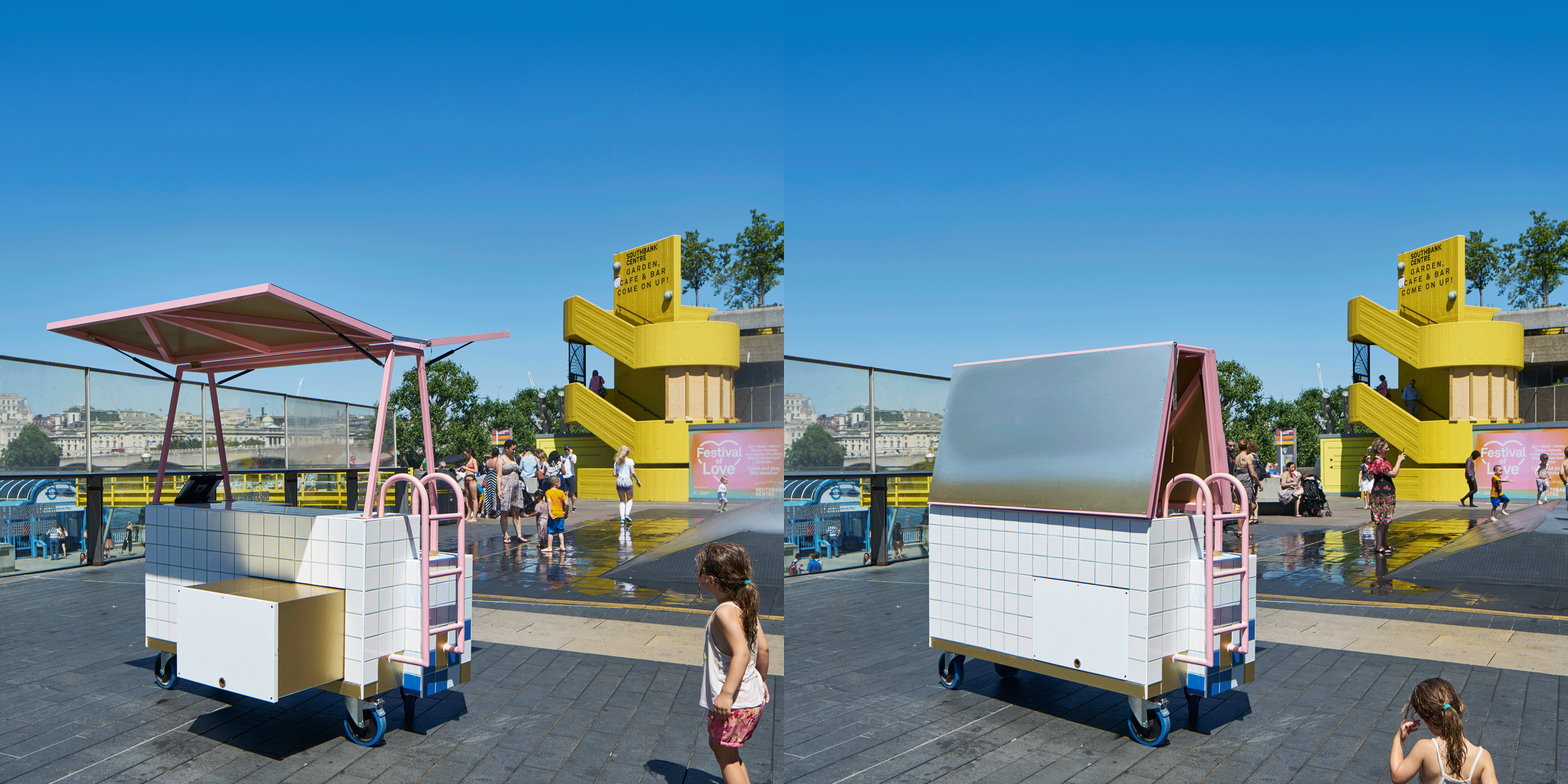
This miniature shop installed at London’s Southbank Centre was designed by How About Studio to resemble the finishes of a public swimming pool (+ slideshow). (more…)


Light House is a project completed by ARKit. Finished in 2015, it is located in Melbourne, Victoria, Australia. Light House by ARKit: “The brief for this project was to create a long desired holiday house for a growing family of five and their dog. Located near a small coastal inlet on a flat, sandy site, the project offers a pared back, family centric escape from city life. Comprising two bedrooms,..

Self-build for public
There is the vacant house which has formed local community. “House of Komajii” in Komagome of Tokyo opened as a place where local people stay in October, 2013. Because originally this vacant house was a dormitory, the space was divided finely. Therefore about half of the building was a storeroom. When I received the request of the design, The client expected that I released the space of the storeroom in the area, and made the structure for “House of Komajii” to become independent, and rotate. (It is run now without almost taking the fee for use by the kindness of the owner.) I plan to break a wall and enlarge the space, and more people can gather in the first floor and convert the second floor to share office as source of profits.
I visited the building several times before beginning design. The state of the building was bad and the outdoor stairs got rusty and died, and the finish of the inner wall had come off. But many people gathered in such the building for some reason. It is the place that everybody can spend from a neighboring child to the elderly freely. It sometimes overflows with a person so that there’s no place to stand in. The community has formed spontaneously by the owner releasing the vacant house in the area. I think the scene like that the community was formed by people gathering for TV in old times when there was only one TV in the town is near that. It is not the “made” public that the government provides administratively, but the new public by “self-build” of citizen.
I collected all the expenses of the renovation from a local user. In addition, I had local people participate in DIY, and the thought of the individual has been left to the building. And I gave priority to that I enlarged the space without spending money. Therefore the things of the different character are simultaneous in one space, for example the rough space that was only dismantled, the Japanese-style room which was just left, newly finished white wall, the old fixtures which I transferred and reused, the pillar that the heights of children were carved , the switchplate which a neighboring foreign student made with cardboard, the signboard which grandfather of the owner handcrafted, and ranma which an old craftsman made. I mix such different things without order and aim at letting them exist in a natural state. I design the architecture which does not make “made” feeling by accumulation of the “self-build” of many people.

Italian brand Riva 1920‘s Earth Table features a bent iron base designed by Renzo Piano to symbolise the Twin Towers wreckage (+ slideshow). (more…)

Rio 2016: if you’ve been inspired to get active after watching this summer’s Olympics in Rio de Janeiro, check out our new Pinterest board full of innovative sportswear designs including athletics apparel created from the same material as condoms and trainers made out of recycled ocean plastic.
Follow Dezeen on Pinterest | See more sportswear in our archive

From the architect. The project involved the redevelopment of three tired 1980s buildings at Monash University’s Clayton campus. The intention was to establish new informal and engaging learning hubs within the three buildings and to clarify campus wayfinding by creating new pedestrian ‘walks’.
JCB’s response was to reinforce the main campus intersection with a formal gesture incorporating folding and twisting concrete canopies, a theatrical stair and seating platforms. The canopies provide shelter, entrance identity and a dramatic engagement with the student realm, allowing for moments of congregation, observation and contemplation from the vantage of the stair.
Themed interiors and informal furniture with complimentary material selections were used to de-institutionalise the interior spaces. The Student Services Desk is sculptural in form, eliminating the traditional linear counter anticipated within this type of facility.
A variety of work tables were designed for self-directed study or collaborative activities. Writable surfaces throughout encourage group learning. Throughout the building, visual links to the surrounding landscape and walks are maximized.
The upper floor schemes took the existing layout of a central corridor with perimeter offices and turned it inside out; open plan office areas, meeting rooms and ancillary spaces have been arranged in bays through the centre of the plan while the new circulation spaces run along the north and south facades, creating break-out spaces and informal seating areas along the perimeter.
The new facades were developed as a colourful ‘kit of parts’ to address solar shading, building identity and transparency. Mild steel shading loops and coloured fins were used to enliven and reinforce the existing structural rhythms of the buildings while the external colour scheme across the precinct sought to both reflect and abstract the surrounding landscape.
From the architect. The project involved the redevelopment of three tired 1980s buildings at Monash University’s Clayton campus. The intention was to establish new informal and engaging learning hubs within the three buildings and to clarify campus wayfinding by creating new pedestrian ‘walks’.
JCB’s response was to reinforce the main campus intersection with a formal gesture incorporating folding and twisting concrete canopies, a theatrical stair and seating platforms. The canopies provide shelter, entrance identity and a dramatic engagement with the student realm, allowing for moments of congregation, observation and contemplation from the vantage of the stair.
Themed interiors and informal furniture with complimentary material selections were used to de-institutionalise the interior spaces. The Student Services Desk is sculptural in form, eliminating the traditional linear counter anticipated within this type of facility.
A variety of work tables were designed for self-directed study or collaborative activities. Writable surfaces throughout encourage group learning. Throughout the building, visual links to the surrounding landscape and walks are maximized.
The upper floor schemes took the existing layout of a central corridor with perimeter offices and turned it inside out; open plan office areas, meeting rooms and ancillary spaces have been arranged in bays through the centre of the plan while the new circulation spaces run along the north and south facades, creating break-out spaces and informal seating areas along the perimeter.
The new facades were developed as a colourful ‘kit of parts’ to address solar shading, building identity and transparency. Mild steel shading loops and coloured fins were used to enliven and reinforce the existing structural rhythms of the buildings while the external colour scheme across the precinct sought to both reflect and abstract the surrounding landscape.
 Sig Nordal