‘Barkingside Town Centre’ is a strategic project which radically transformed the town centre of Barkingside, a suburban town on the eastern fringe of London. The project provide a new ‘heart’ to the town in the form of a civic square and high street park, supported by a range of strategic interventions along the high street and out into the Green Belt landscape beyond.
Courtesy of DK-CM
The project has transformed a series of previously neglected or inaccessible spaces around Fullwell Cross Library and Leisure Centre, a suite of civic buildings designed in the 1960s by Frederick Gibberd. We have turned these unloved spaces into ones which suggest and support activity, bringing the internal generosity of Gibberd’s buildings into the public realm. A new loggia, modelled directly on Gibberd’s clerestory windows, lines a previously blank wall to create a town square which encourages inhabitation. Entrances to all of the buildings have become open air ‘rooms’, particularly the leisure centre’s entrance which incorporates a stage and Christmas tree pit. At the swimming pool, we have created 3,000m2 of new public park out of a disused and private pool yard, bringing the pool to life as a public building connected to its high street and providing a new leafy entrance to the town centre. Where the leisure centre formerly presented its delivery bay to the High Street, we have provided a small retail unit and public convenience, a miniature of the main building, which turns a back into a front and brings the bulk of the pool into dialogue with both the High Street and the new park.
Courtesy of DK-CM
We have brought generous but aloof modernist architecture into playful and generous dialogue with the suburban high street, in a language which riffs on suburban popular building but also on European traditions of public space. Since the project’s completion, the new spaces have hosted music events, childrens’ theatre performances, evening markets and community gatherings. The park has become part of its high street, providing a much-needed place of pause amongst the shops.
Isometric 1
Isometric 2
The project grew out of a series of productive conversations with the local community, significant for their openness and ambition, and key local community groups have been involved at all stages, particularly Barkingside 21, the local environment group who are advocates of the scheme and are active in promoting the spaces and organising events there. Local swimming groups have told us of their delight at being able, for the first time, to swim under dappled sunlight provided by the park’s new trees, whilst the town square is now the de facto heart of the town and is never empty.
Courtesy of DK-CM
The project also commissioned various designers to design and deliver precise interventions in Barkingside’s wider urban landscape. As an example, Assemble
Courtesy of London Borough of Redbridge
crafted a new pedestrian entrance and beacon for Fairlop Waters Country Park, just outside the town centre, whilst Eveleigh & Klein delivered a series of sensitive, beautiful signage and branding designs for independent businesses along the high street.
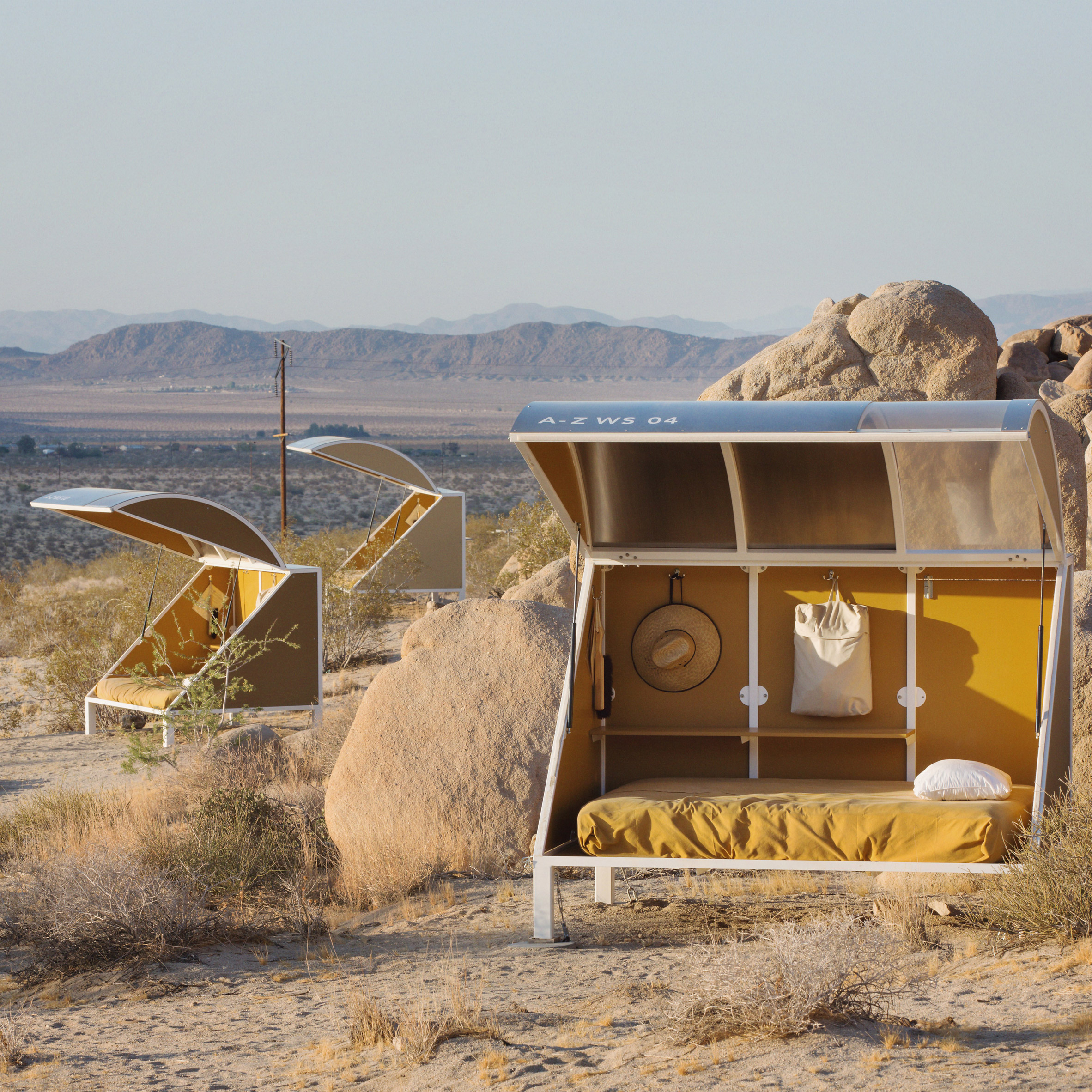
Artists and writers wanting to play out a “desert fantasy” can rent a tiny sleeping pod at a remote campsite in southern California, which looks like a scene from a sci-fi film (+ slideshow). (more…)
Students and architects from over 30 countries have constructed a “village” of 14 wooden structures at Hello Wood’s Project Village 2016. Founded in 2010 as an art camp for students in architecture, art and design disciplines, Hello Wood has since grown into an award-winning interior summer school program focused on creating design through collaborative methods and bringing together the principles of architecture, art, innovation and social impact. The Project Village, conceived just last year, pushes these ideals to their limit by challenging students, teachers and designers to work together to create a new architecture of community at Hello Wood’s rural campus in Csoromfolde, Hungary.
Continue reading to see all 14 projects with descriptions from the designers.
In the second year of Hello Wood’s Project Village, architects were tasked with constructing a place of “arrival, permanence, and connection.” Participants first discussed current and historical settlement precedents, debating and analyzing which “subtle cues and territorial definitions make the roles of host and guest change or interchange.” This deliberation was then used to develop the 14 different typologies that were to make up the campus. Teams were then formed to realize the vision.
“Project Village 2016 is the beginning of a new era for Hello Wood. We are building a rural campus that will be open throughout the year to welcome architects, artists, social scientists, and students. In our brief we asked for projects that address actual needs of the community, from the most mundane and pragmatic ones to the utmost spiritual. We were happy to see responses to these basic functions such as a sanctuary, a storage or a public kitchen, among others,” says Peter Pozsar, one of the founders of Hello Wood.
“One of the main challenges for us during the masterplanning was to create a real settlement, where the projects are not autonomous installations, but adapt to the needs and everyday life of the community,” adds Johanna Muszbek, lecturer at the University of Liverpool and curator of Project Village.
Project by: Urban-Think Tank Chair of Architecture and Urban Design, D-ARCH, ETH Zürich, Professor Alfredo Brillembourg & Professor Hubert Klumpner
Workshop Leaders: Danny Wills, Gianmaria Socci
Team: Nora Behová, Jiaxin Wu, Németh Krisztina, Sung Lim, Iara Pezzuti dos Santos, Dormán Miklós, Cina Mael Bockstahler, Mariia Yastrubchak, Agnieszka Chromiec, Zétényi Zsófia
For the first phase of Project Village 2015, Urban Think-Tank built the Migrant House, a structure that provided the initial point of orientation for a community of travelers. Their proposal for Project Village 2016 seeks to transform the idea of the Migrant House into an idea of Migrant Hous(ing). The current work at Urban-Think Tank focuses on practical strategies of housing while remaining embedded within community-driven processes. The Migrant Hous(ing) builds on their ideas of modular construction, community capacity building, rapid and incremental upgrading and quick, pre-fabricated assembly and disassembly methods. The structures themselves will be migrant in nature. Their ability to be transported and rapidly installed, transformed and dismantled is key and a major performative aspect of the project.
Team: Mangliár László, Eve Stotesbury, Cristina Krois, Zsuzsanna Kovács Zsuzsanna, Vladimír Votava, Henry Lyle, Flavia Notarianni, Sasvári Adrienn, Sonia Molenda
The forest is a point of departure for human colonization and emergence of a modern understanding of space. The project tests the tension between these two poles and aims to make it visible and tangible. The open structure of the installation refers to the surrounding countryside and offers an ever-changing perspective between interior and exterior space. The project also works as a viewing platform to observe the incredibly wide range of biodiversity living in the area.
Project by Artem Kitaev & Leonid Slonimskiy (Kosmos Architects)
Team: Willie Vogel, Aleksandra Liszewska, Niklas Niemeyer, Patryk Slusarski, Martin Spalek, Esther Ellingsen, Martyna Rajewska, Jazmin Charalambous
In the world of communication and global exchange of cultures, walls should unite people and not divide them. As such this project is a wall but a new kind of wall – it attracts rather than separates. It questions physical borders and proposes transforming the typology of a wall from a space-divider into a functional infrastructural space itself which can provide shelter as well as provide for communal, commercial and cultural activities.The structure is built in layers according to Maslow’s hierarchy of needs. The ground floor provides shelter for basic human necessities such as sleeping and the top floor offers space for spiritual necessities such as the need for self-expression. The team built one layer per day, each marked by a ritual of one activity: from sleeping and eating on first days to love and self-actualization on the last days.
Claire Humphreys, Marta Piasente, Lukasz Waclawek, Alexandra Kvasnicova, Kopácsi Anna, Miroslav Styk, Matthew Joyce
Before becoming encapsulated within the realm of hygiene the bath was not only a social event, but also a form of collective pleasure. The space of the bath in the city was a public one, where the care of the self was a practice mediated by architecture. The bathhouse featured different environments that regulated the body temperature in relation with varying degrees of socialization. Inverting the contemporary separation between privacy and exposure, the new baths will restore the public function of washing in the realm of the collective, becoming a place of sociality where the body will be rescued from the tyranny of puritan invisibility. Occupying a central role in the village, the bathhouse will provide a space for relaxation from the intense daily routine of construction.
Project by Martial Marquet, Nicolas Polaert and Vojtech Nemec
Team: Kiss Flóra, Aleksandra Milewska, Maddyn Mathias, Jesús Sánchez, Khrystyna Kurovets, Ozan Sen, Zentai Kinga, Berivan Atik, Horváth Rebeka, Mokos Mariann
Table is a Parliament Parliament is a Table uses the picnic table as a module to create the parliament project that functions both as a gathering place and as a place for debate.You can sit down by the table at the lower level of the arena structure, share food with others and welcome visitors. It fosters inclusivity, diversity and demonstrates the ritual of welcoming: at Project Village 2016 everyone is welcome at the table and welcome to join in the debate. The project aims to rethink the archetypal amphitheatre space. It becomes a tribune for exchange and expression in various media such as sound, music, dance and both the still and moving image. It is as much a place for entertainment as a political space. In our community the expression of oneself should be as natural as eating or drinking. Politics, democracy, entertainment and partying simultaneously shape the spaces of communal living.
Project proposal by Neal Hitch, Martin Hitch, Lucas Hitch
Team: Ania Wozniczka-Wells, Tara McKenna, Kiss Márta, Schramkó Sába, Jung Daniel Attila, Carlos Azpiroz, Davida Rauch, Raya Boyukova, Burenjargal Ganbat
The history of architecture and spirituality have always been linked. The temple structure, therefore, may be the first architectural form to take actual form within the community. In 2015 the Sanctuary project posed the question “what does spirituality look like in an increasingly non-religious world?”, but perhaps our world hasn’t become less religious, we have just given it a different name. By reintroducing traditional symbolism to practices that have never stopped we call attention to the daily rituals in which we participate. Just as the gate of every Roman city was dedicated to Janus, ritual marks one’s arrival. The act of gathering is a ritual. Built on the 300 year old ruins of a previous settlement in Csóromfölde, the Alt-Cathedral is space that represents ritual in the community. Within there are areas for ‘alter’; a fire providing fellowship; an ‘overview’ deck; interstitial spaces allowing rest or self-reflection and an area of ‘dedication’ honoring those who came before.
Proposal by Gregory Quinn and Dragos Naicu – Berlin University of Arts
Team: Géhberger Máté, Rafael Silveira, Viktoria Mank, Ana Maria Rodriguez Bisbicus, Anyana Zimmermann, Maria Tanska, Paola Chessa, Cansu Ergün, Alan Bigelow, Elisabeth Kofler
Actively bending slender natural materials and combining them with other linear or planar materials into stiff structural hybrids has been prevalent in vernacular architecture since the beginnings of human dwellings and homes. Engaging examples of this can be seen in the traditional Mudhif in Afghanistan or traditional Iranian felt tents. While the concepts and technology of such hybrids is not new, there is great potential for novelty and innovation in the digital tools necessary for their design. The hybrid structures built for Project Village 2016 will also host the village museum with an ongoing exhibition of villagers work such as sketches, drawings and a sculpture park.
Project by Suzana Milinovic and Rufus Van Den Ban (TU Delft)
Team: Steef Meijer, Phillip Fai Chung, Kéri Juli, Karl Leung,, Papp Nikolett, Joep Bastiaans, Victoria Guinet
For Project Village 2016 – Settling: Rituals of Arrival the team built and performed a Shou Sugi Ban workshop. Shou Sugi Ban refers to the Japanese technique of charring wood to extend its lifespan. As settling implies an action that requires time, space and craft we wanted to contribute to the longevity of the settlement with one of the first buildings. In order to perform this technique, the team built a fireplace, a table and a shelter. Other settlers will make use of this facility, now and in the future by bringing their material to the workshop and learning the various charring techniques most appropriate for their own purposes.
Project by Suelen Camerin, Carlos Castro (castrocamerin)
Team: Sara Simoska, Clea Granados Nikolaidou, Villányi Fábián, Dominika Galandova, Schmidt Márta, Anne de Zeeuw, Godra Orsolya, Zsuzsanna Horváth Zsuzsanna
The house is a seminal reflection of socio-political relations of people in all cultures. Besides being the place that shelters and protects human life, the way it is built, used and divided can reflect how people relate to each other and organize their society. This project is an homage to one of the most brilliant brazilian architects of all time: Lucio Costa. In 1956 Costa won the competition for the urban plan of Brasilia and in 1964 he designed the installation “Riposatevi: an invitation to rest” for the Brazilian Pavilion at the 13th Milan Triennale. Guitars and colourful hammocks displayed the paradox of a country where laziness and sloppiness are stigmas and yet it was possible to build a new capital in a few short years.
Project by Christian Daschek and Julia Wildeis | solidOperations
Team: Veerle Rigter, Sam van Hooff, Sonya Falkovskaia, Tamás László, Natascha Fakler, Czinger Jákob, Maria Elena Ferraresi
The essence of a summer school is people connecting with each other. Their motivation, skills, knowledge and will to connect and exchange amongst each other are most important. The structure(s) of our proposal are amassed singular elements, a structure which reflects a coming-together of individual elements. A structure in an infinite state, to be split, re-arranged and ultimately in parts to be taken home by all participants so they can set up camp anew somewhere else. Just as importantly, every village needs practical items, like tables and chairs.
Project by BuildunBuilt (Baki Áron, Egyed Csongor, Gadolla Máté, Kőműves Márton, Szabó Ákos, Takács Ákos)
Team: Pablo González Serna, Marta Zabik, Sylvia Winter, Angela Recasens Estrada, Yushi Zhang, Aleksandra Sudnikovich, Anna Raczynska, Makai Luca
BuildunBuilt is the architectural version of a virtual cloud. The team’s interests lie in the question of contemporary housing and the relevance and future of prototyping. They pursued an extensive research on the local history of prototyping as a technology of facilitating and defining social and aesthetic change, be it emancipatory and/or disciplinary, progressive or regressive. The future will reveal if this edifice could transform into the Hello Wood-prototype house.
Project Proposal by Zsófia Szonja Illés and Lukasz Pastuszka
Team: Danique van Hulst, Veniyana Lemonidi, Fiona Thompson, Amelia Linde, Johannes Fandl, Guiseppe Ferrigno, Sarkadi Zsolt, Ruby Sleigh, Petrovicz Anna
May it be a countryside village or a traditional house, Peru, Turkey or Hungary, Hello Wood, Burning Man or Rainbow Gathering, fireplaces always played an important role in community life. Fire was the centre where the community gather and sometimes cook, warm up, party and socialise. They were and still are the centers of communal living space where people instinctively gather. The FIREPLACE stems from a basic need of participants at every Hello Wood workshop and the idea that a fireplace can be flexible depending on its different functions. The team investigated the old Hungarian fireplace structures and were particularly inspired by the idea of the “nyárikonyha” (open-air summer kitchen).
Project Proposal by András Cseh, Endre Ványolós, Áron Vass-Eysen
Team: Florian Gabriel, Maelys Garreau, Petró Panna, Burista Emese, Jambrik Máté, Bíró Bianka, Mercedes Palacio
The project is an introduction to the concept of settling: it marks the event of an arrival. It becomes a reference point when you place down your travelling kit and pick up what you will need. Placed by the entrance on the edge of Csóromfölde. It awaits you as a membrane to pass through both ways, leaving one world with its gadgets behind and gearing up for the adventures to come. You come home to stay, play, work, eat, think, party – to be. Here you will find all you need in one extensible ‘light’, box-like object: the firewood, stones for the fireplace, a saw, a cleaver, a tub, the ladder, a bicycle etc. All are recognisable accessories that inseparably belong to us and once put together will form an inextricable part of the beginning of our story. Inventory is supposed to be an object of identification just like the inventory in Moonrise Kingdom of Wes Anderson. It models the ritual of an arrival and departure through mundane, though very iconic material proofs.
Csapat: Soós Márta, Técsi Zita, Dorota Kopania, Jozef Eduard Masarik, Simon Mitchell, Agnes Brull, Katarina Brnovic, Margot Holländer
Hermit House is a experimental research space for the individual to orient oneself in the world. A basic roof structure in combination with two different wall elements and a minimal set of furniture for cooking, sleeping and sitting, generates a space to be appropriated. All of this can be changed to accommodate the needs for cloister as well as the best ways to interact with nature and the never-ending distractions from the village. Flexibility is not only shaped by budget, climate and artistic pursuits, but also the aim to create hospitality for possible guests. When there are no guests it is the place to enjoy the silence and contemplation.
More information on Hello Wood Project Village can be found at their website, here.
Fashion brand Milly’s logo freezes, grows flowers and is applied like body paint in this campaign by New York design studio Sagmeister & Walsh (+ movie). (more…)
Once again, landscape as a main theme of the project. This time, under our feet the fields, as an horizon the see and a vast changing sky. We were asked to design the first floor extension of a country house, characterized by its random openings configuration and the “gotelé” texture of the lime walls.
The requirement of a quick construction and the condition of a viewpoint guided the construction decisions. We looked for a clear relationship with the house and the new construction, not imitating but maintaining its own aesthetic and function.
Section
Just one exterior access, through an sculptural exterior staircases made of rusted steel was planned. As we go up to the sky we have
a first taste of the views that will be at the studio. Half original roof is used as a terrace, half as a studio. While the limits in between melt with 11 meter sliding windows and sliding timber blinds.
The rest of smaller openings, strategically placed, create green leaves squares. The skin is made by Aquapanel boards outside and plasterboard inside, creating a air chamber to ensure thermal comfort and hide the monorail windows in their opened position. As sunscreen, the traditional timber blinds widely used in Mediterranean architecture but reinvented as sliding elements, combining tradition, contemporaneity and coherence with the rest of elements.
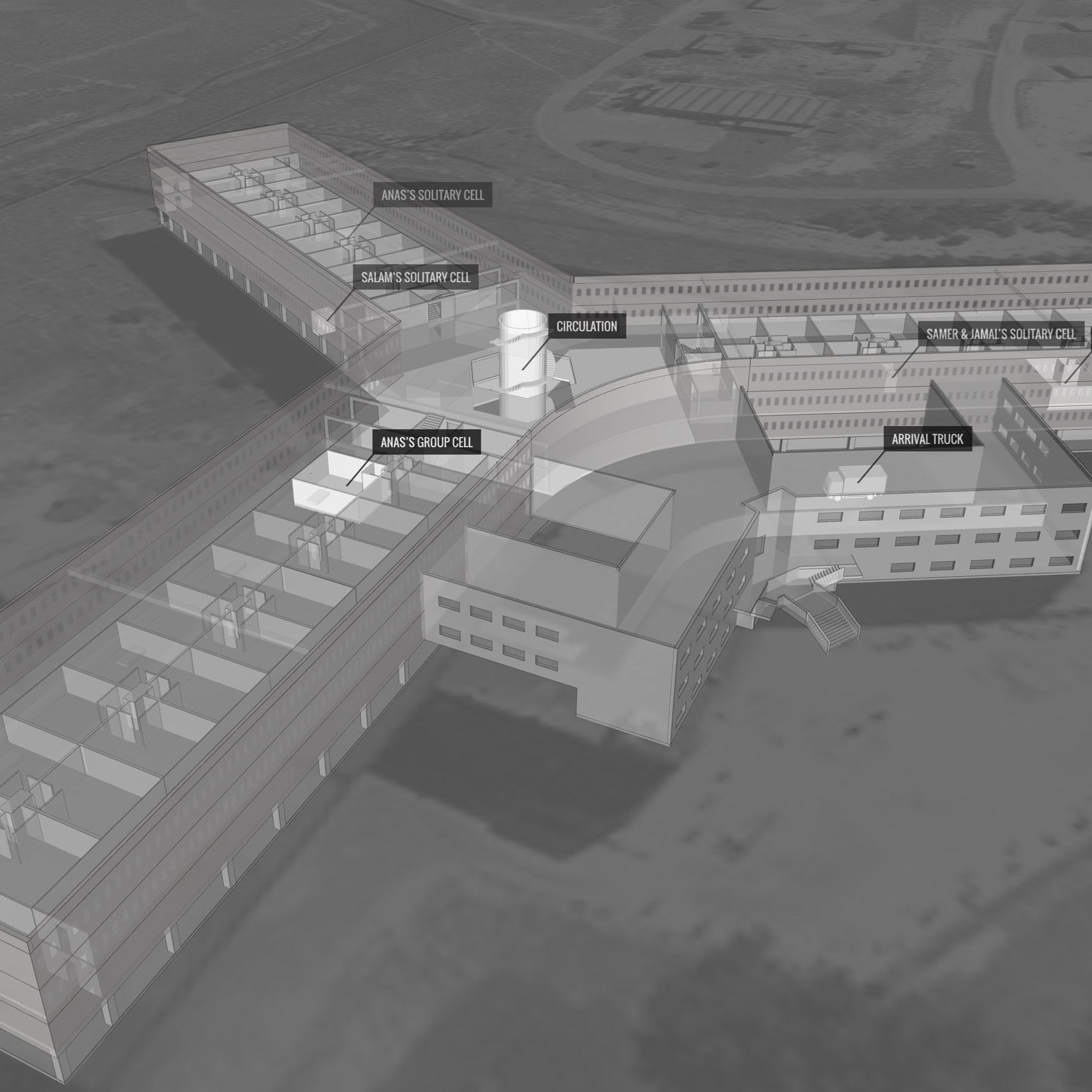
Forensic Architecture has created an interactive model of a notorious torture prison in Syria, using the eye- and ear-witness accounts of survivors (+ movie). (more…)





 Sig Nordal