
Taxi app Uber will trial a fleet of autonomous Volvos on the roads of Pittsburgh later this month, the latest development in the race towards driverless cars (+ slideshow). (more…)
Taxi app Uber will trial a fleet of autonomous Volvos on the roads of Pittsburgh later this month, the latest development in the race towards driverless cars (+ slideshow). (more…)

This article was originally published by Metropolis Magazine as “Good-bye Grand Structures: The Small-Scale Civic Architecture of Today.”
The city hall of my current hometown, Scottsdale, Arizona, gives no hint of any sort of civic function to the boulevard on which it sits. You enter it from the parking lot in back. The only reason I have been there was as part of a team presenting our credentials in a design selection process. My other dealings with government have been online, via mail, or at suburban locations where I have gone to handle such matters as smog tests. I vote by mail.
The big push in American local, state, and federal government is to take everything possible online and off-site and to make whatever remains as minimal and anonymous as possible. The actual operations of government have long taken place in back rooms where politicians and bureaucrats have done the real work. Yet they were often encased in grand structures that gave us a sense of identity and pride in our government while also serving as open sites where we could encounter our civic agents and one another. As a result, we live with a heritage of civic monuments that proclaim our investment in deliberation and democracy, but we build very few, if any, such structures today. Instead, we are looking to get rid of whatever relics of such a history of civic architecture we can—the governor of Illinois would like to sell the James R. Thompson Center, designed by Helmut Jahn in 1982–85, and only the specificity of the grand classical edifices that predate that Postmodern monument prevents other politicians from trying the same. Civic buildings cost money to build and maintain, and their formal spaces sit empty most of the time.
The same is true of the services the government supplies. Post offices are closing at a rapid rate, as are schools in inner cities. Train stations that are now served by the semi-governmental Amtrak lines are often sheds next to the edifices built during the height of that sort of travel. If you are looking for the physical representation of what brings us together and what we all share, whether as a heritage or an ideal, whether as services or in care, you will have to work ever harder.
Even our grandest structures—namely, the bridges, dams, roads, and other transportation and infrastructure components that literally brought us together and serviced us all—are now the subject of rebuilding and repair, rather than of new construction. We are way behind on the maintenance of our road and water networks, so that has first priority. When we do build something new and on a vast scale, it is often excruciatingly bad or boring, not to mention absurdly expensive, such as the new Bay Bridge replacement in San Francisco or the Bunker Hill Memorial Bridge in Boston. Much of the work also goes on where we cannot see it, whether in the new water tunnel and subways being built under Manhattan, or the Big Dig and the Alaskan Way Viaduct replacement in Seattle.
Recently, the State Department has been trying to improve the ways in which the United States presents itself to the rest of the world. Under the leadership of the architect Casey Jones, it has been striving to mask the intense security demands on every foreign structure with good architecture. I was on the peer review committee for the embassy we are building in Mexico City to a design by Tod Williams Billie Tsien Architects, and I saw how difficult it is to make such structures into anything other than fortresses that contain processing centers for thousands of visa applications a day. Now this program is under attack from Republican congressmen who see nothing but waste and vulnerability.
If there is hope, it is in small structures. That same Scottsdale where there is no civic heart has commissioned a series of public libraries, each named after a different breed of horse. Our neighborhood has the Arabian (2007), designed by local firm Richärd + Bauer. A Cor-Ten steel snake, it draws you into a hidden courtyard with slanting reddish walls before letting you explore lofts where books and tables doze under soft light from clerestories. A nearby fitness center, designed by Weddle Gilmore Black Rock Studio and finished the same year, shares much of the library’s aesthetic and grandeur.
Branch libraries seem to have become the one area where there still is an investment not only in civic architecture but also in experimentation. David Adjaye’s two libraries in Washington, D.C., stand as examples of such good design, and you can find other examples by less well-known architects around the country. They are often a chance for local firms to make good design in a civic arena.
New York City, under former mayor Michael Bloomberg, embarked on a program of new libraries, police stations, and other improvements (the salt storage shed on Manhattan’s West Side, designed by Richard Dattner, has received a great deal of attention), and we can only hope that this boon of good, shared architecture will be continued by the less visionary current mayor.
What draws these moments of hope together is that they are all relatively small, and that they have very specific functions. Contrast the success of the salt shed with the turkey carcass of the $3.9 billion transit hub Santiago Calatrava finally managed to finish at Ground Zero and you can see the success of the modest and purposeful as opposed to the kinds of grand structures that become magnets for critics of government waste.
I would argue that this is as it should be, and we should focus our attention on the very specific elements and services government provides in a manner that invests money wisely and only when and where it is needed. That is not to say that the resulting architecture should be cheap and banal. What we must rescue at that small scale is exactly what draws us out of the everyday, away from what separates us, and toward a common purpose, place, and sense of community.
We must also understand that civic space has to embed itself both in existing buildings and in larger complexes that serve other functions. We have a long history of using schools to vote and shopping malls as locations for certain services, but now we must try to understand how to take those opportunities and use them to draw attention to and ennoble—I am not ashamed to use that word—civic architecture.
In Sacramento, a private developer who is creating a new residential neighborhood across the river from downtown commissioned landscape architect Jerry van Eyck to design the Barn, a torus-shaped event structure that has no particular function, but serves to focus the nascent community and provides space for parties or concerts, or just shade. Its instigator, Fulcrum Property design director Stephen Jaycox, sees it as a prototype for such structures that do for smaller neighborhoods what stadiums and museums do on a civic scale.
In an even more commercial sense, Apple works hard to make its stores have an appeal that goes beyond, but ultimately enhances, the products it sells (see the company’s new San Francisco flagship). If it can do so even in shopping malls, why should cities and agencies not be able to do likewise? People gather and linger in places like hospitals and clinics, which are dismal spaces on the whole; could we not enhance them with places of pride and hope?
I realize this is overly optimistic. There is no reason for civic entities to invest in such good places because it will not get politicians reelected or bureaucrats promoted. We need to be even more tactical. Perhaps civic architecture can be temporary. Pop-up election information booths, or tents where hot propositions or candidates can be discussed, would seem to fit within the tenor of the times. The German cultural theorist Peter Sloterdijk has proposed pop-up domes to enhance democracy, and perhaps that is something we could use in this country as well. In the United Kingdom, the multidisciplinary team Assemble won the Turner Prize last year at least in part for its temporary theaters and event spaces, which it often constructs with the neighbors and out of material already on the site. There are pop-up “parklets” in many cities now, but they are on the whole rogue events. Why not make them into sanctioned temporary amenities?
We do this already by encouraging various sorts of fairs and markets in public spaces. The Scottsdale city hall has a regular market, and around the country we are seeing a rebirth of such once-a-week places where people gather, drawn by good produce, but lingering for entertainment and perhaps even social engagement. Why not formalize these gatherings by adding political elements? And if the Coachella Valley Music and Arts Festival can commission the likes of Jimenez Lai to create temporary structures for its gathering, why can’t cities?
Which brings us, finally, to the one part of our civic infrastructure that is improving almost everywhere: public space. With so much of our work and play now online, the desire to experience real places, whether they are parks or squares, with real people, is increasing. Bike lanes and bike share programs open cities up to a use that is more social and experiential than what we have when we cocoon ourselves in our cars. Social networks make it easier to find one another for whatever reason, whether it is music, sex, or protest, and thus crowds can form in an instant. We might be over flash-mob performances, but the idea will reappear in some form. Through public-private partnerships, most cities have leveraged the investment of retailers and restaurant owners, who benefit from lively public space, to upgrade our streets and squares in business improvement districts. Even in suburbs, shopping malls are turning outdoors, mixing public and private spaces.
The question is how to activate all these small moments of hope. I would argue that a task for architects and architecture schools should be to devise civic forms that make use of and energize public services and gatherings, then lift them into a realm where they make us aware of where and who we are in relation to one another and our surroundings. Classical architecture, with its colonnades and domes, did this once. We need a new version of such a collective form-making that is more open, more resonant with different cultures, and cheaper to make, and can even reuse existing structures and materials.
Whatever we do, we should not aspire to make grand new structures like our own city halls and state capitols. We should rather take what we have and imbue it with civic qualities. We should open up our office buildings and shopping malls, which will become redundant as we work and shop more and more online, to collective uses and make them new kinds of focal points.
For all that, I do miss the Hoover Dams and the state capitols we once built. I dream that one day we can once again believe in our collective destiny and the importance of deliberating that future enough to make a true civic architecture. Until then, we must take solace in the small, the temporary, the lively, and the strange, in whatever form it might take to draw us together.

(adsbygoogle = window.adsbygoogle || []).push({});
I know, I know. It’s a bit controversial but if you’re a man reading this, you can hold on to your sock suspenders for a moment and try not to get your boxer shorts in a twist. It’s only a few observations I’ve noticed as a WOMAN in business.
I took over my father’s windows company in 2010 and I’d worked with him beforehand, so I saw up close how he ran the business. Admittedly, he’s a former broker in the City of London so has all the quirks and foibles you’d expect from a stereotype ‘City Gent’ type businessman. Nevertheless, I noticed quite a few things he lacked that could easily have been resolved, just by changing sex.
You can debate all you like but from where I’m standing, there are some fundamental differences between men and women. We’ve evolved in different ways to fulfil our own separate functions as human beings. Men were always the providers and protectors, whereas women were the nurturers and care givers. This is the way we’ve evolved, so don’t blame me for pointing it out.
See Also: What Women Should Know About Men’s Brains
(adsbygoogle = window.adsbygoogle || []).push({});
So on our slightly different paths of evolution, we’ve evolved traits that are specific to our own gender. Now, it’s no secret that women have been held back from the world of business for the last forever thousand years. But in this current age of enlightenment, women get a fair crack of the whip, and it’s interesting to see how our evolved traits seem to give us an edge over the ‘not so’ fairer sex.
//<![CDATA[
aax_getad_mpb({
"slot_uuid":"16dcbcd0-2124-4a85-9abe-c263dd9084e5"
});
//]]>
So, without further ado, let me please explain why women are better at business than men.
Women are better at multi-tasking and that’s a fact. We’ve had to prepare the food, look after the kids, clean the house and carry out all number of chores simultaneously, while hubby plonks himself on the couch after a hard days hunting.
Hunting that is, one wild beast. One. One goal, one aim, just one thing to concentrate on.
(adsbygoogle = window.adsbygoogle || []).push({});
This went on for aeons, so it’s no wonder that women evolved better multi-tasking skills, and that carries through to the world of business. I have to manage over 50 staff, handle multiple customers, enquiries, ensure supplies and equipment are where they’re supposed to be, when they are supposed to be there, and my father, God bless him, struggled massively in this area.
It’s no coincidence that the majority of PA’s and secretaries are women, and the smart businessman hires a woman to multi-task for him. Which takes me to my next point.
(adsbygoogle = window.adsbygoogle || []).push({});
When women were allowed into the workplace, it was generally as assistants to men. Do you not think that these women were looking at their male bosses, thinking they could do a better job?
Of course they were! The trouble is they were never allowed.
But since then times have changed and these women have had daughters and granddaughters and told them never to be afraid of being in charge. So we now have generations of women in business motivated by the outdated misconception that it’s a ‘man’s world’.
Men can be motivated as well, don’t get me wrong. But men have always been in business. It’s expected of them. Women have to work hard to prove they’re stronger, tougher and more capable than the thousands of years of conditioning have taught us.
Yes, women have had to battle against the tide for thousands of years. I’m 100% certain that there were stone age women who thought they could organise a deer hunt better than their half-witted other halves. But they would never have been given the chance. This has helped women develop extremely thick skins.
(adsbygoogle = window.adsbygoogle || []).push({});
Fast forward a million years and this thick skin, or resilience as I like to call it, is helping women succeed in the tough world of business. Resilience is vital for being able to take the knocks and come back stronger.
There was a time when my business was on the ropes, and my father was ready to throw in the towel. But I refused to let it get to me. I reorganised, re-strategised and came back stronger. And now the business is thriving.
Which takes me on to my next point. Women have less of an ego than men. Men need an ego, they’ve evolved one. They need to be able to stand up to a threat, and they build a picture of themselves that’s bigger and stronger than they actually are.
This is important when it comes to facing an enemy that is bigger and stronger than themselves. But it can alienate people that aren’t a threat. We’ve all seen the red socks and suspenders of an Armani suited douche bag who kicks around the office like he’s God. This, in my opinion isn’t good for inspiring your team.
And speaking of inspiring your team. It’s a well-established fact that women are better at communicating than men. To run a successful business, you need a team that works together with cohesion and purpose. If problems are encountered they need to be resolved quickly, so the team can get back on track with the business of being successful.
The trouble with men is they tend to bottle things up. Joe might have a grievance with his position, but rather than speak about it he lets his productivity slide. My father in this position would call Joe lazy, and probably aim a few loud expletives in his direction. Joe would then feel more aggrieved, and so the cycle would continue until Joe either quits, or is fired.
A woman on the other hand is more likely to notice that Joe has an issue, and she would ask him politely to share his feelings. Joe would open up like the delicate flower he is, and the problem would be resolved before it has a chance to spiral.
Which leads nicely to another reason why women are better at business than men. Women are less impetuous. Men have evolved what I call a fight reflex. This was a good trait to have when we were living in caves. You never know when the next caveman is going to steal your cave, your wife, and spread your innards on the wall as art.
So, when a man feels threatened by anything, his heckles go up and he switches to fight mode. Running in fight mode his vision is impaired and he’s liable to make rash, reckless decisions. This is when the woman will step in and tell him to calm down, but he’s likely to shout I AM CALM!
Fortunately, women don’t have this trait, and deal with threats in a calmer, more rational way. This avoids all manner of misunderstandings and helps a business run along like the smooth running ship it should be.
Now, this is probably the most controversial of all the statements I’ve made in this here article. But facts are facts. It’s a modern educational orthodoxy that girls across the developed world are more likely to get top exam grades and university places than boys. The university admissions authority over at UK even warned that being a male could soon be seen as a new form of social disadvantage.
Now, does this mean that girls are more intelligent than boys? You betcha!
Although I’m sure there’s a myriad of factors that go into the reasoning why girls perform better than boys at school, the fact remains that they do. So if they had the same institutionalised thinking on business as men, they’d probably do better at that too.
See Also: Are Men Or Women More Successful At Saving For Retirement?
I’ve made a lot of points here in this paper, and I’m sure if you’re a man reading this you’ll want to disagree with every single word I’ve written. You think it’s all jiggery pokery.
Well, a number of eminent psychologists agree that women’s intuition is very real indeed. Research has shown that women are better at reading facial expressions than men. Also, it’s shown that women are more likely to pick up on subtle emotional messages being sent out by others. This means we instinctively know if someone’s trying to hide something.
So the next time you try lying to a woman, remember she can read every little muscle tick on your face. And that’s a very handy tool to have when you’re running a successful business.
Okay, so you can uncross your legs now guys. You can disagree with a lot that I say, but the fact is I, (a woman) inherited a struggling business created by my father (a man), and turned it into the most successful and fastest growing sash windows company in London. I’ve done this in 6 years and have a 5-year plan to make Sash Windows London Ltd the biggest glazing company in the UK. And all because, thankfully I was born a woman.
(adsbygoogle = window.adsbygoogle || []).push({});
(function(d) {
var params =
{
id: “cb4f919c-04fa-460c-b2ff-2c7f9ecf4472”,
d: “ZHVtYmxpdHRsZW1hbi5jb20=”,
wid: “165294”,
cb: (new Date()).getTime()
};
var qs=[];
for(var key in params) qs.push(key+’=’+encodeURIComponent(params[key]));
var s = d.createElement(‘script’);s.type=’text/javascript’;s.async=true;
var p = ‘https:’ == document.location.protocol ? ‘https’ : ‘http’;
s.src = p + “://api.content.ad/Scripts/widget2.aspx?” + qs.join(‘&’);
d.getElementById(“contentad165294”).appendChild(s);
})(document);
The post 8 Reasons Why Women Are Better Than Men at Business appeared first on Dumb Little Man.

The site, a plot of 25 x 50 meters facing a lake, is located in a private neighborhood in the north area of Greater Buenos Aires. Towards the NW lies the street and the façade and towards the SE the lake and the rear façade. Both the NE and the SW are for mandatory setbacks.
The program consists in a house for two people during the week and fourteen during the weekends.
The house is a rectangular concrete prism with a patio.
It is basically composed by four concrete walls in the ground floor, two longitudinal beams in the first floor, and over them four transversal beams, from which one of the slabs hangs.
Architecture and structure are the same thing.
Appearance and essence; context and parti; orientation and patio; vegetation and matter.
The house closes itself towards the street and the sides looking for privacy, and opens up towards the lake, taking advantage of the antropic natural-artificial landscape. At the same time, the house opens itself with its patio towards the best orientation, searching for sunlight and cross ventilation.
The patio, its vegetation, humidity and aroma, surrounded by the concrete and its forcefulness, configure a space inside-outside that tries to enrich and contrast the repeated form of suburban habitat of the “country-house”. At the same time, it doesn’t cease to –finally– be that.

People are impressed when you tell them you are an architect. Why shouldn’t they, after all? You share the same title as Frank Lloyd Wright, and that other Frank who builds all those crazy looking buildings. As most of us know from experience, our lives are not that dissimilar from most people living in relative anonymity. How did the architects’ reputation become so acclaimed, yet, so far from what most of us experience?
We haven’t been in an era of architect being a top three (or even top five) career choice in a very long time. You don’t have to take our word for it. Most architects probably wouldn’t have been surprised that even five years ago, Careercast.com listed Architect at #108 on the Top 200 Careers List. This year, it sits at #141–representing a fall of 33 places, and still below such professions as Sewage Plant Operator (#124), Maid (#131), and Janitor (#107). And yes, just like 5 years ago, Architectural Drafter is ranked higher at #74 (a drop from five years ago by only 13).
Can a career in architecture ever be a “top job?” There is some hope, after all, “architect” is also consistently ranked high in the list of ‘most overrated jobs’ by Forbes and Careercast.

Our summer sale ends on 31 August, which means there are less than two weeks left to pick up a copy of Dezeen Book of Interviews for just £8. (more…)

We’ve already talked about this. You’re preparing your final project (or thesis project). You’ve gone over everything in your head a thousand times; the presentation to the panel, your project, your model, your memory, your words. You go ahead with it, but think you’ll be lousy. Then you think just the opposite, you will be successful and it will all be worth it. Then everything repeats itself and you want to call it quits. You don’t know when this roller coaster is going to end.
Until the day arrives. You present your project. Explain your ideas. The committee asks you questions. You answer. You realize you know more than you thought you did and that none of the scenarios you imaged over the past year got even close to what really happened in the exam. The committee whisper amongst themselves. The presentation ends and they ask you to leave for a while. Outside you wait an eternity, the minutes crawling slowly. Come in, please. The commission recites a brief introduction and you can’t tell whether you were right or wrong. The commission gets to the point.
You passed! Congratulations, you are now their new colleague and they all congratulate you on your achievement. The joy washes over you despite the fatigue that you’ve dragging around with you. The adrenaline stops pumping. You spend weeks or months taking a much-deserved break. You begin to wonder: Now what?
The university, the institution that molded you into a professional (perhaps even more so than you would have liked), hands you the diploma and now you face the job market for the first time (that is if you haven’t worked before). Before leaving and defining your own markers for personal success (success is no longer measured with grades or academic evaluations), we share 9 lessons to face the world now that you’re an architect.
Let’s start with the first lesson: the university remains a symbol of upward mobility. Many of us are the first architects or even the first college graduates in our families, and being professional is a sure fire way to get a good job, economic stability, and all that (depending on what you studied). If you weren’t born with a desire to study architect or it isn’t your mission in your life, it is likely that this aspect was more important, an idea reinforced by the media, by constantly publishing the rankings of the best-paying careers.
However, it’s a mistake to believe that studying architecture guarantees you a job. A mistake that you don’t notice when you enter the job market (again, only if you’ve never worked before) and then you realize that your first jobs are not what you thought they’d be like in college, or what society thinks an architect is.
But if we understand that college forms skills (check the graduate profile of your school), you can visualize what your advantages are and how to apply them to what you’re looking for. A lesson that goes along with the next point.
Throughout your college career, all your courses rotate around the studio. By default, our value as architects is in how well we design things. In fact, the first fifty architectural references that you can think of will be designers. The alleged diversity in education is false: everyone can focus on what they want, as long as it is the same thing. The very final stage of your studies is a funnel: it doesn’t matter what you did during the rest of your time here, we want you to be able to design something, anything, even if just a box.
This moment is particularly complicated for those interested in landscape (in Spain landscape architects can’t even sign their own projects), urban planning, theory, construction, administration, teaching or anything else other than straight up design.
I have friends with great interest and knowledge in urban planning who had a really hard time with their thesis project. They asked them for “just a box” in order to graduate. The commission did not appreciate “these colored drawings.” My friends thought they’d never get out, but once they got past their thesis projects, their strong will and determination (and of course, the job market) revealed something else.
Mark Wigley, former dean of GASPP says that architecture is “99% hiding 1% displaying”. If those words don’t make sense to you, think back to studio projects. Each architectural design begins with infinite potential layers of information and variables that depend on you, hide them or show them, regulations, technical specialties, budgets, deadlines, sustainability, management, construction, and most importantly, the client. Yes, someone who pays and rightly also has opinions. Because they will. You can count on it.
The university exercises put emphasis on design, they help you develop the technical capabilities we talked about at the beginning. However, in the real world, you should also discuss negotiate and make compromises with the other side of the table. There is no teacher, but there are clients, specialists, and contractors. Do not expect everyone to treat you like a big shot, the rest of the participants feel equally important and that they have something relevant to say and defend.
Yes, you learned to work together at university, but often your group divided the job up like it was the putting together a car on the assembly line of an automobile factory. When the day came to turn it in, you all met up and tried to put it together mechanically.
Teamwork is more than that, and as in the previous point, it means learning to discuss. In addition, in the professional world there are corporate hierarchies and specialties. Some opinions carry more weight than others (of course they do, it’s your boss), but don’t be afraid to put your position out there, defend it and listen to the rest.
The architectural language is special. It’s not only special because of the technical concepts that you’ve adopted, but also because of all those adverbs, nouns and verbs that are seemingly profound and poignant but devoid of all meaning. Why do we use them? Well your professors really liked them and they bring up fond memories of architecture school. However, in the eyes of society it is one of the reasons why our profession isn’t taken seriously. We talk funny.
Talking funny is one thing. Another is having a rich, broad and complex language. Saying nothing at all is something else entirely. Examples? Attributing anthropomorphic properties to your project as if it were a pokémon is totally bizarre. Yes, it is a subjective and personal reading on your work, but it is not clear, or directly or convincing. You can put it another way.
Don’t expect someone to understand that a piece “wishes to rest on a hill and look out over society” or that its concept is “a circumstantial dynamic of urban retreat.” You aren’t saying anything. We talked about this a while ago and a selection of “150 weird words that only architects use.” Some advice? Save the list somewhere and try to eliminate or replace them.
Don’t get frustrated when you see that the official rate scale for architects doesn’t match your own experience. Don’t get upset with your school or your dean. For this, there are two answers, the long one and the short one.
Let’s go with the short answer: this goes beyond architecture. In a market of supply and demand, the oversupply of architects makes for cheaper labor.
Before we had Le Corbusier and Mies van der Rohe. Now there’s Bjarke Ingels. Whether we like it or not, the most well-known architects are also those who do the most self-promoting. Instead of waiting for clients, they offer proposals. They established connections with other fields. They rejected the status quo of the occupation and breakthrough. They did it their way. They published, presented, and discussed. They were convinced of their principles and pushed to make them a reality.
Pro tip: It’s not enough to have the best ideas if you can’t get them across. If our profession is an enrichment to society and we’re convinced that we can contribute, then you should be able to communicate. Don’t expect that, after working quietly for decades, somebody is going to show up on your doorstep holding the Pritzker (or whatever award that you care about the most).
The best (and strongest) ideas are dispersed, spread, discussed, reformulated, expanded and compared.
I am of the opinion that history is a social construct. Its construction is the story of people who write it, schools that influence it, and institutions that validate it. In the case of architecture, it is quite clear. Don’t you find it strange that there is such little recognition of women in our discipline? Cases of injustice are numerous and, fortunately, we are uncovering more and more sexism from the twentieth century. Unfortunately, that vision of architecture is what was then passed on to generations of students. Furthermore, this also lead us to look at ethnic minorities. We are not just talking about history because the wage gap remains scandalous.
The marginalization of Scott Brown in connection to the 1991 Pritzker award of her husband, Robert Venturi. Or the constant prosecution of Zaha Hadid, even when she was already a shining star in the architect world. In the daily lives of thousands of architects, injustice knows no cultural or economic barriers, such as the 19 cases rescued by the New York Times on daily inequality.
How many women have individually won the Pritzker? One, Zaha. How many Latinos? Four. Africans? Zero. Are there no architects of this magnitude or are they invisible? In the end, architecture (and its history) is a long reading, it is assumed knowledge to be the official version and it is then taught it to us. We must avoid repeating that mistake. It’s time to confront this history, expand it, make it more complex and diverse.
We left university thinking that we don’t know anything. We went to an all-you-can-eat buffet and chose a little of everything, but at the end of the meal, we were still not satisfied. This is one of the major frustrations of getting a degree it inhibits us from applying for new jobs and positions, or to try new things.
Don’t worry, because you will learn everything along the way. Can’t you fill out the required city forms? Surely you have a teacher or a friend who already knows how. Contact them. Don’t you know how to construct a foundation on wet ground? Research it, speak to somebody, review old plans, ask someone who already has been working for a while. There is always someone who’s already done it. It’s not the end of the world.
You need to try, fail, figure out, and accomplish.
Carl Gustav Jung is a famous Swiss psychiatrist and psychotherapist who founded analytical psychology. In Jungian psychology, archetypes are highly developed elements of the collective unconscious. It is history, culture and personal context that shape these, giving them their specific content.
Deep down, every one of us is affected by these archetypes, our behavior patterns being based on them. But which one do you channel the most?
Take this quick, easy quiz and find out which Jung archetype best describes you!
The post Which Jung Archetype Best Describes You? appeared first on Change your thoughts.
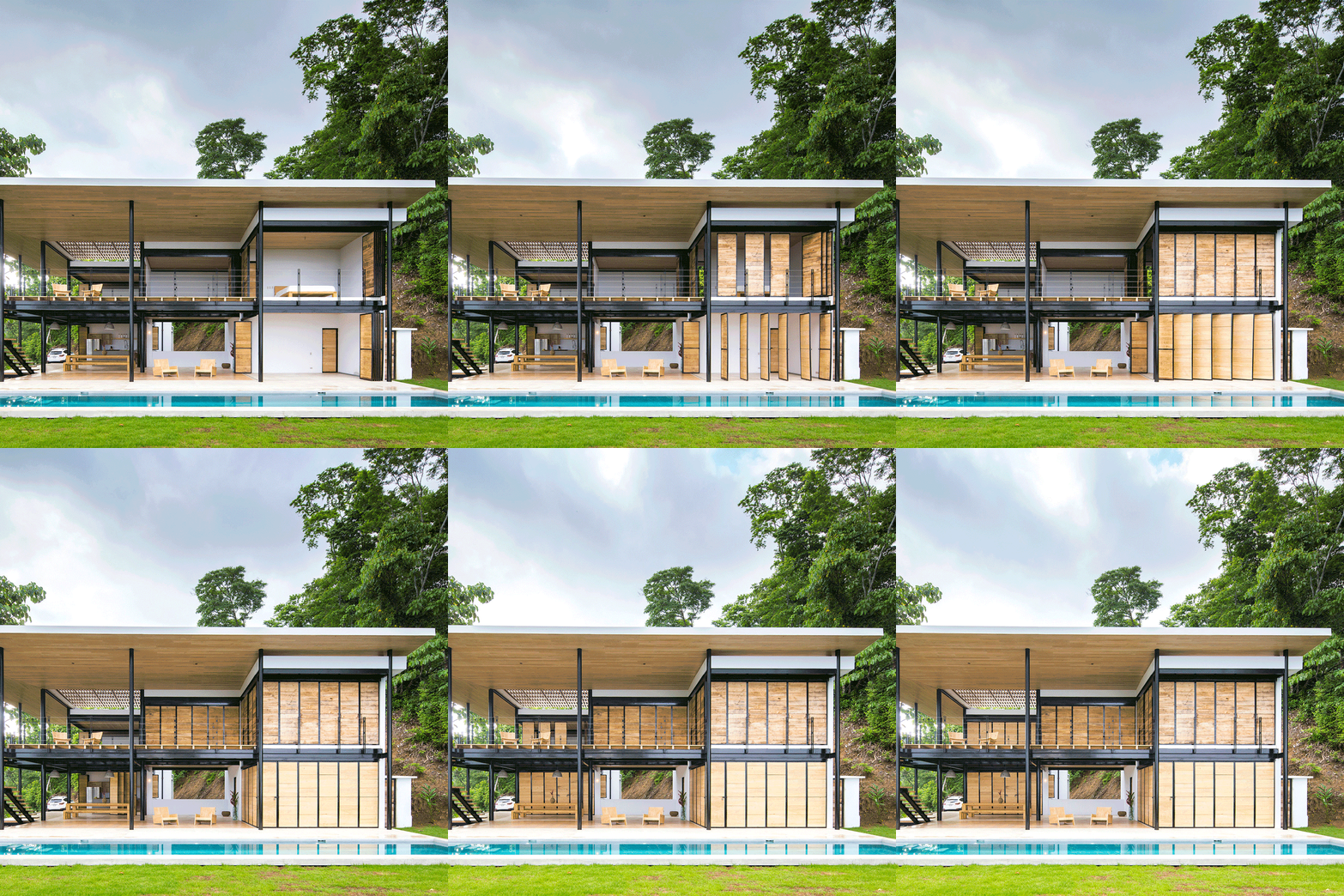
Wooden walls can be folded back from the front of this house on Costa Rica’s coastline, opening up ocean views for the bedrooms and living spaces within (+ slideshow). (more…)

 Sig Nordal