Dutch firm de Architekten Cie. have revealed their design for the Galileo Reference Centre, a new data collection center for the Galileo satellite system in Noordwijk, The Netherlands. Primarily housing office space and computer rooms, the center has been designed as a highly efficient and resilient building which can be adapted into the future.
Courtesy of de Architekten Cie.
The structurally lightweight building sits adjacent to a small bay of sand dunes in the Noordwijk Space Business Park. Wildlife and nature are brought into the building through green terraces aligned to the main functional areas, and the connection between indoor and outdoor is maintained through a “social lobby” which opens up the ground floor. Also functioning as the main circulatory space, the lobby distributes users throughout the building and provides the functional services for the first floor.
Courtesy of de Architekten Cie.
The life-cycle of the building was a driving factor of the design, Primarily comprised of wood, a replenishable resource, the building utilizes prefabricated and composite structures easily disassembled and reassembled. The benefits of using prefabrication, and specifically the pine of the main structure, first floor and roof are threefold. Firstly, the structure is light enough to rest upon the sand; secondly, the structural columns are able to double as wooden partition elements; and lastly, the modular design allows maximum reduction of waste.
Courtesy of de Architekten Cie.
The facade features a singular repeated component in three different transparencies, from fully opaque to fully transparent. This provides necessary permeability and enclosure in required areas of the building. The future-proofing of the building is exhibited here again, as the interchangeability of the panels will allow the facade to be adapted to internal configuration changes as the building’s program changes.
Courtesy of de Architekten Cie.
Alongside the minimization of material wastage, the building is designed to be highly energy conscious. A series of measurements determined that it will be 35% more efficient than currently required by Dutch building regulations. Construction of the building has been accelerated due to the necessity of its completion and is due to be completed in July 2017.
Courtyard House is a project completed by Robson Rak Architects. It is located in Melbourne, Australia. Courtyard House by Robson Rak Architects: “Behind an unassuming façade, the Courtyard house opens up to reveal a pared back design response, mixed with luxurious materials, and practical detailing. This existing building has been altered and extended, with the interior design responding to our client’s love of Japanese architecture and rituals. The site is..
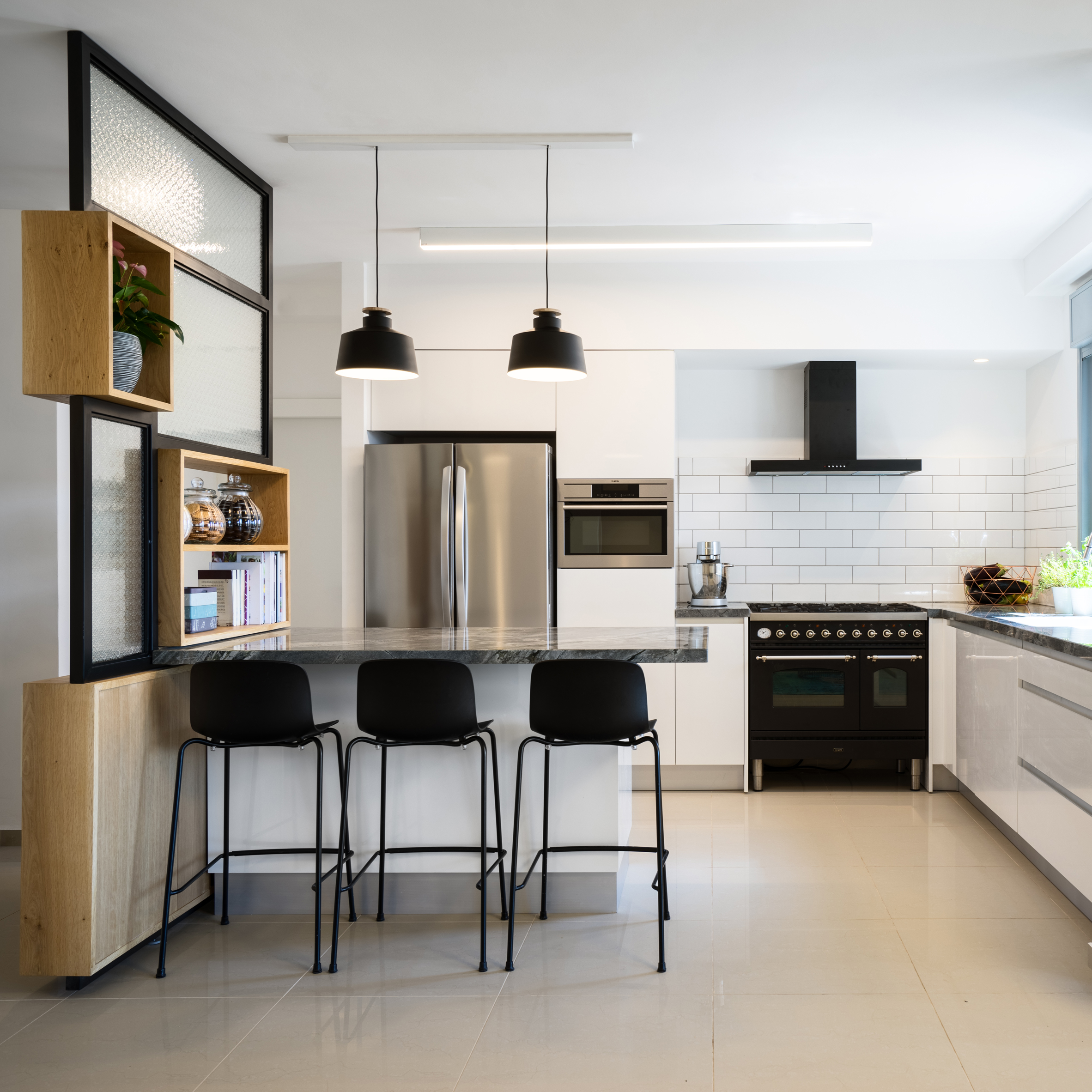
Israeli practice En Design Studio made strategic interventions into this new-build apartment interior to give the home a “young and unique character” (+ slideshow). (more…)
Las Escaleras Country House is a residential project completed by Prado Arquitectos. Located in Hualpén, Chile, it was finished in 2015. Las Escaleras Country House by Prado Arquitectos: “A house on the edge of the cliffs, 60 m (197 ft) above the sea, on Tumbes’s Península, at the Bío-Bío Region. The concept of full dedication to the presence of the Pacific Ocean conditions the architectural gesture to an attitude of..
A modular living system by the Wood Program at Aalto University
As the Nordic countries have recently been experiencing fluctuations in population, it has become apparent that there is a severe shortage of temporary housing solutions for students, asylum seekers, displaced residents, and others with similar short-term needs.
In urban and sub-urban contexts, the pre-fabricated modules can be transported and combined into various configurations to fit numerous sites. Rather than the typical approach of autonomous, deployable containers, Kokoon allows for habitable space that can expand both vertically and horizontally. Additionally, simple approaches to storage, lighting, and spatial division ensure that the interiors are both practical and dignified.
Kokoon is a design / build project from the 2015-2016 Wood Program at Aalto University School of Arts, Design, and Architecture. It was constructed to address the current housing situation in Finland. The three prototype units were finished in Otaniemi and assembled on-site in one day. They are intended to be displayed and used in various locations around Finland over the coming years.
It’s been tough. This whole relationship has been up and down, back and forth, good and bad but lately it’s been mostly bad. You’ve been thinking of leaving for a very long time and have just recently found the courage to do it. You get ready to tell your partner and then you back out again at the last minute, unable to follow through with it. This has been going on for a while now and it’s about time to stop it.
So what’s it going to take for you to finally write that good bye letter. How much more anguish and sadness do you need to feel before it’s time? You already know it’s important for you to do this, why haven’t you yet then? Of course fear plays a big part in all this. Fear is downright crippling and will hold you anywhere for a very long time. There are a few things you must remind yourself of in order to take that leap of faith.
You’re going to be ok.
First and foremost, keep telling yourself you will be ok. Many of us who want to leave a relationship think that we can’t make it on our own without our partner. Of course you can and chances are, you’ll be able to make it even better without them. We think the worst things will happen when in fact, none of them ever do. You’re going to be ok. Keep reminding yourself of that.
You are way better off.
You already know this but you fall into that “things aren’t so bad” mode and decide against your plans to leave. You know life will be beyond fantastic when you leave so hurry up and do it. Why do we prolong our happiness? You already know that every single aspect of your life is going to be great the minute you leave. Don’t wait another minute.
Freedom.
That freedom that you have been longing for will finally be yours. You know the freedom I speak of. That freedom that you get when you are finally on your own doing your own thing with no one to answer to. That freedom where you can come and go as you please and not worry about getting interrogated like you just committed murder. That freedom to be who you are all the time and not have to pretend to be someone you’re not to make someone else happy. Yes, that freedom will be yours.
You don’t need anyone.
Get out of that “I need you” mentality. You don’t need anyone but yourself. You are perfectly capable of making decisions on your own and you have already made some great decisions all by yourself. You don’t need anyone to decide things for you. Once you start making decisions for yourself again you will see how awesome these decisions are for you and self confidence will follow.
Make room for awesome.
You have been hanging on for far too long to a love/relationship that doesn’t supply you with all the love and happiness you deserve. You know you are deserving are far more than your partner is giving you. you also know that you would really like a solid loving relationship. When you finally leave you are making room for the perfect for you partner to show up. You are blocking them right now. Let go of the old, make room for the new.
Who am I anyway.
Who are you really? For years, you’ve been this person trying to please someone else. You’ve been a pretend person keeping the peace just to make everyone else happy but the most important person, you, isn’t happy. As soon as you leave, you will have time to discover who you really are and all the things that make you happy or not. You can do more of the happy things and dump the things you’ve been doing for years that don’t bring you joy.
No one wants to go through the dreaded break up. We all hope to stay with our partner til death to us part but sometimes that’s just not possible and the breakup part is really hard to do. So we hang on. It’s time to let go and go live a happier life. We are all here for joy, not misery. If you are in a relationship now that is causing you misery, it’s time to let go. You deserve happiness.
The Exposition’s poster, designed by Robert Bonfils. ImageCourtesy of the Victoria and Albert Museum
The end of the First World War did not mark the end of struggle in Europe. France, as the primary location of the conflict’s Western Front, suffered heavy losses in both manpower and industrial productivity; the resulting economic instability would plague the country well into the 1920s.[1] It was in the midst of these uncertain times that the French would signal their intention to look not to their recent troubled past, but to a brighter and more optimistic future. This signal came in the form of the Exposition Internationale des Arts Décoratifs et Industriels Modernes (International Exposition of Decorative Arts and Modern Industries) of 1925 – a landmark exhibition which both gave rise to a new international style and, ultimately, provided its name: Art Deco.
via Wikimedia
World’s Fairs were not necessarily new in Europe. Since 1851’s seminal Great Exhibition in London’s Crystal Palace, a multitude of similar fairs drew millions of visitors. This tradition was abruptly cut short by the outbreak of World War One, an interruption that would last until the British Empire Exhibition of 1924.[2] Planning for the International Exposition actually began in 1911, but debate over exhibitor criteria and, eventually, the war would delay the opening until April of 1925.[3]
The Exposition, which occupied both banks of the Seine, was tied together by the Pont Alexandre III, itself built for a previous World’s Fair. Imagevia Wikimedia
The Exposition occupied 57 acres in central Paris, stretching from the Esplanade des Invalides across the Pont Alexandre III to the entrances of the Grand Palais and the Petit Palais.[4] Two-thirds of the allotted land was set aside for various French pavilions; the rest was made available to the other participating nations, most of which were European. Germany was notably unrepresented, as lingering tensions from the war meant they were not invited to join the Exposition until it was too late to organize a national pavilion. The United States was also absent, due to a lack of designers whose work met the requirements laid out for display submissions.[5]
The Dutch Pavilion was an example of Expressionist architecture in a largely Moderne fair. ImageCourtesy of the Nederlands Architectuurinstituut
It was these requirements that would set the 1925 Exposition apart from its forebears. The stipulation that ultimately disqualified American participation was that no design could be based on historical styles – everything was required to be exclusively modern. Though it was hoped that the Exposition would reflect the life of the common person, most products displayed were designer goods aimed at the wealthy elite.[6]
As a result of these same requirements, a variety of contemporary architectural styles were utilized in the Exposition’s many pavilions. The pavilion for the nascent Soviet Union, designed by Konstantin Melnikov, was an angular red and white monument to Russian Constructivism realized in wood and glass. The Dutch pavilion, designed by J.F. Staal, was an Expressionist building composed of red brick. Victor Horta’s design for the Belgian pavilion, meanwhile, eschewed the florid Art Nouveau style for which he was known in favor of a stepped, rectilinear structure more in line with the majority of the French pavilions.[7]
Horta’s Belgian Pavilion was a radical departure from his typically curvilinear Art Nouveau style. Imagevia Wikimedia
Despite the presence of these alternative styles, and even a few historicist entries that defied the fair’s guidelines, it was French art moderne that would feature most prominently at the Exposition. Though it was already popular in France by 1925, the Exposition was the first time that this style would be introduced to an international audience. The global influence of the fair was unmistakable in the following decades; in 1966, another Parisian exhibition would rename the style Art Deco in honor of the Exposition that had popularized it.[8]
The sunburst crowning the entrance to the Galeries Lafayette pavilion is a typical element of Art Deco decoration. Imagevia Wikimedia
Art Deco, despite its innate glorification of—and preoccupation with—modernity, was not Modernist in the strict definition of the term. It was not founded upon principles of rationalist engineering or scientific efficiency, instead using motifs and symbols of modernity as a decorative statement. This differentiated it not only from foreign schools like Constructivism and the Bauhaus, but even from the International Style supported by France’s own Le Corbusier.[9] This difference was readily apparent in Le Corbusier’s L’Esprit Nouveau Pavilion, a model apartment that demonstrated his ruthlessly efficient ‘machine à habiter’ without the stylization which defined Art Deco.[10]
The Bon Marché’s pavilion made use of stepped setbacks, another motif frequently seen in Art Deco buildings. Imagevia Wikimedia
Due to its ornamental nature, it is perhaps unsurprising that the most prominent Art Deco structures at the Exposition were not those of architects or countries, but of French businesses and decorative artists. Several notable Parisian department stores—including the Galeries Lafayette, Le Bon Marché, and Le Printemps—set up elaborate pavilions intended to lure attendees in to admire rooms furnished and decorated with consumer products. The exterior façades of these pavilions utilized several common Art Deco motifs, including stylized floral elements, stepped forms, sunbursts, and zigzags. Representatives from various applied and decorative arts employed similar tactics, from book publishers to famed glassmaker René Lalique; the latter had also designed a massive tiered, obelisk Fontaine Lumineuse (Luminous Fountain) with molded-glass caryatids that stood at the center of a neighboring square.[11]
The Luminous Fountain by Lalique was one of the Exposition’s main centerpieces. Imagevia Wikimedia
The most acclaimed pavilion at the Exposition was the showcase for an individual artist, furniture designer Jacques-Emile Ruhlmann. Designed by Pierre Patout, the Hôtel d’un Collectionneur (House for an Art Collector) consisted of a suite of elegantly-decorated rooms laid out around an ovular Grand Salon at the center. These opulent interiors were contained in a stepped, largely rectilinear building decorated with classical bas-reliefs depicting dancers. Critics admired the elegant modernization of traditional forms which, when paired with the luxurious interiors, ultimately earned the hôtel a reputation as one of the greatest achievements of French Art Deco.[12,13]
The Hôtel d’un Collectionneur was a highlight not just of the Exposition, but of French Art Deco in its entirety. Imagevia paris-pepites.fr
During its six month run, the Exposition Internationale des Arts Décoratifs attracted roughly sixteen million visitors, creating massive international demand for the style to which it ultimately lent its name. In accordance with the organizer’s aims, the Exposition also established France as the arbiter of taste and fashion in the interwar era; Paris itself was put on display as the world’s most fashionable city.[14] But the ramifications of the Exposition Internationale would spread far beyond Paris. Though several similar world’s fairs would follow in subsequent years (including two more in Paris in 1931 and 1937), none would have such a resounding impact as the one which took place in 1925. Time would eventually move past the frenzy of Art Deco that followed the 1925 Exposition, giving way to Modernism in the wake of the Second World War – but no single event would ever have such a profound effect on global design sensibilities ever again.[15]
Plan drawing of the Hôtel d’un Collectionneur. Imagevia maximeold.net
References [1] Encyclopædia Britannica Online, s. v. “France”, accessed August 09, 2016, [access]. [2] Rydell, Robert W. World of Fairs: The Century-of-progress Expositions. Chicago, IL: University of Chicago Press, 1993. p3. [3] Raizman, David Seth. History of Modern Design. Upper Saddle River, NJ: Prentice Hall, 2004. p155. [4] Poulin, Richard. Graphic Design and Architecture, a 20th Century History. Beverly, Mass: Rockport Publishers, 2012. p86. [5] Windover, Michael. Art Deco: A Mode of Mobility. Québec: Presses De L’Université Du Québec, 2012. p120. [6] Raizman, p155. [7] Bayer, Patricia. Art Deco Architecture: Design, Decoration, and Detail from the Twenties and Thirties. New York: H.N. Abrams, 1992. p38-40. [8] Bayer, p12-37. [9] Pile, John F. A History of Interior Design. New York: Wiley, 2000. p349.| [10] Bayer, p21-22. [11] Bayer, p38-46. [12] “Art Deco: The 1925 Paris Exhibition.” Victoria and Albert Museum. Accessed August 9, 2016. [access]. [13] Bayer, p39. [14] “Art Deco: The 1925 Paris Exhibition.” [15] Bayer, p37-38.
Photographs: Courtesy of The Victoria and Albert Museum, via Wikimedia, via paris-pepites.fr, via maximeold.net, Courtesy of the Nederlands Architectuurinstituut




 Sig Nordal