The Moth and the Flame: Jay McInerney on “Bright, Precious Days”

McInerney Side by Side Crop

In deep middle age, the Russell and Corrine Calloways have passed their peak. Or at least Russell seems to feel he has. The man once described as the Scott to Corrine’s Zelda, the Nick to her Nora, now stares at infomercials on TV in the middle of the night. He snores. He is subject to 3:45 a.m. panics of despair. Could it really be that his author, Jay McInerney, has reached his sixties?

With its wistful title, Bright, Precious Days is a continuation of Russell and Corrine Calloway’s life story, which began with 1992’s Brightness Falls and continued with 2006’s The Good Life. Like all of McInerney’s novels, it’s set in Manhattan, which seemed a good place to begin our interview. —Daniel Asa Rose


The Barnes & Noble Review: “Though the city after three decades seemed in many ways diminished from the capital of his youth, Russell Calloway had never quite fallen out of love with it, nor with his sense of his own place here. The backdrop of Manhattan, it seemed to him, gave every gesture an added grandeur, a metropolitan gravitas.” I must say, odes to New York don’t get much nicer than that. Women may come and go in your books, but the city is always there. Is it the most enduring love of your life?

Jay McInerney: The city is certainly the most enduring love of my life, and it’s been the backdrop for most of my other romances. I still get excited when I approach from the east or west and catch sight of the skyline.

BNR: The word bright consistently figures into your titles. (Bright Lights, Big City; Brightness Falls; Bright, Precious Days.) Do you mean to signal a moth-to-flame sensibility in your work?

JM: I think indeed it’s a question of moth to flame. It’s a reference of course to the city lights and the fact that my characters are drawn to them.

BNR: One thing you do particularly well is deliver pitch-perfect aperçus. “Kip believed his wealth entitled him to the truth, as if it were a commodity like any other.” Residents of the Hamptons “used this obscure term [jitney] for a public conveyance because the kind of people who could afford to live in both places either didn’t ride buses or, if forced to, would never identify them as such.” Do these come as easily as they used to? Easier?

JM: I think sometimes they come very easily and other times I have to work a bit on them. There is a certain fluency when one is in one’s twenties that perhaps fades a little with time. However, there’s a wisdom, we hope, that comes later in life. On balance it evens out.

BNR: From the get-go, you’ve brilliantly documented the glamorous-but-often-superficial life of fashionable New Yorkers. Do you think you’re chiefly a satirist or a celebrant of that world — that you’re extolling it, skewering it, or both?

JM: I think both. I think my sensibility oscillates between satire and romance but that the latter is ultimately the dominant note. Pure satire is ultimately, it seems to me, somewhat sterile. I can’t write too much about people I don’t care about.

BNR: I confess I sometimes grow impatient with your fascination for “bold-name faces”: characters dine at the sort of places “where, if you read Vanity Fair and watched Charlie Rose, you’d recognize some of the faces in the room, and if you were yourself one of those bold-name faces, you’d know everyone at the surrounding tables.” Why are your characters still so concerned with having the maître d’ know their names or the waiter, their favorite drinks? I understand it’s a way of keeping score, but why are such niceties still so gratifying to your protagonists?

JM: I was trying to enliven the hackneyed phrase: the chapter is written from Corrine’s point of view, and what she sees in the restaurant is faces, not names. I’m not particularly fascinated with boldface names, but most people on the planet seem to be, hence Access Hollywood, Page Six, TMZ, et al. In the case you cite I’m writing about a particularly celebrity-saturated, self-conscious restaurant frequented by New York media people. It’s a hothouse atmosphere — I didn’t invent it, but I’m describing that world and its obsessions.

BNR: Your protagonist quotes some lovely medieval poetry about romantic love. Do you yourself write poetry? Are you a secret romantic?

JM: I wrote poetry for many years; not so much in recent years. I’m not a secret romantic. I’m a romantic.

BNR: You write about a growing exhaustion with the “ridiculous circus” of New York social life: “the babble, the postures and gestures, the ambition and striving and yearning coiled therein . . . For a moment, he recognized how artificial it all was, but he, too, was part of it.” Yet I can’t quite see you moving to backwoods Maine. What’s the solution?

JM: Well, this opinion is Russell’s, not necessarily mine. I think as you get older the social whirl becomes less interesting. But as a novelist I remain interested in social life and all of its manifestations in Manhattan. Definitely not moving to the woods, though I do spend time in eastern Long Island writing, especially in the winter, when there are few New Yorkers around.

BNR: Toward the end of Bright, Precious Days, your protagonist wakes in a panic in the middle of the night. “It was increasingly difficult to avoid the conclusion that he was . . . a failure . . . [not] ‘beloved on the earth.’ ” Yet you wrote one of the signature books of the 1980s, which is still taught in high schools across the country. Doesn’t your continued success somewhat protect you from despair?

JM: I wish I could say success protected me from despair, but it doesn’t. Success doesn’t prevent you from waking up in the middle of the night in a panic, or worrying about mortality or the well-being of your children.

BNR: You were one of the first of your generation to be swept up into the literary pantheon: hanging with Norman Mailer, etc. Was it in any way a burden to have started with such a triumph? If you had not been tapped, would you have written different kinds of books? Would you recommend the experience to other young writers?

JM: I wouldn’t particularly recommend my kind of literary success to anyone; it was very disorienting in some ways, and perhaps I didn’t handle it as well as I might have. It was more of a surprise to me than to anyone, and there weren’t really any road maps to guide me, though in fact, talking to people like Norman Mailer, who’d gone through something similar, certainly helped. He was a great friend and mentor. Early success was the hand that was dealt me. I certainly couldn’t have predicted that success, but in the end I hope I learned from it.

The Barnes & Noble Review http://ift.tt/2aSBtLH
Pond

Pond Cover Crop

Into this summer of withering heat, political hysteria, and the potential unraveling of Europe comes Pond, a cool and curious dive into a deceptively small world. First published last year by an independent press in Ireland, the book marks the move by writer Claire-Louise Bennett from a series of essays and short stories, which have earned her critical acclaim, to the sustained voice of a collection. And what a voice it is.

In Pond you tumble down a rabbit hole into an unsettling realm of ultra-close focus. Here the minutiae of daily life — how best to chill a banana, why the ink in a pen has gone from black to green, the sounds of nature as heard from a certain picnic blanket — take on the weight of the universe. Our guide is an enigmatic young woman, the world she inhabits shaped in twenty short . . . stories? What they actually are — studies or chapters or literary etudes — is up for grabs.

There is no plot, no story arc, no characters to meet and learn about. There’s just Bennett’s voice and her singular vision. In pieces that range in length from a few sentences to more than twenty pages, with all but the final entry written in first person, you’re left on your own to figure things out.

Bennett never names her narrator, a onetime graduate student who has recently quit a Ph.D. program. She has left the city behind and taken up residence in a small stone cottage on the western coast of Ireland. The young woman speaks directly to us in rambling monologues, more than a little bit strange, always intense, and often wickedly funny.

When we first meet her it’s the banana that holds her attention. This leads to thoughts on the microclimate of a kitchen windowsill, which shifts to an analysis of the contents of a fruit bowl (“Pears should always be small and organized nose to tail in a bowl of their own”) and on to a discussion of the pros and cons of various breakfast options.

This pinpoint vision telescopes inward until it feels vertiginous. Bennett offers us mere breadcrumbs, the tiniest building blocks of plot — allusions to a string of lovers, the narrator’s realization that she likes sex only when drunk, an old letter so fraught she can neither read nor discard it.

You stumble a bit and waver: will you go on to the next sentence, to the next page? Yes, yes, let’s go on — the lovely writing, as precise and disorienting as the narrator, pulls you into its deceptively gentle current.

What with the remote cottage, the obsessive detail and the failed doctoral thesis, which lies abandoned in a shed (“Many of the pages loose, and I knew very well they weren’t in any order”), these at first look like writings of a woman in full retreat. It’s a surprise, then, in this close and closed-in world, each time the outside world enters.

There’s a speaking engagement our narrator accepts at an academic conference, a nearby neighbor whose house she often visits, and a lively summer party she throws because “I have so many glasses after all.” At the conference, the narrator gives a bold talk that shrugs off centuries of male perspective on the rhapsodies of love and presents it instead as “a vicious and divine disintegration of selfhood . . . ”

Afterward, as the conference participants chat, an academic bigwig looks down his nose at the narrator’s speech. Rather than being abashed, she goes in for a bit of bashing. She hopes he will trip and fall and cut his head with “just a trickle of blood so you don’t look inured, only stupid and a bit iffy.”

The narrator’s flight from academia turns out to mirror Bennett’s own change of direction. Instead of completing the postgrad work about which she says she felt tepid, Bennett moved from London to Ireland. She left the university behind but not her writing. In Pond, there’s a nod to her awareness of the experimental nature of her work, though with its assured style it seems more accurate to view it as an investigation.

“English, strictly speaking, is not my first language by the way,” the narrator tells us. “I haven’t yet discovered what my first language is so for the time being I use English words in order to say things. I expect I will always have to do it that way; regrettably I don’t think my first language can be written down at all. I don’t think it can be made external, you see.”

And yet, as Bennett shows repeatedly in the strange and exhilarating universe beneath Pond‘s surface, it can.

The Barnes & Noble Review http://ift.tt/2b25FBi

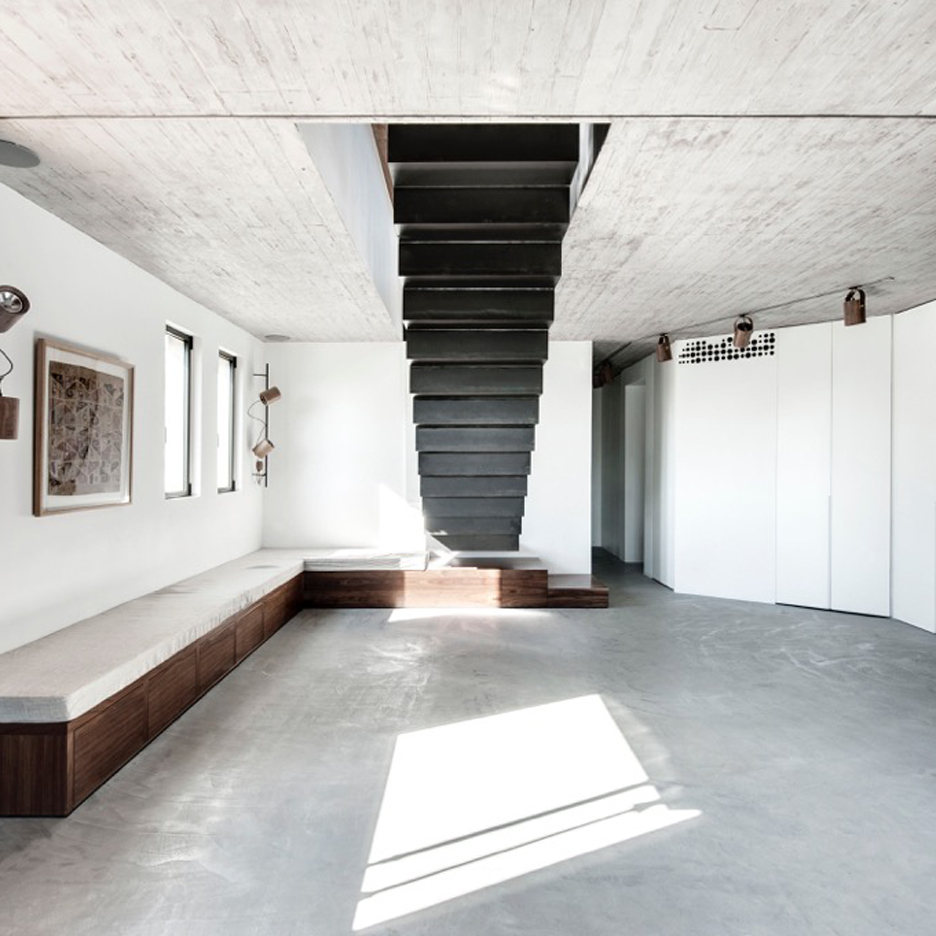
Five of the best apartment renovations in Tel Aviv


Tel Aviv‘s apartment buildings are being transformed with contemporary interiors by a wave of local architects and designers. We’ve rounded up five of the best new apartment designs in the Israeli city, including a renovated space with a dramatic steel staircase and a penthouse with an infinity pool on the roof (+ slideshow). (more…)

http://ift.tt/2aZ9WXf

Las Gaviotas Set / BAK arquitectos


© Inés Tanoira

© Inés Tanoira


© Inés Tanoira


© Inés Tanoira


© Inés Tanoira


© Inés Tanoira

  • Architects: BAK arquitectos
  • Location: Las Gaviotas, Playa Dorada, Buenos Aires, Argentina
  • Design And Project Management: María Victoria Besonías, Luciano Kruk
  • Collaborators: Arq. Florencia Testa, Federico Santinon
  • Area: 285.0 sqm
  • Project Year: 2013
  • Photographs: Inés Tanoira
  • Text: María Victoria Besonías
  • Site Area: 675 sqm

© Inés Tanoira

© Inés Tanoira

The place
Las Gaviotas is a small seaside resort on the coast of Buenos Aires located between the forests of Mar Azul and Mar de las Pampas. A virgin territory of fixed dunes with planted acacias and poplars to which is overlapped an orthogonal trace that defines lots suitable for construction of multifamily developments.
In this case it is an atypical parcel, of just 15 m at the front, with a dense and young poplar plantation, located 300 meters from the beach.


© Inés Tanoira

© Inés Tanoira

The commission
It’s a set of studio apartments for vacation, with a small administration and a house for the owners, in charge of the units’ exploitation. With a change of ownership involved, this property became a new two-room unit. The square footage to be built would be the maximum allowed under code.


Floor Plan

Floor Plan

Floor Plan

Floor Plan

The proposal
The project should fulfill the premise that the resulting volumetric accentuates the set idea by proposing common spaces and making imperceptible the individualization of each unit, without thereby resenting intimacy and privacy. So that each house should have two access and with its own expansions, and controlled views to and from common spaces as well.


© Inés Tanoira

© Inés Tanoira

It was proposed a three-dimensional grid developed on two floors alternating covered, partially covered and open spaces of different scale and use, keeping all the trees from being affected by the proposed construction. In this way the views from the units would be a cutout from the original green landscape of the lot and its vegetation would also serve to achieve privacy between the houses of the assembly and in relation to their neighbors.


© Inés Tanoira

© Inés Tanoira

The functional organization
Passing through the courtyard entrance you access the set by a semi covered directly related to the administration. The ground floor units are reached through a free path through the common areas and you access them by their private expansions. From the two main courtyards and through their own stairs you enter the upper floor units that have private terraces as expansions, which are created as a result of occupying the space reticule.
Each unit consists of a single room with two distinct areas: the sleeping room with a bathroom and a storing sector, and dining and sitting room with an area for cooking.


© Inés Tanoira

© Inés Tanoira

The construction
The work was done in exposed concrete, a material that unifies in a single element structure and finishing. H21 concrete was used with the addition of a fluidifiant so that this mixture, with little amount of water to harden, results very compact and doesn’t require sealing. In the bathroom and kitchen areas was chosen to solve them with dry construction: galvanized pipes structure and pine boards on the exterior walls, and plasterboard on the interior. The floor cloths are also from concrete screed divided with aluminum plates. The openings are of dark bronze anodized aluminum. Electric floor heating is used as heating system combined with salamanders.


© Inés Tanoira

© Inés Tanoira

The furniture
Except the beds, couches and chairs, the rest of the equipment of this house is solved in concrete.


© Inés Tanoira

© Inés Tanoira

http://ift.tt/2aY4PJY

Pollard Thomas Edwards Architects’ Sawtooth Design Wins Finsbury Leisure Centre Competition


Courtesy of RIBA Competitions

Courtesy of RIBA Competitions

The Royal Institute of British Architects’ (RIBA) Competitions division and Islington Council have announced that Pollard Thomas Edwards Architects has been selected as the winners of a design competition for the new Finsbury Leisure Centre at St Luke’s Area in South Islington, London. The winning proposal, chosen from a shortlist featuring 5 top architects including Rogers Stirk Harbour + Partners and Grimshaw Architects, will reinvigorate the site with new council homes, improved public space and a new civic building that will house recreation, childcare, healthcare and energy facilities all under one roof.


via Islington Council


via Islington Council


via Islington Council


via Islington Council


via Islington Council

via Islington Council

The five shortlisted designs had been anonymously displayed at the Finsbury Library until May 23rd, giving locals the opportunity to share their comments on the schemes. Ultimately, the council judging panel though Pollard Thomas Edwards’ solution provided “the most creative and forward thinking ideas for the new civic building.”


via Islington Council

via Islington Council

The new development will feature an engaging street presence, offering views into recreational and leisure facilities, while the recreation center’s sawtooth roof will allow natural light to fill community spaces.

The architects will now continue working with the community to finalize strategies and implement the design.


via Islington Council

via Islington Council

“It’s a real honour for Pollard Thomas Edwards to have won this competition,” said Teresa Borsuk, Senior Partner at Pollard Thomas Edwards. “We are really delighted and are very much looking forward to working with the council and local community to deliver what will be a special combination of leisure, health, childcare facilities, and new homes for Islington, as well as a civic legacy for Finsbury. We pass the site daily with new excitement.”

More information on the competition can be found at the Islington website, here.


via Islington Council

via Islington Council

via Islington Council

via Islington Council

News via RIBA Competitions.

http://ift.tt/2bvDDxE

Sparano + Mooney clads Utah residence in hundreds of scale-like steel shingles


American firm Sparano + Mooney Architecture has covered a family home in Utah with hundreds of weathering steel plates to give the exterior a textured appearance (+ slideshow). (more…)

http://ift.tt/2aXYQVg

The ring of fire by Völundur Jónsson Another one from…

The ring of fire by Völundur Jónsson Another one from Álftafjörður, just fooling around with my postprocessing and trying to explore new areas. http://flic.kr/p/4C692r

http://ift.tt/2by0awN

“The Kardashians are a barometer of popular culture and taste”

The Kardashians

Comments update: angry readers took to Dezeen’s comments section this week after we reported on the Kardashians’ penchant for Modernist architecture, but could exposure to wider audiences actually be a good thing for the profession? (more…)

http://ift.tt/2aSlFIC

7 Reasons To Start Reading Books? Here’s why!

//pagead2.googlesyndication.com/pagead/js/adsbygoogle.js

(adsbygoogle = window.adsbygoogle || []).push({});

Ask a voracious reader why he or she makes time out of their busy schedule for reading a book. Have you ever wondered why they even read books?

What’s the importance of reading books for these bibliophiles? What makes those pages attractive to them? You can’t truly experience this feeling unless you have found the right book for you.

But if you are a beginner, here’s why reading books is an awesome thing.

1. Reliable knowledge base

When Tyrion Lannister in Game of Thrones is asked why he reads so many books, he says, “A mind needs books like a sword needs whetstone.”

//pagead2.googlesyndication.com/pagead/js/adsbygoogle.js

(adsbygoogle = window.adsbygoogle || []).push({});

Since ages, sages have read millions of books and even written many of them from their experience. The Gita, Holy Quran and Holy Bible are some of the religious books that have helped humans to establish peace in the world.

//c.amazon-adsystem.com/aax2/getads.js

//<![CDATA[
aax_getad_mpb({
"slot_uuid":"16dcbcd0-2124-4a85-9abe-c263dd9084e5"
});
//]]>

Moreover, while the Internet might give you erroneous information, officially published and vetted books are reliable sources of knowledge. Books (especially physical books) are thoroughly researched, cross-examined and edited critically. You can bank on the information given in books.

See Also: 9 Ways Reading Fiction Can Jump Start Your Career

2. Enhances imagination

imagination books

//pagead2.googlesyndication.com/pagead/js/adsbygoogle.js

(adsbygoogle = window.adsbygoogle || []).push({});

Watching movies doesn’t enhance your imagination. You are visually served with the characters in the movie and this is where your imagination ends.

In books, a lot is left to the readers’ imaginations. Prominent writers such as Charles Dickens, Bronte sisters, Hardy and others are known for the descriptive portrayal of their characters in the books. You can even draw the portrait of those characters by going through the description provided.

//pagead2.googlesyndication.com/pagead/js/adsbygoogle.js

(adsbygoogle = window.adsbygoogle || []).push({});

When you continue this practice, your imagination is enhanced and to quote Einstein: Imagination is more important than knowledge.

3. Whole new experience

We become the books we read, says Matthew Kelly. When we hold books in our hand and read them in our mind, we are disconnected from the world. In other words, we go far from the madding crowd.

Living in an imaginary world of books is a set of new experience and everyone should experience this at least once in their lifetime. This experience cannot be stated in words and you should experience this by picking just the right book for you.

4. Genius read books

Narendra Modi, the Indian Prime Minister, once shared that he always reads books before going to bed. He is a hard working personality and he manages to make time for reading.

Swami Vivekananda, Abraham Lincoln, and Nelson Mandela are other strong personalities who changed the world with their thoughts. They are also known to be avid readers.

If you’re a voracious reader of books, you might be changing the world in your own way too.

//pagead2.googlesyndication.com/pagead/js/adsbygoogle.js

(adsbygoogle = window.adsbygoogle || []).push({});

5. Book readers experience thousands of lives

book reader

You can be anything and everything you want if you read books. Whether you want to be Harry Potter or Oliver Twist, you can enjoy or suffer the hardship of any character in the book.

Book readers’ life never gets boring: they live millions of lives. On account of their rich imagination, they can dive deeper into the sea of the people from the story. Be an invisible man or time travel into the future, or you can just visit an ancient period and live your character there.

Be what you want if you are a reader!

6. Free Life Lessons

Books teach lessons. Experience is the most important key to success in life but what books can teach us is valuable to us. We can experience hardships and struggles, joys and pleasure even without actually experiencing it yet. Books teach us life lessons that we can apply in our life.

There is no one who can experience everything in life. It is practically impossible to learn from all mistakes. The best thing is to be prepared for every situation and books help us get ready for them.

7. Importance of self-help books

Self-help books don’t have a rich plot but these books inspire readers. Motivation plays a major role in our success. Think and Grow Rich by Napoleon Hill tells you the way how to get rich. The Art of Happiness by Dalai Lama and Howard Carter expresses the true happiness. Books by Robin Sharma and Dale Carnegie have transformed the lives of millions.

See Also: How to Massively Increase Your Reading Comprehension

Books help you find the true meaning of your life. They are your companion. Laugh with them. Cry with them. Books will never judge you but books will teach you everything you want to achieve in your life.

Happy reading!

//pagead2.googlesyndication.com/pagead/js/adsbygoogle.js

(adsbygoogle = window.adsbygoogle || []).push({});

(function(d) {
var params =
{
id: “cb4f919c-04fa-460c-b2ff-2c7f9ecf4472”,
d: “ZHVtYmxpdHRsZW1hbi5jb20=”,
wid: “165294”,
cb: (new Date()).getTime()
};

var qs=[];
for(var key in params) qs.push(key+’=’+encodeURIComponent(params[key]));
var s = d.createElement(‘script’);s.type=’text/javascript’;s.async=true;
var p = ‘https:’ == document.location.protocol ? ‘https’ : ‘http’;
s.src = p + “://api.content.ad/Scripts/widget2.aspx?” + qs.join(‘&’);
d.getElementById(“contentad165294”).appendChild(s);
})(document);

The post 7 Reasons To Start Reading Books? Here’s why! appeared first on Dumb Little Man.

http://ift.tt/2aY3YTH