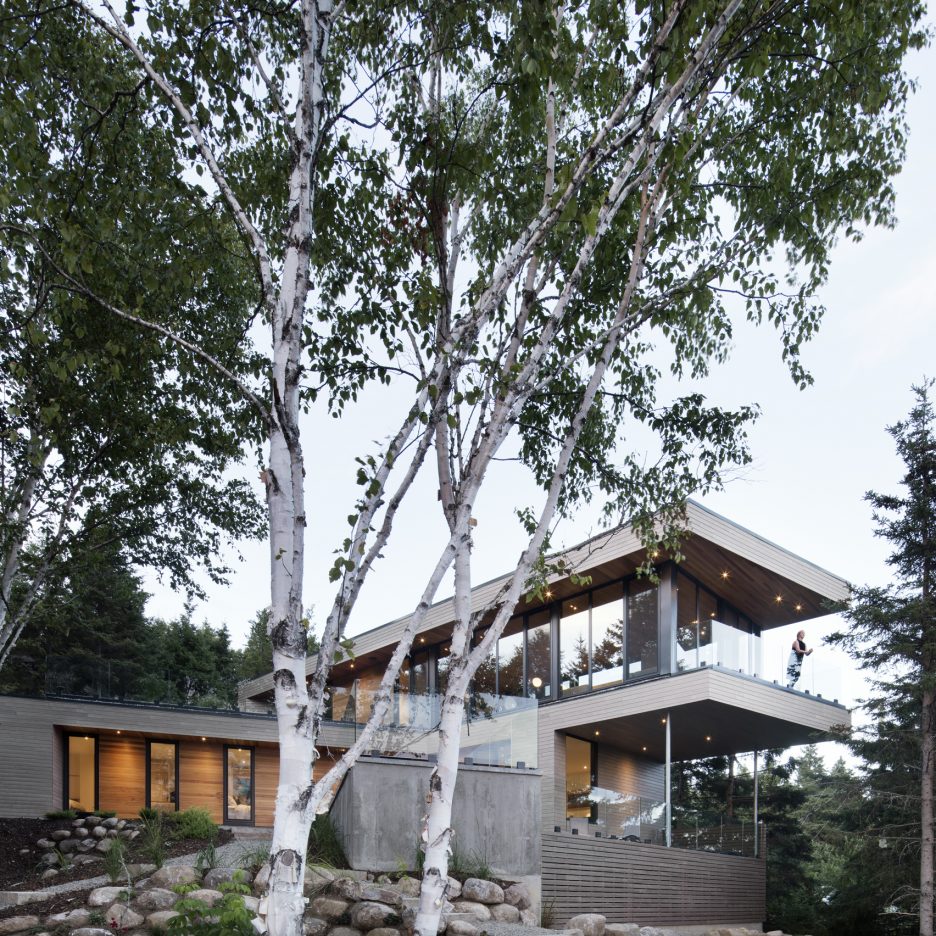
Canadian studio Bourgeois Lechasseur Architects has stacked two wood-and-glass volumes at opposing angles, resulting in a home designed to embrace its picturesque surroundings (+ slideshow). (more…)
The name of house is Yoojeongheon. Nearing the completion of the construction, the owner gave its name and described the meaning to me as, ‘wind stays, sunshine caresses’.
This building is located in an old village on the hill that looks out to the North Port of Jeju Island and is built by an old resident of the village. He is a geologist and a teacher, and of course, he has scientific mind.
Like many, I have intolerance towards the term ‘science’. I distanced myself from its field and it seemed to have the same attitude towards me.
So my approach to look at and to interpret things is with sensibility. I, then translate the collective senses onto 2-dimensional representation and finally build it up with spatial narratives onto a physical ground.
Sketch
However, this time, the resident-to-be-geologist added more stories onto my pile. While designing the house I heard the history of the earth, a story about the life of a typhoon and the movement of the sun; and most of the stories were about the special location, which the house was later built to look out to: the Jeju Island.
The house sits on a hill that is laid out a step back from the forefront of the beach. I was told, until not very long ago, the sea level was up to the bottom of the hill and underneath the hill itself was the birthplace of the legendary female merchant Mandeok Kim.
When I first visited the site, an old apartment building was standing with its back turned around and blocking the view out to the sea. Only some fragment of the ocean could barely be seen pass its side. But as we began, an unexpected restorative project of Kim’s birthplace took place and the apartment disappeared during this time. Without being aware of its disappearance, I flew from Seoul to Jeju and got on a taxi to the site. As I arrived, I felt something different was grabbing a hold of me that I had to stop to take a look at the view. However still, I only felt that something about the scenery had changed and did not quite register the change to be the lack of a mass that used to block the view.
Only except for the time during his college years, the geologist lived in the same neighborhood for over 50 years. Although his old house was long gone, he tended the lot by cleaning up, decorating with pebbles and laying the ground with grass. On the way back from work, he would stop by to sit down next to the lot to read or to gaze at the sunset to think about a new house that would once be built in the location.
The lot was not large. It was perhaps about 130 sq meters. Plus, despite its high ground, the view from the location was not very impressive due to the sounding houses barricading all four horizons of the lot.
I thought of a house that where the sunlight caresses though and the wind comes in to stay a while. The idea took its form as to vacate the center and to take away the portions of the ground level to provide openings of horizontal access. The design also included a strong outer membrane to make it withhold the powerful salty wind from the ocean and, carried by the same wind, the heavy rainfall that strikes horizontally. Naturally all the processes passed by my ideas and the scientific verification of the owner. The house was built with concrete and the same concrete was used to complete the finishing surface. Here, the focus was not, so to speak, on the ‘exposed concrete’ but on the way to ‘expose the concrete.
To apply concrete as a finishing product properly, more effort is put on fabricating the mold to make the surface of the concrete more aesthetically pleasing, which generally raises the overall cost. Contrarily, the surface of concrete used for constructional purpose, in other words, ‘what goes inside’, is left rough because it will eventually be covered with other finishes.
For the finishing the constructional concrete mold was used. The first plan was to cover up the surface later with some other material. But truth to be told, I do prefer the rough texture of the construction finish over the smooth finish. Plus, Jeju is native to the Porous Basalt (Hyun-mu-am) which offers its own rough surface. Perhaps because of this, the decision ended up favoring having the construction finish.
Entering the square courtyard, the sky opens up; then follow the porch, Daechuhng (an outer platform) and Sa-rang (a reception room) arrayed towards the ocean. The East and the West are left open for the wind to run through the courtyard. The membrane is embracing the functional spaces such as the furnace room, and the parking lot. The North-west corner of the house yields the best view of the house, which could be seen while climbing up the staircase leading the way from the porch to the next level. Here, I thought, it would be nice to have this staircase to become a place where one could sit down to ponder upon the great view to be found.
The second floor was designed as a living space consisted of two bedrooms, a living room, a kitchen and a toilet. These rooms were distributed into the North and the West sides of the building and were connected by two bridges. The two bridges were made with different widths to allow multiple perspectives while walking in and out through the space.
Lastly, one can climb a ladder to access the rooftop which has one small room and a terrace with a closed top. However consequently to the disappearance of the apartment building and the horizon was made possible to be viewed from the second floor, the rooftop was the designed to be the designated spot to have the best view of the surrounding area. Here, standing on the top of the hill, he looks forward to spend the rest of his life alongside the mothering ocean and his family.
The Crossing Wall House, designed and built by Mobile Office Architects (MOA), is sited where the Santa Ynez Mountains meet the Pacific Ocean, overlooking the City of Santa Barbara and the Channel Islands.
The parcel’s steep grade necessitated careful site planning and guided the building form as it utilized two narrow existing terraces. The two differing orientations of the terraces are expressed by two geometric grids that come together in the homes central living space and open the home to views toward the ocean, islands, and lowlands. Two crossing retaining walls at the upslope side express the two project geometries and define the project’s position on the site. At the back, one wall takes on an open and porous techtonic blurring the boundary between the constructed environment and the wild chaparral landscape.
The primary living space acts as an indoor-outdoor pavilion; opening fully at the back to the entry courtyard and to a deck at the front with downslope views beyond. The raw corten steel and concrete exterior material palette was developed to create a building that ages with the landscape and responds to localized threats posed by wildfire and wood-eating termites.
Section
The project utilizes passive solar, thermal mass, passive ventilation, and solar hot water strategies to produce a fluid indoor-outdoor environment that operates at high levels of energy efficiency.
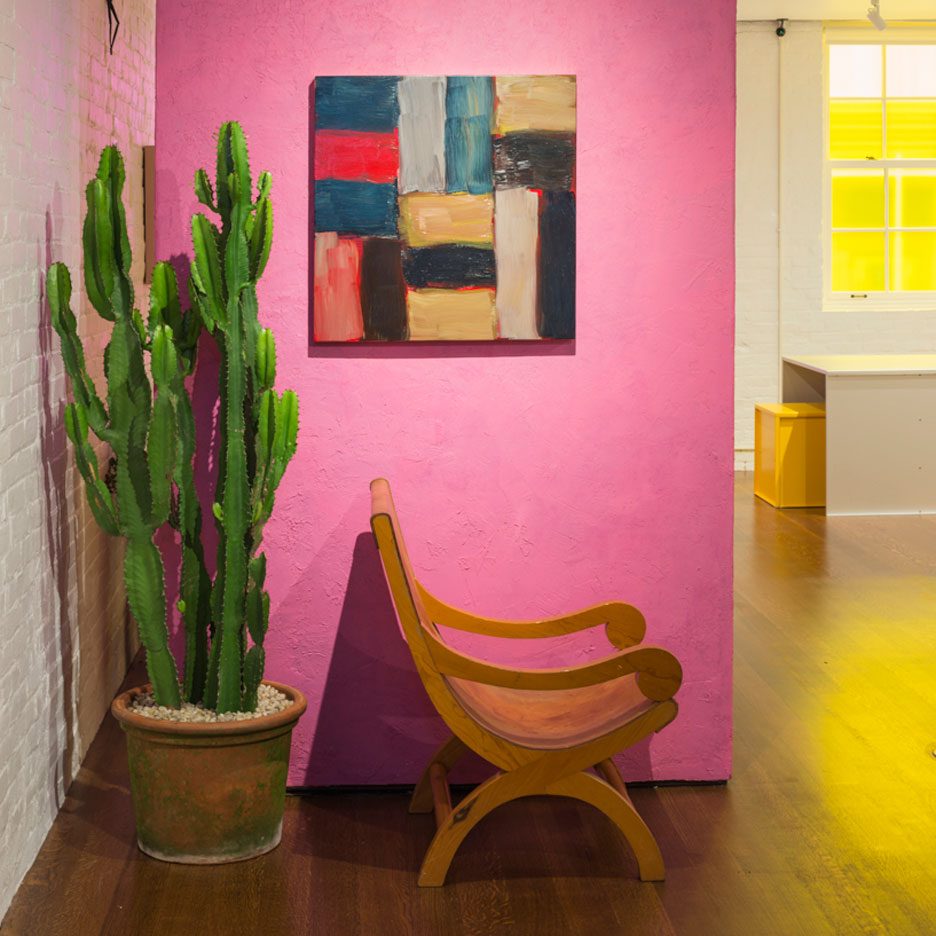
Drawings and furniture by legendary Mexican architect Luis Barragán are on display in Manhattan, alongside the works of prominent artists who have also used colour distinctively (+ slideshow). (more…)
The iPhonePhotographyAwards (IPPAWARDS) has announced the winners of the 2016 edition of the annual competition. Founded in 2007, the same year as the release of the first iPhone, IPPAWARDS is the first and longest running iPhone photography competition. Now in its 9th year, the awards continue to select the best images taken by iPhone, iPad or iPod touch from a variety of categories including Landscape, Animals, People, Still Life and Architecture.
This year’s architecture category was won by Jian Wang of Beijing China for his shot “China Red,” taken at the Beijing Olympic Park. Second and third prizes were awarded to Patryk Kuleta for two shots from his series, “Modern Cathedrals.” Kuleta was also selected as the IPPAWARDS Photographer of the Year for the series, which featured layered-exposure captures of historic cathedrals in Warsaw and Strasbourg.
Continue after the break to see the three winners and honorable mentions.






 Sig Nordal