From the architect. Siam Discovery is The Biggest Arena of Lifestyle Experiments packed with exhilarating experiences that say ‘come play with us’ to visitors. People can come in to experiment and discover what they like and what expresses their own identity best.
Without the constraints of a particular brand or school of design, products are brought together under a single universal concept that puts customers at the centre; everything at Siam Discovery is presented by visitor’s interest. From among a choice of more than 5,000 international and local brands of every price range, customers can conveniently choose, mix, match, try, and then try again so that their purchases are in line with their taste and needs.
Among the exciting debuts at Siam Discovery is a new Loft store with a design concept that is being utilised for the first time in the world and which is conceived by world-renowned designer Nendo and Loft Japan’s designers. Nike is opening its only concept store in Southeast Asia. Issey Miyake will open its first concept store outside of Japan. It is called the World of Issey Miyake and offers a full line of products including, for the first time in Thailand, Issey Miyake’s products for men.
Home decoration brands like Hay, Tom Dixon and Kartell will open their first and only concept stores in Thailand. Artist’s Design Products from world-class artists like Yayoi Kusama and Lisa Larson will have their first and only stores in Thailand. And, Adidas will open its largest concept store in Thailand and with an interactive store concept.
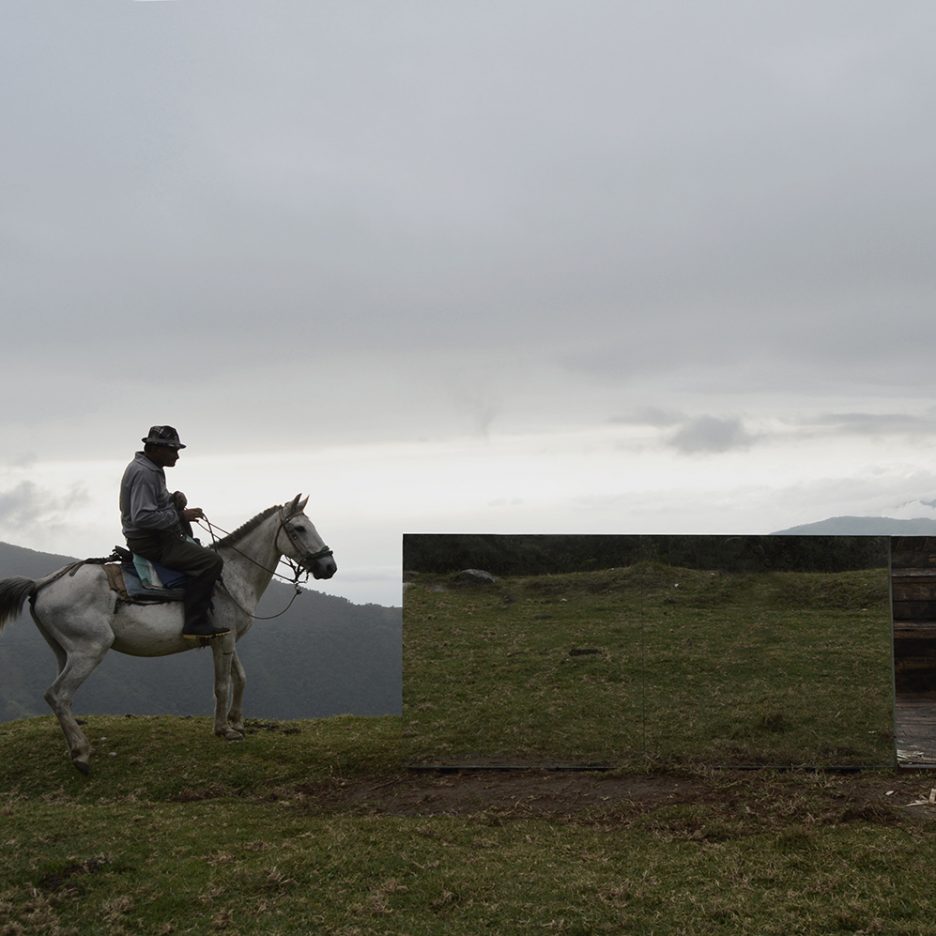
Projecting over a hillside in the Ecuadorean countryside, this small mirrored viewpoint was designed by Natura Futura Arquitectura as a rest stop for hikers (+slideshow). (more…)
From the architect. Through the Artisan House project, Morphogenesis looks to revive and re-establish a patronage for traditional Indian artisanal skills. India is symbolized by the diversity of its art and culture, yet with the changing paradigm there is a great need to conserve these symbols that are under a growing threat of neglect. Craft, emergent from skill and handed-down traditions is inherent in Indian culture, and is strongly representative of the global understanding of luxury today- that of the hand-made, bespoke, one that speaks of its provenance. Additionally, luxury in this project is expressed through the dexterity and beauty of spatial configurations, lending the space an experiential quality through the incorporation of craft, material, method and design.
The design exploits the terrain on which the project is located, to create two different levels that are instrumental in segregating functions. A large house intended to include a large extended family at times of celebration and festivity, the private spaces are placed in the earth-banked lower level, and the more public areas are designated to the upper level. In keeping with traditional Indian schema, the private living is organized around a central courtyard which contains a temple, imparting a spiritual omnipresence. A strong graphic language of striation is the organizing principle of the design, to retain scale within this very large volume. These bands translate into a series of vertical surfaces, with a different story unveiling in each volume subtended between two surfaces. What is unique about this house is that it’s hard to call anything a room when looking at the planning and philosophy behind the spaces. The house evokes luxury in its play with materiality and detail. There is stone craft in one zone, metal craft in another, textiles in the next. The strategy of banding allows for the use of distinct crafts and over 50 materials without impacting the architectural sensibility or destroying the cohesive narrative.
The striated planes notionally extend themselves beyond the edges of the built form, into the landscape and planting. So one could well be within a very stone crafted zone that extends out into a rock garden which then leads into another zone with a sculpture relief on the wall, with further leads into a water garden. There are multiple sequential exposures and experiences for the senses, so in a way there is also a luxury of experiences that this project affords. The experience created is akin to unfolding of space after space in a museum.
In nutshell, this project accommodates a traditional Indian family, traditional living principles and traditional craft and materials, but at the same time it was conceived as an extremely contemporary and modern house. This house represents luxury that is redefined: the luxury of handcraft, luxury in terms of freedom with experimentation which the client allowed, and finally, the luxury of different experiences.
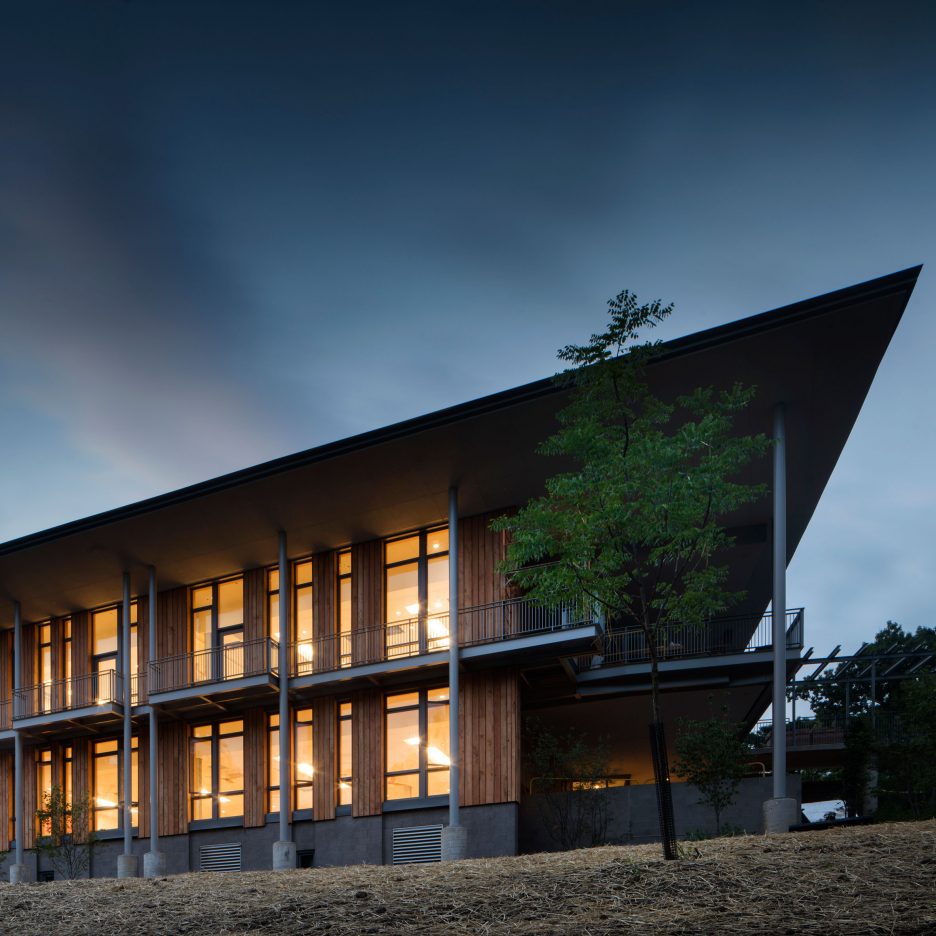
The thin columns and wood cladding that front this educational facility in a Pittsburgh park are designed to help the building fit in with its woodland setting (+ slideshow). (more…)
From the architect. A stand of silver birches marks the place. Their trunks are white heat, tempered by pools of black. Everything here is light and shade. Taking cue from their slender friends, black downpipes score the white walls of the house, disappearing into the canopy above.
Approaching the threshold, the visitor is welcomed by pockets of shade nestled among protective brick walls. A large pivot window and a large pivot door throw themselves wide open, exposing the full throat of the house to the garden.
Plan
Section
Inside and out, the roof rests like a canopy. Sky and foliage are ever-present. Light filters in from all sides marking the passage of a day, while overhead, triangles beget triangles, folding and multiplying against the sky like barely tethered kites.
This house renovation stretches diagonally across the junction of its L-shaped backyard, unifying the two arms of the garden with a single gesture. Fin-walls project from the new living spaces, creating pockets of shade and shelter at the thresholds of outdoor living.
Internally, the geometry of the external canopy is drawn inside, bleeding the boundary between indoor and outdoor areas. This gesture also affords the opportunity to ‘flip’ open the rooftop, inviting shards of morning light into the living areas. Through the course of the day, sunlight penetrates the house from multiple angles, subtly marking the passage of time.
In the backyard a garage/studio building emulates the angular gesture of its sibling, though tips its hat in deference. Beneath its generous brim, a private garden provides a place of reflection for the studio space within.
The Royal Institute of British Architects (RIBA) Competitions has announced a shortlist of 5 teams in the competition for the Upper Orwell Crossings Project in Ipswich, England. The project brief consists of 3 new bridges spanning the Upper Orwell River that will enable the redevelopment and regeneration of several districts of Ipswich, as well as relieve congestion and improve connectivity for multiple forms of transportation.
The three bridges include:
Crossing A
A new road crossing to the south of the Wet Dock Island, which would connect the east and west banks. This crossing would be for all road users, including cyclists and pedestrians.
Crossing B
A new road crossing of the New Cut, which would connect the west bank to the Wet Dock Island. This crossing would be for all road users, including cyclists and pedestrians.
Crossing C
An improved crossing over the Prince Philip Lock, which would connect the east bank to the Wet Dock Island. This crossing would be for cyclists and pedestrians only.
After a pre-qualification phase that attracted a range of submissions from firms of varying sizes, the evaluation panel selected the following shortlisted teams:
Adamson Associates (Toronto) with William Matthews Associates and Ney & Partners
Wilkinson Eyre (London) with FHECOR and EADON Consulting
The finalists were selected based on “experience of collaborating on major infrastructure projects, working within a multi-disciplinary team environment, and designing projects of architectural distinction with a complexity, scale and/or budget similar to that required on the Upper Orwell Crossings scheme.”
The five teams will present their designs to the Judging Panel (Chaired by Sir Michael Hopkins CBE) in mid-December 2016, with a winner to be announced in early 2017. The winning team will work with an existing project team led by WSP | Parsons Brinckerhoff, who will provide structural and civil engineering consulting for the project.







 Sig Nordal