Lisbon Triennale Millennium bcp Début Award: Shortlist Announced


Courtesy of Trienal de Arquitectura de Lisboa

Courtesy of Trienal de Arquitectura de Lisboa

The Lisbon Triennale Millennium bcp Début Award was created to celebrate the achievements, and promote the careers of, young architects and practices under the age of 35.

More than 140 applications were received, representing five continents and including 39 countries including Portugal, Germany, Brazil, and Mexico, as well as Iran, Jordan, Sudan, and Palestine. The jury have praised the very high level of the proposals across the board.

The experts especially appreciated the ability for participants to expand and experiment with the limits of the discipline, connecting technological innovation to socially and environmentally conscious solutions.  

Ten finalists have been chosen by the jury to compete for the second edition of the award. The winner will be announced during the opening week of the Lisbon Architecture Triennale (5th-9th October 2016) and will give a lecture on the closing week (7th-11th December 2016).

Al Borde, Ecuador

Founded in 2007 in Quito, Al Borde is led by architects Pascual Gangotena (1977), David Barragán (1981), Maria Luisa Borja (1984) and Esteban Benavides (1985). The collective focuses on the human dimension of space achieved through a minimal resort to available resources. Drawing on the “ordinary”, they wish to expand the human condition engaging people and communities in the design process, questioning the subjection of architecture to bureaucracy and capital. In 2015 they were nominated for the Design of the Year Award at the Design Museum in London, while this year they figured in the official selection of the Venice Architecture Biennale. 


Espaço de Experimentação Teatral / AL BORDE. Image Courtesy of Trienal de Arquitectura de Lisboa


Equipe AL BORDE. Image Courtesy of Trienal de Arquitectura de Lisboa


Casa Barrial 11 de Mayo / AL BORDE. Image Courtesy of Trienal de Arquitectura de Lisboa

ASA STUDIO, Rwanda

Based in Kigali, this architectural practice is currently involved in a long-term project combining research, education, design and construction. ASA is responsible for the realization of the first kindergarten in Rwanda (2012), 11 preschools, more than 60 maternity wards, health centers and facilities. To this activity they combine the commitment to the creation of the first Architecture School in Rwanda, where they wish to promote opportunities for the future architecture graduates.  


Recinto Pré-Escolar / Asa studio. Image Courtesy of Trienal de Arquitectura de Lisboa


Recinto Pré-Escolar / Asa studio. Image Courtesy of Trienal de Arquitectura de Lisboa


Equipe Asa studio. Image Courtesy of Trienal de Arquitectura de Lisboa

Carles Enrich, Spain

After graduating from the Architecture School of Barcelona, in 2009 Carles Enrich founded his own studio initiating projects at different urban scales. His work has been exhibited at the Venice Biennale both in the Catalan Pavillion (Vogadors) in 2012 and in the Spanish Pavilion (Unfinished) in 2016. Since 2008 he holds a teaching position at the Architecture School of Barcelona as well as at School of Architecture in Reus.


Casa-Pátio em Gracia / Carles Enrich. Image © Enric Fabre


Novo Acesso ao Centro Histórico de Gironella / Carles Enrich. Image © Adrià Goula


 Carles Enrich. Image Courtesy of Trienal de Arquitectura de Lisboa

El Umbral, Mexico

Founded in Mexico City in 2013, El Umbral is led by architects Mercedes Landa Quintanilla, Mario Ramos Catalá, Jos Sacre and Pamela Martínez. Their activity includes the construction of residential buildings, public spaces as well as urban design projects. In 2014 the practice was awarded the Jardin San Hipolito Award and was recently chosen with other two finalists to present a proposal for the international cultural fair in Mexico City. 


Casa Xochitepec / EL UMBRAL. Image Courtesy of Trienal de Arquitectura de Lisboa


Jardim San Hipolito / EL UMBRAL. Image Courtesy of Trienal de Arquitectura de Lisboa


EL UMBRAL. Image Courtesy of Trienal de Arquitectura de Lisboa

Hevia + Urzúa (Guillermo Hevia García + Nicolás Urzúa), Chile

The practice was founded by Guillermo Hevia Garcia (1986) and Nicolás Urzúa Soler (1986), who are both graduates of the Pontificia Universidad Católica do Chile, where they now teach in the school of architecture. They won the first prize in the 2016 YAP Constructo Award and were between the finalists of the Iakov Chernikhov Award in 2014. In 2015 they represented Chile at the fourth Architecture Biennale of Latin America.


Colégio Aliança Francesa Jean Mermoz / Guillermo Hevia García + Nicolás Urzúa Soler. Image © Nico Saieh


Guillermo Hevia García + Nicolás Urzúa Soler. Image Courtesy of Trienal de Arquitectura de Lisboa


'Tu Reflexión', proposta vencedora do YAP_Constructo 2015 / Guillermo Hevia García + Nicolás Urzúa Soler. Image Courtesy of Trienal de Arquitectura de Lisboa

Paulo Manuel do Vale Afonso, Portugal

Architect (1982) trained at the University of Coimbra and at the NTNU, in Trondheim, Norway. He has worked with OAB, Office of Architecture in Barcelona, as well as with 51-1 Arquitectos in Lima, in the same city he was one of the co-founders of AMA (Afonso Maccaglia Architecture).


Paulo Manuel do Vale Afonso. Image © Paulo Manuel do Vale Afonso


Mazaronkiari / Paulo Manuel do Vale Afonso. Image © Paulo Manuel do Vale Afonso


Escola em Chuquibambilla / AMA + Bosch Arquitectos. Image © Paulo Manuel do Vale Afonso

Pedro Pitarch, Spain

Architect (1989) and contemporary music composer. Pedro Pitarch works and lives in Madrid. Occupying a somewhat tangential position within the architectural practice, his investigations focus on the interrelations between society, contemporary culture and media.   


Pedro Pitarch. Image Courtesy of Trienal de Arquitectura de Lisboa


Pedro Pitarch. Image Courtesy of Trienal de Arquitectura de Lisboa


Pedro Pitarch. Image Courtesy of Trienal de Arquitectura de Lisboa

PLURAL, Slovakia

Plural was founded by Martin Jancok in 2009 and later joined by Michal Janak in 2013. The practice’s projects are based on a conception of architecture as a public domain, a common language whose structure should be used for the common good. In 2015 Plural received the first prize for the SSE-Complex Award, and was awarded an honorable mention in the House for the Elderly Award in 2014.


PLURAL. Image © Daniela Dostalkova

Terra e Tuma Associated Architects, Brazil

Founded by Danilo Terra, Pedro Tuma and Fernanda Sakano, the practice is devoted to research and design at different scales. Through the combination of their respective experiences, the three founders wish to give shape to ambitious projects able to exploit at best of the technical assets of available materials.


 Terra e Tuma Arquitetos Associados. Image © Pedro Kok


Casa Maracanã / Terra e Tuma Arquitetos Associados. Image © Pedro Kok


Casa Vila Matilde / Terra e Tuma Arquitetos Associados. Image © Pedro Kok

UMWELT (Scheidegger & Garcia Partarrieu), Chile 

Founded in 2011, by Ignacio Garcia Partarrieu (1984) and Arturo Scheidegger (1983), Umwelt develops research and design projects at different scales. Umwelt has exhibited projects at the Shenzhen, Hong Kong, Santiago and Venice Biennales as well as at the Storefront for Art and Architecture in New York. The practice has recently been selected for the 2015 Iakov Chernikhov Award as well as for the 2016 Emerging MCHAP Award.


 UMWELT + Juan Manuel Sepúlveda. Image © Felipe Fontecilla


Central de Transmissões / UMWELT + Juan Manuel Sepúlveda. Image © Felipe Fontecilla


Central de Transmissões / UMWELT + Juan Manuel Sepúlveda. Image © Felipe Fontecilla

The jury was composed by André Tavares (PT), Chief Curator of The Form of Form; Fernanda Bárbara (BR), architect; Luís Santiago Baptista (PT), architect and critic; Margarita Jover (FR), architect; Mimi Zeiger (US), critic, editor and curator; Tetsuo Kondo (JP), architect; and Tim Abrahams (UK), architecture critic and editor at Machine Books.

The winner of the Début Award receives a 5000EUR prize and will deliver a public lecture in Lisbon as part of the main programme of the Lisbon Architecture Triennale. With this prize the Triennale wishes to support new voices and forms of practice, expecting that the prize will contribute to the young professionals’ creative, intellectual and professional growth at a crucial and potentially transformative stage in their career.

Via Trienal de Lisboa

http://ift.tt/2dgcuSO

💙 Noirmoutier Sunrise on 500px by Phil Buckle, Carlisle,……

💙 Noirmoutier Sunrise on 500px by Phil Buckle, Carlisle,… http://ift.tt/1YgwJgU

http://ift.tt/2dfWKvj

AD Classics: Tokyo Metropolitan Government Building / Kenzō Tange


No.1 Building

No.1 Building

The career of Japanese architect Kenzō Tange features a curious anomaly: he received the same commission twice. In 1952, during the early stages of his career, Tange designed an administrative building in Yūrakuchō, Tokyo, for the city’s metropolitan government. Over thirty years later, when the government relocated to Shinjuku, Tokyo, he again won the commission to design its administrative building. Completed in 1991, this would be one of his last, and most ambitious, projects. The second incarnation now dominates the city’s skyline, its highly distinctive design guaranteeing it landmark status. Nicknamed Tochō (an abbreviation of its Japanese name Tōkyō-to Chōsha), its architectural references to both tradition and modernity act as a visual metaphor for the eclectic city over which its inhabitants govern.


No.1 Building


No.2 Building


Elevation of No.1 Building (Public Domain)


Plan of the Complex (Public Domain)


Plan of the Complex (Public Domain)

Plan of the Complex (Public Domain)

Though usually referred to as a single building, Tochō would be more accurately described as a complex comprising three structures. Though visually distinct and individually named, all three buildings within the complex are linked by pedestrian routes. No.1 Building is the tallest of the three; the main structure stands thirty-four stories high but its twin towers soar to forty-eight stories, making it the tallest building in Tokyo at the time of its construction. Clad in precast concrete panels, the façade is inset with light and dark granite to create a variety of geometric patterns.

At its base, the façade of No.1 Building forms a sheer face which becomes increasingly articulated as the two towers ascend. This irregular composition adds visual interest and prevents the building from appearing monolithic, despite its height. The articulated surfaces also perform a practical function by disrupting the strong winds which buffet the building at its highest points. Receding cutouts at the tops of the towers create a frame for a collection of satellite dishes, transforming aesthetically­ unappealing—though necessary—elements into intentionally decorative features.


No.2 Building

No.2 Building

To the south of No.1 Building stands No.2 Building. Its structure comprises three interlocking towers of increasing height, the tallest of which stands at thirty-four stories – level with the main structure of its counterpart. Again, no attempt is made to conceal less attractive architectural elements, with many of the building’s services displayed prominently on the large balconies formed by the rooftops of the lower towers; an example of the architectural honesty which typifies Tange’s work. The façade of No.2 Building features the same patterns of granite and concrete as its neighbor; by maintaining stylistic consistency across the complex Tange was able to create a visual link between its individual components.

The third building in the complex is the Assembly Building, an eight-story semicircular structure which sits at the foot of No.1. While the No.1 and No.2 Buildings primarily house government offices, the function of the Assembly Building is more specific: it serves as the meeting chamber for the councilors of Tokyo. The sweeping curve of the building encompasses an expansive courtyard which is sunk below street-level, separating it from passing road traffic to create a tranquil clearing in which open-air concerts, for example, can be held. As the building extends westward, its arms become high-level walkways raised on piloti. The southern arm intersects with a bridge spanning the gap between No.1 and No.2, binding together the three components of the complex through a system of pedestrian circulation.


No.1 Building

No.1 Building

Tange’s architecture is characterized by an interplay between tradition and modernity; he believed that “the most vital task of today is creatively to elevate both past and future.”[1] Many of his early works lean heavily on the architectural traditions of his native country of Japan –  particularly evident in his design for his own home of 1953. However, while he acknowledged the influence of Japan’s heritage, he repeatedly attempted to distance himself from purely historical associations. “Tradition can be compared to a catalyst;” he wrote, “it stimulates our design process, but just as a catalyst disappears after the chemical action, so tradition does not remain in the final design.”[2]

By the late stages of his career, references to architectural history in Tange’s designs had become less overt, but remained extant. At Tochō, the geometric pattern of the façades recalls the screen paneling of traditional Japanese houses. The twin towers of No.1 Building, meanwhile, can be compared to the split towers of Gothic cathedrals.


Unknown Author (25 January 1955). Public Domain. ImageKenzō Tange's residence

Unknown Author (25 January 1955). Public Domain. ImageKenzō Tange's residence

Throughout his extensive writings, Tange frequently extolled the virtues of modern technology. This is somewhat surprising given that his first completed project, the Hiroshima Peace Park, bore witness to the destructive potential of human ingenuity. Nevertheless, Tange’s design for Tochō directly invokes technology through its design; the architect cited the computer chip as the stylistic inspiration for No.1 Building.[3] This digital imagery is repeated within the building, where a circuit-board motif decorates some of the ceilings.[4]

Given the economic climate in Japan at the time, references to computing were particularly apt. Thanks to its world-leading technology industry the country was enjoying an economic boom and the computer chip had become a national symbol for modern Japan. Tange even borrowed the rhetoric of technology, quoting Norbert Wiener (the inventor of cybernetics) when describing his own architectural designs as “communication spaces” linked by “informational channels.”[5] As such, the transfer of people through the corridors and elevators of No.1 Building emulates the transfer of information through electrical signals in a computer. Not only does the building employ the iconography of a computer chip, it also functions as one.


Elevation of No.1 Building (Public Domain)

Elevation of No.1 Building (Public Domain)

Tange’s embrace of modernity did not, however, extend to the adoption of European Modernism; a style of which he was highly critical. Though he admired the work of Le Corbusier, he disdainfully noted that for most Modernist architects “the mere white box—which was no more than a starting point—was in itself a true goal.”[6] Tange also took issue with the functionalist attitude of the International Style, which he saw as overly simplistic and rigid: “criticism has often been made by people living and working in these buildings that this restricts their life and I believe their complaints are worthy of attention.”[7]

Tange’s own design process involved a “typification of function,”[8] wherein the most fundamental needs of the building’s future users were prioritized and other needs, deemed arbitrary, were ignored. For instance, the massive scale (and $1billion cost) of Tochō led to public outrage during construction but, as justified by the project’s construction manager, “it needed to be this size to house the ganglia of a huge computer network intended to make the Tokyo government the most sophisticated in the world.”[9]


Satellite dishes on No.1 Building

Satellite dishes on No.1 Building

While Tange may not have subscribed to the European model of Modernism, he did share the movement’s aim to (ostensibly) sweep away the old and build anew. Tochō‘s new site in Shinjuku—the historic red-light district of Tokyo and a notorious center for Yakuza activity—afforded Tange the perfect opportunity to do so. The area had been targeted for regeneration by city councilors in the 1980s, and the construction of Tochō signalled the beginning of the redevelopment of Shinjuku as a modern financial district. Though the neighborhood still retains some aspects of its insalubrious past, its transformation into a thriving economic hub has been hugely successful. Twenty-five years after completion of Tochō, the area is now strewn with skyscrapers which house the headquarters of national and multinational corporations.

It has been suggested that Tange’s belief in the regenerative power of architecture has its roots in the cycles of growth and decay described by Buddhist teachings.[10] The demolition of Tange’s original Metropolitan Government Building shortly after the opening of Tochō completed this cyclical process. Though Tochō is often overlooked within the architect’s oeuvre, in many respects the complex exemplifies his style through its harmony of tradition and modernity, its typified functionalism, and its capacity to reflect a national identity.


The Assembly Building and Public Square

The Assembly Building and Public Square

References
[1]
Tange, Kenzō. “Creation in Present Day Architecture and the Japanese Tradition”. In Robin Boyd. Kenzō Tange. New York: George Braziller, 1962. p.113
[2] Tange, Kenzō. “In Search of a New Architecture”. Japan Quarterly, 31:4, 1984. p.407
[3] Weisman, Steven R. “A Plush City Hall, but Please, No Marble Bathtub!”. New York Times, 20 August, 1990
[4] Žaknić, Ivan. 100 of the World’s Tallest Buildings. Victoria: Images Publishing, 1998. p.104
[5] Ibid. Tange. “In Search of a New Architecture”. p.408
[6] Ibid. p.406
[7] Ibid. Tange. “Creation in Present Day Architecture and the Japanese Tradition”. p.116
[8] Ibid. Tange. “In Search of a New Architecture.” p.407
[9] Ibid. Weisman.
[10] “Tange, Kenzō”. Oxford Art Online. Accessed 13 July, 2016. [access]

http://ift.tt/2cy9flp

Labour conference: Watson says party must prepare for ‘fourth industrial revolution’

Rolling coverage of all the developments from the Labour conference in Liverpool, including speeches from Sadiq Khan and Tom Watson

9.05am BST

Labour does not feature much on the newspaper front pages this morning although, given the splash headline on one of the few papers that does lead on Labour, Jeremy Corbyn may consider that a blessing.

Tuesday’s Daily Mail front page:
Labour in la-la-land#tomorrowspaperstoday #bbcpapers http://pic.twitter.com/hjgkCbCMOs

New automated technologies are fusing with the internet, and creating models of work and jobs we haven’t seen before. Daily we hear stories of machines and systems that can do things we thought only humans could do – driving cars, drafting contracts, even composing music.

It’s been called the fourth industrial revolution – a new era of fast, technology-driven change, which we’re beginning to feel in everything we do.

It’s only with Labour in power that we can create a fairer, more equal and more just Britain.

Labour out of power will never, ever be good enough … The people who need us the most are those who suffer the most when Labour is not in power.

Our aim will be to provide the care and support for every child to fulfil their potential, and to help parents back to work. Getting it right will improve the life chances of countless children across the country. That must be our mission.

[Lewis’s] view is that the matter has been decided for the time being. But it is always open for our party members to raise these issues.

Moderate Labour MPs claim that the language used by Mr McDonnell acts as a “nod and a wink” to leftwingers to target them with abuse online.

Some of Mr Corbyn’s closest allies have told the leader that removing his old friend from his post would be the “single best thing” he could do to repair relations in the party …

Continue reading…

Politics blog | The Guardian http://ift.tt/2dcsGCN

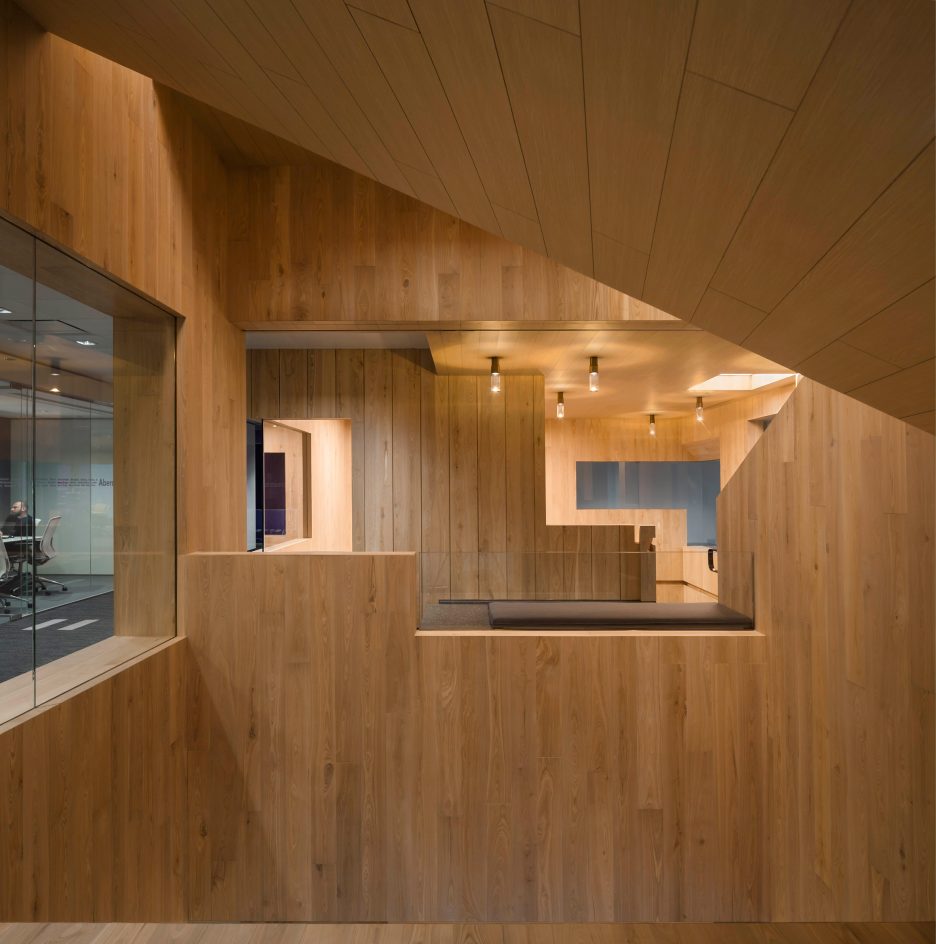
Neri&Hu creates “stair of encounters” inside Bloomberg’s Hong Kong office


To encourage Bloomberg’s Hong Kong employees to interact more, architecture studio Neri&Hu has given them a staircase with generous landings, seating areas and strategically positioned windows (+ slideshow). (more…)

http://ift.tt/2cRIOYL

House in Laax / Valerio Olgiati


© Archive Olgiati

© Archive Olgiati


© Archive Olgiati


© Archive Olgiati


© Archive Olgiati


© Archive Olgiati

  • Construction Supervisor: Franz Bärtsch, Chur
  • Structural Engineer: Patrick Gartmann, Ferrari Gartmann AG, Chur
  • Project Manager: Sebastian Carella

© Archive Olgiati

© Archive Olgiati

From the architect. The single-family house rises from a 10-20m wide and 90m long lot in Laax, Switzerland. Local building legislation only permitted the construction of volumes aboveground at opposite ends of the property. One end of the area is situated in the “village zone”, while an “agricultural zone” surrounds the other end. Two completely opposite worlds form the context of this house.


© Archive Olgiati

© Archive Olgiati

At the historical village limit of the parcel is the so called “city house”. A clear and simple facade underlines the public space lying in front of the house with the volume and rooms orientated towards the village. Located here are the children’s bedrooms and the guest rooms. Towards the agricultural zone, at the other end of the plot, rises the so-called “country house”, a lower lying solid volume that opens towards the landscape.


© Archive Olgiati

© Archive Olgiati

The two ends are connected by an underground hall, where the daily life of the family takes place. Two top lights provide natural lighting to the space. All the main rooms in the house are niches and with their gables they transform into caves. Each space is interconnected with a 90m long corridor that forms the spine of the entire building. 


Basement Plan

Basement Plan

Ground Floor Plan

Ground Floor Plan

Site Section

Site Section

Exterior and interior walls are all in white in-situ concrete. On the outside, attached tilting windows preserve the clarity and legibility of the two exterior volumes and lived-in niches.


© Archive Olgiati

© Archive Olgiati

Outer appearance and inner experience of the house form a contradiction that only mentally can be reconstructed as a unity. The house has an unexpected “grandezza” and homogeneity that is in stark contrast to the compartmentalisation and heterogeneity of the surrounding village.


© Archive Olgiati

© Archive Olgiati

http://ift.tt/2d5O8ZQ

Cristiana Vannini Designs an Apartment Near Bratislava, Slovakia

Private Apartment_BRA by Cristiana Vannini (3)

Private Apartment_BRA is a private home located in Bratislava, Slovakia. It was designed by Cristiana Vannini. Private Apartment_BRA by Cristiana Vannini: “Positioned between the city of Bratislava and the forest of XXX, the house is surrounded by a large terrace overlooking all the daytime spaces. Designed as a continuous space, the space is however strictly defined by its functions, balancing the contemporary style of the house as a place to..

More…

Chapel in Valleaceron / Sancho Madrilejos


Courtesy of Juan Carlos Sancho

Courtesy of Juan Carlos Sancho
  • Architects: Sancho Madrilejos
  • Location: 13400 Almadén, Cdad. Real, Spain
  • Architect In Charge: Sol Madridejos, Juan Carlos Sancho
  • Project Year: 2001
  • Photographs: Courtesy of Juan Carlos Sancho
  • Assistant Technical Architect: Martín Pozuelo
  • Project Leader: Luis Renedo
  • Study Collaborators: Luis Renedo, Juan A. Garrido, Emilio Gómez Ramos, Patricia Planell, Marta Toral, Andrey García, Javier Moreno

Courtesy of Juan Carlos Sancho

Courtesy of Juan Carlos Sancho

From the architect. The idea of situating and relating a series of objects in the landscape- Dwelling, Chapel, Hunting pavilion and Guard´s residence- gave the project a dual significance: in addition to the close relationship between landscape, objects and itinerary –between space and objects-, each item had to provide a different response with different emphasis, from the most symbolic to the most silent or private. The unifying thread was to be the concept of the fold: the fold as a hidden generator of different spaces.


Sketch

Sketch

The Chapel unit is developed around the study and manipulation of a focally tensed “box-fold”.

It is set at the top of a slight hill, turning it into a reference point in the landscape seen from the entrance to the property, at a 2km distance from a lower level, displaying different visions along the entire itinerary. It is oriented slightly off an east-west axis. One goes around the chapel on arrival at the residential zone, making it an entrance turning point. Visitors enter the chapel rising through the western façade until arrival, interiorly, at the focal point in a non-symmetrical front.


Courtesy of Juan Carlos Sancho

Courtesy of Juan Carlos Sancho

Along this walkthrough interval the varying scale of the fold makes the compact volume break offering a closed-compact, open-fragmented sequence of spaces in a constant change of time.


Diagram

Diagram

The chapel has been thought naked, with no artificial lightning, as in a place where the exterior-interior spatial relationship determine its sense, its attention; only a cross, an onyx lamp and an image in the focal point reinforce the symbolic aspects involved in the project.


Courtesy of Juan Carlos Sancho

Courtesy of Juan Carlos Sancho

By proposing a fold in the box, in the corbusian “boîte”, a single material arises: golden concrete that captures all of the shades demanded to the volume, from capturing the direct light that breaks through an additional plane in the spatial composition, to the transmission of the unstable, coloured scent of dawn.


Model

Model

Light thus takes on the role of a second material in the chapel, a material that contrasts with concrete, fragile, changing, mobile, unstable, dominating or vanishing.


Courtesy of Juan Carlos Sancho

Courtesy of Juan Carlos Sancho

http://ift.tt/2d2pU6I

Nils Holger Moorman launches dog-sized version of its flatpack bed


German furniture maker Nils Holger Moormann has released a flat-pack bed designed for the needs of man’s best friend (+ slideshow). (more…)

http://ift.tt/2d2iFfn