‘Perspectives’is an organic pavilion structure covered with Cedar Shingles, whichsits atop the beautiful Surrey Hills at Winterfold, and throws itself evocatively into the vista that has been opened up below.
Commission by Surrey Hills Arts and the Mittal Foundation, the project aimed to create places of quiet and restful contemplation along a beautiful scenic route on the Hills of Surrey, south of London.
Inspired by the words and messages etched by people in public places, on trees, benches and elsewhere, Giles Miller has collated poetry, messages, initials and messages of love and memory from local schools, residents and other contributors to the project. These messages have been etched onto the surface of the organic cedar shingles that cover the piece, and appear to throw themselves out towards the front of the sculpture as if voicing their sentiments to the world that opens up below.
At its core, the shingles overlap and the sculpture functions architecturally to protect and shield the user from the elements, but at its mouth the surface flattens and evocatively opens out in dissipation as the shingles appear to fly out towards the waiting valley.
In Native American Culture, everything is connected. Humans are connected with the animals, the sky, the earth.
Since time immemorial, animals were considered representations of qualities that we, as humans, all aspire to have. This makes animals some of the most powerful symbols in our spiritual toolbox.
Take just now this quick and easy quiz and find out what is your spirit animal!
In this video from CNN Style, London designers Edward Barber and Jay Osgerby discuss Forecast, a wind-powered installation they created in collaboration with V&A Museum for the first London Design Biennale. With the intent to help city residents find their way “at a time of turbulence,” the installation responds to the Biennale’s theme “Utopia by Design.”
As everyone knows, the British are obsessed with weather, Osgerby said. It’s completely intrinsic to our way of life, and that’s why I think we talk about it incessantly.
Courtesy of Barber & Osgerby
Forecast — inspired by traditional weather instruments — is composed of three elements: a weathervane measuring wind direction, an anemometer measuring wind speed, and a turbine to harness wind power. In celebration of the 500th anniversary of Thomas More’s Utopia, the Biennale’s theme encouraged Barber and Osgerby to reflect on Britain’s past and future, settling on the idea of wind. Showcased along with works from 37 other countries, the UK’s Forecast is partially meant to incite political reaction and challenge the status quo, stated the designers. Their piece’s elements move with the wind to continually show a different direction.
Courtesy of Barber & Osgerby
The Biennale runs from the 7th to 27th of September.
Recent years have seen a rapidly increasing interest in the architecture of the former Soviet Union. Thanks to the internet, enthusiasts of architectural history are now able to discover unknown buildings on a daily basis, and with the cultural and historical break caused by the collapse of the Soviet Union, each photograph of a neglected and decaying edifice can feel like an undiscovered gem. However, often it can be difficult to find more information about these buildings and to understand their place in the arc of architectural history.
That was the reason behind the creation of Socialist Modernism, a research platform started by BACU – Birou pentru Artă şi Cercetare Urbană (Bureau for Art and Urban Research) which “focuses on those modernist trends from Central and Eastern Europe which are insufficiently explored in the broader context of global architecture.” Soviet Modernism already consists of a website on which BACU has cataloged a number of remarkable and little-known buildings. However, now the team is raising funds on Indiegogo’s Generosity platform for the next step in their research project. With this money they hope to create an app on which users can add new sites and buildings to the database.
On their fundraising page, BACU describes the background to the project as follows:
The architecture of the Socialist period and more precisely the modernist tendencies of the period between 1955 and 1991, as a concept, is becoming more and more popular in specialists circles […] Modernism in architecture first arose in the capitalist societies of Western Europe, following a series of essential principles such as “form follows function,” the use of mass-produced materials, the adoption of industrial aesthetics, simplicity and formal clarity, and the elimination of unnecessary details. In the socialist countries of Eastern Europe, on the other hand, modernist trends manifested themselves as a result of their influence over professionals, an influence that was able to penetrate beyond the borders and the limits imposed by the Socialist ideology.
In Central and Eastern Europe there is a number of important architectural monuments that are representative of the post WWII identity of each county in which they are located, and express the aspirations of socialist era architects […] Most of these buildings are found today in an advanced state of decay. Through this initiative we would like to encourage stylistic and architectural discipline and we invite the involvement of local authorities and civil society, so that the architectural value of these buildings would be acknowledged and, along with the surviving social and cultural tissue, be taken into account in the context of urban planning.
Speaking about the app they hope to create, they explain:
All the important socialist modernist landmarks would be included in this platform, allowing them to be accessed by anyone interested in these vestiges. Your contribution would help us create the interactive map and an application that would be made available in app-stores to be downloaded to any mobile device.
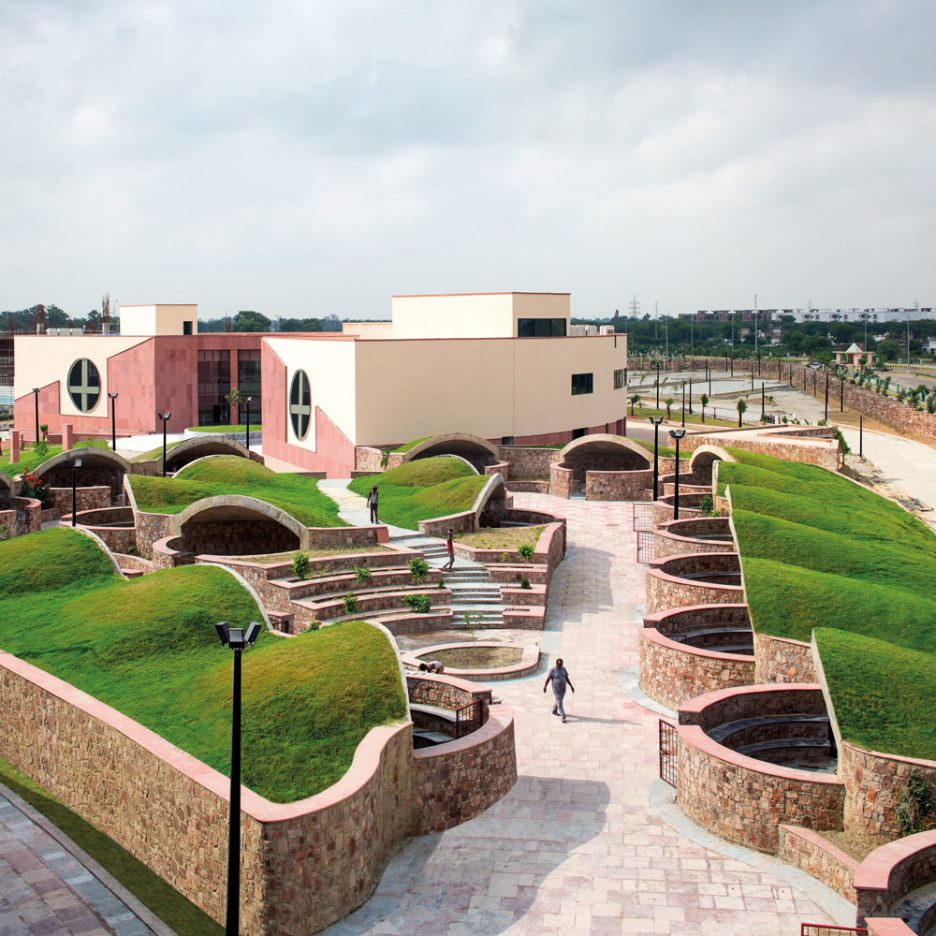
Architecture studio Archohm has completed a campus for promoting crafts in the Indian city of Lucknow, featuring a cluster of grass-roofed workshops and a spiralling shopping arcade (+ slideshow). (more…)
A Big LITTLE Nest is a residential project designed by Mickaël Martins Afonso & L’atelier miel in 2014. It is located in Bordeaux, France. A Big LITTLE Nest by L’atelier miel: “This small apartment on two levels is located in a stone building, in the heart of the historical centre of Bordeaux. The challenge of this rehabilitation was to design a small space in which all the functions of a..
La Cité des arts is an artistic island located in the heart of an evolving area, to the East of the town of Saint-Denis, in Reunion Island. New lighthouse in town, it has been designed as a multidisciplinary village, with a concert hall of 350 seats (expandable to 600 via retractable seats), workshops for artists, studios for dance and theatre, studios for resident artists, an administration building, a bar, a restaurant and a cultural shop.
Under this monolith carved by the winds, small streets and courtyards punctuate the City, where the implementation of confined strips creates shady alleyways and private patios, which are refreshed by plantations, thus offering to the general public, as well as artists, places of relaxation, artistic encounters and workshops.
A landmark at the entrance of the town La cite des arts has a strong challenge; that of being a landmark at the entrance of the town, in a large ensemble dedicated to culture, recreation and sports in Saint-Denis on Reunion Island.
A city that reconnects the town to the coast Restrained by a major road, which separated it from the town and from the ocean, the site has been subjected to an architectural work of urban reconnection. The project of La cite des arts, with its new links with the coastal path and surrounding neighborhoods, reconnects the town to the ocean, by creating a meeting point, an artistic confluence.
Plan
Plan
Footsteps of history Although the program entailed some novelty, there was no point in erasing the history of this emblematic place, a former industrial site converted into a cultural and artistic place, and which recently hosted workshops for artists and a theater, the Palaxa. This one is preserved and renovated, like former industrial walls that make the link with the past, symbolizing the freedom of creation.
A mineral architecture The project presents itself as a mineral project, as a monolith carved by the wind, the rain and the sun, like the ravines of Reunion Island. Its raw lines and angular concrete works interchange with the smooth and rough materials similar to rock strata found on the cliffs of the island.
A signal architecture From this monolith emerges the volume of the auditorium (the Fanal), dressed in a double polycarbonate skin, illuminated at night. This volume is a real lighthouse, which has become an urban signal and the symbol of the city’s radiancy.
A set of double skin The North and South facades form an envelope which protects the heart of the island: one in concrete, the other one made of glass. They allow interior facades to open up outdoor areas, offering all possibilities for contribution natural light and cross ventilation. These monolithic façades consist of a double skin that plays with bare interior façade either move away and create patios bringing freshness and green places, either to arrange for real visual openings to the coast or the city.




 Sig Nordal