Erik Giudice Architecture has released its proposal for a transit station at Södra Munksjön, in Jönköping, Sweden, a design that was created as an entry for the station area ideas competition, which recruited four firms to create a new station as a part of the area’s larger expansion plan.
Based on the idea of connecting the city and its surrounding nature, the station proposal utilizes light and a playful wooden canopy structure to create a portal from Jönköping to Munksjön, a lake on its opposite side. The “matchstick” structure of the station additionally pays homage to the city’s past as Tändsticksstaden, a famous matchstick capital of Sweden.
Courtesy of Erik Giudice Architecture
Using a combination of wood and polycarbonate panels, the structure will provide partial shade, as well as views over the surrounding lakes and forests, for its travelers.
Courtesy of Erik Giudice Architecture
Transparency and openness helps sunlight reach below the cover and onto the platforms and other areas, ensuring that all areas of the station have access to light with entrance areas on all sides, making the spaces above as well as below the viaduct feel safe and secure for all users – described the architects.
Courtesy of Erik Giudice Architecture
Courtesy of Erik Giudice Architecture
Conceptualized as a “living room in the forest,” the project is “green” not only in its use of materials but also in its incorporation of nature. Local tree species like ash, pine, and oak will be planted in areas of the station where the canopy dips down and is anchored into the streets.
Furthermore, the polycarbonate portions of the canopy will feature solar panels on the south side of the building, and rainwater will be harvested and reused in planted areas on site.
Courtesy of Erik Giudice Architecture
The use of wood and curbed, creates irregular surfaces helping to absorb and diffuse noise from the train and other traffic and adds to a more peaceful atmosphere, a place where people are invited to linger and relax – said the architects.
Long, circular ramps will guide visitors to the upper level of the station, where they can walk and take in views of the lakes, forest, and city.
The lower level of the station will host a number of different uses including ticket offices, shops, cafes and restaurants. It is where other modes of transportation connect with and within the train station. It has been designed to favour easy access for all users and a good flow of both pedestrian and motorized traffic in and around the station through the use of wide sidewalks, large entrance areas and transparency which offers excellent visual orientation.
Dezeen promotion: this film by Eizo ColorEdge follows visualisation artist Forbes Massie as he describes his studio’s methods for creating images that “your grandmother falls in love with” (+ movie). (more…)
Choreographies, an installation at the 4th Lisbon Architecture Triennale by Pedro Alonso and Hugo Palmarola, presents the construction of building sites as cultural and political archetypes. By critically contesting comic films and animated cartoons released in the United States and the Soviet Union between 1921 and 1980, it presents construction sites as places in which ideology and imagination were combined through the choreographic movements of hanging steel-beams in the US, and flying concrete-panels in the USSR. These building components symbolize the construction of the modern world, the technological optimism of industrialization, the relevance of the building process over the completed building, and the standing of workers—welders, riveters and crane operators—against the vanishing figure of the architect.
These Choreographies are presented by a simultaneous projection of two looping films, screening selected fragments from movies and animated cartoons in order to stress both the symmetries and differences between the USA and the USSR in, for example, opposing beams to panels, riveters to welders, and skyscrapers to housing blocks. This selection highlights the mise-en-scène of buildings sites in film, including visual gags on Taylorism, parodying the industrial production of steel beams and concrete panels.
In America, Harold Lloyd’s silent comedy Never Weaken (1921) was the first comic film presenting a steel beam that casually comes through the window of a building. As it does, Lloyd performs all sorts of acrobatic movements in the context of the skyscraper construction boom and the economic prosperity of the 1920s. This film later became a fundamental reference to the work of various animation studios including Looney Tunes, Walt Disney and Fleischer, each having their own well-known characters to conduct feats similar to Lloyd’s. This is the case of Bosko, Mickey Mouse, Popeye, Olive Oyl, Porky, Mr. Magoo, Bugs Bunny, Tom and Jerry, Daffy Duck, and Droopy, in short animations such as Hold Anything (1930), Building a Building (1933), A Dream Walking (1934), Bridge Ahoy (1936), Porky’s Building (1937), The Riveter (1940), Rhapsody in Rivets (1941), Nix on Hypnotricks (1941), Construction Mayhem (1949), Homeless Hare (1950), Child Sockology (1953), Tot Watchers (1958), Cat Feud (1958), Pent House Mouse (1960), Base on Bawls (1960), Bad Day at Cat Rock (1965), Skyscraper Caper (1968), Droopy’s Restless Night (1980), and Droopy’s Good Luck Charm (1980).
Courtesy of Pedro Alonso & Hugo Palmarola
In the Soviet Union, it was Cheryomushki (1963)—a film based on an operetta by Dimitri Shostakovich—which praised the newly established policy towards the use of large-concrete panel construction, a building technology promoted in the 1950s by Nikita Khrushchev. This movie had a climax in the frenetic dance of a couple on top of a panel while being transported through the air. Cheryomushki and the later comedies Operation Y and Shurik’s Other Adventures (Operatsiya Y i drugie priklyucheniya Shurika, 1965), were followed by many other short animations that took the theme of the flying panel, such as The Story of a Crime (Istoriya odnogo prestupleniya) (1962), How the House Was Built to the Kitten (Kak kotenku postroili dom) (1963), Granny’s Umbrella (Babushkin zontik) (1969), At the Port (V portu) (1975), the opening animated cartoon of The Irony of Fate, orEnjoy Your Bath! (Ironiya sudby, ili S lyogkim parom!) (1975), and I’ll get you! (Nú,! pogoduí!) (1976).
How the House Was Built to the Kitten (Kak kotenku postroili dom), URSS, 1963, producida por Soyuzmultfilm y dirigida por Roman Kachanov.. Image Courtesy of Pedro Alonso y Hugo Palmarola
In these animations, steel-beams and reinforced-concrete panels are denoted as weightless elements that reach the sky thanks to technology, construction and architecture. In the United States these cartoons gave value to skyscrapers and their role in the development of capitalism. In Soviet Russia these films took the choreographic movements of panels carried by cranes, symbolizing egalitarianism and a raw aesthetic that took up some principles of constructivism, intended to replace the Socialist Realism of Joseph Stalin. In both, beams and panels were key elements of the plot of the films, reflecting the two most representative structural paradigms of the twentieth century. Because its primary function was to amuse, the films were successful in presenting in a simple way construction sites as belonging to the daily life of cities, but without the burdens assigned to them by the histories and theories of modern architecture and urbanism.
A Dream Walking, EE.UU., 1934, producida por Fleischer Studios y dirigida por Dave Fleischer.. Image Courtesy of Pedro Alonso y Hugo Palmarola
At the Port (V portu), URSS, 1975, producida por Soyuzmultfilm y dirigida por Inessa Kovalevskaya.. Image Courtesy of Pedro Alonso y Hugo Palmarola
In both the United States and the Soviet Union beams and panels never stop moving. Such endless motion is not accidental but central to the comic plot, as well as the jokes that are all too similar. The only substantial change is the preferred building component chosen by capitalist America and communist Russia: fearless acrobatics high up in the structures, jumping or dancing from beam to beam and from panel to panel, characters chasing each other, somnambulism, unconscious walks, or sudden vertigo that may be taken as tokens of utter the confidence on the technologies and their sustaining ideologies, subtlety admitting they are at the same time teasing danger. As long as they were addressing general public and children, the building sites of dancing beams and panels were battlefields in the construction of a certain consciousness displaced towards politics, ideology and education. Beams and panels were not only sustaining structural loads, but also a whole range of cultural weights.
Cheryomushki, URSS, 1963, producida por Lenfilm Studio y dirigida por Gerbert Rappaport. Image Courtesy of Pedro Alonso y Hugo Palmarola
Never Weaken, EE.UU., 1921, protagonizada por Harold Lloyd y dirigida por Fred Newmeyer.. Image Courtesy of Pedro Alonso y Hugo Palmarola
Outside cinema, however, one of the most famous images on a steel-beam is Lunch atop a Skyscraper (1932), in which eleven workers are having lunch on a large metal beam on the 69th floor, during construction of the RCA Building in Rockefeller Centre in New York. The image, although staged, reflects the job insecurity caused by the Great Depression when risky tasks were accepted without proper safety standards. Coincidentally, within the same decade, and in contrast to that image, animated cartoons started to portray an opposite imagery. In A Dream Walking (1934) Olive Oyl sleepwalks on the moving beams of a building site. Wearing only a nightshirt that was transparent to the moonlight, she puts her bare feet on beams as they appeared on her way, making a remarkable choreography. Virtually every of the American cartoons of this series seem to insist that the beam is a safe way to walk in, even if their starring characters are, for different reasons, absolutely unconscious. These characters, in Giorgio Agamben’s words, are the ones “who can walk on thin air as long as they don’t notice it; once they realize, once they experience this, they are bound to fall” [in: Infancy and History: The Destruction of Experience]. Quite like the irrational walking choreography of Olive Oyl, we shall never fall because that was the time of total confidence in the structural paradigms of beams and panels, elements forming solid imaginary structures that created reliable ways for Americans and Soviets to face the dangers of industrialization and progress, even in state of unconsciousness.
Pedro Ignacio Alonso and Hugo Palmarola, Choreographies. Simultaneous animated loops, 2:56 min. Compiled, edited and produced by Paulina Bitran. Credits: Pedro Ignacio Alonso and Hugo Palmarola, 2016. Music: Akai 47 by Nortec Collective presents: Bostich & Fussible (Courtesy of Nacional Records and Canciones Nacionales). Work sponsored by DIRAC of the Ministry of Foreign Affairs of Chile, and the Dirección de Artes y Cultura, Vicerrectoría de Investigación de la Pontificia Universidad Católica de Chile.
Título: 4.ª Trienal de Arquitectura de Lisboa: Choreographies – Pedro Alonso y Hugo Palmarola
Scandinavian Inspiration is a project designed by ZROBYM Architects. It is an adorable two-story residence created with a young couple in mind. Renderings by ZROBYM Architects
It doesn’t matter if you’re the wealthiest, prettiest, most successful person around. It doesn’t help if you have the biggest house, the fullest fridge or the most friends. Everyone has bad days, and sometimes even all those other nice things contribute to our sour mood.
Sometimes the more things you have add to our stresses. You always wanted that beautiful house, but now you have a larger mortgage and larger property to take care of. That new car you got was an enriching purchase, but now it’s devalued by over half when you want to sell it, and broken parts are costly to fix.
I recall a friend of mine making a harmless but critical post about his day on Facebook once. A few people reflected the notion in their responses, but another friend just said, “I’ve never seen you complain about anything before.” The original poster quickly deleted the post, since he could see how that attitude can be toxic and spread.
It’s surprising how little it takes to offset our mood. Sometimes just waking up from a bad dream is enough, and it feels like fixing our day would be irreparable. It’s not so hard though! Here’s a couple of things to take your mind off your sour state:
1. Go watch a movie
We always complain that we work too much, need more rest or need to take a vacation. In fact, we don’t have to go too far to elicit the same reaction in our brain that taking a vacation gives to us. Put in a DVD, watch a new trending series, get a Netflix account or even better, go to the cinema! For a few hours, movies take us away from our world and allow us to enter their world. We can forget about our script and enjoy someone else’s script, going to new worlds, seeing new people, and being mystified by the supernatural. So it doesn’t really cost thousands of dollars to take a vacation – just watch a movie and experience the feeling of the unknown for free (or much less)!
2. Go for a run/the gym
I know it seems like the hardest thing to do when you are in a funk. Even when I am in a bad mood it is hard to imagine using what energy I have to exercise. But getting a bit of sweat has consistently throughout history proven to put us in a better mood no matter what. You might have an awful workout or a short run but at least you tried. You will feel at least a bit better, and can use the rest of the day to recover further.
3. Retail therapy
Any excuse to go shopping is good enough for some! Hey, you’re in a bad mood and it doesn’t happen too often, so go buy that cool thing you’ve been looking at. Your dark thoughts will be glazed over by the interactions you had with salespeople and the experience of finally pulling the trigger and getting yourself something nice. A new emotion will occur – bravery! You could never buy that thing before but suddenly doing it now makes you feel a bit stronger. That’s what you need today!
4. Eat some junk food!
Hopefully you are usually conscious about your health and eat somewhat properly. Even if you don’t, there will always be some foods that you like to treat yourself too. Now’s your chance! Eat as much of it as you like. You will feel great that you offered to treat yourself and gave yourself the liberty to enjoy the food when you usually don’t let yourself. Today’s the day to say “who cares!” and do whatever you want.
5. Blast some music and clean your house
You know you have to clean your house, but when are you going to do it? If you’re in a bad mood, the best thing to do is take up that spring cleaning chore. Play your favourite music as loud as you want and tidy up those dark corners of your house and that yucky sink. You’ll have a good time, take your mind off your day and refocus your energy on something else, and at the end of it you’ll have a nice clean house! Great!
6. Play with some animals
Do you have a pet? Do you know someone who does? Spend some time with your dog or cat, or someone else’s. Maybe there’s a cool cat cafe you’ve always wanted to check out in your time. Pets love you unconditionally and want to give you hugs no matter what state you’re in.
7. Talk to an old friend
Talking to someone you haven’t spoken with in a while is a great way to bring you back down to earth. Ask what they’ve been up to all these months or years. It will remind you of good times and all the enjoyment you’ve had up until, unfortunately, today. You can both reminisce and you’ll feel rewarded by the interaction, and maybe make plans to meet up again some time!
8. Find a new recipe for dinner
If you’re having a bad day, counter it by spending your day reading about some exciting new flavours you’ve been wanting to try, occupy your day by going to the grocery and finding all those new ingredients, and treat yourself and/or your friends and family to a great (hopefully) new meal! It’s adventurous and anything to get your mind out of a rut is great (especially if you can eat it!)
Rolling coverage of all the day’s political developments as they happen
9.05am BST
Finally the Labour leadership contest is coming to an end. The ballot closes at 12pm today, and the winner will be announced in Liverpool on Saturday, just before the start of the party’s annual conference.
I think it’s going to be really tough to get the 59.5% that we got last time around because of the numbers that have been prevented from voting. Some will argue if we dip below the 59.9% that somehow Jeremy’s mandate has lessened. If we win, no matter what, his mandate is still in place.
In the latest edition of Section D, Monocle 24’s weekly review of design, architecture and craft, Henry Rees-Sheridan visits Oslo to speak to Hanna Dencik Petersson, Director of the 2016 Oslo Architecture Triennale, and Alejandra Navarrete Llopis and Ignacio González Galán – two members of its curatorial team, the After Belonging Agency. The show explores the concept behind the exhibitions of the Triennale, what it means to be located in Norway’s capital, and how the event’s trajectory is both a symptom and cause of Oslo’s development as a design city. ArchDaily’s James Taylor-Foster weighs in on After Belonging’s significance.
After Belonging is the sixth incarnation of the Triennale and the first one in which a single curatorial thread has woven all of the festival’s activities together, including the international conference. The goal of the two primary exhibitions—On Residence and In Residence, including a series of Intervention Strategies—is to develop platforms with the aim of “rehearsing research strategies,” providing new ways for architects to engage with “contemporary changing realities.”
"In Residence" Exhibition (National Museum – Architecture, Oslo). Image Courtesy of Oslo Architecture Triennale
"On Residence" Exhibition (DogA, Oslo). Image Courtesy of Oslo Architecture Triennale
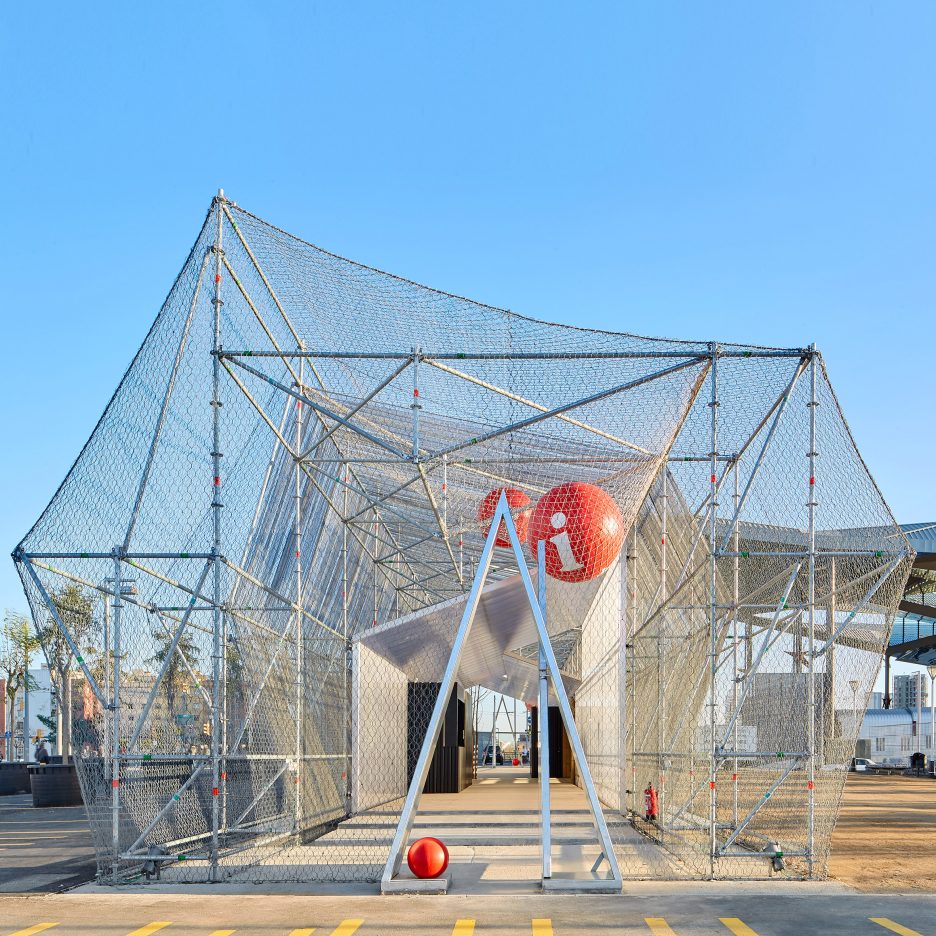
Layers of polycarbonate, netting and metal mesh wrap the scaffolding structure of this temporary visitor centre, designed by Peris + Toral Arquitectes for a public square in Barcelona (+ slideshow). (more…)



 Sig Nordal