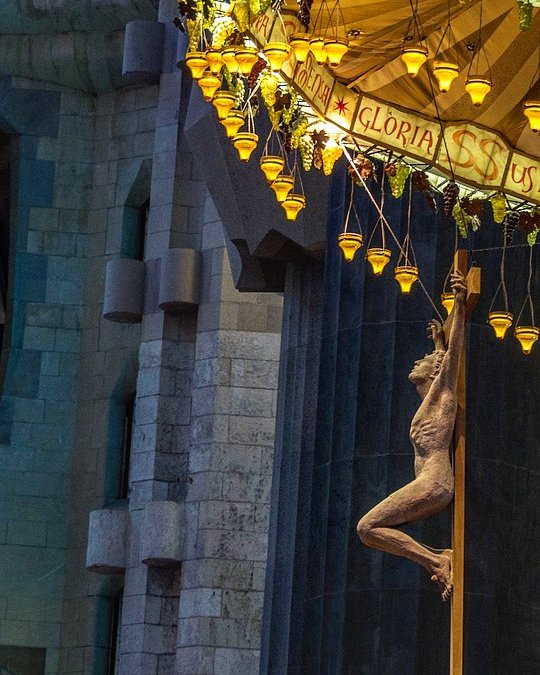
@signordal Detail Cathedral Sagrada Família Barcelona Catalonia

via Instagram http://ift.tt/2cFqyDM

@signordal Aurora Borealis Lofoten Norway

via Instagram http://ift.tt/2d03I9G

“Sundry Doubtful and Uncertain Reports”

Publick Occurences Crop

The first American newspaper was published in Boston on September 25, 1690. The opening editorial of Publick Occurrences Both Foreign and Domestick outlined the newspaper’s aims, which included helping people “better understand the Circumstances of Public Affairs” and doing “something towards the Curing, or at least the Charming, of that Spirit of Lying, which prevails amongst us.”

The first issue included reports on a local suicide, a bountiful harvest, and a range of military troubles with the Indians and with the French colony in Canada. No doubt it was the military news that alarmed the British colonial authorities in Boston. Finding Publick Occurrences full of “reflections of a very high nature” and “sundry doubtful and uncertain reports,” they banned it after one issue and decreed that all future newspapers would require a government license.

The colony’s first attempt at a free press was undoubtedly “a tiny and timid affair conducted by a handful of people in a remote backwater of the great British Empire” (Christopher B. Daly in Covering America). Fourteen years later, when that Empire thought its colonists were ready for the news they deemed appropriate to share, they authorized and subsidized The Boston News-Letter, generally regarded as the first successful American newspaper. It published from 1704 until 1776 — a year in which the colonists had some news of their own for the Empire. By 1791 the First Amendment would enshrine the principle of a free press, reflecting Thomas Jefferson’s opinion that good government required that its citizens get, and be capable of grasping, “full information of their affairs thro’ the channel of the public papers”:

The basis of our governments being the opinion of the people, the very first object should be to keep that right; and were it left to me to decide whether we should have a government without newspapers, or newspapers without a government, I should not hesitate a moment to prefer the latter.

The enduring significance of Jefferson’s comment, reapplied to our multimedia era, is noted in Andrew Pettegree’s The Invention of News: How the World Came to Know About Itself. But Pettegree also notes the significance of a contemporaneous comment by Benjamin Franklin about the power and the potential abuse of the printed word:

The facility with which the same truths may be repeatedly enforced by placing them daily in different lights in newspapers which are everywhere read, gives a great chance of establishing them. And we now find it is not only right to strike when the iron is hot, it may be very practicable to heat it by continually striking.

In Blur: How to Know What’s True in the Age of Information Overload, Bill Kovach and Tom Rosensteil say that the power of today’s media conglomerates, and the hot-iron reach of today’s digital technologies, threaten to take us from “the age of information to the age of affirmation,” the free press envisioned by the Founding Fathers having been hijacked by a free-for-all of belief-driven claims and counterclaims. Given that the informational gates are all but kicked in, making journalism’s traditional “gatekeeper” role problematic or obsolete, Kovach and Rosensteil argue that reporters must hone their skills — as sense makers, witness bearers, investigators — to create a “next journalism” that “joins journalists and citizens in a journey of mutual discovery.”

There is undoubtedly no going back, but two recent books, Peter Rader’s biography Mike Wallace and Dan Rather’s memoir Rather Outspoken, suggest that we may not yet have the consensus needed for finding a way forward. Rader praises Wallace for being “decades ahead of his peers in realizing that in order to sell the news, you have to sex it up.” In contrast, Rather laments that his career witnessed (and fell victim to) the increasing corporatization, politicization and trivialization of the news, and reminds us of another Jeffersonian caution:

In 1823 Thomas Jefferson put it succinctly: “The only security of all is in a free press.” Alas, when you have a press that has become compliant to politicians, owned by corporations and staffed by people who only want to entertain and obey their corporate masters, the plan fails. The “free press” is no longer a check on power. It has instead become part of the power apparatus itself.

The Barnes & Noble Review http://ift.tt/2d2ANVz

Reputations

Reputations cover crop

Juan Gabriel Vásquez is a cold-case novelist, a writer whose characters — though not detectives — investigate the long lost and almost forgotten. In The Sound of Things Falling, the 2013 novel with which the Colombian Vásquez broke through to a large and appreciative North American audience, a law professor looks into the life of his murdered billiards partner, an inquiry that leads back to the death of the man’s wife years earlier and to the violence of drug cartels in the 1980s. In this new novel, Reputations, the protagonist thinks of Colombia as an “amnesiac country obsessed with the present,” a “narcissistic country where not even the dead are capable of burying their dead. Forgetfulness was the only democratic thing in Colombia: it covered them all, the good and the bad, the murderers and heroes.” Vásquez doesn’t forget. The narrator of his first novel, The Informers, attempts to understand why his father contributed to the detention of immigrants in Colombia during World War II. Vásquez’s second novel, The Secret History of Costaguana, goes further back in history to imagine the protagonist’s relation to Joseph Conrad, his Nostromo, and the creation of the Panama Canal.

The three earlier novels had the leisurely sprawl of oral storytelling, digressions and inventions, historical facts and temporal gaps. At 187 large-print pages, Reputations is shorter and tighter. It takes place in two settings over three days and resembles a closet drama, a play about closeting the past. The protagonist, the sixty-five-year-old newspaper caricaturist Javier Mallarino, is being officially celebrated in Bogotá as a national hero for his forty years of fearless political cartoons. The next day, a young woman named Samanta comes up to his mountain home, ostensibly to interview Mallarino for a blog — in fact, she wants access to his house. At the celebration she recognized slide-show images of the interior and remembered that she had been there once twenty-eight years before to play with Mallarino’s daughter, Beatriz.

Samanta wants to know what Mallarino remembers of that night, so Part Two is a detailed but inconclusive flashback to the visit and its aftermath. During a housewarming party, the seven-year-old girls drained the dregs of drinks and were put to bed unconscious. Something happened (I’m being purposely vague here) that caused Mallarino to draw the next day a caricature that ruined the life of a politician attending the party — and perhaps eventually caused his death. Pressed to recall by Samanta, Mallarino, rather self-servingly, thinks of the “past as a watery creature with imprecise contours, a sort of deceitful, dishonest amoeba that can’t be investigated because, looking for it again under the microscope, we find that it’s not there, and we suspect that it’s gone, but we soon realize it has changed shape and is now impossible to recognize.”

Because only one person can resolve the uncertainties of that night, in Part Three Samanta and Mallarino come down from the mountain intending to interview this informant, though both are ambivalent about knowing the truth — Samanta because she was happy before memory intruded on her present, Mallarino because he may have defamed an innocent man in the past and may have his artistic reputation in the future soiled should the interview be made public.

The visit by Samanta seems like a recipe for a familiar sort of confrontation, but the appeal of Reputations is not its quickly concatenating plot but the questions about the motives for and the effects of events. Looking back at three days and twenty-eight years, Mallarino and readers have to consider if his prideful certitude about the accuracy of his physical intuitions and about the gadfly effects of his art may have fractured three families: his own, because his wife and he split years before over the threat of reprisals from the powers he mocked; the family of the politician, who left behind two young sons; and Samanta’s family, abandoned by her father when she was fifteen, perhaps because of that evening at Mallarino’s house. Though his caricatures serve the public by speaking presumed truth to power in dangerous times, we discover that Mallarino enjoys his subjects’ “humiliation,” a much-repeated word rhyming with the title. Whether or not he achieves a saving humility at the end readers will decide.

Vásquez’s first historical inquiries were humble in their engagement with history, raiding archives but also proposing counterfactuals, playfully calling attention to their own fictionality, more surprised and bemused than enraged at the past unearthed. Their versions of history entertain and instruct but do not insist. The investigation of history becomes more serious for the protagonist of The Sound of Things Falling, who ultimately recognizes his obsession with the past has endangered relations with his wife and daughter. Reputations extends the danger of remembering, for Samanta, Mallarino, the newspaper for which he works, and the public that believes in him as the national conscience may all be affected if a disturbing secret is exposed.

“Life turns us into caricatures of ourselves,” Mallarino says at the celebration of his career. Vásquez’s characters are not exactly caricatures but are given little space to develop. The novel, though, is like a mathematical gnomon, adding to and caricaturing Vásquez’s earlier works, presenting a small sketch in black and white of their complex amplitude. When Mallarino can’t think of a contemporary political subject to satirize, he sends his editor a caricature of himself. Perhaps Reputations is a self-examination, Vásquez’s second — or fourth — thought about his cold case orientation and earlier narrative methods. Mallarino wonders if his amusing caricatures have served only to defuse political discontent. Maybe Vásquez wonders if his entertaining stories could have more efficaciously attacked the Colombian “forgetfulness” Mallarino diagnoses. At sixty-five, Mallarino has difficulty imagining his future. At forty-three and recently returned from many years in Europe to live in Colombia, Vásquez may be imagining in Reputations his possible future as an artist, creating a self-cautioning tale about the temptation of artistic and cultural pride. Most probable, though, is that Reputations intends to comment on tendentiously political artists, novelists, and others who are, like Mallarino, cocksure about their representations of and interventions in public life. Vásquez’s plural title refers to his protagonist’s repute, to the reputations of others whom he may have sullied, and possibly to artists who achieve their reputations through ideological affinities in the politicized literary landscapes of Latin America.

Vásquez’s first three novels have first-person narrators with distinctive voices. Vásquez uses limited omniscience in Reputations, and I think it an unhappy choice. As I said in my review of The Sound of Things Falling, Vásquez has a remarkable lightness of touch given his subjects. Though briskly paced, Reputations is sometimes heavy with the kind of ponderousness that omniscience seems to encourage, as in the following passage about couples:

They too were worn down by the diverse strategies that life has to wear lovers down, too many trips or too much togetherness, the accumulated weight of lies or stupidity or lack of tact or mistakes, the things said at the wrong time, with immoderate or inappropriate words, or those that, the appropriate words not having been found, were never said; or worn down too by a bad memory, yes, by the inability to remember what’s essential and live within it (to remember what once made the other happy: How many lovers had succumbed to that negligent forgetting?), and by the inability, as well, to get ahead of all that wearing down and deterioration, to get ahead of the lies, the stupidity, the lack of tact, the mistakes, the things that shouldn’t be said, and the silences that should be avoided . . .

Because the passage doesn’t really sound like Mallarino, its repetitiveness leaves the impression that Vásquez is trying to add weight, as well as length, with generalizations about situations that have been only minimally dramatized in the novel. While Vásquez’s other three novels seem to have been selected from a large stock of materials outside the works’ frames, Reputations appears to have been expanded from limited material to novel length. Mallarino paraphrases Michelangelo when the caricaturist thinks about “trying to extract the sculpture from the stone.” It’s difficult to imagine what Vásquez may have chipped away from Reputations.

Vásquez has said Reputations “was written in the spirit of the short novels I love, those concentrated studies of one character in his predicament.” Although he doesn’t specify those novels, in interviews he often mentions American writers — such as DeLillo and Roth — as influences, and has said Reputations seems to him more like an American novel than his other books. The context here remains political, but the past to be investigated is highly personal and, as Vásquez has said, “intimate.” Both DeLillo and Roth have written short novels about old male writers reconsidering their personal failures — Point Omega and Exit Ghost — but Reputations is closest in its outlines to a novel that Vásquez has specifically referred to: Bellow’s Mr. Sammler’s Planet, in which an elderly, isolated, and proud commentator on contemporary politics and sexuality learns humility at the end of the novel.

An admirer of Vásquez’s wider and larger novels, I’m both disappointed by and fascinated with Reputations. I can say that for those who don’t know his earlier work, this new novel may be a good place to begin, a Vásquez primer in cold-case forensics and unsolved mysteries, an introduction with American echoes. Reputations also shouldn’t diminish his faithful readers’ respect, for Vásquez is an artist who experiments with the form, narration, and tone of his work — unlike the artist he puts at the center of his novel. For those familiar with his fiction, Reputations is a provocative coda to what’s come so far, a work that again solicits reexamination of the past — this time Vásquez’s own.

The Barnes & Noble Review http://ift.tt/2cPo7hc

Residential Building / Paula Santos


© Alberto Plácido

© Alberto Plácido


© Alberto Plácido


© Alberto Plácido


© Alberto Plácido


© Alberto Plácido


© Alberto Plácido

© Alberto Plácido

The building was designed and constructed, entirely new, in 2014, after the previous building collapsed in 2011. The new design proposes an identity that mostly concerns on creating a completely new facade with three black panels of prefabricated monolithic and heavy concrete, integrating the windows.


© Alberto Plácido

© Alberto Plácido

Section

Section

© Alberto Plácido

© Alberto Plácido

Each floor becomes a small apartment except for the ground floor that becomes a duplex unit with a garden. The interiors also incorporate the traditional central stair with a skylight to all the internal spaces and circulations. 


© Alberto Plácido

© Alberto Plácido

Floor Plans

Floor Plans

© Alberto Plácido

© Alberto Plácido

The new construction finally reflects the metric and the characteristics of the traditional buildings, representing a possible reinterpretation of the collective housing in the historical centre.


© Alberto Plácido

© Alberto Plácido

http://ift.tt/2cX5XfO

“People are beginning to rediscover traditional bathing traditions”


London Design Festival 2016: communal bathing culture is experiencing a global revival according to curator Jane Withers, who has put together an exhibition exploring the phenomenon. (more…)

http://ift.tt/2cH3MPh

A Whole Life

Whole Life 4 Crop

You’d think that the novella would be a more popular form among American readers. Our level of distraction means that attention spans are too obliterated for serious novels in the 400-page range, and everybody knows that we refuse, have always refused, to buy short-story collections. So you’d think that the novella would be a pleasing medium, a nice compromise to make with ourselves. Nothing, of course, is compromised in the form itself. Heart of Darkness, The Stranger, Death in Venice, The Member of the Wedding, Notes from Underground, One Day in the Life of Ivan Denisovich — the list of vigorous shorties is a tall one.

At only 150 pages, German writer Robert Seethaler’s A Whole Life is a whole book, a bantam beauty of extraordinary subtleness, a touching homage to personal composure, to the cultivation of one’s own silent spaces amid the brutal noise of being. Andreas Egger lives his solitary life on a mountain somewhere in Germany in the middle decades of the twentieth century. Orphaned young, he is brought up by a sadistic uncle, a farmer who beats him savagely enough to break his leg, saddling Egger with an unfixable limp. Egger grows, works, gets strong, buys his own mountainside plot, weds a village maiden who soon dies in a landslide, goes to war, suffers for eight years in a Soviet POW camp, returns to his mountain, works more, walks and thinks, misses his dead wife, feels alternately disgusted and grateful, and dies as simply as he’s lived.

That’s the entire story, the whole life of the title, expertly folded into the yardage most writers take just to clear their throats. The story unspools as a series of set pieces threaded together by contemplation: a horse-drawn hearse buckles in a ditch, the dead woman’s hand dangling from the casket; Egger writes his marriage proposal in fire on the mountainside; a falling tree severs a worker’s arm, “its fingers still gripping the hatchet”; Egger and a schoolteacher, in their seventies, fail at lovemaking and feel quietly humiliated — “People are often alone in this world,” she tells him, and they remain alone afterward. Egger’s eight years in a Russian camp, “this ice-bound, wounded world” north of the Black Sea, are dispatched in ten deft pages.

One needn’t have a view of the whole world in order to form a whole worldview. Excepting his time at war, Egger never encounters life beyond his mountainside and the valley beneath it. And yet Seethaler’s episodic, meditative armature makes a coherent vision of one man’s Weltanschauung. If most of the novelistic furniture has gone missing from this house — the dutifully detailed back story of emotional wreckage, the conveniently complex interiority, the handy psychological motives, etc. — its absence does nothing to impede the melancholy slap of this book, its dignified sadness in the face of such trampling loss. You can all too readily imagine an editor or agent trying to goad Seethaler into fleshing out, filling in, building up, and you can imagine it getting pummeled by the platitudes of your average MFA workshop: “I don’t feel a connection to anyone in this story” and “I need to know more about these characters to like them.” A Whole Life can’t be had by such musty formulae; it has the earned intransigence of art that proclaims itself unable to be anything other than what it demonstrably is.

Andreas Egger is not another version of the noble savage, nor is he a vista through which we apprehend divine manifestation in nature, a manifestation vital to certain strands of the Romantic worldview. “What is it we probers of Nature are seeking?” Goethe asks. “Out there the God whom within we hear speaking!” Seethaler’s conception of nature is closer to Hardy’s than Goethe’s, a nature indifferent at best and malignant at worst. Snow “seemed softly to swallow the landscape” and “the silence was absolute . . . the silence of the mountains that he knew so well, but which still had the capacity to fill his heart with fear.” The climate is an “eternal cold,” one “that gnaws the bones. And the soul.” Nature, says Emerson, forces upon you “the tyranny of the present” — something savage or something serene, it is a present that will not be shunned. Here, “the mountains breathe,” and not only that: they quake and consume. The landslide of snow and rock that kills Marie, Egger’s new wife, and decimates his home, sounds “as if something deep inside the mountain were splitting with a sigh” before the “deep, swelling rumble” rushes in and wrecks him.

The population of the village triples after the war, and Egger works as a tourist guide, but quickly he finds these intruders “increasingly hard to tolerate.” For the tourists who have thronged to the valley after the construction of the cable car, nature is the rumored balm they’ve come searching for. Egger cannot share their postcard conception of the wild. “People were evidently looking for something in the mountains that they believed they had lost a long time ago. He never worked out what exactly this was” as he watches them “stumbling . . . after some obscure, insatiable longing,” though it’s not the longing they stumble after. The longing lives within; what they stumble after is the appeasement of that longing, the satisfaction of half-formed yearnings. If Egger achieves the peace of his selfhood, it’s because he’s dismissed yearning altogether. His only ambitions are the quietude in which he can remember Marie and, like Nick Adams after a different war, the grunt work that will keep him from remembering too much.

Self-exiled, Egger is also self-fulfilled and so cannot be numbered among what Rilke names die Fortgeworfenen, those castaways with no place in the accepted social order. Instead, Egger is a hulking, limping embodiment of Goethe’s notion of “renunciation”: not a fed-up surrender to one’s fate, a submission to circumstance, but a cool-headed acceptance of the good and bad in tandem, a disciplined understanding that the world peddles both disaster and advantage, an understanding that’s kin to Keatsian negative capability. Egger has no articulated moral program, no preoccupation with moral maturity, but he knows right from wrong and behaves with considerable goodness toward others. The first we see of him, he has an infirm goatherd strapped to his back, toting him down a rock-ribbed mountain path in winter, trying to get him medical help. No one called him to attempt this rescue. He called himself.

Seethaler’s is an insistently sensuous realm: the warm feel of newborn piglets, their scent of “earth, milk, and pig muck,” or Marie’s hair smelling of “soap, hay, and . . . a little of roast pork.” There’s the scent of “dry moss and resin,” of “horse piss” and “lumps of cheese” and “primroses and leopard’s bane.” The pure physicality of Seethaler’s storytelling necessarily derives from the pure physicality of place. “Something’s stirring in the bones,” Egger thinks of spring, and that something’s stirring in the prose, too, in its verdant reticence. This reticence of prose is born of Egger’s own skeptical stance on language: “Talking meant attracting attention, which was never a good thing.” The cable car building crews and tourists are everywhere: “the rattling of the engines, the noise that suddenly filled the valley. Nobody knew when it would go away . . . or whether it ever would.” The only silence Egger can count on, he knows, is the silence that awaits in his grave.

Death is both an omnipresent reality and a mystery. A dying goatherd tells Egger: “People say death brings forth new life, but people are stupider than the stupidest nanny goat. I say death brings forth nothing at all! Death is the Cold Lady.” Children die from diphtheria, workers from falls, women and men from age — one old woman “lost consciousness while baking bread, toppled forwards and suffocated with her face in the dough.” In the Soviet camp, “after a few weeks Egger stopped counting the dead” because “death belonged to life like mold to bread.” One cable car worker tells Egger, “It’s a messy business, dying,” and when Egger replies that more merciless cold will come after death, the worker says: “Rubbish. There won’t be anything, no cold and certainly no soul. Dead is dead and that’s that. There’s nothing after that — no God, either. Because if there were a God, his heavenly kingdom wouldn’t be so bloody far away!”

Unswervingly tactile, Seethaler’s tale also rubs against the mysteries of spirit, as it must. This is a land where, for most, punishment by God means more than metaphor, more than myth, a land where people dwell among the occult, believe in ghosts and “bloodsucking forest demons,” feel presences for which they cannot account, and navigate their lives by signs, though the signs are often inscrutable. After moths appear on a windowpane, Egger “thought their appearance must be a sign, but he didn’t know what it was supposed to mean.” After the landslide kills Marie, “he wanted to understand” but “he knew there was nothing to understand.”

Loyally translated by Charlotte Collins, A Whole Life is a lovely whisper of a book, proceeding with an understated, mythical gravitas, pulsing with its own coiled possibilities, its anticipant calm, the heavy hush of its unfolding. If you are a reader who weeps with books, you will weep with this one.

The Barnes & Noble Review http://ift.tt/2dewNNY
Schmidt Hammer Lassen Wins Competition for Mixed-Use Tower and Urban Plan in Stavanger, Norway


© Schmidt Hammer Lassen Architects

© Schmidt Hammer Lassen Architects

Schmidt Hammer Lassen Architects has won an international competition for the design of an urban redevelopment plan and high-rise in Stavanger, Norway. Beating out entries from Snøhetta, UNStudio, Dark Arkitekter and Eder Biesel Arkitekter, the winning proposal, “Breiavatnet Lanterna,” features a dynamic scheme to support the proliferation of sustainable and creative work environments throughout the city.

The project encompasses a new public center, the transformation of an existing park and a new 101 meter (331 foot) tall tower that will contain 18,170 square meters (195,580 square feet) of highly-flexible space for offices, restaurants, conferences and exhibitions. Both the ground and top floors of the high-rise will be publicly accessible, ensuring the building will remain an asset for the entire community.


© Schmidt Hammer Lassen Architects


© Schmidt Hammer Lassen Architects


© Schmidt Hammer Lassen Architects


© Schmidt Hammer Lassen Architects


© Schmidt Hammer Lassen Architects

© Schmidt Hammer Lassen Architects

The new tower will be located near Stavanger Central Station, beside the future “Tivoliparken,” a new green space that will link the district to surrounding neighborhoods and the greater city. The tower is accessible on 3 sides, with the main entrance turned toward the park, rather than the street. To cohesively site the building within the city, the plan of the ground floor has been arranged to interweave with the existing urban fabric.


© Schmidt Hammer Lassen Architects

© Schmidt Hammer Lassen Architects

© Schmidt Hammer Lassen Architects

© Schmidt Hammer Lassen Architects

“The new 26-storey tower will stand simple and modern in its form with a clear Scandinavian architectural reference, bringing a timeless expression to the varied building structures in the area,” the architects explain. “The facade design is a composition of slim vertical aluminium and glass panels which offer increased daylight to over 1,000 work spaces. The building design is optimized to the highest degree of user-friendliness and energy efficiency. Green terraces at different heights and orientations bring a distinct recognizable character to this new high-rise in Stavanger, which will be one of the highest in Norway.”


© Schmidt Hammer Lassen Architects

© Schmidt Hammer Lassen Architects

© Schmidt Hammer Lassen Architects

© Schmidt Hammer Lassen Architects

Public program on the first two floors will include a café, restaurant and cafeteria, as well as adaptable performance and exhibition spaces centered around a large amphitheater staircase. The third through fifth floors will house a church currently located on the site, while floors 6 to 24 will contain brightly lit, open concept offices. The top two floors will offer conference facilities, restaurants, bars and public space featuring panoramic views of the city skyline and nearby fjord.


© Schmidt Hammer Lassen Architects

© Schmidt Hammer Lassen Architects

© Schmidt Hammer Lassen Architects

© Schmidt Hammer Lassen Architects

The competition was managed by Base Property and Borderholm Aksjeselskap, who were seeking a “timeless, high-quality, sustainable” development to serve as a new attraction for Stavanger.

News via Schmidt Hammer Lassen Architects.


© Schmidt Hammer Lassen Architects

© Schmidt Hammer Lassen Architects

© Schmidt Hammer Lassen Architects

© Schmidt Hammer Lassen Architects

© Schmidt Hammer Lassen Architects

© Schmidt Hammer Lassen Architects

© Schmidt Hammer Lassen Architects

© Schmidt Hammer Lassen Architects

© Schmidt Hammer Lassen Architects

© Schmidt Hammer Lassen Architects

© Schmidt Hammer Lassen Architects

© Schmidt Hammer Lassen Architects

http://ift.tt/2cNYhMc

“We can’t stop superblocks or sprawl, but we have to make space for life in between”


Opinion: Aaron Betsky finds lessons for western city planners and designers in amongst the mega-blocks, privatised spaces and urban sprawl of Asian cities. (more…)

http://ift.tt/2ckhqlb

Vik Iceland by Michael Ver Sprill Work For Sale |…

Vik Iceland by Michael Ver Sprill Work For Sale | www.milkywaymike.com | FB Fanpage | Twitter | Google+ | Youtube Fotodiox wonderpana 1000x filter http://flic.kr/p/BbdvG6

http://ift.tt/2d8K8LU