The Midden Garden Pavilion / Metropolis Design


© Wieland Gleich

© Wieland Gleich


© Wieland Gleich


© Wieland Gleich


© Wieland Gleich


© Wieland Gleich

  • Structural Engineer: Sutherland & Associates (Pty) Ltd – Gerdi Bruwer
  • Quantity Surveyor: Shevel and Simpson – Alastair Simpson
  • Project Manager: Rogan Hindmarch
  • Contractor: Batir Construction

© Wieland Gleich

© Wieland Gleich

The project forms part of a larger renovation to a freestanding villa located high up on the slopes of the Vlakkenberg. The clients required a pavilion within their extensive and beautiful garden, from which to appreciate the natural landscape around them.


© Wieland Gleich

© Wieland Gleich

Site and Context 

The site consists of a series of terraces, oriented north- south and falling to the east. The house is located over two terraces and overlooks the garden terrace below. There are significant mountain views to the north and sweeping views of the peninsula to the east. South-east winds are severe in summer.The existing garden terrace contained an ostentatious water folly at its southern end, comprising a water cascade falling in to a pond with elaborate fountains. This feature is on axis to a large pool on the far end of the terrace, separated by a large expanse of garden.While this garden folly appealed to the new owners’ sense of humour, they requested that it be ‘toned down’ and incorporated into a meaningful outdoor relaxation area for the appreciation of the back of Table Mountain to the north, a view they love, but cannot really appreciate from the house.The siting concept was to locate the new pavilion both as a termination of the garden, as a backdrop to the water feature and as an evocation of the mountain across the valley. It required both solidity and presence, transparency and lightness.The earth banks behind the pavilion were manipulated to form a natural basin


Plan

Plan

Design Intentions    

The pavilion attempts to address a complex question: how to create a meaningful dialogue with place when the surroundings are both de-natured and powerfully ‘natured’. This requires that the relationship between architecture, nature and modernity is carefully considered. The building is intended to be of nature: to contain a distillation of landscape which then allows it to be naturally contained by its surroundingsWe limited our consideration to the timeless, the simple, to charting the movement of the sun, the changing quality of light during the day, the mystery and magic of the landscape at night. To stillness, emptiness, possibility.The intention is to say as much as possible with as little as possible and to leave as much as possible unsaid…


© Wieland Gleich

© Wieland Gleich

Concept

An abstract sculpture, which is a distillation of nest and tree canopy, floating over the flat plane of the garden. The abstract form is neither purely aesthetic nor purely rational. It is conceived to be elemental, of itself, more of an object than a building, which can compete in its perceptual power with the strength of the surrounding natural landscape on the one hand and the artificiality of its immediate surroundings on the other. The notion of change, the passing of time expressed through the day and the year, is tracked by a perimeter aperture which mediates an ever changing and subtle play of light on the rough concrete walls of the building. 


© Wieland Gleich

© Wieland Gleich

Design Realisation Organisation & Accommodation 

The accommodation comprises a number of seating areas, both under cover and in the open and a barbeque area. A small kitchen, storage and bathroom block are included due to the distance from the house and complete a flexible entertainment place for individual and large scale gatheringsThe pavilion is arranged on intersecting axes. The major axis was an existing one between the existing water feature and the swimming pool. It is expressed by the timber floor plane and is really the axis which connects to landscape on both sides. The cross axis, is defined by the shelter and adjacent services block.The placement of the building was calculated to create a series of outdoor places with different spatial qualities to allow for a layered and varied experience.


© Wieland Gleich

© Wieland Gleich

Structure & Material
The materials are minimal- concrete, timber and textured plaster.The entire canopy structure is of self-compacting reinforced concrete, with a Penetron additive. The shuttering was pine planking, planed all round. This smoother surface treatment was specified, in order not to disturb the overall unity of the form in the raking sunlight. 


© Wieland Gleich

© Wieland Gleich

http://ift.tt/2d5gCa0

Alberto Zavala Arquitectos Design a Contemporary Residence in Villahermosa

💙 Kirkjufell on 500px by Torsten Liebert, Freital,……

💙 Kirkjufell on 500px by Torsten Liebert, Freital,… http://ift.tt/1Tr0QhK

http://ift.tt/2cByVAx

5 Reasons Why Less Is More

We’ve heard it our whole lives – “less is more” – but what does it even mean? Teachers tell us this without background, and little posters of Buddha tell us this without frame of reference – but we seem to love hearing it anyways. How many times have you said “oh well, less is more” as a response – maybe for a joke or not!

Less is more is a phrase used to express an idea that a minimalist approach is better for something than a larger production would be. It’s a lot deeper than that, but these days people like to use it to define themselves or justify their lifestyle.

less_is_moreWhen you think of people who use this phrase as a lifestyle maybe you think of underachievers – people who live in small, basic homes, with little decor and what seems to be little ambition to change. These people are maybe not seeking a physical life of less is more, but maybe they have to adopt it in a frame of positivity because their bank balance won’t let them into another style of life. Some people are forced to treat less is more as a happy place because they cannot afford to live another way.

Or maybe we think of the young professional overachiever, portrayed as being a bit snobby, in their fancy IKEA flats where everything serves a purpose, decor is once again at a minimum, and their home looks like the front page of Advertisement magazine. We accidentally tend to be almost jealous of people who can enjoy their picture perfect lifestyle with so little but so much, but again, we never know the full story.

Why is less, more?

1. Emotional relief

It may sound a bit psychopathic, but people who are less emotionally attached to things will also feel the relief of not being so upset when disaster strikes. These people have hardened themselves to be able to quickly recover from breakups or financial concern, while still being able to maintain an air of happiness and gratitude. Less is more for them because they are able to live life without feeling trapped by emotions of the past.

2. The power of summary

We are almost forced to accept that less is more in our social media lives these days. They say the hardest part of journal writing isn’t necessarily reaching the word count, but trying to stay under it. Professionally or academically for some people, our text based world of 144 characters these days has a positive contribution in the way we are able to summarize things. We can get the point across without taking up too much paper, and this is something we like to see when we’re scanning headlines.

3. Declutter!

Of course the obvious one is to keep your home looking fresh and clean. We’ve all seen episodes of hoarders that look like our worst nightmare – are our homes on the same path? Take a look around and open your closet – did 10 pounds of boxes just fall on you? If not, great! If so, perhaps it’s time for a bit of spring cleaning.
There are piles of things laying around your house that you don’t need. Inside we are all secretly hoarders. Throughout our lives we amass catalogues of interesting thing that remind us of our lives. You don’t have to throw things out, but in order to keep your home fresh, consider donating your things to other people, or limiting what you have out on display. Make sure everything serves a purpose and isn’t cluttering your view for nothing.

4. The backpacker

Just for reference, what might be the opposite of a hoarder is the backpacker. These are the people living lifestyles we can only sort of dream about from our office – people who travel the world living just out of a backpack or suitcase, with only their possessions to their name. How do they do? Easily. Instead of filling up closets with new shoes, they fill up passports with stamps, and their head with memories. For backpackers, less is more – the less you have, the more mobile you are, and the more room you have in your heart for unforgettable adventures.

5. Your words

We’ve all gotten in trouble with our significant other for talking too much. Sometimes we just ramble on, losing track of our thought and words, leading us into dangerous territory. We make mistakes doing this and continue to learn about how not to do it again. Sometimes less is more in a relationship. You will learn to say only what you need to when things are on ice, and keep your points concise and confident, keeping your relationship safe. It doesn’t take much to recover from a domestic argument – a few well placed words and gestures is often enough to save the day.

The post 5 Reasons Why Less Is More appeared first on Change your thoughts.

http://ift.tt/2d1mMDd

Glück auf: Das Geleucht, The Stockpile Rhineprussia (Halde…

via Statues in Focus http://ift.tt/2cSs4Uv

Corbyn says huge turnout at his rallies shows he can win an election – Politics live

Rolling coverage of all the day’s political developments as they happen

8.36am BST

The “good cop/bad cop” routine is a familiar one in any negotiation and it is a strategy the Labour leadership seems to have been adopting as Jeremy Corbyn ponders what to do about the majority of MPs who do not support his leadership. Some of his allies are quite happy to issue threats to the dissidents, as the Guardian reports in its splash today.

Related: Len McCluskey: disloyal MPs ‘asking for it’ and will be held to account

I have made it my business to talk to quite a lot of Labour MPs and will continue to do so and I hope they will understand that we’ve been elected as Labour MPs …

It doesn’t mean everybody agrees on everything all the time – that I understand – but the general direction of opposition to austerity, opposing the Tories on grammar schools, those are actually the kind of things that unite the party.

That then becomes, surely, a very strong campaigning basis for the Labour movement, becomes a campaigning factor in towns and cities where there’s never been very much activity before. That does begin to change the debate and national mood. I think you’ll begin to see that play out, particularly in local elections next year and after that.

I’ve been at political rallies all my life, of various sorts. What I find exciting and nice, but slightly depressing, is when I know half the people at the meeting I go to. I go to these events all over the country, and some of them, I don’t know anybody. I don’t know anybody at all, and they’re people who come up to me who say ‘I’ve never been involved in politics before, I’m interested in what you have to say, because I’m interested particularly in the economic argument that you have to rebalance society away from inequality towards equality’.

Continue reading…

Politics blog | The Guardian http://ift.tt/2cjrjV4

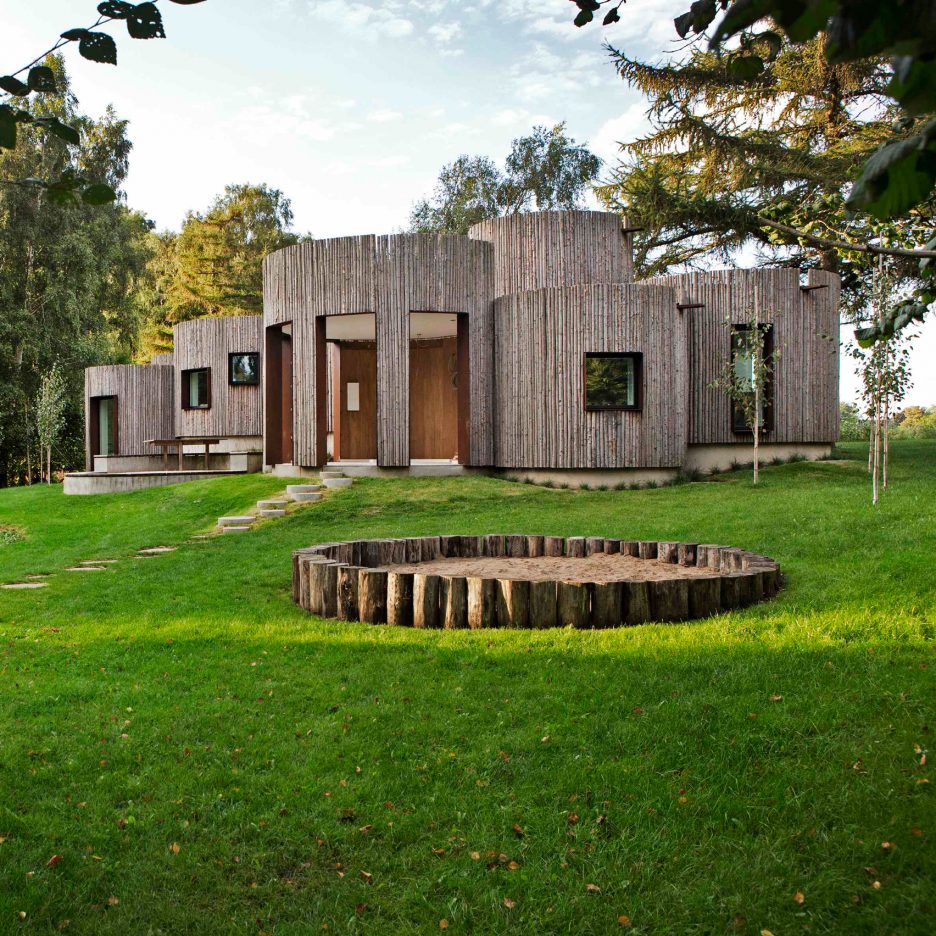
Overlapping cylindrical and log-covered blocks form Danish holiday home by Jan Henrik Jansen


Nine cylindrical volumes interlock to form this holiday home on the Danish island Møn, which is covered in thousands of spruce logs and lined with beach pebbles (+ slideshow). (more…)

http://ift.tt/2d56D4g

Single-Family Home in Rodersdorf / Berrel Berrel Kräutler Architekten


© Eik Frenzel

© Eik Frenzel


© Eik Frenzel


© Eik Frenzel


© Eik Frenzel


© Eik Frenzel


© Eik Frenzel

© Eik Frenzel

The prefabricated timber-frame house stands on a slope with views over the hilly Alsatian countryside. The cubature of the detached house reflects the skilful orchestration of the local building code specifications, with the interior divided into split levels in order to create four independent levels.The roof and short façades are clad in a skin of copper-titanium-zinc alloy, while spaced wooden slats were used on the long sides. The façade materials accentuate the idiosyncratic volumetry of the wooden house. The structure is formed by a wooden shell mounted under the roof, which serves as the upper storey.


© Eik Frenzel

© Eik Frenzel

Section

Section

© Eik Frenzel

© Eik Frenzel

The over-height space between the shell and building envelope is the highlight of the house and at the same time its centre. This area is connected to the outdoors via a large window. Narrow skylight-slits in the roof and along the integrated shell bring light into the sculptural interior. At its core it is a wooden installation that divides and connects the entrance, cloakroom, kitchen, dining area, living room and lounge. The precise carpentry work makes the functions in these areas disappear into an all-enveloping abstract sculpture.


© Eik Frenzel

© Eik Frenzel

Section

Section

© Eik Frenzel

© Eik Frenzel

Access to the upper floors in the installed shell is gained via seamlessly built minimalistic stairs made from solid wood steps. The bedroom, study and bathroom are separated by built-in wall cabinets. The walls and doors are aligned with no projections.


© Eik Frenzel

© Eik Frenzel

http://ift.tt/2dcBef6

A Suite with a View in Rotterdam, The Netherlands

The Rotterdam Suite by 123 DV (18)

The Rotterdam Suite is a private residence designed by 123 DV. The 2,690-square-foot loft is located in Rotterdam, The Netherlands. The Rotterdam Suite by 123 DV: “Great Expectations What would you expect, when entering a 250 m2 (2690 sq ft) loft at De Rotterdam, the biggest building of The Netherlands, (designed by OMA/Rem Koolhaas), at the height of 143 meters (469 foot), on the 43rd floor? Rotterdam seen from the..

More…

Smiley Zeeburgereiland Apartments / Studioninedots


© Peter Cuypers

© Peter Cuypers


© Peter Cuypers


© Peter Cuypers


© Peter Cuypers


© Peter Cuypers

  • Architects: Studioninedots
  • Location: Amsterdam, The Netherlands
  • Clients: Van Wijnen Midden, IC Netherlands, DUWO
  • Design Team: Albert Herder, Vincent van der Klei, Arie van der Neut, Metin van Zijl
  • Project Year: 2016
  • Photographs: Peter Cuypers
  • Project Team: Stefan Dannel, Wouter Hermanns, Jurjen van der Horst
  • Contractor: Van Wijnen Midden
  • Project Type: 364 student apartments

© Peter Cuypers

© Peter Cuypers

On Zeeburgereiland in Amsterdam, right before the Piet Hein tunnel, a growing student population has been livening up the area. Here Studioninedots designed an iconic block with 364 student apartments. Passersby this summer caught glimpses of the first residents enjoying the sunshine on the shared terraces that form the stepped roof.

Zeeburgereiland is rapidly developing into an urbanised part of Amsterdam, and the city-wide demand for student housing is addressed here on the 134-metre-long site on IJburglaan. Studioninedots utilised the organisation of the outdoor spaces as a way to facilitate a collective culture and the dynamic use of the building. A major strategy relocated the terrace, which was originally allocated on the quiet but unattractive north side of the building, to the roof.


© Peter Cuypers

© Peter Cuypers

By stepping the block down southwards, this created space for shared terraces, enabled variety in the apartment layouts and formed an iconic urban silhouette. The clever positioning of the stepped terraces enables the building to function as a barrier against traffic noise for the residences behind.


© Peter Cuypers

© Peter Cuypers

Double height glass entrances mark access to the apartments. Complementing the roof terraces is a green zone that lines the front facade, filled with hollyhocks that lean against the brick piers. The terraces of the ground floor apartments open onto here.
The dimensions of the piers vary, widening towards the centre of the building, which appears as a triptych. Each with its own rhythmic quality, the different sections together accentuate the overall upturned form: the building smiles.


© Peter Cuypers

© Peter Cuypers

Plan

Plan

© Peter Cuypers

© Peter Cuypers

Our cities are becoming more compact. In this context Studioninedots sees an increasing need for better collective spaces and public spaces. Its architecture creates characteristic spatial interventions on dense urban sites that function as catalysts for meeting, exchange, connection and activities between people – in this case, between students. 


© Peter Cuypers

© Peter Cuypers

http://ift.tt/2cVmU8t