How do you make school fun and sustainable in the age of technology? S.Misagh Architecture and Planning’s design for an Iranian village school creates an edgy alternative to the antiquated classroom. The firm’s three principle concepts for their Deh-e Now VillageSchool — identity, knowledge, and the natural environment— allow students an array of opportunities for interactive engagement with their surroundings.
Courtesy of S.Misagh Architecture & Planning
By connecting educational spaces to the public space, the architects hope to foster effortless interactions between students, faculty, and parents. In a plan to create zero hierarchy between these sectors, the firm promotes a single identity as a “coherent framework central to the nurture of the children.”
All the spaces are designed to provide opportunities to experience and discover through playing games, socializing and cooperating with others, and sustainably using natural resources, the firm writes.
Courtesy of S.Misagh Architecture & Planning
In addition to the the two yards (village yard and play-yard), the classrooms and administrative spaces distinguish four distinct zones within the school — all adapted for creative development and learning processes on a daily basis. Six classrooms overlook the central courtyard, whose ground was designed with various textures to inspire children’s imaginations.
Courtesy of S.Misagh Architecture & Planning
The ground floor plan attempts to convey three key features to the environment: climate, local culture, and rural lifestyle. While the students become acquainted with the fundamental elements surrounding them, the students will garner greater appreciation, writes the firm. Further encouraging growth, a small agricultural area is used for testing various cultivation methods before planting them in large scale.
Courtesy of S.Misagh Architecture & Planning
Courtesy of S.Misagh Architecture & Planning
Serving as a meeting entrance for the school, the final zone “Administrative, Scientific, and Public Spaces,” welcomes a multitude of activities including a public space for socializing within the village. The semi-open space blurs the line between outside and inside, benefitting village events and parent-teacher meetings.
Courtesy of S.Misagh Architecture & Planning
Courtesy of S.Misagh Architecture & Planning
The firm also looked at site layout to design in accordance with the grid of the natural landscape. Their attention to climate played into structural decisions as well as their dedication to natural elements.
Location: Jiroft, Kerman Province, Iran
Architect In Charge: Salman Zangeneh
Area: 0.0 sqm
Project Year: 2016
Photographs: Courtesy of S.Misagh Architecture & Planning
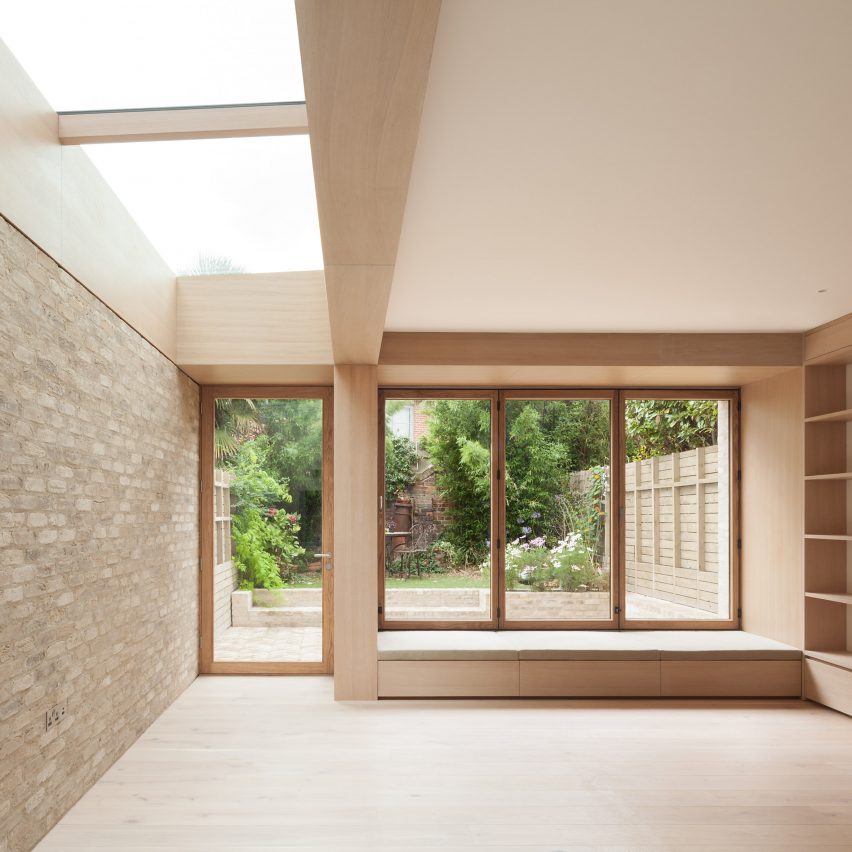
Architecture studio Erbar Mattes has added a limewashed brick and glass extension to a house in London‘s Crouch End, creating a bright and spacious living area for a family of four. Read more
House Luxembourg is a residential project designed by EPAD in 2015. It is located in Luxembourg City, Luxembourg. House Luxembourg by EPAD: “The renovation and interior transformation works in a 1920ies manor house in Luxembourg City proved to be a challenge for everyone involved in the project, above all for the client who has been living in the house during the four months long operations. The bad condition of the..
From the architect. Boursorama Banque has moved into its new Parisian head office in Boulogne-Billancourt designed by Studioninedots. In collaboration with Ateliers 115, Studioninedots created a robust and clear building distinguished by its subtle recesses and terraces but foremost by the striking facade that interplays rhythms of bronze-coloured blades.
The bank building is situated on a section of the old Renault factory site in Paris. The plot Lot YA sits within a dense urban fabric and points with its southern tip towards the adjacent Parc Billancourt and the river Seine. This resulted in a paradox: optimal views of the park were desired but, simultaneously, incoming direct sunlight should be blocked.
Concept
Concept
Concept
Studioninedots approached the challenge with a clear solution: vertical aluminium blades. By placing them at an angle, the blades function to block sunlight during the harshest hours while retaining views. The spacing of the blades is determined by the amount of sunlight and the orientation, resulting in a large variety of facade compositions. As one moves around the building, the facades continuously change appearance. Placing the main entrance in the southern tip positions the bank prominently amongst the ‘front row’ on the park and also establishes an interesting vista through the inner court.
The building is designed to stand its place among the high rises on Avenue Pierre Lefaucheux. Utilising horizontal layers, for example in the form of recesses and terraces, connects it better to the smaller scale residential buildings in the neighbourhood.
This site comprises the last large scale development within Greater Paris and will accommodate approximately 15,000 residents and occupants. The urban plan is designed by Patrick Chavannes. Renowned architects including Jean Nouvel, Dominique Perrault, KCAP, LAN and Baumschlager&Eberle have designed individual plots. Studioninedots won the invited competition in 2012 for the development of Lot YA, which was commissioned by an innovative, open-minded client. YOU, Lot YA is the first project completed by Studioninedots in France.
A House in Nha Trang is a residential project completed jointly by Vo Trong Nghia Architects & ICADA. It is located in NHA Trang, Khanh Hoa Province, Vietnam. A House in Nha Trang by Vo Trong Nghia Architects & ICADA: “The house is located in Nha Trang, a city in central Vietnam surrounded by the beautiful ocean and mountains. The client wanted a large house with a large garden. Answering..






 Sig Nordal