From the architect. Hotel ICHINICHI is a small hostel located in a local shopping street of Akabane, Tokyo. It is retrofitting an existing five-story reinforced concrete building with history. This building was originally built as a tiny complex housing a beauty salon and offices, as well as dormitories for its employee. Through time, it has remained vacant for several years.
The building’s interior holds a unique character with unexpected blend of styles, resulting from several remodeling in the past, including an impressive spiral stairs and a chandelier at the entrance hall, reminiscent of the days of the beauty salon.
Foor Plans
The accumulation of time embedded in this old but charming building appears to present an alternative image of modern Tokyo’s development, which we have become accustomed to. As such, we started by carefully subtracting existing elements to reveal and at times emphasize the multiplicity of its spatial layers. In some areas concrete structure is exposed, whereas only the most recently finished surface was peeled in others to either show its hidden surfaces.
The personal spaces in the shape of nested huts were then installed in the building’s redefined interior space. The size for these huts are carefully designed to provide just enough space for an average guest to stand and sleep with his/her arms wide open, relax, refresh and sleep comfortably.
The hostel owner grew up in this neighborhood, and started her business utilizing the building her relative had built. We hope this serves as a prototype for a small urban hostel situated in a humble community.
From the architect. The project is located in one of the apartment block of residential complex. during the design, we considered two essential factors to develop the concept of Mehr Khaneh interior design. The first factor is the client’s interests in the Persian civilization, culture, and values, namely the metaphors of Mithraism and sun. The second factor is the artistic character of the client, which had to be reflected in design.
Considering the budget restrictions, we aimed to develop a minimal and affordable space, yet artistic and Iranian genius loci with a symbolic approach to Mithraism.
Accordingly, by conceptualizing the design based on the styles of Loft Architecture, we used exposed concrete, rebar, and metal oxide to design the space. The choice of brick and wood as well as lighting design created a cozy and warm atmosphere that is desirable for a residential place.
One of the most important design ideas is the set of stairs located in the living room; it is a symbolic, yet philosophical element. This element is inspired from historic mehrabs and ziggurats, which are symbols of promotion and approaching closer to sun. Sun is the symbol of light, and light is the symbol of knowledge and wisdom. This design is a symbol of approaching to sun and advancing to knowledge essential for improvement and actualization of thoughts for an artist. The direction and raise of stairs are toward east and sunrise.
Floor Plan
The design of lighting fixtures is also inspired by the symbolic role of Sun, and it follows the geometric symbol of sun, which a triangle surrounded by a dodecagon, used in traditional Iranian architecture. In a part of ceiling the triangular and pyramidal shapes are used such that they are such as the extensions of the light radiation that pass through the roof and shines inside such that no barrier _even a concrete wall- cannot prevent the knowledge and wisdom.
The ancient sun pattern was used as a light frame in this unit. Furniture are designed in accord with the aforementioned concepts, realized by using materials such as concrete, rebar, and metals. Not only we applied this concept to the interior design of kitchen for consistency, we also used turquoise tiles in this space to inspire the sense of place (Genius loci) that emerges in the Iranian traditional architecture.
Considering the role of plants in traditional Iranian architecture, planting components have been placed in different parts of this unit, for example, in the kitchen, as hanging components.
In the space right in front of the kitchen, wooden materials are used to create a beautiful scenery with the special daylight available at sunset. One room is considered as the home office and meeting room, designed with simple yet creative ideas like using patterns of concrete for the floor lamps.
Although affordable materials such as concrete, rebar, and recycled wood are used in the bedroom’s interior design, our design has created a desirable and relaxing space to satisfy the requirements of a bedroom
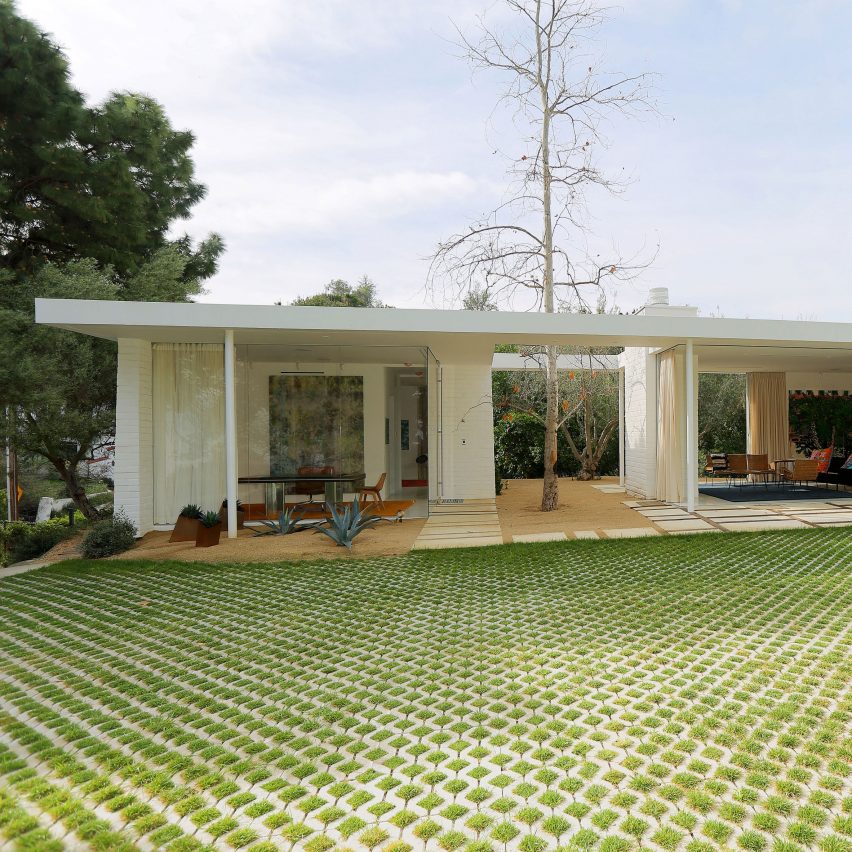
This house in the Hollywood Hills, by Los Angeles firm Struere, promises to “renew the modern living promise” by extending the indoor spaces to the exterior. Read more
From the architect. Jointly organized by Singapore Institute of Architects (SIA) and Singapore Institute of Landscape Architects (SILA), Archifest 2016 returns from 23 September to 9 October 2016 with a Pavilion, designed with the theme ‘Exhale’. The annual architecture festival not only celebrates Singapore’s urban environment but also sets the stage for a wider discussion about our city, spaces and life. From exhibitions, conversations, workshops, markets to architecture tours, the Archifest Pavilion @ Raffles Place Park will host an exciting program that is diverse, informative, thought-provoking and fun.
Sketch
Celebrating its 10th edition, Archifest’s theme for this year ‘Exhale’ seeks to challenge the rapidity and density of activities that define our pace of life, weigh in on the state of Singapore’s built environment and breathe new life into it.
The festival will be bringing back the popular Archifest Pavilion, after a hiatus last year. The winning pavilion design by a team from DP Architects is composed entirely of construction site materials – safety netting suspended on a frame of steel scaffolding. The gigantic Technicolor urban sculpture plays on the interaction of multiple primary colour layers that overlap to create a playful pavilion, offering a respite from the hectic city life right in the centre of the Central Business District. Professor Richard Ho, Chair of Archifest 2016 Organizing Committee said, “One of the primary aims of Archifest is to make architecture more accessible and engaging to everyone. Offering a unique and multi- sensorial experience of the city in the spirit of ‘Exhale’ this year, the psychedelic Archifest Pavilion is set to inspire more people to recognize the profound impact that design and the built environment have on the vitality of the city and our lives.”
With a line-up of more than 30 events, Archifest 2016 will feature activities for everybody. Highlights include exhibitions featuring winners of SIA Architectural Design Awards and SILA Student Design Awards; lunchtime architecture studio sessions City-Studio; specially curated Architours to explore Singapore’s hidden architectural gems; weekend Barter Market to trade good vibes; SG Farm for a dose of urban farming in the city; a Pop-up Library to borrow and exchange your favorite reads; interactive event #FlipTable to release your work stress; parent-children design workshop by ArKIDecture; as well as several Conversations with creatives sharing their inspirations and projects.





 Sig Nordal