This is a renovation of collective housing in Osaka.The small which was renovated is filled with natural light and refreshing wind going through the inside. Flowing clouds and flying birds are reflects on the glossy floor.As time has passed, this white space is dyed by various color of sky.
Courtesy of Jun Murata
Several handmade flowerpots made of concrete are displayed inside. Warped shape. Simple texture. Small plants are dissolving in daily life.
Courtesy of Jun Murata
Trains and cars. Moving crowds. Voices of children echoing in the distance. Various tone of city is passing in the peaceful interior.I want dwellers to enjoy small life in the city with feeling the nature.
From the architect. The challenge: using the building circular geometry and creating efficient spaces. The design process starts with creating radial axis from core and split it with circulation torus; it creates straight trapeziums spaces for open /closed offices and meeting rooms.
Axonometric
Focus point: Another design principal is creating a multipurpose interactive unit to gather people both business and social proposes. Area located the most common part of the office faced both circulation and office areas. Row wood layered design hides all the hardware units but act as see through partition.
Organic fluidity: Designing chamfered ceiling edges at the circular form building creates homogenous lighting reflections. Diffused light breaks side effects of the low ceiling.
Natural light: Creating radial axis perpendicular to the facade for transmitting natural light to inner core. While transmitting natural light over radial axis, gathering light due to translucent material.
Axonometric
Coherent material usage: Material decision made by the identity of the global firm and light fluidity. To create light circulation geometry and light used together. Lighter colors reflect the light all around the area with the smooth effect of chamfered edges. Neutral touch of grayscale colors provides to create identity in order to usage of powerful red identity. Using fabric products such as acoustic carpet and acoustic wall coverings on reflected surfaces provides acoustic comfort at low ceiling space.
From the architect. The initial core aim of the St Kilda East Townhouses was as a family development generating two typical dwellings that can functionally house downsizing grandparents in one (my parents), and comfortably accommodate a young family of five in the other (myself, wife and kids). It had to be cost effective but with a good aesthetic outcome. The site being located on a corner with a dog leg in the street and a street address to the long boundary meant that the dwellings needed to run end to end, parallel to the street. This breaks from the more traditional side by side mirrored plan townhouse. It also meant that along with particular site and planning conditions, in this case, daily living is somewhat exposed to the local community.
While the building itself is a striking and prominent presence, the architectural success of these dwellings is how they embrace genuine social interaction in an increasingly prohibitive culture, avoiding obsessions with technology, regulation and total privacy. Kids lean over the fence to say hi to grandparents & passers-by, dogs bark in unison and neighbours honk as they drive pass.
The two read as one, with a long, elevated oblong containing the more secluded areas which still remain very connected to the neighbourhood with a long continuous strip window that still maintains suitable privacy. It presents itself as an extension to the streetscape as the site falls and tapers to the short southern boundary, maintaining its elevation with the open living areas below and floating out over the street corner.
Ground Floor
1st Floor
Functionally the layout efficiently minimises egress zones, opting for room to room movement giving this space back to living areas. A multipurpose airlock separates the dining room from the study/4th bed and powder room. This also doubles as an ensuite when a cavity slider is used to close it off to the living area so it can service the study/4th bed. Both townhouses are crowned by roof decks that provide generous entertaining areas with amazing 180° views of Port Phillip Bay, Indented Head, and the You Yangs right through to the city skyline. The sunsets are regularly spectacular and it dangerously invokes excessive entertaining, especially when passing friends, both in the car and on foot, look up to see who’s up there, stop and come in for a “quick drink”.
Through thermally passive design, the challenging western exposure is controlled by a modest eave which supports removable external blinds at ground floor, while level 1 has a reduced horizontal glazing area but fully openable sliding windows to its full length and more window openings to the eastern side which allows extensive cross ventilation to all rooms. The stair can be closed off at level 1 to act as a thermal chimney which draws the air up from the ground floor up and out of the fully openable bi-fold doors to the roof deck to generate a breeze in any wind direction. The whole building is double glazed and while there is heating and cooling available in extreme conditions, in most instances it is very much a case of the occupants utilizing and operating the house to properly benefit from these passive features.
Careful selection of hardwearing, economic materials combined with controlled portions of higher end detailing, enabled the dwellings to be delivered for a construction budget of approx. $600,000 each. At 174m2 and 189m2, the efficient footprints happily accommodate & facilitate the requirements of two very different demographics and are a great example of multi-functional medium density living which has been neglected by recent government and we believe could be a very important part of trying to rectify the problem of the current housing situation in Victoria.
The outcome is two aesthetically interesting, modestly sized and very efficient homes that successfully draw on how the architecture responds to the site more than how the site responds to the architecture. Both households will have an extremely hard time deciding when the time will come to move onto the next nuclear family project!
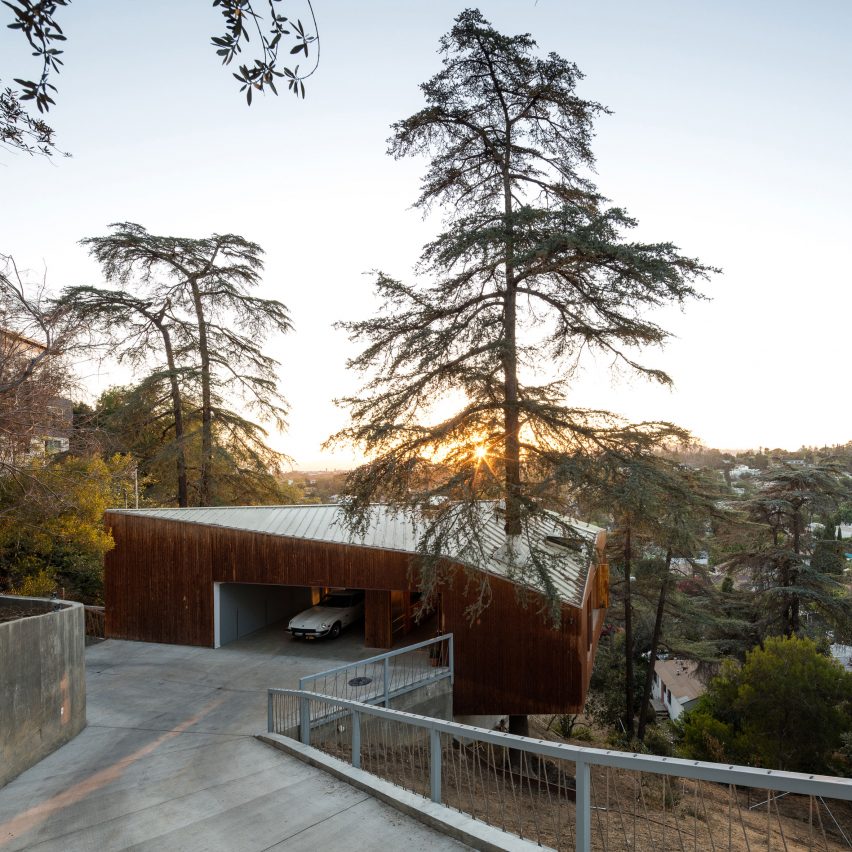
Instead of chopping down a tall tree in the middle of a Los Angeles site, American studio Anonymous Architects incorporated it into this cantilevered cedar-clad residence. Read more
Final renderings of BIG’s latest New York City project, 149 East 125th Street in East Harlem, have been revealed at the project’s groundbreaking ceremony. In contrast to original images showing a bright red facade, the undulating, rotating building will instead feature a gray exterior that Bjarke Ingels has referred to as “inspired by an elephant’s skin.”
The 11-story building will encompass a total of 275,566 square feet containing nearly 40,000 square feet of retail space and 233 studio, one-bedroom and two-bedroom rental apartments, of which 46 will be rented at affordable rates through the NYC housing lottery.
As the structure rises, the volume turns to pass over top of an existing New York DMV building. On the roof will be a communal garden and lounge area.
Inside the building, common areas will be clad in a burst of colors and patterns inspired by Ingels’ recent travels to the Caribbean, while individual units will be finished with more neutral tones to allow for personalization.
Building amenities will include a fitness center, roof garden, game room and lounge, as well as a dedicated area of the lobby exhibiting works from local artists.
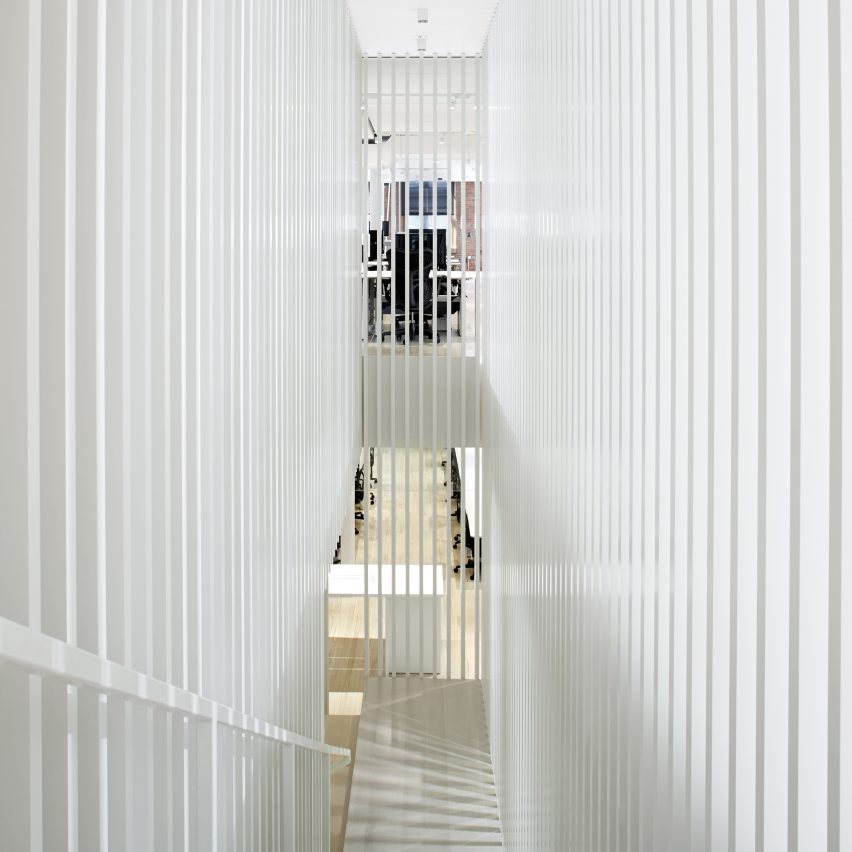
A staircase surrounded by vertical white ribs sits at the centre of tech company Square’s offices in New York, by interior designer Magdalena Keck. Read more
From the architect. The project involves an extensive refurbishment of the existing sports facilities and its extension.
Plan 0
The refurbishment required to conserve the old sports hall. The project includes two new separate buildings, and a new entrance hall that links the old and the new constructions.
The two new buildings are conceived as two regular prisms. One houses the indoor pool, its locker rooms, spa area and multipurpose rooms, and the other the Municipal Sports Department and a small auditorium.
By contrast, the entrance hall is a completely irregular distribution volume. It adapts its shape to successfully integrate new buildings with the existing one. It is cladded entirely in zinc sheet, to be read as a unitary element, with no difference between facades and roof.
The pool building prism is a glass volume on three sides, South, East and West. In summer, its lower part opens to the grassland, through guillotines windows 9 m. high. Above, the glasses are protected from the sunshade with horizontal aluminum louvers. The roof, formed by four large skylights, it can also be opened. On the North side are located the locker rooms and the spa area, with saunas, Jacuzzis, Scottish showers, cold water swimming pools, and a solarium overlooking the park. Below the pool, technical rooms (purification and air conditioning) and multi-purpose sports halls are located.
The prism which houses the offices of the Sport Department is formed on the ground floor by three volumes (auditorium, warehouse and the staircase) forming a concrete podium. Above this podium, the first office floor is solved with ventilated facades of high pressure laminated panels finished on wood on three sides. The fourth facade, facing south and with the best views of the garden, is a curtain wall protected from the sun with wooden louvers.
The project is completed with the refurbishing of the existing facilities. A new gym is located in the old swimming pool, opening one of its facades entirely to the garden. Under the gym, medical units and monitors offices replace the old technical rooms. All these rooms open to a new inner courtyard, which serves as connecting element with the new building, where also overlooks the new multipurpose rooms and the swimming pool lockers.





 Sig Nordal