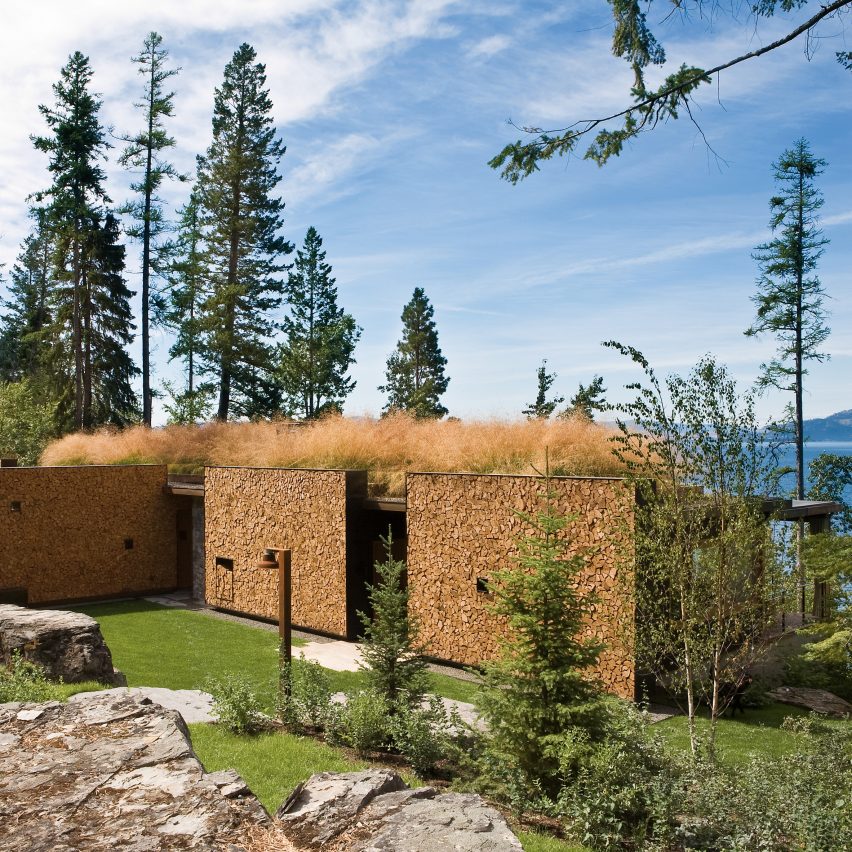
Short pieces of debarked timber are stacked to form the walls of this remote wilderness retreat, designed for an active family by US studio Andersson-Wise Architects. Read more
Short pieces of debarked timber are stacked to form the walls of this remote wilderness retreat, designed for an active family by US studio Andersson-Wise Architects. Read more

“The brief for this project was to design a beautiful addition to a heritage listed Bowral cottage – one which was private and allowed the existing cottage to appear unchanged from the street. The clients were passionate about restoration of the original parts of the building, and replacing the dysfunctional 1980’s addition to the rear of the building.
The additions were to maximise the solar-passive performance of the house, create a large entertainers kitchen in the heart of the home, allow for a new living and dining area, provide for a new sunken media room and guest accommodation. The client was keen to explore a contemporary approach to the new work, allowing for the new addition to juxtapose with the original weatherboard cottage. Most importantly, the house had to ‘work well’ from an environmental performance perspective.
The new additions have been detailed to eliminate thermal bridging, create a well insulated and airtight envelope and to maximise passive solar heat gain and natural cross ventilation. The house has been designed to capture the sunlight in winter, and to exclude it from heating up the spaces in summer. A geo-thermal heat recovery system heats the pool, floor slab and domestic hot water and 35kW of solar panels provide more electricity than the occupants are likely to use (feeding the surplus back into the grid). A charging station in the garage powers an electric vehicle.”
Product Description. Windows and doors- ThermalHEART range. ThermalHEART™ window and door systems are thermally broken to deliver improved energy efficiency for building. The thermal break in ThermalHEART™ windows and doors is created using a polyamide strip between the aluminium exterior and interior elements. The thermal break minimises the transfer of heat and cold through the aluminium window frame, giving the thermally broken aluminium window excellent insulation properties.


The Royal Institute of British Architects (RIBA) has announced the shortlist of six finalist projects in the running for the inaugural RIBA International Prize. The first RIBA Award open to any qualified architect in the world, the International Prize seeks to name the world’s “most significant and inspirational” building. Criteria for consideration include the demonstration of “visionary, innovative thinking and excellence of execution, whilst making a distinct contribution to its users and to its physical context.”
The six finalists were named from a longlist of 30 buildings, from which a further selection of 21 projects have been recognized by the jury for the RIBA Award for International Excellence. The jury has also named the winner of the RIBA International Emerging Architect prize recognizing “the achievement of architects in the earlier stages of their career who are working on global projects.”
The Grand Jury is lead by Richard Rogers and includes Billie Tsien, Kunlé Adeyemi, Philip Gumuchdjian, and Marilyn Jordan Taylor.
“Our panel of jurors have been particularly impressed by the way in which each building reacts to, resolves and assimilates into the varying geographies and contexts – from dense urban cities to a small town in the Arctic Circle,” said RIBA President Jane Duncan on the naming of the finalists. “Each project resolves the complex demands of its context with ingenuity, exceptional detail and finishing and a sensitivity to the needs of the users and communities which will inhabit these spaces.”
Arquipelago Contemporary Arts Centre (Menos é Mais) is located in The Azores, an archipelago of nine small islands in the middle of the Atlantic Ocean. Restoring the site of an 1890s sweet potato distillery, the building expertly combines restoration, reconstruction and new build, drawing on the history of the building and its distinctive black Basalt exterior to create a restrained, industrial character. Constructed over the course of three years, the process revealed a complex of cloisters and cells in the basement of the old distillery, which have been transformed to display artwork – an ancient backdrop for very contemporary use. The building has become a beacon for progress both locally and internationally, and has made a substantial impact on the local community – showing respect for its past and ambition for the future.
Heydar Aliyev Centre Baku, Azerbaijan / Zaha Hadid Architects and DiA Holding
Designed to celebrate Azerbaijan’s independence and first president Heydar Aliyev, Zaha Hadid Architects’, Heydar Aliyev Centre in Baku was completed in 2013 and offers a vibrant programme of arts, music and performance to audiences in the vaulted spaces and distinctive wave-like form that dominates the eastern aspect of the city. The building represents a break from tradition – not least in the post-Soviet landscape of Baku, and now welcomes over 1000 visitors a day as both a public social space and a cultural nucleus for the city.
The complex landscape has been brought together into a single, fluid composition which appears out of the hill. The building is distinctive not only for its scale and undulating form, but for its use of white cladding and paving, a marked departure from the traditional architecture and aesthetic of the city. The heart of the building is found in its sophisticated and welcoming central auditorium; a warm performance space whose innovative use of oak to line and sculpt the interior showcases a sophistication in both vision and joinery.
A structure that celebrates the industrial heritage of its site context in Mexico City, David Chipperfield Architects, Museo Jumex is home to the largest private collection of Latin American contemporary art in the world. Centrally located in a bustling and overcrowded city, the building offers a contemplative space in which visitors can escape the rush of the city.
A large public space is divided across three spacious levels; a glazed Piano Nobile gallery and a flexible secondary space punctuated by a single large window flooding the space with light. The top floor opens out to present the museum’s collection under a soft diffused daylight through original factory roof lights. The quality of light distinctive to Chipperfield’s practice defines the space, as does the consistent sense of quality in the materials and subtle detailing that separate public from work space. A characteristic dialogue of travertine and timber marks the Museo Jumex as a remarkable building.
Stormen Concert Hall, Theatre and Public Library, Bodø, Norway / DRDH Architects
Stormen Concert Hall and Library has created a new community focus for a small town, with two new civic buildings in Bodø, 100km inside the Arctic Circle. DRDH’s first major building commission, the scheme is expertly stitched into the existing urban fabric, playing off the link to the town centre as well as the nearby harbour and the luminous experience of the Arctic sunshine. With rigorous attention to detail, material and the user’s experience of both the space of the library building and new concert hall spaces, the architect’s design is matched with technical ambition. The concert hall houses three music venues within its structure, and is considered comparable to the New York’s Carnegie Hall as one of the best in the world for symphonic music.
The Ring of Remembrance memorial in Notre-Dame-de-Lorette near Arras commemorates the thousands who died in the region during World War I. The unification of former enemies is the strong idea that underlines AAPP’s design scheme of the ring, inscribing all 600,000 names irrespective of their nationality, creed or rank. Located on the Hill of Lorette the location has long views over the battlefields of the plain of Artois, the piece sits lightly in the landscape, rooted at one end but cantilevers out precariously as the landscape falls away, and representing the fragility of peace.
UTEC Universidad de Ingenieria y Tecnologia, Peru / Lima Grafton Architects and Shell Arquitectos
The UTEC in Lima is a new faculty for a 50 year old engineering university to enable young Peruvians to gain engineering qualifications and to encourage social mobility. This powerful statement of a building symbolises a bold and positive future for Peru, and draws on the temperate climate of the city and cultural environment. Grafton Architects have created an innovative solution to the architectural program in the design of a vertical concrete campus, with open ended spaces of circulation interlinked with a series of suspended platforms that flow in between the structural frame, offering a balance between enclosed spaces and permeability to the exterior.
Selected from the award longlist, these 21 projects have been selected as a testament to the high quality of nominated projects:
In addition, Rural Urban Framework has been named as the RIBA International Emerging Architect for their ambitious plan for Angdong Hospital in Baojing County, China.
The buildings will now be visited by the Grand Jury to evaluate their candidacy. The winner will be announced on Thursday 24 November 2016.
News via RIBA.

New York’s Museum of Modern Art has announced the addition of the original 176 emoji set to its collection of “humble masterpieces”. Read more

La Bruyère high school is composed of four buildings erected at different times. The school canteen was achieved in 1980 as an extension of the historical building constructed at the end of the nineteenth century. As the high school is built on a steep slope site, the canteen is half buried and enlightened only by zenithal openings.
The purpose of the operation is the kitchen’s upgrading, the creation of a second line of distribution to respond to an increase of requests and the refurbishment of the teachers and students’ refectory. The school restaurant takes place in a 70m long, 14m wide and 6m high volume divided into three parts : the kitchen East, the refectory West and in the center the distribution line, the laundry and access to garden by the roof terrace.
The main asset of the project is the realization of a mezzanine at the center of the volume: first it allows spreading the flows coming from the roof of the refectory on both lines of distribution and avoiding crossing flows out of the restaurant, while ensuring continuity between the kitchen and the canteen for the staff. Afterwards, the mezzanine provides an additional relaxing and meeting space, offering a stunning view on the refectory throughout large windows.
The project stands out for the implementation of two wooden parts, in birch precisely, defining the atmosphere and different spaces: on one hand, the balloon frame false ceiling that connects the refectory with the mezzanine and on another hand, the alcove which forms the teachers’ dining hall.
These two elements aim to qualify each space in a different way while providing a reading of the existing volume the widest and most generous way possible. This is why, the teachers’ dining room was designed as a cocoon within the students’ refectory, a cocoon formed by a two meter high furniture both visual barrier and seat. Meanwhile, the false ceiling is lowered as if it was drawn above the alcove, providing more privacy to this space and improving the acoustic features.
The game between the two components, ceiling and alcove, offers an alternative to the traditional partitioning by proposing a richer and more subtle relationship between the two refectories, redefining thereby the concepts of intimacy and communication.
The expression of raw materials – colorless varnished wood, polished concrete floor et galvanized railings, the care giver to their implementation as well as the visibility of the structure and of the technical bodies express the particular attention to the raw material, the one that was already there, the one used to build and which is too often hidden from public view. The ceiling is like a veil that shows what is going on behind the scenes.
Product Description. The principal material of this project is the birch plywood, used for the false ceiling and the alcove of the teacher’s refectory. The digital die-cutting of the birch plywood panels made it possible to achieve in an economic way the complex geometry of these two elements.

Apple has unveiled a new version of their professional-level portable computer, the MacBook Pro, making steps towards defining the laptop as a tool for those in the creative industries. With a full 500 days since these devices were last refreshed by the company, the standout feature of this latest incarnation is a new, application-specific Touch Bar – a touch-sensitive display band at the top of the keyboard which becomes an “intuitive” part of the user interface, which also includes a Touch ID fingerprint sensor. Oh – and there’s still a headphone jack!
The laptop’s display is now 67% brighter than its predecessor, with a 67% higher contrast ratio and 25% more visible colors. The computer is also 130% faster in rendering 3D graphics, and is able to be connected to multiple 5K displays making the device ideal for CAD, modeling, and high-quality video editing. But perhaps the most useful update for architects is the touchbar’s integration with many designer’s favorite tool: Adobe Photoshop.
The display and interactivity of the new Touch Bar adjusts to display only the controls needed for a particular task, such as using the Brush or Mask tools – and even provides a unique way to pick colors. You can also use it for simple tasks, such as resizing photos; “it’s a two-hand way of working. Hands and eyes work in concert,” a representative from Adobe said. According to Adobe, this new version of Photoshop will be in the hands of customers before the end of the year.

Kodak has rebranded for the first time in 10 years, ditching its typographic logo for a red and yellow version of the marque it used during the 1970s and 80s. Read more
Shopping online is a convenient way to buy holiday gifts and other things. Get the best prices and protect against online shopping problems and fraud with these tips.

 Sig Nordal