Margaret Sanger was arrested 100 years ago this week for having opened her New York City birth control clinic, America’s first. The illegal clinic was by no means covert, Sanger herself having defiantly alerted city authorities before opening her doors. After monitoring the situation for ten days, during which some 500 women had lined up to learn, as Sanger put it, how “not to have any more children than their health could stand or their husbands could support,” the police moved in on October 26, 1916, charging her with distributing obscene material.
Birth control was a highly debated topic in the early decades of the century, and Sanger was far from its only advocate. In 1915 the activist Mary Ware Dennett had founded the National Birth Control League, and the cause was widely promoted on the lecture circuits. But Sanger had a provocative personality, experience as a maternity nurse, and, says Jean H. Baker in her biography Margaret Sanger, a determination to take the issue to the streets:
Sanger meant her clinics to demonstrate a bold new phase of educating poor women about birth control beyond speeches, meetings and lobbying. Their establishment would mark the first free health clinics for women in the United States, an event, though largely forgotten today, that Sanger properly recognized as “of social significance in the lives of American womanhood.” Additionally, a Margaret Sanger birth control clinic, where self-help techniques were actually demonstrated, would raise her to the national standard bearer the movement required.
Sanger made a point of setting up her first clinic in a poor section of Brooklyn and of making clear, in pamphlets distributed in Yiddish and Italian as well as English, that birth control was a better choice than poverty or abortion:
MOTHERS!
Can you afford to have a large family?
Do you want any more children?
If not, why do you have them?
DO NOT KILL, DO NOT TAKE LIFE, BUT PREVENT
Safe, Harmless Information can be obtained at
46 AMBOY STREET.
Recognizing that the birth control methods she could make available in 1916 were largely inconvenient or unreliable, Sanger spent the rest of her life in search of a better option. Jonathan Eig’s The Birth of the Pill begins with the winter evening in 1950 when the seventy-one-year-old Sanger took her hopes for an oral form of contraception to Gregory Goodwin Pincus, a biologist whose work on reproduction had attracted as much controversy as Sanger’s. He also shared, says Eig, her driven and defiant personality:
He looked like a cross between Albert Einstein and Groucho Marx. He would speed into a room, working a Viceroy between his yellowed fingers, and people would huddle close to hear what he had to say. He wasn’t famous. He owned no scientific prizes. No world-changing inventions were filed under his name. In fact, for a long stretch of his career he had been an outcast from the scientific establishment, rejected as a radical by Harvard, humiliated in the press, and left with no choice but to conduct his varied and oftentimes controversial experiments in a converted garage.
Sanger always insisted that her campaign was all about giving women options. In Making Babies, the award-winning Irish author Anne Enright humorously describes exercising hers by, as her subtitle puts it, “Stumbling into Motherhood.” In the passage below, from somewhere in the fourth month aboard the postpartum rollercoaster, both mother and child pause for a mutual look around:
The baby is becoming herself. Every day she is more present to us. A personality rises to the surface of her face, like a slowly developing Polaroid. She frowns for the first time, and it looks quite comical — the deliberate, frowny nature of her frown . . . She gets rounder. Her features begin to look strangely confined, like a too-small mask in the middle of her big, round face.
It is now that babies look like Queen Victoria or Winston Churchill, or anyone fat, and British, and in charge. She is most imperious when her father picks her up. She sits in his arms and looks over at me as if to say, So who are you?
For the International Edition of the CEMEX Building Award 2016, 62 finalists from 20 different countries in North America, South America, Asia and Africa will compete in 5 main categories and and 4 special prize categories. The award, given by CEMEX— the Mexican multinational building materials company—recognizes the best architecture and construction projects that highlight innovation aesthetic and constructive uses of concrete.
The projects that are now set to compete at a global level range from a cultural center in Poland to a school and Spain and even a dam in the US. See this year’s finalists below and see the previous winners here.
RESIDENTIAL HOUSING
Los Samanes House / Arq. Carlos Campuzano Castelló Anapoima, Colombia
Los Samanes House / Arq. Carlos Campuzano Castelló. Anapoima, Colombia. Image Courtesy of CEMEX Building Award
Vistas a la Colina / Grupo Leumi San José, Costa Rica
Technical Institute for Training and Productivity / Departamento de Diseño e Infraestructura del Instituto Técnico de Capacitación y Productividad, Ing. David Lepe Cervantes Salamá, Guatemala
Alternative Routes El Quimbo Hydroelectric / Consorcio Obras Quimbo (CSS Constructores S.A., CASS Constructores &CIA S.C.A., Sonacol S.A.S.) Garzón, Colombia
Alternative Routes El Quimbo Hydroelectric / Consorcio Obras Quimbo (CSS Constructores S.A., CASS Constructores &CIA S.C.A., Sonacol S.A.S.). Garzón, Colombia. Image Courtesy of CEMEX Building Award
Bridge over Tárcoles River / Camacho & Mora Alajuela, Costa Rica
New Assiut Barrage & Hydro-power Plant. Assiut, Egypt
New Assiut Barrage & Hydro-power Plant. Assiut, Egypt. Image Courtesy of CEMEX Building Award
Dubai International Airport, Concourse D / Dar Al Handasah Dubai, UAE
Dubai International Airport, Concourse D / Dar Al Handasah. Dubai, UAE. Image Courtesy of CEMEX Building Award
Technical Institute for Training and Productivity / Departamento de Diseño e Infraestructura del Instituto Técnico de Capacitación y Productividad, Ing. David Lepe Cervantes
Comprehensive Renovation of the Streets in Colonial City / Arquitectura, Urbanismo y Cooperación S.L. Santo Domingo, República Dominicana
Comprehensive Renovation of the Streets in Colonial City / Arquitectura, Urbanismo y Cooperación S.L.. Santo Domingo, República Dominicana. Image Courtesy of CEMEX Building Award
Deca Homes Resort and Residences / 8990 Housing Development Corporation Davao, Filipinas
Deca Homes Resort and Residences / 8990 Housing Development Corporation Davao, Filipinas. Image Courtesy of CEMEX Building Award
Technical Institute for Training and Productivity / Departamento de Diseño e Infraestructura del Instituto Técnico de Capacitación y Productividad, Ing. David Lepe Cervantes Salamá, Guatemala
From the architect. This project is a renovation and extension to an old 1880’s Victorian brick house in an old suburb of Melbourne Australia. The new building at the rear of the house consists mainly of one large L shaped open plan kitchen, living and dining area with large glass doors across the rear verandah porch, as well as other utilitarian rooms.
Floor Plan
The predominant materials used are white bricks, which continue internally on the fireplace reflecting the outside within, as well as a cedar timber verandah and blackbutt hardwood floorboards. The external skillion roof forms dominate the internal spaces and include highlight windows in the voids, and are a nod to the varied mix of industrial and residential building forms and garages and outhouses in the immediate area.
The interiors are largely subdued and done in a simple natural white palette, set off with a plain grey concrete credenza, honey coloured timbers and a smoky grey tint mirror splashback. Suspended pendant concrete light fittings also add to the mix.
Section
The old front part of the house has also been renovated and upgraded throughout including new bathrooms and side windows. Some of the old fruit trees were retained and landscaped around with grass to suit the new backyard layout.
Product Description.The external bricks I used were Austral bricks from the La Paloma range in a white “Miro” colour principally to match the existing rendered brick house which is painted off white, and to keep the new work light and clean and to set it off against the green grass.
– Do you know who I’m presenting the conference with this afternoon? – Of course I do. Paulo, one of the best architects in Brazil. – For me, the best worldwide.
I heard by chance this conversation between Eduardo Souto de Moura, 2011 Pritzker Prize, and Joanna Helm, our Content Director from ArchDaily Brazil, in the gardens of Ibirapuera Park, as I waited to enter the auditorium for the activities of X Ibero-American Architecture and Urbanism Biennial (X BIAU). In that same afternoon, a small crowd occupied all the seats to watch and hear Souto de Moura and Paulo Mendes da Rocha sharing the stage.
Paulo Mendes da Rocha turns 88 today and 2016 has been what one can call an enviable year for him, at least in his professional life. This year alone, he was awarded three major international architecture prizes: the Golden Lion for Lifetime Achievement of La Biennale di Venezia, The Praemium Imperiale of the Japan Art Association, and the RIBA Gold Medal 2017. Besides that (as if it wasn’t enough), Paulo Mendes da Rocha has already been awarded the Lifetime Achievement Prize in the first Ibero-American Architecture and Urbanism Biennial in 1998, the Mies van der Rohe Award for Latin-American Architecture in 1999 (for his project for the Brazilian Sculpture Museum – MuBE) and 2000 (a retrofit project for the Pinacoteca de São Paulo), and, perhaps, the most important, the Pritzker Architecture Prize in 2006.
Although Paulo’s shelf of trophies and medals is beginning to run out of space, his daily life has seen little change. The same office, the same room, the same clothes even his humanistic ideas have not changed. In several interviews, that he has participated in the last few years we can clearly see his ideals of architecture and city. “Nonsense”, “absurd” and “aimlessness” are often the words related to the importance given to cars in the public space and submission of urban space to capital, unfortunate aspects of almost every contemporary city and specially aggressive in São Paulo, a city where we can find some of Mendes da Rocha’s most famous works.
Rambling at length in several interviews, Paulo is emphatic when he says “we know what we don’t want to do.” Sixty-two years on the road of architecture may be enough for him to be sure about what he does not want, or what he must avoid with his architecture. But, what does Paulo want, after all? Open to unpredictability and singularities of context, he does not respond accurately.
But he does give hints. Hints that can be found in the series of interviews, articles and news below on Paulo Mendes da Rocha, our Golden Lion.
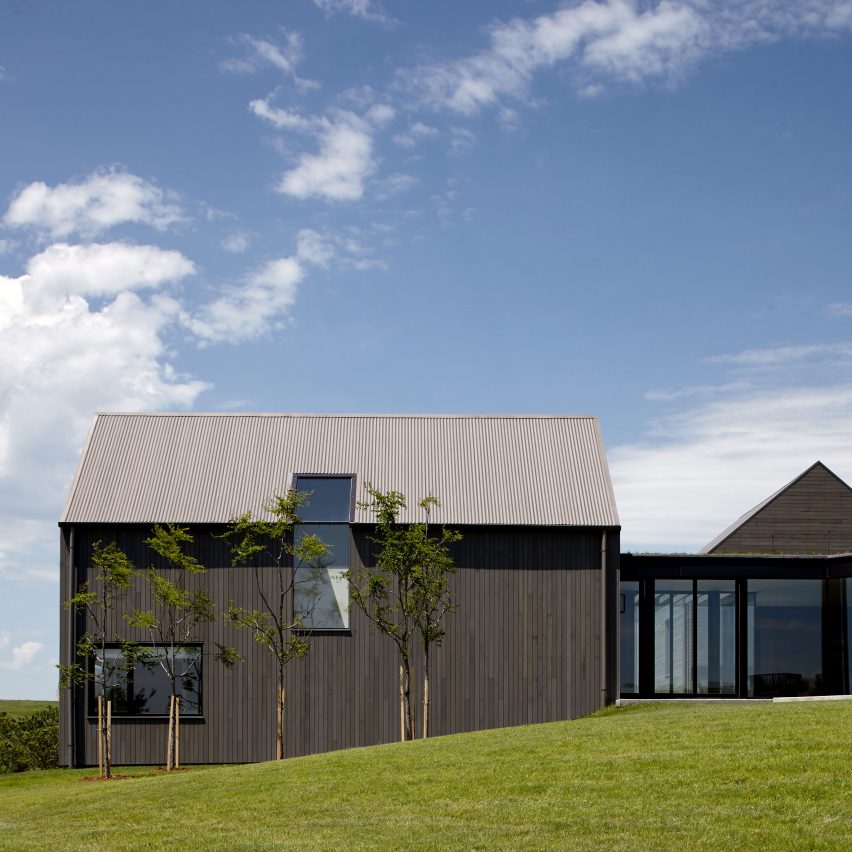
American studio El Dorado took cues from traditional farmhouses to design a rural dwelling composed of cedar-clad volumes topped with pitched metal roofs. Read more
The first stage of Columbia University’s new Manhattanville Campus, consisting of two buildings by Renzo Piano Building Workshop, is nearly complete, with a move-in and grand opening slated for spring 2017.
The Piano-designed Jerome L Greene Science Center and Lenfest Center for the Arts are the first two buildings to be completed within the larger campus masterplan, conceived by Piano in collaboration with SOM, that will eventually encompass nearly 19-acres between 125th and 133rd streets in northwestern Manhattan.
The 450,000-square-foot Science Center constitutes the single largest building ever constructed by Columbia University, and contains open-plan laboratory areas and interactive spaces, encircling a core of meeting and collaborative spaces. An abundance of natural light penetrates deep into the building via double-skin glass walls, which have been designed to eliminate noise from nearby subway and highway bridges.
“I’m suspicious about metaphors,” remarked Piano. “But if it is a palace, it is a palace of light.”
At ground level, a community wellness center, education lab, exhibition area, retail and restaurants will invite the public to use the building as well.
Next door, the 60,000-square-foot Lenfest Center for the Arts will provide flexible space for a variety of artistic interventions, including more 4,000 square feet of column-free exhibition space, a 150-seat theater for film and digital projection, an adaptable performance space for experimental productions and a 4,300-square-foot lecture and presentation space. The four main program elements feature double-height spaces, with support services and offices located on the mezzanine levels. Unique exterior “column-like structures” will distribute loads to the outside of the building, allowing interior spaces to remain open.
The 8-story building has been clad primarily in painted aluminum, with large expanses of double-height windows strategically located to provide performance areas with targeted natural light. The ground floor, however, has been fitted with a completely transparent custom-glazed curtain wall to promote a connection to the campus and provide views to activities within.
The next phase of the campus masterplan consists of a third building by Renzo Piano Building Workshop, the 56,000-square-foot University Forum and Academic Conference Center, which is currently under construction and expected to be completed by 2018. Soon to begin construction is the a new home for the Columbia Business School, designed by Diller Scofidio+Renfro in collaboration with FXFowle around a one-acre publicly accessible green space.
Future phases will include the adaptive reuse of several former industrial buildings including an auto finishing plant for Studebaker Motors and a Sheffield Farms dairy facility. All buildings on the campus will eventually be connected through an underground system leading to a 75,000-square-foot energy plant, which will provide all buildings with electricity, chilled water and high-pressure steam.
“Underground, there is continuity among the various buildings,” said Piano, “but above ground the buildings belong to both the campus and the city.”



 Sig Nordal