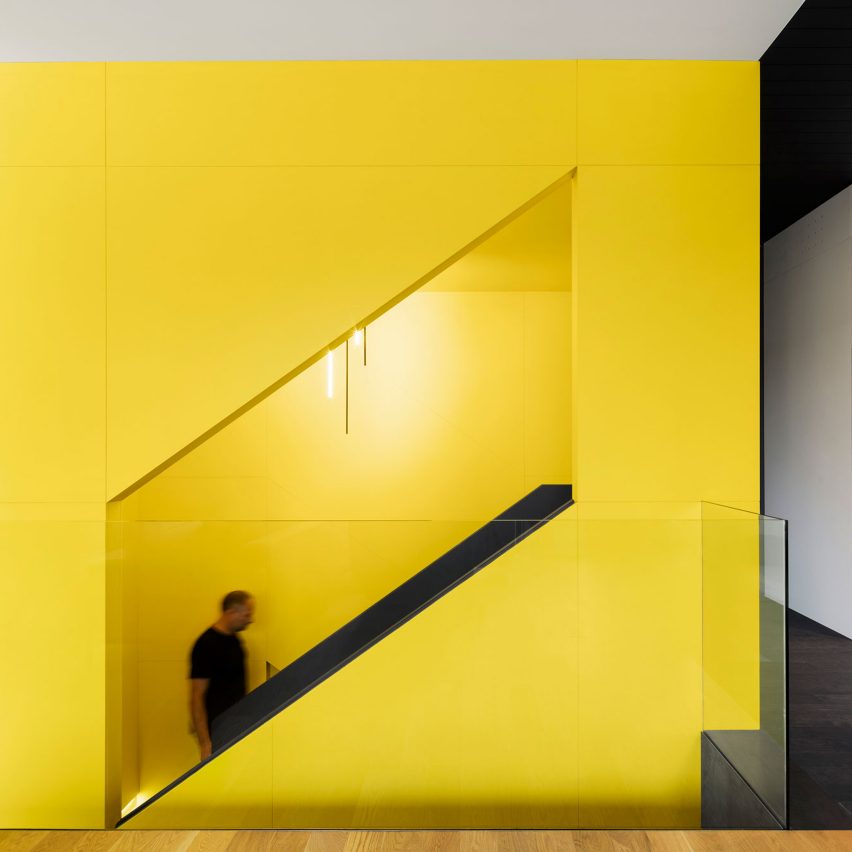
Canadian studio Naturehumaine has transformed a 1930s brick building into a contemporary home featuring a sculptural stairway that brings a “vibrant tone to the project”. Read more
The ancient architype of The Castle as an Outpost or Fort is rarely articulated in the modern world. This New Zealand farmhouse project explores this typology by being both commanding and defensive in one form.
There is no modification to the landscape other than the sentry of the form itself. Wind and sea spray thunders up from the ocean some 60 metres below and the form wraps around to protect a circulation courtyard from the rugged and harsh coastal environment. The resulting structure defends that same environment.
A simple strategy of formal juxtapositions such as converging and expanding walls create varied spatial experiences throughout the form. An entry lobby is guarded by a portcullis to keep the sheep out and sections of the perimeter wall also pivot open unexpectedly.
The home is arranged as a series of spaces linked by way of the circulation courtyard and secret doors, discovering forms and shapes seemingly arbitrarily positioned, yet suggesting a history; a sense of transcended time. Long views across the protected courtyard end on the all persuasive horizon, moving toward the edges of the structure, the ocean and sky open up above and below, until the view’s full breadth is revealed.
New York’s Architecture Research Office (ARO) has been selected to lead in the renovation and master planning of the Rothko Chapel in Houston, Texas. The project aims to modernize and improve the renowned structure, which houses 14 monumental paintings by Mark Rothko in an interior space designed to meet the artist’s precise specifications, and its surrounding plaza and reflecting pool. The original building was largely designed by Rothko himself, with consult from a trio of architects including Philip Johnson.
“We are honored to be entrusted with work at the Rothko Chapel,” says Stephen Cassell, partner at ARO. “For more than 40 years, the Chapel has been a deeply moving experience of personal contemplation that furthers the Chapel’s mission of social action. We feel enormous responsibility toward its future.”
The firm will be tasked with the renovation of the Chapel’s entry vestibule and skylight, and will collaborate with lighting designer George Sexton to make improvements to the interior light baffle and electric lighting. The project scope will also include updating the building’s HVAC system and acoustics. All changes will be made with extreme sensitivity to Rothko’s original intent for the space.
Outside, a new master plan will include improvements to the plaza and reflecting pool containing Barnett Newman’s sculpture “Broken Obelisk,” as well as provide additional space for the public and staff. New pathways and visual corridors will connect the complex to its two neighboring institutions, the Menil Collection (master planned by David Chipperfield and home to two buildings by Renzo Piano) and University of St. Thomas, both of which are currently involved in ambitious campus redesigns. The project is hoped to raise visibility for the Chapel and to accommodate future increases in foot traffic, while allowing the site to continue functioning as a quiet sanctuary.
ARO has experience renovating the environments of minimalist artists: in 2013, the firm completed the restoration of 101 Spring Street, a 19th century cast-iron SoHo warehouse that served as the home and studio of Donald Judd until his death in 1994. The project included extensive renovation and refurbishment of exterior and interior finishes to update the building with minimal visual intrusion.