Eric Parry Architects’ 72-Story Skyscraper Receives Approval from City of London


© DBOX for Eric Parry Architects

© DBOX for Eric Parry Architects

Eric Parry Architects’ 1 Undershaft has been granted planning permission from the City of London Corporation’s Planning Committee, which will allow the 73-story tower to become the tallest building in the London Financial District and the second tallest building in the UK, behind only The Shard.


© DBOX for Eric Parry Architects


© DBOX for Eric Parry Architects


© DBOX for Eric Parry Architects


© DBOX for Eric Parry Architects


© DBOX for Eric Parry Architects

© DBOX for Eric Parry Architects

The 295 meter (967 foot) tall structure will house over 130,000 square meters (1,400,000 square feet) of Grade A office space and 1,800 square meters (19,3875 square feet) of retail and restaurant space accessible from an open public square beneath the building.


© DBOX for Eric Parry Architects

© DBOX for Eric Parry Architects

At the top of the building, a free public viewing gallery, the tallest free observation deck in the UK, will provide views of the city and an education center with two classrooms. A bank of dedicated elevators will transport visitors to the deck, 7 days a week.


© DBOX for Eric Parry Architects

© DBOX for Eric Parry Architects

The project (already being dubbed “The Trellis”) will join the group of iconic towers that make up the City of London’s distinctive skyline, including the Leadenhall Building by Rogers Stirk Harbour + Partners (The Cheesegrater), Foster + Partners’ 30 St Mary Axe (The Gherkin), and PLP Architecture’s upcoming 22 Bishopsgate.


© DBOX for Eric Parry Architects

© DBOX for Eric Parry Architects

Learn more about the project, here.

News via Eric Parry Architects.

http://ift.tt/2gGz5qP

Clifton Hill Clinic / Cloud Architectiure Studio


© Jeremy Wright

© Jeremy Wright


© Jeremy Wright


© Jeremy Wright


© Jeremy Wright


© Jeremy Wright

  • Builders: Ascot Group

© Jeremy Wright

© Jeremy Wright

From the architect. The Clifton Hill Clinic challenges the design norm prevalent in local medical practices. The 1901 former residential building has been transformed into a 9 room contemporary facility that will become an important social hub for the local community. 


© Jeremy Wright

© Jeremy Wright

Inspired by a visit to the Royal Children’s Hospital in Melbourne the client, a local GP challenged us to deliver a cutting edge conversion on a very tight budget. We cut an internal corridor through the center of the site and fed of that space. This allowed us to create colour and light that is typified by the stair light well and courtyard spaces. 


Section

Section

Section

Section

The building has created considerable local interest since its completion, its light and airy feel very different to the medical practices the locals visit.


© Jeremy Wright

© Jeremy Wright

Product Description. The client for the project required a tough and seemingly impenetrable exterior cladding to the rearof the property, worried about potential break-ins We selected VM Zinc to provide this exterior but also for its beautiful aesthetic properties. 


© Jeremy Wright

© Jeremy Wright

http://ift.tt/2fO8r0A

Yellowstone National Park – Wyoming – USA (by Wilson Hui)

Yellowstone National Park – Wyoming – USA (by Wilson Hui)

New Permanent Garden / Gabriel Orozco


© Andy Stagg

© Andy Stagg


© Andy Stagg


© Andy Stagg


© Andy Stagg


Steps

  • Designer: Gabriel Orozco
  • Location: Pitzhanger Manor House & Gallery, Walpole Park, Mattock Ln, London W5 5EQ, UK
  • Collaborators: 6a architects, horticulturists at the Royal Botanic Gardens, Kew.
  • Project Year: 2016
  • Photographs: Andy Stagg

© Andy Stagg

© Andy Stagg

Created over the past two years by the artist, with support from 6aarchitects and horticulturists at the Royal Botanic Gardens, Kew, this extraordinary garden will be open to the public every weekend and used by invited groups during the week. It introduces a new, planted entrance to the garden for residents of Sceaux Gardens housing estate, where the SLG has run art programmes for a number of years. The opening of the garden marks a pivotal moment in the SLG’s history of working with artists on ambitious and challenging projects which aim to inspire, attract and connect with large and diverse audiences. 


Plan

Plan

Establishing a tension between symmetry and assymetry, a geometry of intertwining circles intricately outlined in brick dimensioned york stone subtly maps a series of discreet spaces or notional rooms. Each is lent its own distinctive character through slight shifts in form or by being at different levels, variously planted or featuring seating, a sink, water butt or welcome bowl built up from the york stone. 


© Andy Stagg

© Andy Stagg

The various levels and spaces can be used interchangeably for sitting, eating, playing or showing work by other artists, reflecting the multiple activities the garden will be used for. The choice of materials was drawn from the language of the gallery’s Victorian building and includes bricks from the newly opened up rear facade. Playing on the idea of an urban ruin, the garden will gradually evolve to become rambling and overgrown with different grasses, low level creepers and fragrant plants chosen with expert advice from horticulturists at the Royal Botanic Gardens, Kew.


Plan

Plan

Plan

Plan

The invitation to create a garden at the SLG as a permanent art work presented a unique opportunity to extend my work into new territory. From my first visit I was impressed by the SLG’s commitment to its local community and neighbourhood and intrigued by the relationship between the garden space and its different audiences, and the idea of creating something which could provide an inspiring platform for all of them. I started to think about various geometries emerging from the architecture surrounding the space and how they might be re-integrated into it as the basis of a design. It has been a fascinating process working directly with the gallery, architects and horticulturalists to develop the plans for the work which I am excited to see become a reality.

http://ift.tt/2g2TjtM

Downpour by Kevin.Grace No wives got wet in the making of this…

Downpour by Kevin.Grace No wives got wet in the making of this photo !
Seljalandsfoss, Iceland http://flic.kr/p/gFNkVQ

http://ift.tt/2fNG1nh

North Yorkshire, Englandphoto via lauren

North Yorkshire, England

photo via lauren

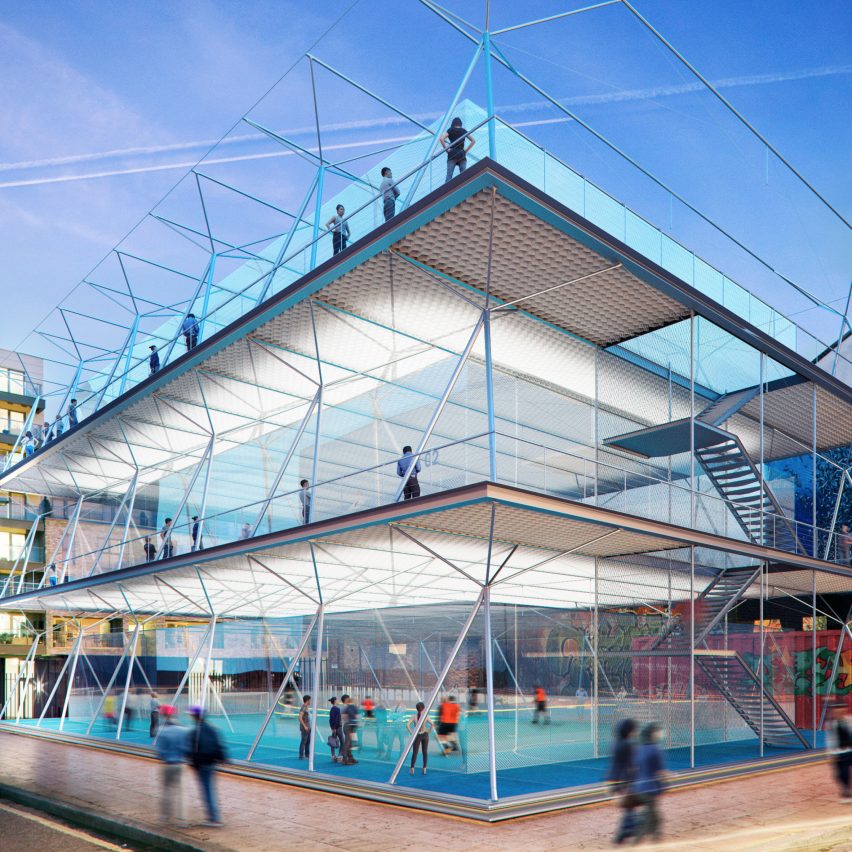
Amanda Levete’s firm proposes multi-storey football pitches for central London

Pitch/Pitch by AL_A

Stackable football pitches could be erected on disused or temporarily empty plots across London, according to Amanda Levete and her London-based studio AL_A. Read more

http://ift.tt/2fIiil5

Calatrava’s St. Nicholas National Shrine at the World Trade Center Tops Out


via Saint Nicholas National Shrine at the World Trade Center

via Saint Nicholas National Shrine at the World Trade Center

The Santiago Calatrava-designed St. Nicholas National Shrine at the World Trade Center has topped out, and capped with a temporary, six-foot-tall cross.

The Byzantine-styled structure was envisioned by Calatrava in 2013 as a non-denominational spiritual center to replace the original St. Nicholas Greek Orthodox Church, located at 155 Cedar Street, which was destroyed on 9/11.

Now, the 40 structural pieces of the ribbed dome have been set into place, matching the number in the dome of Hagia Sophia. Foundation work on the project began just over a year ago.

Located around the corner from Calatrava’s “Oculus” at the WTC Transportation Hub, the church is being constructed at a cost of $40 million, raised completely from private donors. The project is estimated to complete in early 2018, at which time, the permanent cross will be lifted into place.

http://ift.tt/2gFYPUx

http://ift.tt/2gSwFsb

http://ift.tt/2gFWwR5

http://ift.tt/2gSC5U0

News via The New York Times. H/T Curbed NY.

Calatrava Reveals Design for Church on 9/11 Memorial Site
//cdn.embedly.com/widgets/platform.js

Video: Santiago Calatrava On His Design For Ground Zero’s Only Non-Secular Building
//cdn.embedly.com/widgets/platform.js

http://ift.tt/2gSzt8M

Gamla Villan / Mer Arkkitehdit


© Marc Goodwin

© Marc Goodwin


© Marc Goodwin


© Marc Goodwin


© Marc Goodwin


© Marc Goodwin

  • Architects: Mer Arkkitehdit
  • Location: Hanko, Finland
  • Architect In Charge: Paula Leiwo
  • Area: 120.0 m2
  • Project Year: 2016
  • Photographs: Marc Goodwin
  • Carpenter: Ossi Eronen
  • Structural Engineer: Ingenjörsbyrå Anders Westerlund Oy

© Marc Goodwin

© Marc Goodwin

“Gamla Villan” was designed to connect with unique history of the villa district built between 1879 and 1939. During this period a famous spa with celebrity guests operated in Hanko. Most of the old villas have been preserved with their grand towers, verandas, balconies and charming atmosphere still intact. The aim was to create a modern house with a touch of historic Hanko. 


© Marc Goodwin

© Marc Goodwin

Floor Plan

Floor Plan

© Marc Goodwin

© Marc Goodwin

The house sits on a quiet and sheltered meadow in Hanko, Finland. Oak and apple trees combine with a view across the meadow to the sea to provide coordinates which situate the house in its surroundings.


© Marc Goodwin

© Marc Goodwin

Several steps were taken to increase volume and create a sense of dignity in keeping with a villa in this area. The cold storage / guest room area was integrated into the main space. The height of the house was emphasized which also gave possibilities to play with the loft space.


Section

Section

The entrance facade to the street with systematic narrow windows is restrained and calm. The roof is pitched, but over the main living space it is turned – origami-like – to face the garden and the sea. As a result the garden comes as a surprise with its groin vault structure. The high landscape window creates an illusion of a space bigger than its area. Through the loggia in front of the glass wall one moves gradually from the living room outside to the terrace.


© Marc Goodwin

© Marc Goodwin

http://ift.tt/2fIyxPi