The Aggregate Architectural History Collaborative has organized a collection of essays, entitled The Destruction of Cultural Heritage: From Napoléon to ISIS, which examines several centuries of the demolition of monuments in the Middle East. With world events like ISIS and the protection of architectural heritage growing to be more and more topical, this collection is a useful tool in considering the role of violence, how ancient architecture is perceived as a cultural entity, what role the media has to play, and beyond.
In the essay collection, prominent scholars in the field discuss the above issues and more in the hope of expanding readers’ frames of reference concerning the nuanced issue of threatened monuments. For example, the introductory essay of the series delves into the historic destruction of cultural heritage, as well as changing motivations for destruction, and the use of documentary imagery to accentuate violence and evoke horror.
This and other essays go on to discuss various views on the subject, including the role of museums in cultural destruction, how Islamic culture is perceived abroad, how cultural damage affects local citizens, whether buildings deserve the same protections as people, Napoleonic forms of looting, and how the structure behind war can be influenced to prevent destruction.
The client for this project was SU’s Facilities Management,with the end user being SU’s Faculty of Medicine. The brief called for two 450 seater auditoriums, with break out areas. The budget was tight, the program fast-tracked and siting crucial.
This building had to be located close to the existing Teaching Hub, while not affecting campus parking & landscaping. Of the three potential sites identified, this one was selected for its ability to comply with the above prerequisites, while offering more.
By ‘docking’ into the Teaching Hub, with auditoriums straddling the axis, the opportunity arose to create a new iconic entrance. This also reinforced the axis, linking the Student Union to the Teaching Hub, bringing it indoors, transforming the row of trees into columns.
Ground Floor Plan
Scale & Massing were important urban design considerations. A low profile was maintained, so to not block a visual connection to the Teaching Hub building behind it. Even so, ± 4,5m internal ceiling heights were maintained appropriately-scaled to internal public space.
The Tygerberg campus lacked a focal outdoor space, as in UCT’s Jameson steps. These new entrance steps were thus designed to establish symbolic interface. The platforms out of which steps were carved, also serve as seats, while also having planters for trees.
The low profile also gave the building good human scale. Straddling the 2 auditoriums over an axis,created the opportunity for a looser composition of solids. These were fronted by a biomorphic break out area, its asymmetry held together by the axis cutting through it.
The West-facing, glazed ‘fish bowl’, break-out area presented its own difficulties, which in turn, triggered design solutions. Firstly was the need for precise sun control measures. Secondly the quest to also capture good outward views to the campus gardens.
A layer of vertical sun control fins was thus added to the West elevation, manufactured from Hulabond sandwich panels, perforated with stylized DNA patterns. The patterns & signage were designed in collaboration with renowned graphic designer, Robin Lancaster.
Considerable effort went into auditorium design – size, shape, raking, seating, finishes, lighting & services. The faceted plan was found to be efficient for sight-lines, acoustics & distance from lecturer, while strict lines of geometry where imposed on services, for visual order.
A complex arrangement of communication, climate control, power, lighting, audio visual, acoustic & fire detection services were incorporated. The consultant team was managed by a high level of coordination, to achieve functionally efficient, visually uncluttered interiors.
The most significant material used in the project is that of the Hulabond aluminum screens.
Part of the client’s vision was to have break-way spaces from the main auditorium that would have a visual connection with the campus surroundings. Due to the orientation of the new building with relation to the old, a clear, unshaded Western façade was not possible. In response to this climatic barrier, the architects decided to introduce vertical sunscreens that were pivoted in such a way that the sun would be blocked out, and the view only partially obscured.
Using aluminum made sense for various reasons. The product is light weight which made the manufacturing of these large fins easy. Being in a coastal area the corrosive properties and durability of the material is also advantages. From an aesthetic point of view, aluminum has a clean and contemporary appearance and could be punctured with a DNA pattern to let in additional filtered light.
In an exclusive half-hour episode focusing on the life and legacy of Jane Jacobs, “one of the most influential urban thinkers and city activists of our time.” Featuring interviews with a carefully selected range of city planners, historians and activists, alongside recordings of Jacobs herself, this special episode of Monocle 24’s The Urbanist examines why Jacobs was—and remains—so influential when considering the contemporary city.
“Micro living” might be all the rage in some cities right now, but that doesn’t mean anyone’s prepared to live in a tiny space if they don’t have the kind of furniture, style, and organizational skill that goes with making a very small apartment into a functioning home. In big cities like London, England, however, families are often left with no choice if they want to live right in the..
An indoor basketball court takes the place of an entrance hall in this home in eastern Japan designed by Koizumi Sekkei. Rooms surround the wooden court, but are protected from stray balls by sliding doors and metal grilles.
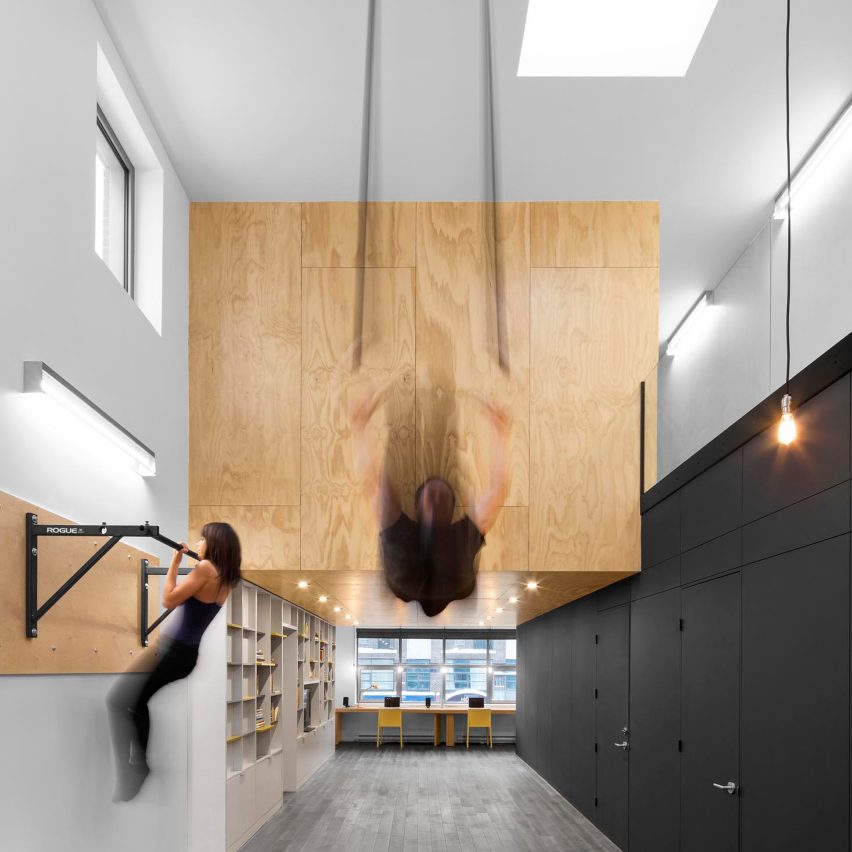
A pair of gymnast’s rings dangle from the ceiling of this Montreal home renovated by Naturehumaine to create a workout space for the client’s athletic children. The apparatus is installed in a double-height atrium and overlooked from a gallery above.
Punch bags take the place of keyboard keys in this conceptual computer by Ines Kaag and Desiree Heiss – the perfect home office for a fitness fiend. The designers developed the Workout Computer to “blur the boundaries between working in the office and working out”.
Gymnast’s hoops allow guests at this Amsterdam hotel an impromptu workout. Concrete styled this suite and 132 others in the same block as micro apartments, giving guests all the amenities they might expect at home.
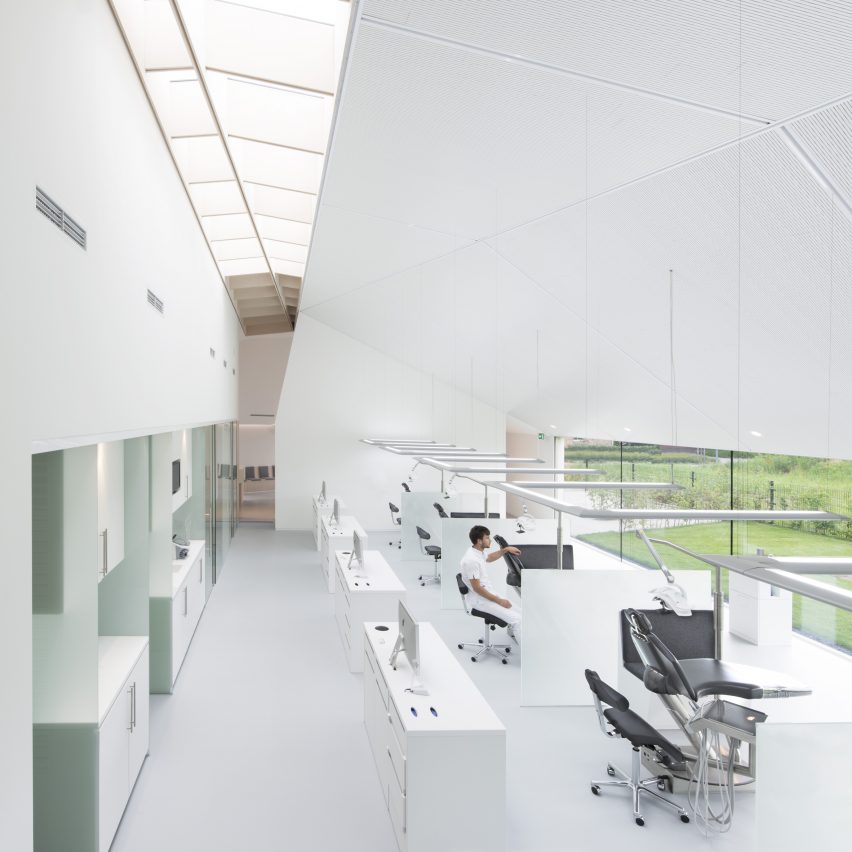
Birch-framed skylights and windows offer patients garden views when undergoing treatment at this sculptural dental clinic in the Netherlands, designed by Studio Prototype. Read more
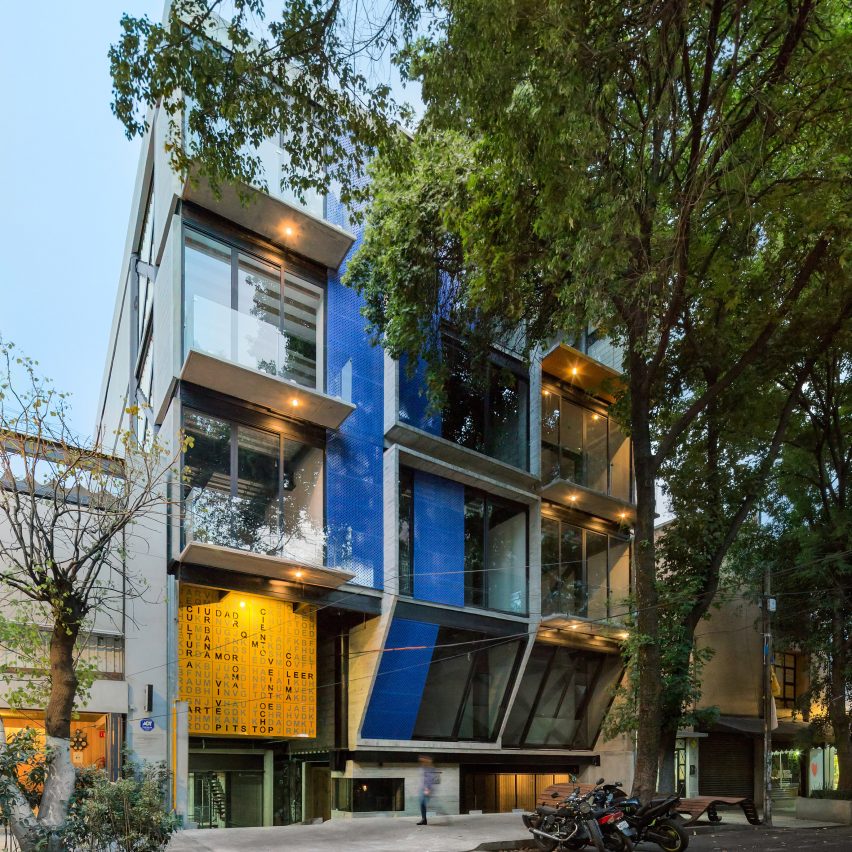
This urban residential building by Arqmov Workshop features a faceted facade sheathed in a patchwork of vibrant laminate panels and large windows framed in black metal. Read more



 Sig Nordal