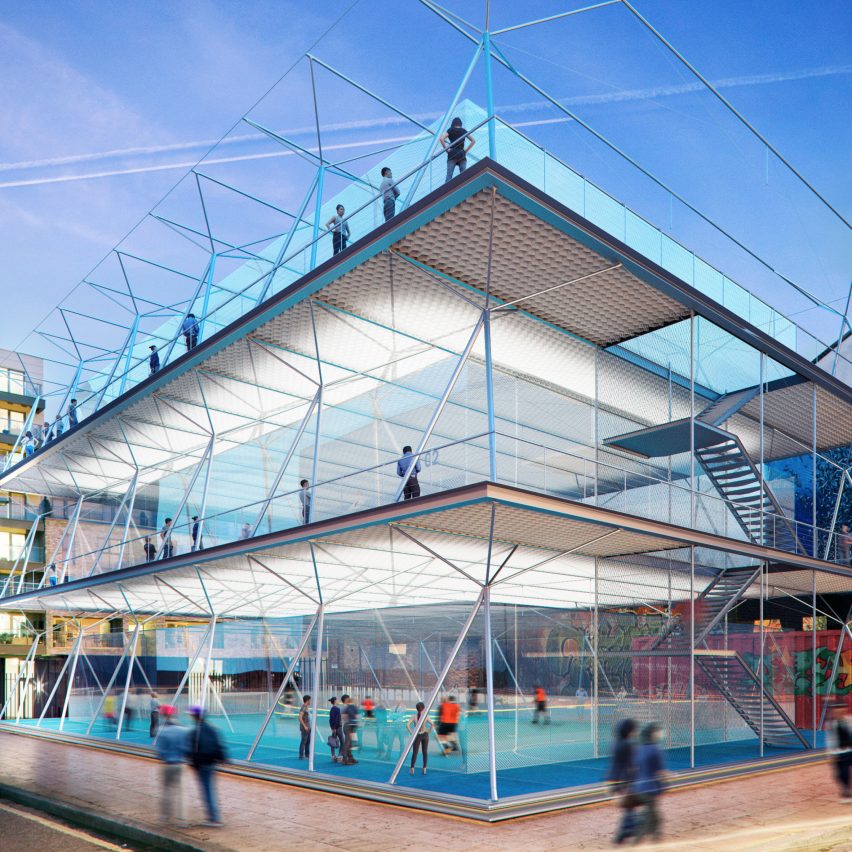
Stackable football pitches could be erected on disused or temporarily empty plots across London, according to Amanda Levete and her London-based studio AL_A. Read more
Stackable football pitches could be erected on disused or temporarily empty plots across London, according to Amanda Levete and her London-based studio AL_A. Read more

The Santiago Calatrava-designed St. Nicholas National Shrine at the World Trade Center has topped out, and capped with a temporary, six-foot-tall cross.
The Byzantine-styled structure was envisioned by Calatrava in 2013 as a non-denominational spiritual center to replace the original St. Nicholas Greek Orthodox Church, located at 155 Cedar Street, which was destroyed on 9/11.
Now, the 40 structural pieces of the ribbed dome have been set into place, matching the number in the dome of Hagia Sophia. Foundation work on the project began just over a year ago.
Located around the corner from Calatrava’s “Oculus” at the WTC Transportation Hub, the church is being constructed at a cost of $40 million, raised completely from private donors. The project is estimated to complete in early 2018, at which time, the permanent cross will be lifted into place.
News via The New York Times. H/T Curbed NY.
Calatrava Reveals Design for Church on 9/11 Memorial Site
//cdn.embedly.com/widgets/platform.js
Video: Santiago Calatrava On His Design For Ground Zero’s Only Non-Secular Building
//cdn.embedly.com/widgets/platform.js

“Gamla Villan” was designed to connect with unique history of the villa district built between 1879 and 1939. During this period a famous spa with celebrity guests operated in Hanko. Most of the old villas have been preserved with their grand towers, verandas, balconies and charming atmosphere still intact. The aim was to create a modern house with a touch of historic Hanko.
The house sits on a quiet and sheltered meadow in Hanko, Finland. Oak and apple trees combine with a view across the meadow to the sea to provide coordinates which situate the house in its surroundings.
Several steps were taken to increase volume and create a sense of dignity in keeping with a villa in this area. The cold storage / guest room area was integrated into the main space. The height of the house was emphasized which also gave possibilities to play with the loft space.
The entrance facade to the street with systematic narrow windows is restrained and calm. The roof is pitched, but over the main living space it is turned – origami-like – to face the garden and the sea. As a result the garden comes as a surprise with its groin vault structure. The high landscape window creates an illusion of a space bigger than its area. Through the loggia in front of the glass wall one moves gradually from the living room outside to the terrace.
Building regulations are stifling architects according to developer Roger Zogolovitch, who has declared support for ideas proposed by Patrik Schumacher in his controversial World Architecture Festival speech. Read more

The new terminal for Stockholm’s permanent ferry connections to Finland and the Baltics will be a landmark for the new urban development Norra Djursgårdsstaden – both architecturally and environmentally.
The firsthand experience of the terminal reveals a confident realization and immediacy detailing that demonstrates an innovative new type of typology in the area.
Mixing urban park and infrastructure
The terminal recalls the shape of a moving vessel and the architecture – with large cranes and warehouses – that previously characterized the ports. At the same time, the terminal has an ambitious sustainable profile, characteristic of the entire development. The main idea has been to create natural links between central Stockholm and the new urban area in connection with the terminal, so that city life will naturally flow into the area.
Therefore, the terminal is raised to be at level with the urban zone, so it is easy for both pedestrians and traffic to access. At the same time the roof of the terminal building is designed as a varied green landscape with stairs, ramps, niches, and cosy corners, inviting both Stockholmers and passengers for a stroll or relaxing moments, while enjoying the view of the ferries, the archipelago, and the city skyline.
In that way radically blurring the way in which the line between architecture, harbour and the rooftop landscape is experienced, linking the terminal to its maritime context in a direct manner, both in scale, tectonics and though its materiality – but also back to the city through its accessible public park on top.
Clarity and consistency
A deliberate clarity and consistency of architectural solutions, most clear through the terminals exposed zig-zag trusses, vast use of floor high seamless panoramic glass sections and seem less floors and cladding used for its facades and ceilings. And for the urban park its vast green buildup on top it’s roofscape.
Focus on light
The inside of ferry terminal is a testament to C.F. Møller’s careful attention to daylight and pleasant indoor spaces. This focus is particularly evident in the large arrivals and departures hall. The sculptural roof of the hall draws in sunlight by day and provides stunning views of starry skies at night.
Made to be self-sufficient in energy
Solar energy and geothermal heating/cooling are provided via the building’s integrated systems, making the terminal self-sufficient in energy. Värtaterminalen will receive the environmental certification level Gold.
An estimated four million people annually will pass through Värtaterminalen, travelling to and from Finland and the Baltics.
Product Description.The firsthand experience of the terminal reveals a confident realization and immediacy detailing that demonstrates an innovative new type of typology the area, capable of intermixing fluid spaces for traffic and passengers, further enhanced through a setting of large seamless surfaces, interwoven from outside in and outwards. Applicating a special atmospheric sensuality and attention to material, detail – perhaps more parallel to the architecture of its vessels it serves than the traditional architecture in the area, surrounding the site of the terminal.
Radically blurring the way in which the line between architecture, harbour and the rooftop landscape is experienced, linking the terminal to its maritime context in a direct manner, both in scale, tectonics and though its materiality – but also back to the city through its accessible public park on top.
A deliberate clarity and consistency of architectural solutions, most clear through the terminals exposed zig-zag trusses, vast use of floor-high seamless panoramic glass sections and seem less floors and cladding used for its facades and ceilings. And for the urban park it’s vast green buildup on top it’s roofscape.

From the architect. As the cultural core of the Faena District, the Forum provides a focal point to the neighborhood and to the mid-Beach zone at large. The ensemble of three buildings – the Faena Forum, Faena Bazaar and Parking—enrich Faena’s hotel and residential components along Collins Avenue, providing a dynamic symmetry between the district’s cultural and commercial programming across Miami Beach’s main thoroughfare.
The existing site presented three distinct conditions for the three distinct programs– a large, wedge shaped site for the Forum, a protected historic art deco hotel for the Bazaar and an empty lot allocated for parking. Although the Faena District enjoys a unique location spanning two waterfronts, the cultural components were positioned on the quieter, residential zone along Indian Creek rather than the activated Atlantic beachfront.
The Forum claims the heart of the complex by addressing this urban context with two volumes that generate distinct frontages toward Indian Creek Drive and Collins Avenue. Embedded within the residential zone west of Collins, the Forum’s cube and cylinder achieve the same intimate scale as the Bazaar and Park. The Forum’s circular plan enables the public domain to expand, activating pedestrian movement within the district. A 45-foot cantilever allows the landscaped plaza to slip under the Forum along Collins, providing a dramatic sense of arrival.
The combination of the Forum’s classical dome space with a black box theater in the main assembly space provide the ultimate flexibility for the diverse programming of Faena’s multifaceted ambitions. Combined, the full layout has the capacity for large scale events. Independently, the spaces can be divided to host distinct events, with dedicated acoustics and arrival. The Forum represents endless possibilities to host a range of events – from concerts to conventions; roundtable discussion to banquets; intimate exhibitions to art fairs- all within a single evening. Liberated from obligations to operate as a strictly institutional or a strictly commercial entity, the Forum presents a new typology for interaction, leveraging the ambiguous advantage of Faena’s redefinition of culture.
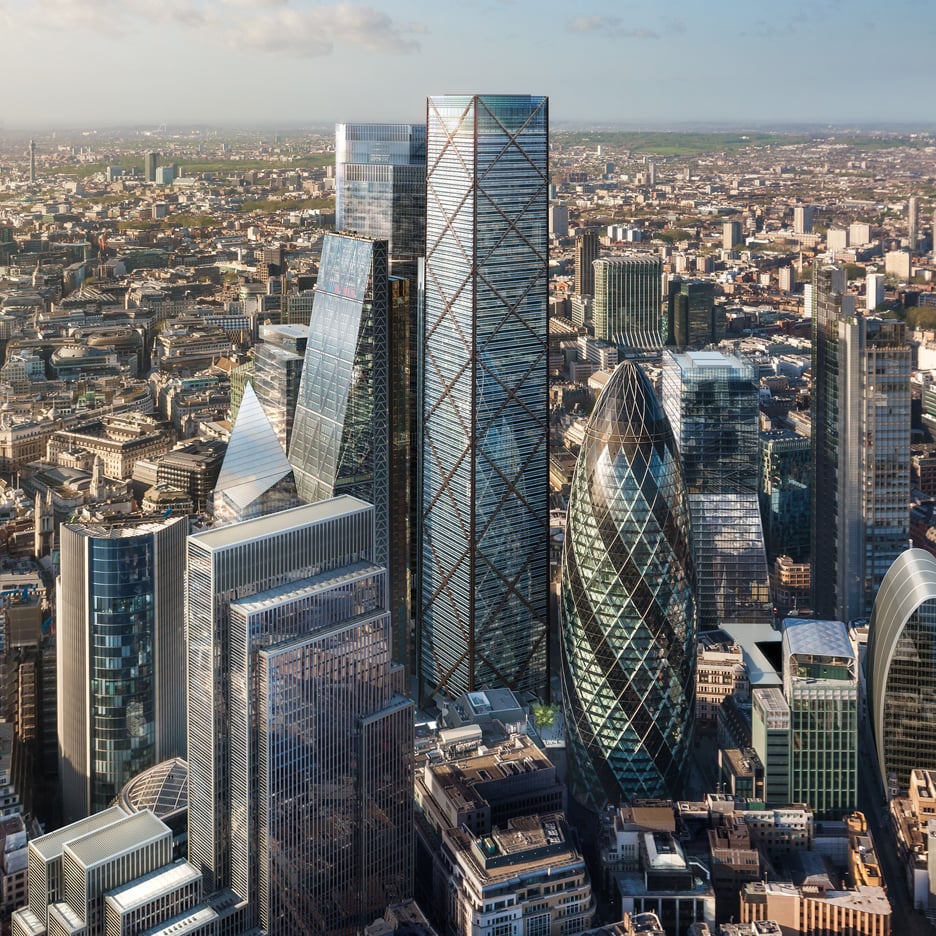
Eric Parry Architects has been granted planning permission for 1 Undershaft, a 73-storey skyscraper that will dwarf The Gherkin and The Cheesegrater to become the tallest building in London’s financial district. Read more

BIG and Barcode Architects have been selected as the winning team in a competition to design a new mixed-use building in the emerging district of IJburg Steigereiland in Amsterdam. To be known as Sluishuis (Lock House), the building will serve as a new icon connecting the neighborhood to Amsterdam’s historic center while providing 380 zero-energy residences, 4,000 square meters of commercial and public space, and a marina with space for up to 30 houseboats.
The winning design takes the form of a classic European courtyard typology, adapted to the canal-centered landscape of Amsterdam and the complex context of the site, close to both large infrastructure and small-scale urban development. Towards the water, the building corner is lifted to bring daylight and views to inner apartments and to allow watercraft to enter the complex. From this peak, a cascade of landscape terraces creates a transition from the scale of the cityscape to its small-scale surroundings.
“Having spent my formative years as an architect in Holland at the end of the 20th century, it feels like a homecoming to now get to contribute to the architecture of the city that I have loved and admired for so long,” said Bjarke Ingels, Founding Partner of BIG.
“Our Sluishuis is conceived as a city block of downtown Amsterdam floating in the IJ Lake, complete with all aspects of city life. Towards the city, the courtyard building kneels down to invite visitors to climb its roof and enjoy the panoramic view of the new neighborhoods on the IJ. Toward the water, the building rises from the river, opening a gigantic gate for ships to enter and dock in the port/yard. A building inside the port, with a port inside the building.”
Around the building, a vegetated promenade connects an archipelago of public program elements, including mooring points for houseboats, a sailing school, and floating gardens. The pathway loops around to connect to a public passage climbing the terraces on the roof of the building, leading to community viewing platform at the building’s peak.
“We have tried to design a building with a surprisingly changing perspective and a unique contemporary character, which reflects the identity of the future residents and all users of Sluishuis.” explained Barcode Architects Partner Dirk Peters.
The design was lauded by the competition jury for its ambitious sustainability goals, which aim to increase social sustainability by “reducing environmental impact during the construction phase, limiting total CO2 emissions, and by using renewable resources throughout the building.”
“The world-famous urban environment of Amsterdam was created by the fusion of water and city,” said Andreas Klok Pedersen, Partner at BIG. “The new Sluishuis is born of the same DNA, merging water and perimeter block and expanding the possibilities for urban lifeforms around the IJ.”
News via BIG.
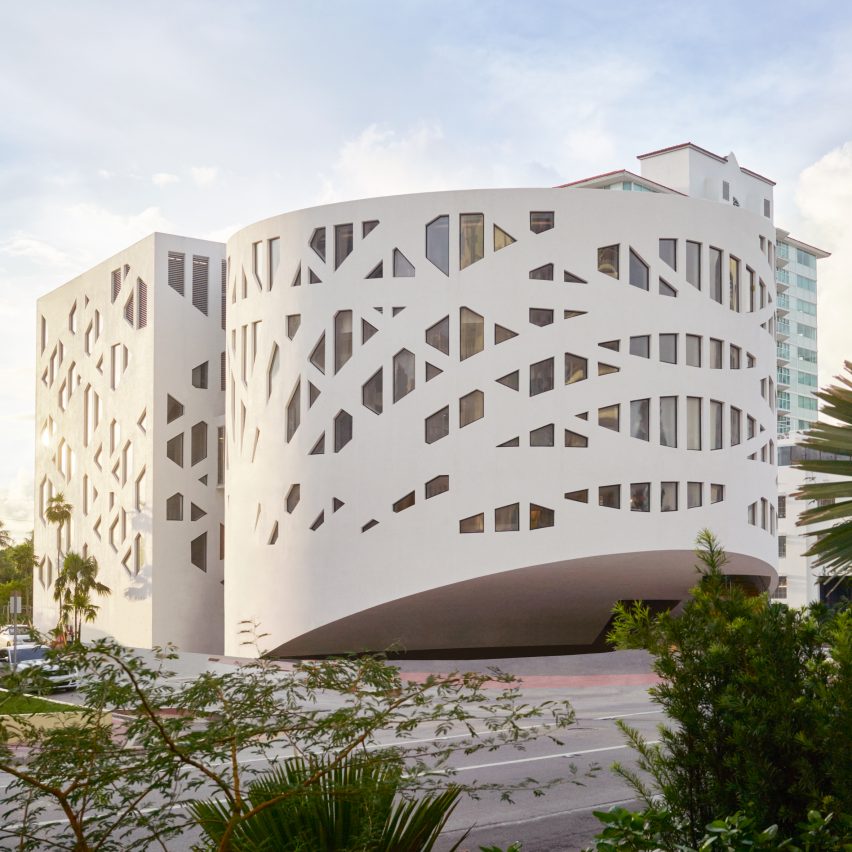
OMA has finished its perforated Faena Forum art and performance centre in Miami Beach, the heart of a new ocean-side cultural district springing up in the US city. Read more