Frei Otto’s Drawings and Models Showcased With Exhibition Design by FAR frohn&rojas


Courtesy of FAR frohn&rojas

Courtesy of FAR frohn&rojas

Frei Otto (1925-2015) was best known for his innovative lightweight structures, even naming an institute after them at the Stuttgart Technical University. His speciality in tension and membrane structures were, and still are, not only beautiful, but also incredibly modern for his time, creating forms that were entirely new to the eye. One of his most notable creations is the Multihalle, which he contributed towards with the architects Carlfried Mutschler + Partner in 1975; it still remains the largest freestanding wooden lattice structure in the world.

Following the award of the Pritzker Prize to Otto shortly before his death in 2015, the ZKM Center for Art and Media in Karlsruhe is hosting an exhibition of his works in order to introduce “new perspectives on the work of Frei Otto” while “formulating present-day questions concerning the future of our built environment.” In service of this aim, architects FAR frohn&rojas created an exhibition design both reminiscent of Otto’s deceptively simple structures, and carefully calibrated to show the huge archive of work to great effect. Read on to find out more about the exhibition and its design.


Courtesy of FAR frohn&rojas


Courtesy of FAR frohn&rojas


Courtesy of FAR frohn&rojas


Courtesy of FAR frohn&rojas


Courtesy of FAR frohn&rojas

Courtesy of FAR frohn&rojas

Description from exhibition architects FAR frohn&rojas:

Frei Otto. Thinking in Models

Frei Otto (1925-2015) is one of the best known and most innovative international German architects of the 20th century and is a key figure in the architectural culture of the federal state of Baden-Württemberg. In 2015 he was awarded the Nobel Prize for Architecture for his work, also known as the Pritzker Prize, and is the highest honor for architecture in the world. The biggest exhibition on the oeuvre of Frei Otto is a shared project between the Archive of South West Germany for Architecture and Engineering (saai) of the KIT and the Wüstenrot Foundation in cooperation with ZKM | Karlsruhe. Projects that are both known and completely unknown are presented. The material encompasses over 200 models, approximately 1,000 photos, drawings, sketches, plans and films as well as a large-scale media projection. In the 1950s Frei Otto was a major presence at garden shows with his marquee designs, offering the emerging West Germany a diversion from its post-war reconstruction. In 1964 he founded the Institute for Lightweight Structures at Stuttgart Technical University, which he made into one of the leading research institutes for environmentally aware architecture and engineering sciences in the world.


Courtesy of FAR frohn&rojas

Courtesy of FAR frohn&rojas

The newly open Germany

With the German Pavilion at the Expo 1967 in Montreal, which he realized with architect Rolf Gutbrod, he created a symbol for the newly open Germany. This impression was further strengthened by the roof-scape for the 1972 Olympic Games in Munich, which he created together with the architects Behnisch & Partners. Over the following decades Otto participated in the completion of numerous buildings such as the Multihalle in Mannheim, which was designed by the architects Carlfried Mutschler + Partner in 1975. The Multihalle remains the biggest free-standing wooden lattice construction in the world, and was awarded heritage status due to its sophisticated, materials-minimizing construction in 1998. Several surveys plan to subject the “wonder of Mannheim” to a general refurbishment. The partial upkeep of the hall and its dismantling are presently being discussed. In 1997, together with Frei Otto, the architects Ingenhoven, Overdiek, Kahlen and Partners won the competition for the refurbishment of Stuttgart Central Railway Station. Otto designed the chalice-shaped pillars which characterize the overall appearance of the station. Otto developed the optimum design of the pillars using numerous models. Otto distanced himself from the project in 2009. In the year 2000, Otto designed the Japanese Expo Pavilion in Hanover with the architect Shigeru Ban. The exhibition consists of four central positions which fill each atrium to spectacular effect and guide the visitors through the wide ranging archive material which the Archive of South West Germany for Architecture and Engineering (saai) has prepared especially for this exhibition.


Courtesy of FAR frohn&rojas

Courtesy of FAR frohn&rojas

Thinking in Models

Frei Otto’s approach expresses itself in its willingness to experiment, in which methods that straddle architecture, science and art can be found. He developed instruments for researching self-organizing processes, measurement tables for determining force flows, equipment for researching pneumatic design forms and tools for the analysis of sophisticated network models. His tireless experimentation with models served the purpose of researching causal contexts and was simultaneously part of the formgenerating design process. In this way Frei Otto provided the foundation for a culture of experimentation between academic observation and artistic skill which remains relevant to this day — a form of technical-intellectual self-alignment in which design can represent the development of individual knowledge as well as a starting point for a collective discourse on the future of the built environment.


Courtesy of FAR frohn&rojas

Courtesy of FAR frohn&rojas

With Frei Otto, the architectural models do not function as “static objects” but as “dynamic objects”, or as process models for the entire environment. They embody an “operational aesthetic” (Georg Vrachliotis) which alternates between the precision of scientific objects and the imagination of artistic instruments.


Courtesy of FAR frohn&rojas

Courtesy of FAR frohn&rojas

The innovative potential in Frei Otto’s oeuvre is based on the dramatic interdisciplinary nature of his thinking that straddles architecture, technology, science and society. He consistently addressed the example provided by nature, and throughout his life, tried to make use of it for architecture and engineering. The goal of this exhibition is to convey new perspectives on the work of Frei Otto and to serve as a basis for new discussions on the future of the built environment between architecture, technology, sustainability and society.


Courtesy of FAR frohn&rojas

Courtesy of FAR frohn&rojas

Four central positions

The exhibition consists of four central positions which fill each atrium to spectacular effect and guide the visitors through the wide ranging archive material which the Archive of South West Germany for Architecture and Engineering (saai) has prepared especially for this exhibition.

1. “Frei Otto’s Model Landscape”

All of the models are organized to scale, placed in their content-related and historic context, and presented on an approx. 50-meter-long table construction. The technical and design context of the individual models and projects is supplemented by the original plans and detailed picture material. In this way, the researching character and aesthetic continuity in Frei Otto’s thinking becomes evident. The visitors gain the impression that they are exploring a “horizontal cabinet of curiosities”.


Courtesy of FAR frohn&rojas

Courtesy of FAR frohn&rojas

2. “Frei Otto’s open archive”

A key component of the exhibition is the “open archive.” This consists of 18 over-sized archive shelves which are constructed in a circular form around both courtyards and therefore provide the exhibition with spectacular cohesion. With the use of selected original plans, photos, books and reproductions, the users are guided through the key events in the life of Frei Otto — the Development Institute for Lightweight Building in Berlin, the world-famous Institute for Lightweight Structures in Stuttgart and his studio in Warmbronn, to ground breaking projects like the German Pavilion for the Expo 67, the Multihalle in Mannheim and his initial research into Stuttgart 21. The shelves of the archive function as a freely accessible storage area and a place of knowledge that straddles presentation and storage.


Courtesy of FAR frohn&rojas

Courtesy of FAR frohn&rojas

3. “Frei Otto’s Cosmos”

Throughout his life, Frei Otto collected and archived photographs of structures from the natural world. They served as a source of inspiration and free association to him and were also definitive source of research. The key factor in this respect is that Frei Otto consistently addressed the example provided by nature and tried to make use of it for architecture and engineering. At 18 tables — which are inspired by the tables in Frei Otto’s studio in Warmbronn — visitors are able to see large-format photos of studies of nature, spiders’ webs, sand structures and soap bubbles. A sophisticated world of images is opened to them which provides insights into the poetic and scientific cosmos of Frei Otto’s thoughts and imagination.


Courtesy of FAR frohn&rojas

Courtesy of FAR frohn&rojas

4. “Frei Otto’s Projection”

Frei Otto’s innovative potential is based on the dramatic inter-disciplinary nature of his thinking that straddles architecture, technology, science and society. The image and technical media dimension play a major role in this respect. In a projection which is over 25 meters in size, this thinking is conveyed in terms of its aesthetics and power of media-based visual expression.


Courtesy of FAR frohn&rojas

Courtesy of FAR frohn&rojas

Courtesy of FAR frohn&rojas

Courtesy of FAR frohn&rojas

Exhibition design: FAR frohn&rojas Berlin, Santigo de Chile and Los Angeles
Team: Marc Frohn, Mario Rojas Toledo, Max Koch, Daniel Stanojevic, Leonie Weyrauch, Maximilian Kessler

Curator: Georg Vrachliotis
Co-curators: Marc Frohn , Martin Kunz, Joachim Kleinmanns
Project assistant: Julia Schiffer
Graphic design: Lukas Feireiss Studio with Floyd E. Schulz
Media partner: ARCH+

http://ift.tt/2gDOGGI

BNL-BNP Paribas Headquarters / 5+1AA Alfonso Femia Gianluca Peluffo


© Luc Boegly

© Luc Boegly


© Luc Boegly


© Luc Boegly


© Luc Boegly


© Luc Boegly

  • Architects: 5+1AA Alfonso Femia Gianluca Peluffo
  • Location: Roma Tiburtina, 00162 Roma, Italy
  • Architect In Charge: Alfonso Femia, Gianluca Peluffo, Simonetta Cenci
  • Work Team : Alfonso Femia, Alessandro Bellus
  • Area: 75000.0 m2
  • Project Year: 2016
  • Photographs: Luc Boegly
  • Client/Owner: BNP Paribas Real Estate
  • Project Directors: Alessandro Bellus, Marco Corazza, Gabriele Filippi, Francesca Raffaella Pirrello
  • Design Team: Alfonso Femia, Gianluca Peluffo, Simonetta Cenci, Annalura Spalla, Alessandro Bellus, Marco Corazza, Gabriele Filippi, Marzia Menini, Sara Sartini, Maria Michela Scala, Daniele di Matteo, Sara Massa, Vanesa Carbajo Fernandez, Roberta Nardi, Francesca Zampetti
  • Collaborators: Gianmatteo Ferlin, Michela Lucariello, Paolo Oliva, Eleonora Zinghinì, Etienne Bourdais, Stefano Cioncoloni
  • Net Usable Area: 39.000 m2
  • Cost: 83 M euro
  • Environmental Certifications: BBC Classe A Cened Certi cation Leed Gold

© Luc Boegly

© Luc Boegly

From the architect. The design of the new headquarters of BNL is part of a particular and unique context. Unique because the nature of the context is a layering of infrastructures that are separated by two important urban areas of the city of Rome, thanks to the construction of the station for high-speed rail, which leads to a new role, not only in terms of services service but also as “urban place”. Particular because the area where the new building will stand, due to its geometric shape and topography and its relative orientation, suggests to design the building according to the principle of “Janus”. We consider it important that the new building develops a dialogue with the adjacent complex of Tiburtina railway station, with its main features characterized by size and horizontality. The dialogue does not necessarily have to be direct, but should have references both to perspectives and to the different levels of the station, and also a different role (the horizontal stratification) in the new urban landscape.


© Luc Boegly

© Luc Boegly

Section

Section

© Luc Boegly

© Luc Boegly

Our goal is to meet the functional needs with a building that is capable, in its autonomy and identity, to belong to the urban context of the Tiburtina Station and at the same time to be representative both for the city of Rome and for its users.


© Luc Boegly

© Luc Boegly

From these considerations, a proposal is made for a building that is able to relate differently to the north-west with the district Pietralata and south-east with the Tiburtina Station complex. Dynamic, reflective and fading, where its perception is mainly dynamic and different meter after meter (from the train, from the station, from the different areas of the city), almost as if it was moving, comparatively, where the context is urban or “slow”, facing North, the perception is static transparent and material.


© Luc Boegly

© Luc Boegly

Section

Section

© Luc Boegly

© Luc Boegly

The building thus assumes different roles leading our imagination to important works of contemporary artists and filmmakers who have treated the themes of perception and “reflection” of reality.


© Luc Boegly

© Luc Boegly

http://ift.tt/2grJOVN

Vincent Coste Architecte Designs a Stunning Villa in Saint-Tropez

Maison L2 by Vincent Coste Architecte (11)

Maison L2 is a private home located in Saint-Tropez, France. It was designed in 2016 by Vincent Coste Architecte. Maison L2 by Vincent Coste Architecte: “L2 house is the result of a reflection on the envelope and how to develop outdoor spaces that change the perception of volumes of an existing structure. In this case a viewpoint made of a dressed in wood steel structure works as an air traffic..

More…

Le Signe National Centre for Graphic Design / MOATTI-RIVIERE


© Michel Denancé

© Michel Denancé


© Michel Denancé


© Michel Denancé


© Michel Denancé


© Michel Denancé

  • Architects: MOATTI-RIVIERE
  • Location: 52000 Chaumont, France
  • Architect In Charge: Alain Moatti
  • Area: 2460.0 m2
  • Project Year: 2016
  • Photographs: Michel Denancé
  • Engineering: Graphics and signage
  • Structure : RFR
  • Fluids : Inex
  • Conservation Preventive: Les sentinelles des collections
  • Costs Surveyor: Bureau Michel Forgue
  • Multimedia And Audiovisual: Vincent Taurisson
  • Lighting: Lumières Studio
  • Acoustics: Avel

© Michel Denancé

© Michel Denancé

Our project is composed of large-scale planes installed within the city. The architectural design takes its imprint from the universe of graphic design and from the objects and supports that have always invested this art form and continue to do so today: the poster – the sheet of paper – the page – the screen – the billboard.


© Michel Denancé

© Michel Denancé

These large planes are made of stone and compose the walls and roofs. They are rendered abstract by their thinness with 12cm thick panels: stone siding with an aluminium honeycomb core. This rigid material gives the stone its finesse.


Section

Section

Section

Section

These juxtaposed or superimposed planes are close to or distanced from one another. Between them relarge areas of glass, vast surfaces that can be closed off with curtains. In this way, one can see the interior of the space from the exterior.


© Michel Denancé

© Michel Denancé

Stone and glass compose simple or complex wholes to respond to the different roles of the street façades:
– on the corners, they compose a serial grouping that marks the public expression of the edifice through its monumentality.
– on the station alley side, they are simply juxtaposed redans or projections.
– on the bank side, these stone sections are mobile and make it possible to open the exhibition hall to the exterior in continuity with the courtyard and so with the city.
– three foils that are higher than the others offer their surfaces up to monumental installations in strategic articulations: at the exit of the station,the city entrance on the rue de Verdun, and in the centre of the «SIGNE» facing the Place des Arts.


© Michel Denancé

© Michel Denancé

Minimalist graphic design as an epidermis of the architecture
The graphic intervention in its minimalism deliberately adheres to the architecture, appearing on the walls like a watermark, marking its surface.


Axonometric

Axonometric

Two screens of regular, orthogonal dots graphically structure the stone sheets of the Centre.

From above, a screen of metal dots on the monumental scale of the building comes down to the height of a person, connecting with a screen of smaller, screen-printed dots.


© Michel Denancé

© Michel Denancé

In its upper part, the screen can function as a picture rail or cyma to receive signs and images in any format.

The free wall spaces offer their screened surfaces to the invitees of special events, proposing that artists such as typographers, poster artists, graphic designers and illustrators make use of these surfaces.


Floor Plan Level 00

Floor Plan Level 00

The screened surfaces of the stone offer multiple uses, lending support to events, signs and drawn, still or projected images. These “visual” usages are guarantees for the capacity of the architecture to incarnate and transmit the essence and topicality of the place, its legitimacy and boldness.


© Michel Denancé

© Michel Denancé

They thus make it possible to renew and bring up to date all writings and movements, from heritage works to contemporary graphic design.


© Michel Denancé

© Michel Denancé

Product Description.
Facade materials: The stone “leaves” are made of a 120 mm siding complex consisting of a 5mm natural stone facing, glued to an aluminum honeycomb through glass fibers impregnated with epoxy resin. The complex comprises, on its rear face, inserts embedded in the resin enabling the fixing of reinforcements made of Z-folded sheet.
Type of stone: Limestone Moka cream
Dimensions: 120 x 240 cm
Exterior: steel joinery
Interior: structural walls and raw concrete floor.


Floor Plan Level 01

Floor Plan Level 01


© Michel Denancé

© Michel Denancé

http://ift.tt/2fwCrzl

TA Dumbleton Architect Turns a Former Farmhouse into a Private Residence in The Hamptons

WE Guest House by TA Dumbleton Architect (5)

WE Guest House is a residential project designed by TA Dumbleton Architect in 2013. It is located in Bridgehampton, The Hamptons, New York, USA. WE Guest House by TA Dumbleton Architect: “Elegant and Timeless, the WE Guest House reminisces an old farmhouse, whilst exuding modern clean lines and architecture. Full double height windows maximize the relationship with the gardens and open every space of the house to the sprawling landscape…

More…

Casa RJ / Archiplan Studio


© Davide Galli Atelier

© Davide Galli Atelier


© Davide Galli Atelier


© Davide Galli Atelier


© Davide Galli Atelier


© Davide Galli Atelier

  • Architects: Archiplan Studio
  • Location: 46100 Mantua, Province of Mantua, Italy
  • Architects In Charge: Diego Cisi, Stefano Gorini Silvestrini
  • Area: 230.0 m2
  • Project Year: 2016
  • Photographs: Davide Galli Atelier

© Davide Galli Atelier

© Davide Galli Atelier

From the architect. The project involves the recovery of an entire multi-storey building of 500’s located in the consolidated urban tissue of the city of Mantua, in which the apartment constitutes a portion.
The project deal with the topic of a luxury home, stating its condition of belonging to this ambit through the research for a spirituality of the spaces that is expressed in the study of the details and in the sensuality of the materials that has been used.
The house is characterized by its decorations in the ceilings and in some walls dating back to 500’s and the first half of 800’s, the project maintains its layering of signs in their ambiguity without drawing a philological selection.
The distribution organization of the spaces is maintained in original condition, while the subdivision of the interior spaces happens through the introduction of elements of furniture that reconfigure in part the structure, specifying the hierarchies.
The project proceeds by layering of elements that overlap without vanishing.


© Davide Galli Atelier

© Davide Galli Atelier

Floor Plan

Floor Plan


© Davide Galli Atelier

© Davide Galli Atelier

http://ift.tt/2gCZg0F

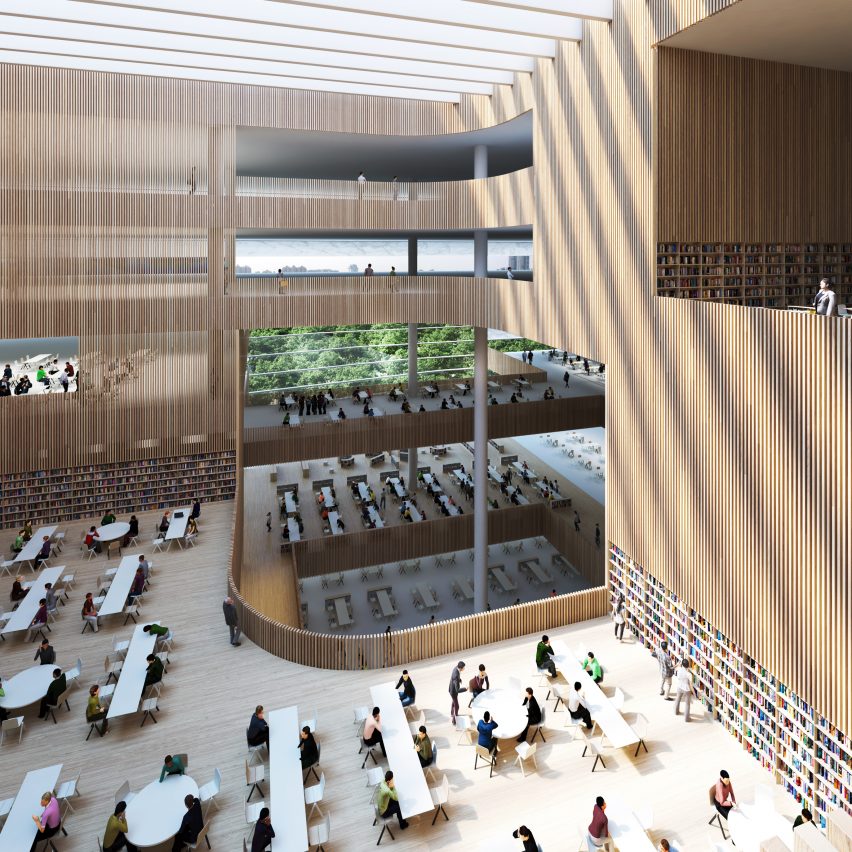
Schmidt Hammer Lassen Architects wins Shanghai Library competition

shanghai-library-shanghai-library-schmidt-hammer-lassen-architects-architecture-cultural_dezeen_sq

Danish firm Schmidt Hammer Lassen Architects has revealed its competition-winning designs for a new library in Shanghai featuring bands of glazing and wood-lined reading rooms. Read more

http://ift.tt/2gBRRPa

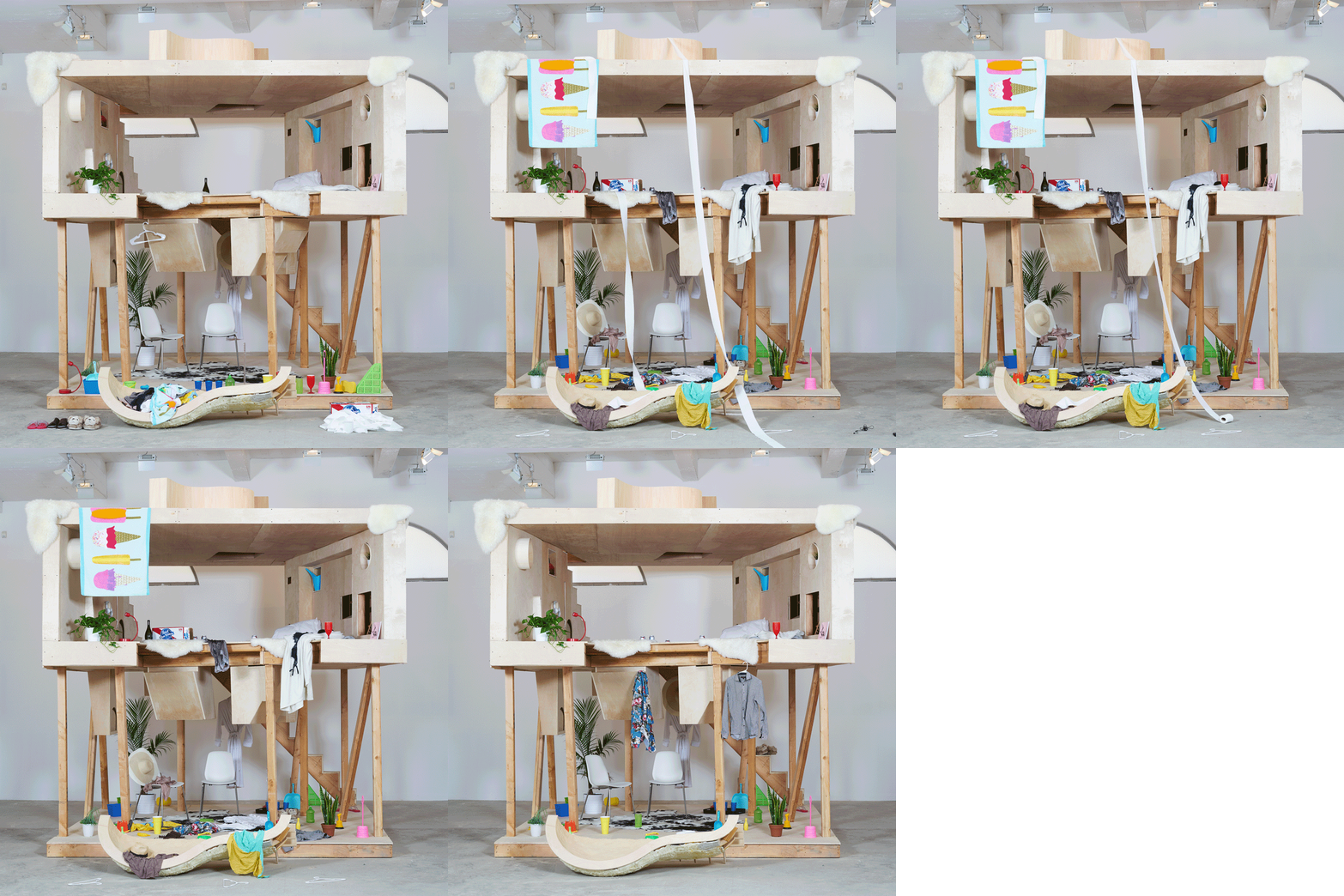
Bureau Spectacular reimagines Laugier’s Primitive Hut as “indoor treehouse”

Another Primitve Hut by Bureau Spectactular

California studio Bureau Spectacular has created a wooden structure on stilts that references the Primitive Hut proposed by philosopher Marc-Antoine Laugier in the 18th century. Read more

http://ift.tt/2fuITab

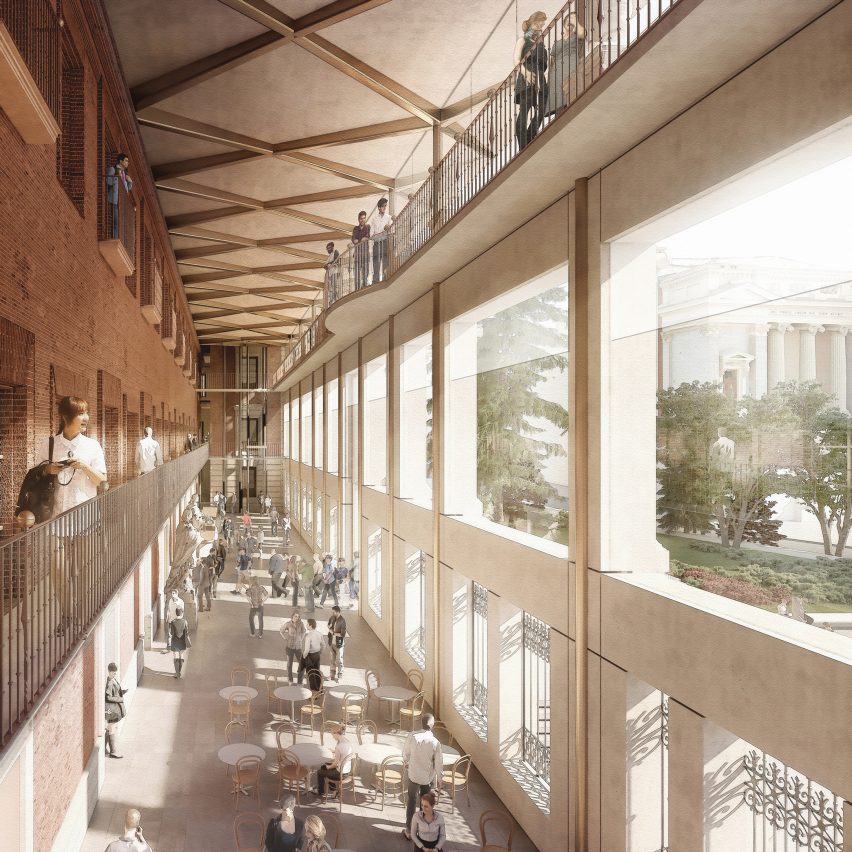
Foster + Partners and Rubio Arquitectura to extend Madrid’s Museo del Prado

Prado Museum by Foster + Partners

Foster + Partners and Rubio Arquitectura have won a competition to overhaul Spain’s most important art museum, the Museo del Prado in Madrid. Read more

http://ift.tt/2gzf340

Patrik Schumacher embarrassed by “Mr Nasty image” after World Architecture Festival speech

patrik-schumacher-dezeen_sq

Zaha Hadid Architects director Patrik Schumacher has said he regrets the reaction to his recent speech about London’s housing crisis, and claims he only wanted to trigger a discussion. Read more

http://ift.tt/2gbgPrE