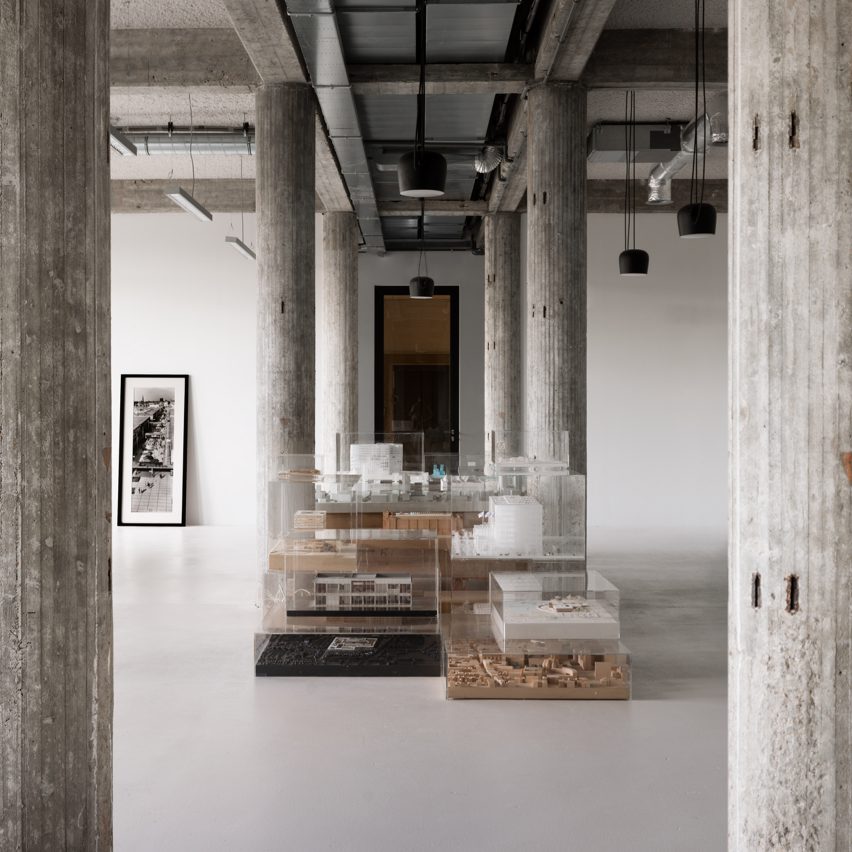
Dutch studio KAAN Architecten has moved into new offices of its own design in Rotterdam, featuring coarse concrete columns, smooth white walls and rich walnut floorboards. Read more
Dutch studio KAAN Architecten has moved into new offices of its own design in Rotterdam, featuring coarse concrete columns, smooth white walls and rich walnut floorboards. Read more
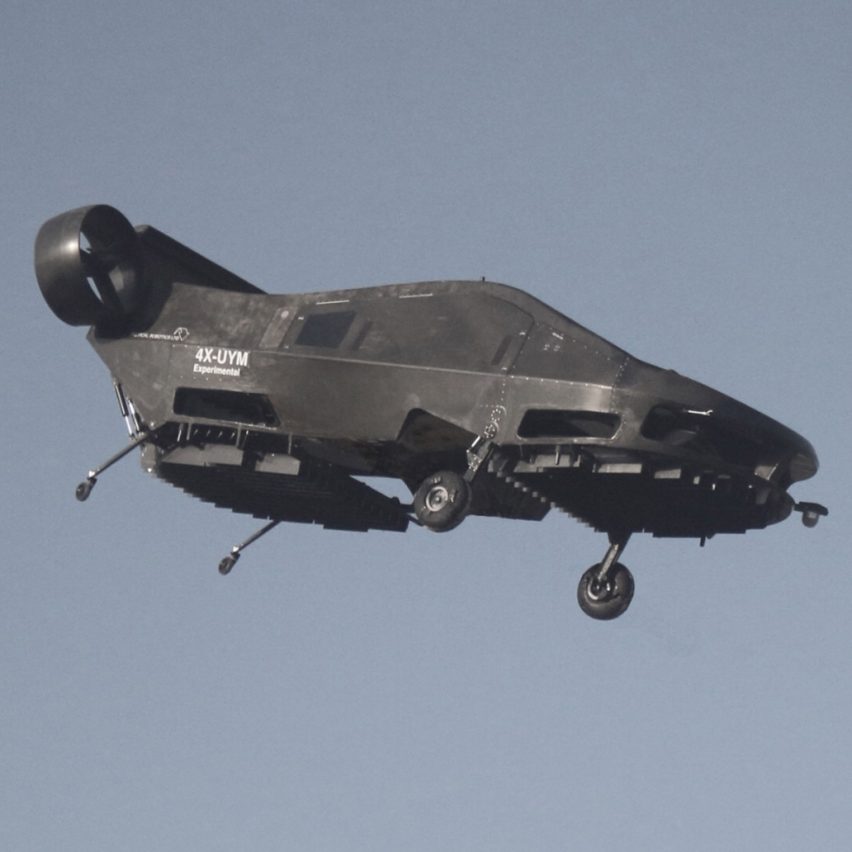
An autonomous aircraft designed to operate in dangerous territory has successfully completed its maiden voyage. Read more

Many have walked by and wondered what purpose this vast, windowless skyscraper in the heart of Manhattan serves. 33 Thomas Street, also known as the “Long Lines Building” (LLB), appears as an impenetrable monolithic fortress amid a canyon of glass and steel. Ostensibly an AT&T telecoms building, the New York Times have reported (based on investigative work by The Intercept) that this “blank face[d] monument to privacy” may in fact be a NSA (National Security Agency) listening post – and hidden in plain sight.
Designed by San Franciscan John Carl Warnecke—an architect who worked closely with the Kennedy administration, and even designing the late President’s mausoleum—the Brutalist tower was completed in 1974. Built to withstand a nuclear attack on New York or, at the very least, a devastating loss of power to the city, the 550 foot-tall (169 meters) structure is supported by systems that allow it to provide enough food, water and fuel to sustain 1,500 people for two weeks completely removed from public infrastructure. It has been said that during the aftermath of the September 11, 2001 attacks it was the only operational building south of lower Manhattan.
The history of the LLB’s programme is not totally fabricated. While it continues to house AT&T’s long distance telephone switches and carrier exchanges (originally as the New York Telephone Company), it also now operates as a datacenter and “gateway switch”. The vision of the practice who designed it, according to The Intercept, was as “a communication nerve center like a ’20th century fortress, with spears and arrows replaced by protons and neutrons laying quiet siege to an army of machines within’.” They continue:
True to the designers’ original plans, there are no windows and the building is not illuminated. At night it becomes a giant shadow, blending into the darkness, its large square vents emitting a distinct, dull hum that is frequently drowned out by the sound of passing traffic and wailing sirens.
Story via New York Times. At this time no concrete evidence is available which connects the building to the NSA – for more information read The Intercept’s article in full.
From the architect. The highest value of the plot is a wonderful view stretching out. The idea was for the house to become its framework that crops it. The most appropriate building turned out to be a fully open on mountain landscape one-storey building, which gives the same view to all of the interiors.


Because of the plot being located in an absolute wilderness a problem of security came out. The solution turned out to be “twisting” the building so as only its one corner touches the ground and the rest is hang over the edge of the hill. With this solution, part of the ground floor where the bedrooms were located was pulled up to the level of the first floor. Because of the fact that there are wide glass openings in the building, my wife asked me to effectivly close the entrance side of the house. A 10 meter wall and a drawbridge, which combines the function of stairs and a window shutter, appeared.
Location of the house on a steep slope, was followed by high risk of landslip, more and more frequent in polish mountains. As to limit the movement of the subsoil the house was treated as a bridge, under which rain water flows naturally.
Realities of mountain landscape as well as the local law constrained a gable roof. House took the form of a typical barn standing on three thin walls
To give rigidity to the building the walls were tensed by the planes of the ”inverted” roof, slightly lifted over gound. Their incline increased the feeling of security. And so, we basically created a house with two roofs that protect it from water, it began to resamble an arc floating over the fields. After some time I realized, that in order not to disturb this impression, the best garden design would be lack of it, the best fence would be a temporary herding fence, the best approach – few rocks. In the same time the building was supposed to be cheap and easy to construct. That is why I deciced on insulating it from the inside, the concrete structure became an finnished elevation. This is how I got rid of complicated details and finish, they were replaced by poured concrete from a local producer. Sprayed closed-cell-structure foam turned out to be the optimal insulation. It is also a vapour barrier.

TLV Zechariah Apartment is a private residence designed by Dori Interior Design. It is located in Tel Aviv, Israel. Photos by: Adi Cohen Zedek

The site is located overlooking a golf course fairway on a prominent Johannesburg golf estate. Orientation is due north-east and there are distant views beyond the golf course to the horizon.
Access is taken from the south-west and the site is positioned on a bend on one of the main arterial roads within the estate. The land is predominantly flat with no natural features other than two thorn trees on the golf course interface.
The home was designed for a bachelor with limited mobility looking for a modern, single storey home characterized by a strong connection to nature and views from all rooms in the home. The client loves natural materials and the bushveld and was looking for a home which imbued a sense of being away in the bushveld: a place of comfort, a refuge from the world but reinterpreted in a more contemporary, urban context.
Given the clients requirement for a sense of seclusion and privacy and the location of the site on the bend of a main arterial roadway within the estate, the departure point for the design and defining gesture of the home is a large dry-packed natural stone wall which defines the line between public and private space. The intention to create a sense of protection and enclosure on the private side of the home but also to create an increased sense of interest and anticipation in the approaching visitor by the restrained use of line, form, pattern and materiality on the street. The bulk of the home hunkers down behind the spine wall, the only suggestion of what lies beyond being three chimney structures with an intentionally exaggerated vertical scale and a steel and timber roof terrace structure above the main terrace space. Given the position of the site the architects felt that providing an opportunity to access the incredible views and perspective from a first floor vantage point was too valuable an opportunity to miss. Accordingly, the architects planned a rooftop entertainment space taking full advantage of the panoramic views available looking north down the 13 th fairway and to the horizon beyond accessed from the ground floor entertainment space.
The spine wall also defines the primary movement route within the home and, whether experienced from inside or outside the home, provides powerful visual legibility.
A naturally filtered koi pond runs the length of the wall on both sides which not only provides life and movement at the wall but also the illusion, through reflection, that the wall continues into the ground.
Natural materials such as dry-packed stone, solid hardwood, solid granite tiles and copper create contrasted against more clean, contemporary materials such glass and off-shutter concrete.
Product Description. Our client has a physical disability and was looking for a single storey home. To create the most modest silhouette in the landscape and ‘hide’ the home behind the large 4m stone feature spine wall we opted for a flat in-situ concrete roof slab. For complete peace of mind and in order to simplify the construction of the roof slab and waterproofing thereof we chose Penetron Admix which is added to the concrete mix at the batch plant at the time of batching and renders the concrete completely waterproof without the need for cement screeds to fall and a waterproofing bituminous membrane of any sort. Penetron was pivotal to the success of this building.
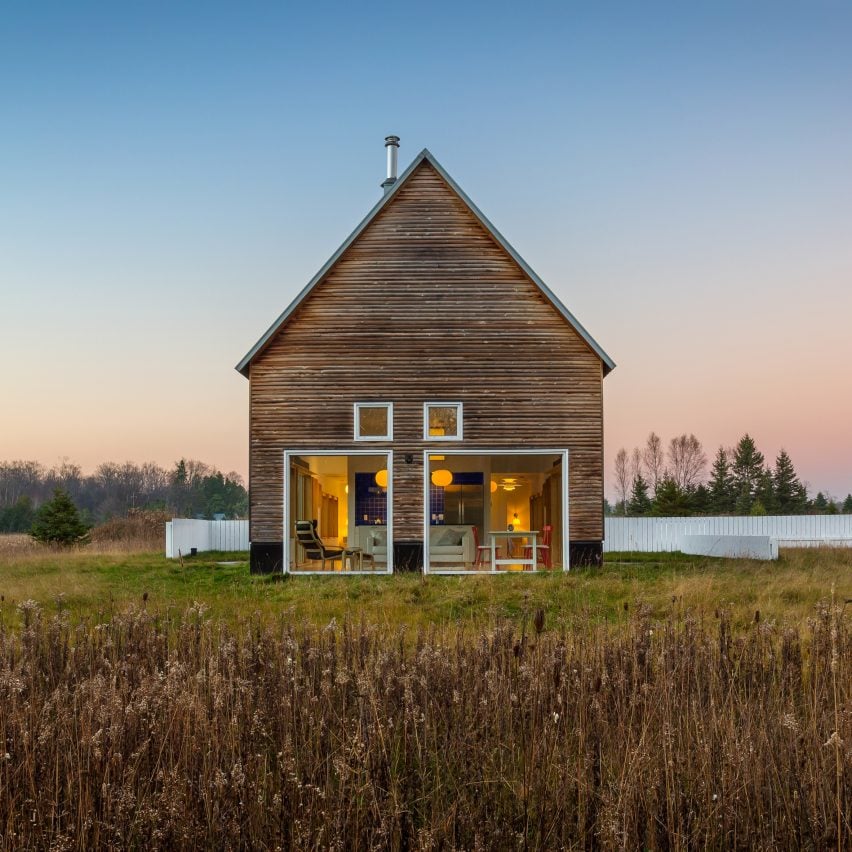
American studio Salmela Architect has created a rural Wisconsin home that features a steep roof, square windows and natural cedar cladding meant to age over time. Read more

Located on a small peninsula, the project site faces directly the beautiful scenery of the Seto Inland Sea.
The most interesting challenge for this project was to create a comfortable inside silence combined with a new openness atmosphere.
In this plan I set two squares intersecting each other and thought about the good balanced interaction between the wall structure and the openings.
The moving line inside the house becomes fluid thanks to the use of skipping floors and short stairs that connect the living area with the sleeping rooms. The use of a polish concrete finish for the living room and the kitchen floor became important in order to give an additional value to the external light.
The first floor is slightly buried and its ceiling was set lower rather than the living room in order to achieve a more private and cozy feeling.
Here resides a very special concrete spiral staircase. The thickness of the supporting slab becomes invisible to its outer and inner end and it was designed in order to avoid any necessity of a central pillar. In this way from its central axe only a perfect straight line appears.

From the architect. In 2007 Sutherland Hussey Harris, in collaboration with Beijing based Pansolution, won first prize in the international competition for the design of the new City Museum for Chengdu in Sichuan, China.
Tian-Fu Square was recently established in the historic core as a new central focus of Chengdu. The Existing Science museum forms the entire Northern edge with a giant statue of Chairman Mao saluting the main North South city axis, and on the East side a new concert hall is planned.
The New Chengdu Museum sits on the West side of the square and maximises its profile to present a façade of commensurate scale and proportion to embrace and address the huge scale of this new square and establishes a strong formal relationship to it by forming a simple enclosing rectilinear profile. The building further enjoys and celebrates this relationship to this monumental public space by extending an internal promenade of public foyers and circulation behind the entirety of the veiled façade addressing Tian-Fu Square.
The long narrow site is exploited using all the public areas to maximise a dramatic relationship with the new square, the remaining façades consequently enclose the largely hermetic exhibition halls, these are represented as a giant crafted artefact in the city cloaked in a precious skin of copper alloy rigorously profiled to play with light, shade and texture whilst accommodating all the technical requirements for ventilation grilles. Aside from the east face this skin is ‘lifted’ to reveal glazing at street level, allowing a more human scaled intimacy and a relationship to the interior.
The form envelopes a new undercover outdoor public space – a monumental gateway through the building, offering a large outdoor public space where people can gather, cultural events can take place, even the local street market extends through to the square. This gateway within the building also creates an important connection between the C16th Huang Cheng Mosque, the most significant in South West China, and the main square. The main entrances to the museum, theatre and museum offices all connect with this route through the building.
The Museum requirements extend to over 65,000m2 of development and includes exhibition space for Natural History, History and Folk, and an 800 seat Chinese Shadow Play Theatre as well as a 1000m2 Temporary Exhibition space. A huge challenge within the project was to be able to provide the museum with their requested 30m clear span exhibition halls whilst assuring the structure is capable of withstanding an earthquake measuring up to 8 on the Richter scale. In addition to this the city’s subway network runs under the Northern half of the building, resulting in the above ground section of the building cantilevering over the tunnels.
A rigid diagrid steel lattice forms the structural shell enclosing the enormous interior volumes of large climatically controlled halls, The building further extends 24m into the ground to accommodate the conservation stores, theatre and plant rooms and is structurally isolated from the effects of any earthquake via a protective box structure into which the whole construction sits.
Unusually for China, Sutherland Hussey Harris with Pansoloution design, Beijing, were retained beyond the conceptual design phase and contracted to deliver the detailed and production information stages for all the public areas of the building, the detailed design of the skin and its integration with the structure and the landscape and subsequently all site supervision related to this work.