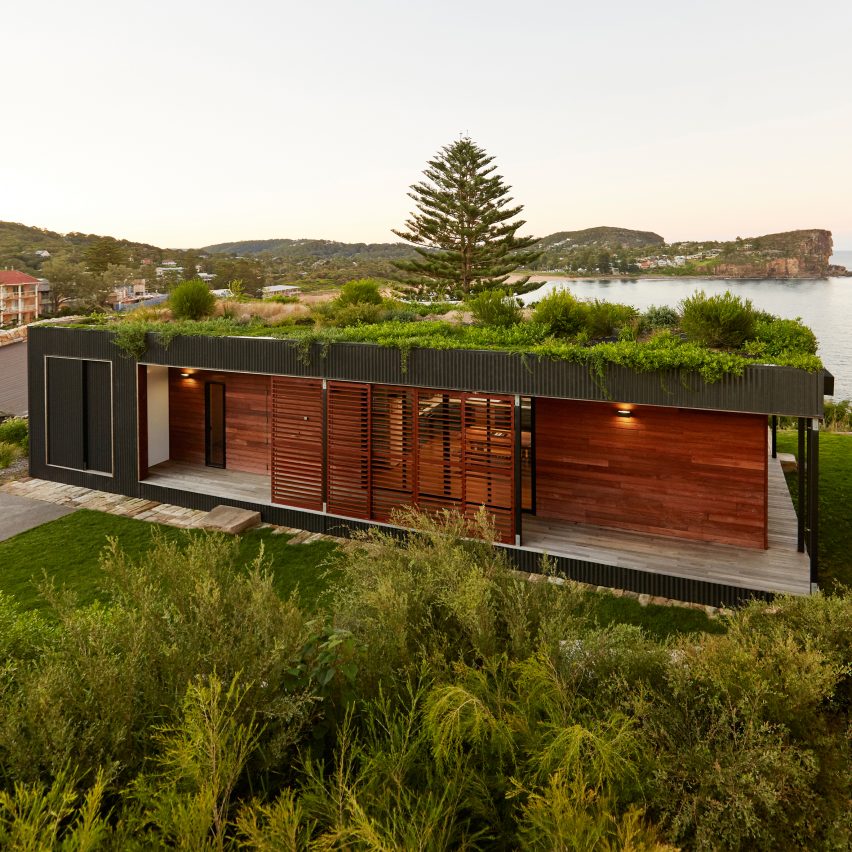
ArchiBlox has given this prefabricated beachfront house near Sydney a verdant plant-covered roof to help it blend into its clifftop setting. Read more
ArchiBlox has given this prefabricated beachfront house near Sydney a verdant plant-covered roof to help it blend into its clifftop setting. Read more

From the architect. The 300pyong irregular shaped piece of land near the outskirt of north eastern Seoul simultaneously faces forests and the dense urban conditions. The boundary that faces the city is walled up according to wishes of the client, who is both an avid collector of Pinocchio dolls and artifacts from around the world, and owner of a private kinder-garden. The client had a programmatic vision for a museum and galleries where her Pinocchio collections and related collections and designs could be enjoyed and experienced. The first building was envisioned as mainly as a Pinocchio doll museum with some seating areas for watching performances. There was a request for an outdoor hall where make shift arena could take place. The second building was to house many other character designs related to Pinocchio, with an emphasis on interactive program and a larger auditorium for movies, concerts and other congregational uses. The third building needed to accommodate a museum shop with a cafeteria, and some workshop space.
Even though the plot of land is not small, placing three buildings, including a large underground parking and service area, prompted 2 buildings to situate around the boundaries facing the city, and one facing the forest. The buildings provide a nice ample grassed inner court where a sky-train, a pond, and large Pinocchio statue all mingle in a spacious manner.
The 1st building- (Wave and whale) attempts to express a space and form which is somewhat inspired from the Pinocchio story where a large storm and whale appears. The plan is curve linear reminiscent of a fetus crouching in the womb, the plan grows out to become a mix of whale and wave mixing and becoming one entity, a very narrow crawl space between large and small stepped seats attempts a space of playfulness and adventure, unfortunately though, it is closed for the time being. The sky open, concave crater like space enclosed within the structure can become an extension of indoor space in good weather, since all windows can be folded and pushed to the sides, many interior concepts and designs were pushed to the limit, but it had to be met in the middle grounds due to program and safety issues.
The 2nd building-(Whale Tale) is a figurative building, standing and holding strong like a large whale. The tail space aspires and let in the sun and moonlights in at the right moments, while the body space boasts both the heights and the double deck upheld by steel hanging columns. This is where many activities take place with large character dolls and accompanying tables and seats. The head boasts a curved and high ceiling auditorium space for shows and performances for children and adults alike.
The 3rd building-(The nose fountain) is adjacent to the pool and sky train. The stainless nose is a water fountain that provides active sound and movements to the still environment. The form assimilates to the overall curve linear tone, with windows following suit, but with Morse code symbols If you look at them carefully and try to read them, you will figure out few simple words. The balcony in the second floor can be open at both sides, encouraging visual connectivity to the forest. This connectivity in visual and spatial terms was a most important factor in the design of the building. The 2nd floor café provides good view of the court and two other buildings.
The three dimensional curve of the two buildings required many intensive section drawings, which carpenters needed in order to build proper and accurate scaffoldings, The prior cost estimate for a clean and immaculate finish turned out too expensive, so a rough hand built quality of the surface was expected from the beginning, the patterns of those two building relied heavily on the esthetic and functional eye of the carpenters. The final products flash many different regions of texture, it somehow seems resembles the space ship from the movie Prometheus.

The New Zealand Institute of Architects Incorporated has announced the winners of the 2016 New Zealand Architecture Awards, which recognizes the best works by New Zealand’s architects.
Out of the 28 winners selected from 50 shortlisted buildings, four projects have received special acknowledgment and have been named outstanding New Zealand Architects.
The winners of the 2016 New Zealand Architecture Awards are:
LightPath; Canada Street Bridge, Auckland / Monk MacKenzie together with GHD, Landlab and Novare Design
Annandale Farm; Banks Peninsula / Patterson Associates
Te Kura Kaupapa Māori o Ngāti Kahungununu o Te Wairoa / by RTA Studio
Zavos Corner; Wellington / Parsonson Architects
Annandale Farm; Banks Peninsula / Patterson Associates
Aro Hā Retreat; Glenorchy / Tennent Brown Architects
The APL Factory – “Lifting the Veil”; Te Rapa, Hamilton / Jasmax
St Cuthbert’s College Centennial Centre for Wellbeing, Epsom, Auckland, by Architectus and Architecture HDT in association
Te Kura Kaupapa Māori o Ngāti Kahungununu o Te Wairoa; Wairoa / RTA Studio
New Zealand Settlement Company – Awaroa House; Takaka / Sir Ian Athfield
St Andrew’s Church (1960); Le Bons Bay, Banks Peninsula / Hendry and Mitchener
National War Memorial Projects [Carillon and Hall of Memories]; Wellington / Studio of Pacific Architecture
Toko Toru Tapu Church; Manutuke, Gisborne / Architects 44
Fortieth & Hurstmere; Takapuna / McKinney + Windeatt Architects
Bramasole; Waimauku / Herbst Architects
E-Type House; Grey Lynn, Auckland / RTA Studio
Fold House; Waipiro Bay, Bay of Islands / Bossley Architects
K Valley House; Thames / Herbst Architects
Tom’s House; Queenstown / Anna-Marie Chin Architects
The Wanaka House / Lovell and O’Connell Architects
Belmont Garden Room / Mitchell & Stout Architects and Rachel Dodd in association
Mary Potter Apartments; St Albans, Christchurch / Warren and Mahoney Architects
Zavos Corner; Mt Victoria, Wellington / Parsonson Architects
New Zealand Post House; Waterloo Quay, Wellington / Jasmax
141 Cambridge Terrace/Lane Neave; Christchurch / Jasmax
Zavos Corner, Mt Victoria, Wellington, by Parsonson Architects
LightPathAKL/Canada Street Bridge; Auckland / Monk Mackenzie with GHD, Novare and LandLAB in association
Christchurch Bus Interchange/Whakawhitinga Pahi / Architectus
Te Pātaka Kōreroo Te Hau Kapua – Devonport Library / Athfield Architects
Cardrona Hut; Wanaka / RTA Studio
Number 5; Onetangi, Waiheke Island / Architectus
Studio and Garden Room – Peters House; Pakuranga, Auckland / Lynda Simmons – Architect
News via The New Zealand Institute of Architects Incorporated.

Ennead Architects has broken ground on the Shanghai Planetarium, a new 38,000-square-meter project that will define a new identity for the Shanghai Science and Technology Museum (SSTM) in the Lingang district of Shanghai, China.
Inspired by astronomical principles, the design is centered on the concept of orbital motion. “Each of the building’s three principal forma—the oculus, the inverted dome, and the sphere—acts as an astronomical instrument, tracking sun, moon, and stars, and reminding visitors that our concept of time originates in distant astronomical objects.”
In a celebration of time and space, the Planetarium looks towards the future, for instance, the ambitions of China’s space exploration program, while also presenting a link to the past, through the rich history of Chinese astronomy.
“In linking the new Museum to both scientific purpose and to the celestial references of buildings throughout history, the exhibits and architecture will communicate more than scientific content: they will illuminate what it means to be human in a vast and largely unknown universe,” said Thomas Wong, lead designer of the building and Design Partner at Ennead.
The Planetarium is expected to open in 2020. Learn more about the project here, and here.
News via: Ennead Architects.

TALENY is an institutional Project designed by ARO Estudio; located in the Guadalajara Metropolitan Area, its facilities have three levels of education Preschool, Elementary and Middle school, arranged in a plot of 5,000 m 2 through four building modules.
The design is based on the educational philosophy of the institution, which seeks its students to arouse interest in innovation, creating an environment that encourages the curiosity of the educational community, through facilities that promote in each child personal development and learning life skills.
The school´s entrance is framed by two brick walls, behind them the parking lot is placed. Following the length of the same wall it opens the way to the pedestrian entrance of the school, which, in its interior receives us in the administrative area; It is in it where through a covered patio the three educational levels are distributed and the heart of the institution, the MAKER SPACE is framed.
This module houses inside the creative areas of the school, in it converge the library, the computer area and the robotics room; Arranged in a space at double height, students can interact with the three areas, thus responding to the concerns that arise at the time of innovation (research-library, programming-computing, create-robotics). The windows that give light to the space, are of different sizes and orientations, projecting diverse shades and giving dynamism to the interior.
In the west of the school we find the preschool entrance, this building is designed half a story below the natural terrain to ease the walk for toddlers. All the classrooms are planned to have a cross ventilation with windows on the corridor side (North) arranged to reduce distractions and on the orchard side (South) displaced to have a full view of the plants and a North-South orientation to reduce solar incidence.
The Preschool Gym is a double story height space that accentuates its scale proportionally to the child’s size, promoting the freedom of movement and the physical stimuli of the youngest students. And just like the Maker Space and all the classrooms, the electrical installations and the waterworks are visually exposed, designed purposefully on a pedagogical level to awaken the students interest to question the meaning and function of the built environment.
The orchard is purposefully designed between the preschool and elementary buildings so that all the classrooms in this two buildings have a view to it, achieving a natural sight to soothe the classes.
The elementary classrooms follow the same criterion of placement of windows as those of kindergarten, with cross ventilation and north-south orientation.
The music classroom in front of the Maker Space, is an area of common use to all students of the school, built in brick following the same criteria of windows as the Maker Space, playing with the shadows projected into the interior.
The school’s program has three multipurpose courts, to the ends of which is the picnic area and stands; as well as a playground for the kindergarten area and individual recreation areas for elementary and middle school.

The annual AAP American Architecture Prize, which recognizes outstanding architectural design, interior design, and landscape architecture worldwide, has given URBANLOGIC‘s Sichuan Arts Factory and Innovation Center a Silver Award in the mixed-use category. The panel of judges included Troy C. Therrien of the Guggenheim Foundation and Museum, Peggy Deamer of Yale University, Ben Van Berkel of UNStudio and Harvard University Graduate School of Design, and Alan Ricks and Michael Murphy, founders of Mass Design Group.
URBANLOGIC was commissioned by a glass manufacturer to design an upgrade for his factory into a large-scale art production and innovation center. The brief included production facilities, a sales hall, a small museum, individual artist studios, and a boutique hotel for VIP clients. Inspired by the character and malleability of industrial buildings, the architects based their design on a warehouse typology, using exposed concrete frames and concrete bricks to create a neutral canvas for the artistic production and exhibition within.
A continuous, undulating roofscape stretches across the length of the building, creating both pitched and butterfly roofs that peak at varying heights. The architects included elements of traditional Chinese architecture in both the upward curves of the roof’s eaves and the four introverted courtyards. Lined by vertical bamboo elements, these courtyards contrast with the industrial warehouses for balance and cohesion. The largest, central courtyard, designed for open-air shows and screenings, shields the hotel from noise and dust emanating from the factory. A second courtyard will house a sculpture garden and balance the central plaza.
URBANLOGIC is an architecture and urban design firm based in Hong Kong and Berlin. Claiming projects in over 20 countries, the firm combines its practical work with a theoretical and research background, focusing on the socioeconomic and cultural context of their projects.
News via: The American Architecture Prize

From the architect. The refurbishment proposal of Óptica Queirós goes through the redefinition of the functional zoning and circulations.
The front desk and workshop are placed sideways.
The central space of the showroom and personalized attendance is well-marked by the false ceiling design.
The access to the contactology office is done by a passage in the curved plane of the wall.
The shelves of the eyeglass frames follows the shop design in all it dimension. They perform the double function of showcase from the inside and outside and also work as sun blockers. All the functional elements follow the global design, creating a unifying image of the whole.

A competition for the design of the Aurobindo Pharma towers in the center of Hyderabad, India has declared CnT Architects as the winner. The 300-meter site is located in the center of Hitech City of Hyderabad. Two options exist for the final towers: one intends to accentuate the building’s verticality while the other amplifies the horizontality of the site.
CnT Architects noted that they stressed the incorporation of commercial elements, like retail and restaurants, to break away from the regular gated office building designs.
Option one divides the length of the building into three towers, with commercial and office floors separated by a middle zone. The middle zones serve as a connection zone between the towers, with the inclusion of wide, social staircases. Also providing a cafeteria and recreation floors, the middle zone is left transparent and protected from heat gain by mechanically operable louvers.
Option two scatters the cafes and conferences rooms across the floors along the exterior edge of the building. Various levels of transparency allow for external identification of the rooms.
Moreover, this concept breaks the building into pieces. A collection of terraces forms outdoor social spaces toward the top of the building.
The towers will be 120 meters in height when built.
Architect – CnT architects
Office Location – Bangalore India
Project location – Hyderabad India
Design Team – Sreenath Vinayakumar, Krishna Chaitanya, Karthik P Nair, Ashish Bykode, Harshvardhan, Prem Chandavarkar, Vikram Desai
Visualisation – Arun Babu , Lucid dream
News via: CnT Architects

This article was originally published by Metropolis Magazine.
For many years now, climate change has been a major concern for architects and engineers— and with good reason. After all, the built environment contributes to over 39% of all CO2 emissions and over 70% of all electricity usage in the United States. Several architecture and design-based initiatives aim to guide architecture away from environmentally harmful practice and towards a more sustainable approach. Architecture 2030, one such initiative, believes that to incite design change we must begin at its source: architectural education.
Started in 2002 by Edward Mazria, the organization hopes to position architecture as part of the solution to climate change. Noted for their valuable resources, such as 2030 Palette—an online database of emission simulators, statistical data, site specific topics, government codes for sustainable designing, and more—Architecture 2030 just launched another endeavor, a pilot program titled the 2030 Curriculum Project.
After first holding an open call for courses, seven winners were selected for their unique approach to considering sustainability-centered design. As Anthony Guida, Program Director for 2030 Curriculum, explains: “Students in architecture, planning, and other professional design disciplines must be prepared to meet the challenge of designing a zero carbon future, and the 2030 Curriculum Project highlights and supports the best in high-performance design education.”
Many were undergraduate studio courses, like a course submitted from Ball State University’s Architecture program. The 4th year studio stipulates that designs be zero net energy and incorporate socially resilient housing; works produced can then be built the following semester.
Another winner, at the Urban Planning department at the University of Washington, is a graduate studio that focuses on sustainable agriculture and the development of carbon neutral eco-tourism in Bajo Lempa, El Salvador.
One of the most interesting courses chosen is offered as part of a Real Estate Development program at the University of Southern California. A summer course that centers on design history & criticism, it aims to teach future real estate agents the value in investing in sustainable development. The course will result in design proposals for mid-rise infill development in urban Los Angeles. You can find all the winners here.
Architecture 2030 is sponsoring the winning courses for this pilot run of the 2030 Curriculum Project: winners will receive access to Architecture 2030’s network of members, critical feedback on their curriculum from experts at the organization, a chance to add to the 2030 Palette, and press opportunities in journals, conferences and media outlets. As Guida explains: “These courses and their outcomes will serves as instructional models for transforming the culture of design education in architecture and planning programs nationwide.”