A single-storey pavilion of glass, concrete and wood, located in the suburbs of Chisinau.Flat plot of a trapezoidal shape, with three sides surrounded by the existing low-rise buildings, which dictated the shape of the house, but in spite of this plan forms the inner courtyard of regular shape with a swimming pool above which hovers home construction.Clear and concise exterior lines flow into the interior of the house.The house is spread over most of the area, all areas of the house are built around a courtyard.In addition to the common area in the house are three bedrooms of which two children and one master bedroom with bathroom en-suite bathroom and dressing room, as well as auxiliary facilities and a games room.Space home minimalist and restrained.
Hiding House is a private home located in Sydney, Australia. It was designed by Jackson Clements Burrows in 2014. Hiding House by Jackson Clements Burrows: “This compact house is composed of a series of interlocking rooms and gardens that create spatial variety, while allowing the house to adapt to changing needs. Doors and windows slide open and closed, revealing views and protecting privacy on a site that was once a..
The competition for a new mixed-use building in Lille piqued our interest both in its unprecedented mixture of program and its prominent triangular site in the heart of the new district of Porte de Valenciennes. The brief outlined a 70-cradle nursery, a 200-bed youth hostel, and an office dedicated to social and economic innovations all collected under one unified roof; a tall order even by multifunctional building standards. Rather than simply dividing horizontally by level or vertically by mass, our solution combines efficient organization with a programmatic strategy that converts the geometric constrictions of the site into social amenities, and resolves the seemingly contradictory functions in an intertwined social spiral.
Over the past twenty years Lille has become a European hub; a destination for business and congress, a great place to study and live and also a tourist destination. It is a city with a turbulent history of conquest and reconquest, a heritage as an important medieval city and later on enjoyed and sometimes suffered the title of Northern France industrial capital.
Courtesy of JDS Architects
Courtesy of JDS Architects
Courtesy of JDS Architects
The Maison Stéphane HESSEL emerges from the idea of creating an urban catalyst, designed to accommodate the three ages of mankind, from birth, through adolescence, and into adulthood; a volume that captures the stages of human growth.
By placing each program at a separate point of the triangle, we maximize privacy at the edges with a continuous gradient of programmatic overlap towards the central, uniting courtyard space which becomes a calm cloister of retreat from the city. The corners of the building are lifted to invite neighborhood interaction and provide spaces for public activities, extending the function of the building beyond its walls and intentionally blurring the line between private and public.
Designed to meet strict energy efficiency targets, the Maison Stéphane HESSEL is an environmentally conscious and socially responsible intervention which responds to an ambitious brief with an equally ambitious solution; a hybrid structure that facilitates the life of its users, from nursery to nursing home.
Context SMA254, located on an area of just 10m2 in Cau Giay District (Hanoi), is the remnants of Hanoi’s rapid development. Its narrow facade overlooks a 1- meter-long alley and other sides are neighbors’ houses. Its small surface area, with a size of 2.5×4 meters, causes many difficulties. The status quo is deteriorated and needs renovating with low costs and fast construction that does not affect the surrounding neighbors.
Concept It poses a question for the architects of SMA Architecture Studio of how to ensure a small yet flexible house that uses both natural light and ventilation for maximum energy savings. The original idea was to use stacked-up cubic modules with different proportions to create spatial interactions from every direction and to make it possible those living in the house to see each other from any floor.
Materials Materials such as iron, sheet metal and steel are painted white. Not only does this make the house look airy and spacious but this also has a reflective effect, helping to spread the light throughout the floors and mezzanines. The mezzanines are made of rubber wood combined with white sheet metal and grey concrete floor, creating a contrast between modern and rustic.
Space All spaces in the house are flexibly linked together from floor to roof. The house consists of 2 main floors. In-between is mezzanines with different heights so as to create ventilation and to ensure the compliance to building regulations. The spaces are shared to avoid stuffiness. There are floor ventilation and glass floors between the spaces to help raise interactions and create airiness for the house. Thanks to the natural light and ventilation, lamps and air-conditioners are not needed, which saves a lot of energy. The facade area is windows which can open up to 70%. These windows are combined with balconies, turning the indoor space into an open one to create maximum interactions with the outside, especially in nice weather. Since we are young architects, we use iron ladders not only to save space but also increase physical activities.
The house is currently a workspace of an architecture studio, however, it can be turned into a family house when needed. The first floor consists of a reception room and a restroom; the second floor a working space, a versatile space and a kitchen. The rooftop is a relaxing space with a garden and a BBQ area.
The pots on the house’s rooftop use the automatic irrigation system made of lightweight materials with different heights and sizes. These pots help shadow the house and are a place for the architects to relax during working hours.
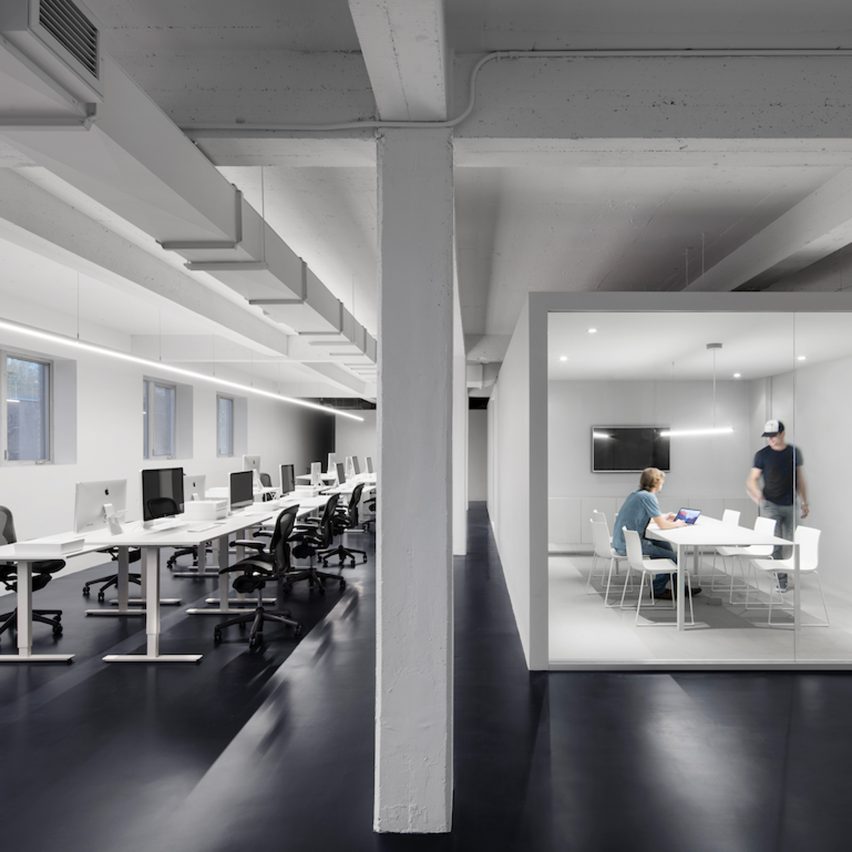
Canadian designer Anne Sophie Goneau has transformed part of an old building into a minimalist workspace for a tech company, featuring a restrained palette of materials and colours. Read more
From the architect. Penda recently finished a Project for an Art Auditorium on the Southern 3rd Road in Beijing. The venue is located at Xi Da Wang Lu, an upcoming cultural area with Galleries and Museums in its neighbourhood. Next to it Art Auditorium, penda completed the “Hongkun Museum of Fine Arts” in 2013.
Penda was asked by Residential and Cultural Developer Hongkun to design a meeting space that hosts lectures, readings, small exhibitions and and area for trading artworks. Within this cultural district, there was a desire to connect the public to artists as well to create a direct link to art itself. Visitors enter the Art Space through a monolithic facade that connects its appearance to the neighbouring Museum. From outside, the facade is mirrored in its centre offering identical doors through the solid exterior on the left and right side.
Model
Model
The topic of a centred and mirrored space continues to the interior. Penda inserted a lively box of arches, mirrors and steps that can host lectures or team meetings, and is used as a grand entrance to guide visitors to the lower floor. Here the space accommodates an exhibition and art-depo area. Walking around the box on the left side, guests will reach a art-selling lounge on the first floor, where paintings and art-pieces are traded and a small bar invites costumers to an informal talk. On the right side of the box, a staircase lead employees to an office space on the second floor.
The solid centre-cube offers a warm, wooden contrast to its grey concrete-plastered background. The wooden cube is seen from every space in the building and has round cutouts for visitors to peak into the main lecture space.
Within the box, visitors immerse into a landscape of wooden arches and circles that are mirrored on each sides and on the ceiling. Inspired by artworks of Dali and Escher, the reflective landscape creates a skewed and distorted reality and connects visitor to art in a direct and interactive way. Rather than looking at an artwork, people can experience the artwork physically to widen their imagination
The use of arches is a signature element in many of penda’s projects. The neighbouring Hongkun Museum of Fine Arts features Arches and Counter-Arches as one inviting entrance-ribbon to guide people into the Gallery. To connect the Gallery and the Auditorium, penda continued this formal expression of arches and counterarches into the auditorium.
“Our love for arches as a structural element, but also as a welcoming gesture and symbol of entrance manifested itself in this project. With the reflective walls, the arches transform from a physical to a intangible element and connect with each other to one endless swing. A space that connects reality and imagination.’
From the architect. A meaningful engagement with nature was the driving thought behind the conceptualization of Seletar Park Residence. Upon arrival at the site, the entrance is lined with mature rain trees, greeting the visitor almost ceremoniously before the space extends onwards to open into a clearing embraced by the surrounding terrain. This theme is recurring and impressed – preserved in the design to create a home that first welcomes and lateroffers experiences with nature. Providing a backdrop of simple elegance, the fine edges and sharp lines of the rectilinear forms break down the massing of the blocks while offering a textured fabric through repetition of frames, sun-shading ledges, façade fins and trellises. Rigorous in its application, this fabric lines the site boundaries, forming a canvas onto which a central landscaped court is strongly expressed.
To create intimacy in the vast court, the ground plane is separated into two, one of which is sunken and leads down into the basement level via a set of landscaped stairs. The main pool is placed on the higher plane, creating a reflecting vista towards the feature clubhouse, which is furnished for the residents’ enjoyment.
The water element then breaks down into cascading pools in the sunken half, with large planters interspersed to appear as floating landscapes, and culminates in a tranquil reflective pool and shaded court shared with the other communal facilities of the clubhouse. Spatially, each apartment is provided with a balcony or private enclosed space stretching across the entire length of the unit, thus extending the interiors to the outdoors. These intermediate spaces are finished in timber, allowing the palette of natural materials and colours to flow from private to communal spaces. The interaction of the living spaces with the lush gardens and water courts engenders a sensuous engagement with the elements, resulting in a calming, peaceful environment.





 Sig Nordal