From the architect. 1200 Intrepid is a LEED Gold office building shaped by the encounter between Robert Stern’s master plan of rectangular city blocks and James Corner’s iconic, circular Central Green Park.
Site
Context
Navy Yard Basin Views
The building’s double curved, pre-cast concrete façade bows inwards to create a generous urban canopy that responds to the ‘shock wave’ of the park’s circular running track, activity pods and planting vignettes – rippling outwards like rings in water to invade the building’s footprint. Shaped by the city grid, the cornice and remaining elevations return to the orthogonal design of the Navy Yard’s master plan, forming the building’s double curve and melding the neighborhood’s two dominant forms.
Referencing the Navy Yard’s maritime history while providing much needed natural light, a functioning periscope penetrates the core of the building, projecting views of the Navy Yard basin into the center of the elevator lobby. Visitors and employees can admire the mothballed ships sitting in the adjacent docks while embracing Central Green Park – connecting the building and its inhabitants to their surroundings.
On November 3, TheatreSquared Executive Director Martin Miller and Artistic Director Robert Ford unveiled the completed plans for the company’s new permanent home, a 50,000 square-foot building in Fayetteville, Arkansas designed by London-based theater planners Charcoalblue and New York–based Marvel Architects. The new building will include two theaters, a rehearsal space, staff offices, design workshops, a community space, a 24-hour cafe/bar, three levels of outdoor public space, and a separate building housing eight guest artist apartments.
Charcoalblue worked to preserve and enhance the sense of panoramic immersion in the current space, adding 100 seats to the theatre’s base seating capacity while only deepening the room by one row, said senior project manager Clem Abercrombie. I’m proud to say this is one of the most intimate, yet immersive, theatre spaces Charcoalblue has designed.
The theater achieves acoustic isolation with an acoustic envelope composed of board-form concrete, shielding the performance spaces from the noise of downtown Fayetteville. Meanwhile, the assemblage of volumes integrates the theater with its surroundings: the theaters and rehearsal space project out from the building’s facade, and the outdoor areas are designed for transparency to the community at large.
TheatreSquared is the professional regional theater of Northwestern Arkansas. Named one of the nation’s foremost emerging theaters by the American Theatre Wing, founder of the Tony Awards, TheatreSquared has expanded its audience tenfold in the last five years and now hosts 40,000 visitors annually. In 2015, TheatreSquared was chosen as one of three inaugural beneficiaries of the Walton Family Foundation’s Northwest Arkansas Design Excellence Program, which funds the development of public spaces by renowned architects. Since launching in 2015, the Program has curated a group of 36 architecture and landscape architecture firms to participate in all phases of design projects aimed at elevating the quality of Northwestern Arkansas’s built environment while complementing the region’s rich architectural history.
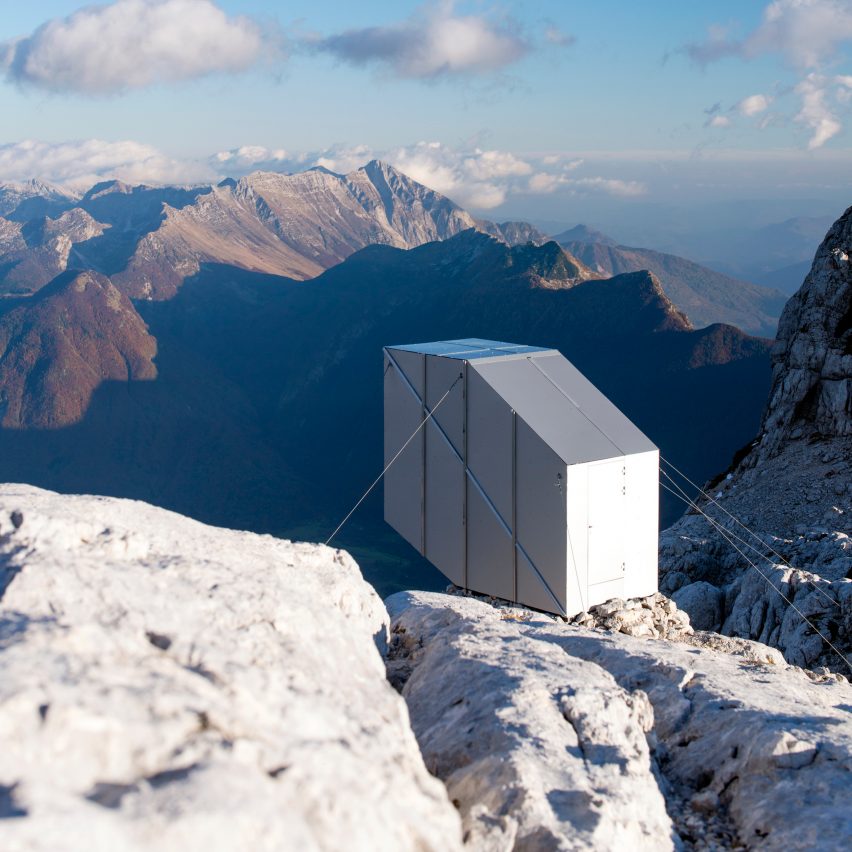
Forest Lodge is a private home located in New Forest, Hampshire, England. It was designed by PAD studio in 2015. Forest Lodge by PAD studio: “Located within a clearing of New Forest Woodland PAD were commissioned to design a bespoke contemporary mobile dwelling. The mobile dwelling conforms to the 1968 Caravan Act and will be capable of being lifted once erected. The air tight, highly insulated dwelling is constructed to..
Maybe with the sole exception of railway stations, public space is generally understood as outdoor space. Whether in the United States or in Europe, especially now with heightened concerns around security, there seems to be this determined way of privatizing everything that is indoors, even as we are increasingly aiming to improve access to public space outdoors. But in the layered systems of our cities of the future, we will need to focus on the public spaces that are found inside buildings—and make them accessible.
In 1748, Giambattista Nolli made this wonderful map of Rome where he only had two distinctions—what was private and what was public. Whether it was indoor or outdoor, whether there was a church space or a plaza, it didn’t really matter. It told a different story of the city. There are some examples from today—the roof of our Oslo Opera House is outdoors, for instance, but it’s on the building and publicly accessible. Opening up the Louvre and trying to let people walk through it 24 hours a day—as with the museum’s recent takeover by the artist JR—is another way of not making a distinction between indoor and outdoor public space.
These kinds of programming decisions are essential to the way new architecture typologies develop, and architects should definitely have influence on them. In certain situations, accessibility to indoor public space is enough. In other situations, you have to define the program for the particular indoor or outdoor spaces to be adequate. To use the example of the roof of the Opera House in Oslo again, it was basically programmed only for one thing, and that’s to be walked on, for a promenade. But on occasion, it could be reprogrammed to hold an outdoor concert. Or it could be reprogrammed against the original intention by skaters or by a biker who actually drives his motorbike up and down the roof.
Maybe the outdoor can be programmed in such a way that it unlocks the possibility of the public spaces indoors. There’s always a bit of urban planning in designing interiors. There’s always a bit of interior design in an urban space. There’s no question that interior architecture is professionalizing itself as well—interior architects are not seen as decorators of interior space anymore. The same is true of landscape architects. And those are only the traditional design professions.
Every architect doesn’t need to be trained in every specialized profession, but what is lacking is an overall understanding of how people should collaborate. That’s why we’ve introduced transpositioning as a working method in our office, where you not only sit around tables with a lot of specialists, but you actually swap professions during creative workshops. The only thing that can save the essence of architecture is some kind of collaborative model like this.
By adopting this model, both in education and practice, I think we would be better equipped to fully understand the effects of programming. We are usually generalists enough to understand that a change of use is sometimes demanded and that we shouldn’t try to desperately hold on to certain kinds of programming. But the profession itself should, in my opinion, really contain that kind of knowledge, simply because it’s so tightly connected to the actual design task. How can we change the relationship between buildings and the public unless we’re directly involved in programming ourselves?
Kjetil Trædal Thorsen is a founding partner at Snøhetta. The firm’s recently completed projects include the Ryerson University Student Learning Centre in Toronto and the expansion of the San Francisco Museum of Modern Art.
In the beginning of 2010, Russian President Dmitri Medvedev announced the creation of a “Silicon Valley for Russia,” to be located in a southern suburb of Moscow, that would feature research facilities, university laboratories, start-ups, meeting hubs, and housing. After an international competition in 2011, each of the districts within this larger project was awarded to its own architect. After careful planning, Agence d’Architecture A. Bechu & Associés has unveiled its design for District 11 of the project.
Concentrating on ecological housing, this district will contain individual houses dedicated to researchers and their families, under the greater goal of positive social interactions.
Like penguins gathering on ice in a circle to keep each other warm, one hundred villas are grouped in tens, in a vast clearing surrounded by a river to accommodate snowmelt explained the architects in a press release. This organization also allows for the formation of micro-communities around a central square, reminiscent of a village.
Each of the villas will be unique, giving occupants their own identity within the urban ensemble, but will all feature a modular concrete frame, green roof, and use of renewable energy and water recycling.
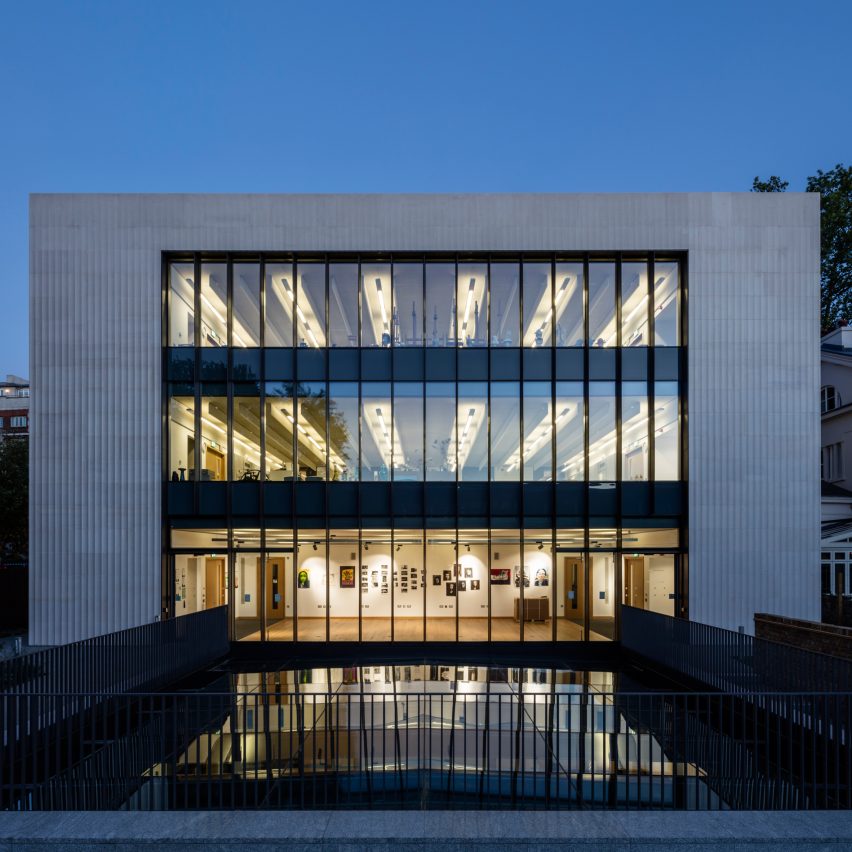
Fluted stone panels form a frame around a huge window in the facade of this building designed by Walters & Cohen Architects for the American School in London. Read more
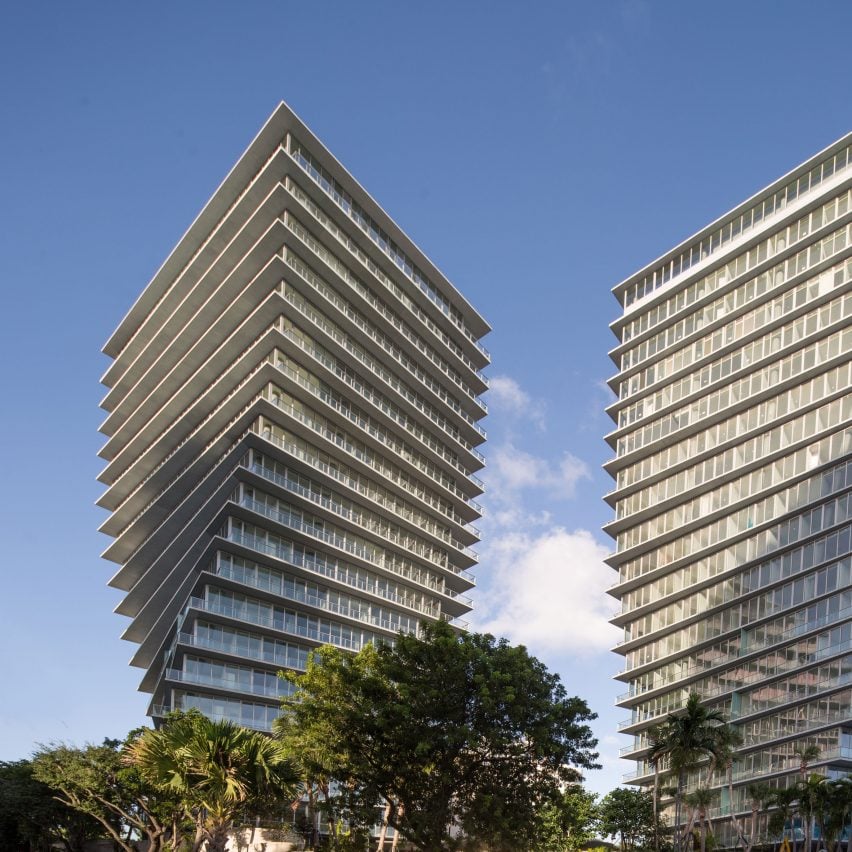
Work has finished on Bjarke Ingels Group‘s first condominium project in the United States, a pair of glass high-rise buildings that overlook Biscayne Bay. Read more



 Sig Nordal